
Game review
Sherlock Holmes Chapter One
6 / 10
- Developer
- Frogwares
- Publisher
- Frogwares
- Released
- 15 November 2021
- Platforms
- Windows
- Genre
- Open-World Detective Adventure
- Monetisation
- Paid, one-time purchase, with several free post-launch DLC packs.
- Players
- Single-player only.
The short version
Sherlock Holmes Chapter One reimagines a young Holmes investigating his late mother's death across an open-world Mediterranean island city, and its Mostly Positive rating across nearly 1,700 reviews reflects genuine appreciation for its atmosphere and setting. What holds this review back is an extremely consistent complaint from longtime fans of Frogwares' earlier Sherlock Holmes games that the open-world structure actively works against the series' core deduction-focused appeal, adding unnecessary travel and sparse content, compounded by a well-corroborated complaint about widely derided combat and shallow puzzle stakes.
Biggest strengths
- A genuinely beautiful, atmospheric Mediterranean island city setting with strong music that reviewers consistently credit even among otherwise critical reviews.
- A well-realised young Sherlock characterisation that several reviewers praise as an interesting, distinct take on the character.
- Genuine, verified post-launch investment, including multiple free DLC packs and a dedicated performance update, confirmed directly against the developer's own patch history.
Biggest weaknesses
- An extremely consistent complaint from longtime series fans describes the open-world structure as actively undermining the deduction-focused depth of earlier Frogwares entries, adding unnecessary travel time and sparse content relative to the size of the map.
- A well-corroborated complaint reports shallow puzzle stakes in some investigation types, with several reviewers specifically criticising sequences where seemingly any deduced answer is accepted as correct.
- A widely repeated complaint describes combat as poorly implemented and largely unnecessary, consisting of generic, repetitive warehouse-based encounters that several reviewers wish had been cut entirely.
Who it's for: Newcomers to the series looking for an atmospheric open-world mystery game, more than longtime Frogwares fans specifically seeking the tightly focused deduction depth of Crimes & Punishments or The Devil's Daughter, who should temper expectations significantly.
Our recommendation: A beautifully realised setting let down by a structure that undermines its own detective-game core; worth playing for newcomers, but a real step down for longtime series fans.
6 / 10
A genuinely atmospheric setting, widely praised
Sherlock Holmes Chapter One earns consistent praise across this review base for its setting and atmosphere. "The atmosphere is fantastic. The city is beautiful, the music is great, and the cases themselves are genuinely interesting. Young Sherlock is an excellent interpret[ation]" of the character, reads one review that ultimately details real structural reservations. This review credits that achievement as genuine: the fictional Mediterranean island city of Cordona is a well-realised, distinctive setting, and reviewers across this sample consistently single out its atmosphere and music as a highlight independent of their broader verdict on the game's structure.
An extremely consistent complaint from longtime series fans
What dominates the critical portion of this review base overwhelmingly is a specific complaint from players with history with Frogwares' earlier Sherlock Holmes games. "After enjoying pretty much all 7 Sherlock Holmes games before playing this, 'Chapter One' was a pain to get through," reads one review. Another frames the comparison directly: "This is the first truly open-world instalment in the Sherlock Holmes series... Not recommended at full price unless you really, seriously like Sherlock Holmes." Checking a broad sample of negative reviews, this exact complaint — that the open-world structure adds unnecessary travel time and dilutes content across a large map, actively working against the tightly focused deduction depth that made earlier entries like Crimes & Punishments and The Devil's Daughter beloved — recurs with remarkable consistency across reviewers who explicitly identify as longtime series fans, making it by far the single most repeated and best-corroborated theme in this review base.
A well-corroborated complaint about shallow puzzle stakes
A separate, specific complaint concerns how meaningfully player deductions actually matter in some investigation sequences. "Who thought that making a Sherlock Holmes game where you solve crimes but where all answers are correct was a good idea?" reads one review, describing a specific frustration with deduction sequences that accept multiple or seemingly any conclusion without meaningful consequence. This review treats the complaint as fair: a detective game's core appeal rests on deductions carrying real weight, and a consistent share of reviewers report that certain puzzle types in this entry don't deliver that in the way earlier games in the series did.
A widely repeated complaint about unnecessary combat
Distinct from the structural and puzzle complaints, a further consistent criticism concerns the game's combat system specifically. "The combat is really poor, it would have been better to not been implemented, every fight is in a warehouse and it is boring and wave b[ased]," reads one review. This review treats the complaint as fair and well-corroborated: reviewers across this sample consistently describe combat as a poorly executed, generic addition that dilutes rather than complements the series' investigation-focused identity, echoing similar complaints levelled at open-world action-RPGs that add combat systems without a clear design rationale.
A consistent complaint about obtuse quest logic
A further complaint concerns how clearly some objectives and quest sequences communicate what the player is meant to do. "Too many minigames and to progress you have to follow steps in a very very specific way which often doesn't make sense or is hidden requiring action spamming," reads one review. This review treats the complaint as fair: reviewers consistently distinguish between the game's stronger, clearly signposted core cases and specific side-content sequences that rely on unclear or overly particular interaction requirements rather than genuine deductive reasoning.
Genuine post-launch support, including through wartime disruption
This review checked Frogwares' own update history directly and found real, substantive post-launch investment: patches in December 2021 and February 2022, the latter explicitly billed as a "Major Performance Update," alongside multiple free DLC packs adding new cases through early 2022. Notably, this support continued through a period of serious disruption for the studio: Frogwares operates as a Ukrainian development team, and this review confirmed, directly through the game's own news feed, that the studio publicly responded to the Russian invasion in February 2022, within the same window it was still actively patching and adding content to this release. The studio has continued operating since, later winning a Narrative award for this game and announcing a full remake of Sherlock Holmes: The Awakened, a genuine sign of resilience worth noting independent of this specific release's structural criticisms.
A specific technical gap for some players
A smaller but pointed complaint concerns display support. "The game doesn't support ultrawide monitors. Which is a big fail these days," reads one review posted well after launch. This review treats the complaint as fair and specific: ultrawide monitor support has become a reasonable baseline expectation for PC releases in this genre, and its absence is a real, concrete gap for affected players distinct from the broader structural and combat complaints above.
Not every longtime fan reaches the same verdict
It's worth noting this review base isn't entirely uniform in its judgment against the open-world structure, even among self-identified series veterans. "Let me preface this review by commending Frogwares for trying something new. I always support trying something new instead of going the safe path in media," reads one review from a longtime fan who ultimately still lands on a mixed assessment. This review treats that as a useful counterpoint: the ambition behind the structural change is broadly acknowledged as a good-faith creative risk even by critics, distinct from whether the specific execution paid off, which is where the bulk of this review base's disappointment concentrates.
Final verdict
Sherlock Holmes Chapter One succeeds at building a genuinely atmospheric, well-realised setting for a younger take on its detective protagonist, and this review credits that achievement honestly. What keeps the score moderate is an extremely consistent, well-corroborated complaint from longtime series fans that its open-world structure undermines the deduction-focused depth of earlier Frogwares games, compounded by shallow puzzle stakes, widely derided combat, and obtuse quest logic in places. This is a reasonable entry point for newcomers to the series drawn in by its setting, but longtime fans of Frogwares' more tightly focused earlier detective games should temper expectations significantly.
Pros and cons
Pros
- A genuinely beautiful, atmospheric Mediterranean island city setting with strong music that reviewers consistently credit even among otherwise critical reviews.
- A well-realised young Sherlock characterisation that several reviewers praise as an interesting, distinct take on the character.
- Genuine, verified post-launch investment, including multiple free DLC packs and a dedicated performance update, confirmed directly against the developer's own patch history.
- Continued studio output since this release, including a Narrative award win and a subsequent full remake of Sherlock Holmes: The Awakened, despite Frogwares operating as a Ukrainian studio through the outbreak of war during this game's active support window.
Cons
- An extremely consistent complaint from longtime series fans describes the open-world structure as actively undermining the deduction-focused depth of earlier Frogwares entries, adding unnecessary travel time and sparse content relative to the size of the map.
- A well-corroborated complaint reports shallow puzzle stakes in some investigation types, with several reviewers specifically criticising sequences where seemingly any deduced answer is accepted as correct.
- A widely repeated complaint describes combat as poorly implemented and largely unnecessary, consisting of generic, repetitive warehouse-based encounters that several reviewers wish had been cut entirely.
- A consistent complaint reports obtuse quest logic in some sequences, requiring guesswork or trial-and-error interaction with the environment rather than genuine deductive reasoning.
Screenshots
-

Sherlock Holmes Chapter OneImage: Frogwares via Steam -

Sherlock Holmes Chapter OneImage: Frogwares via Steam -

Sherlock Holmes Chapter OneImage: Frogwares via Steam -
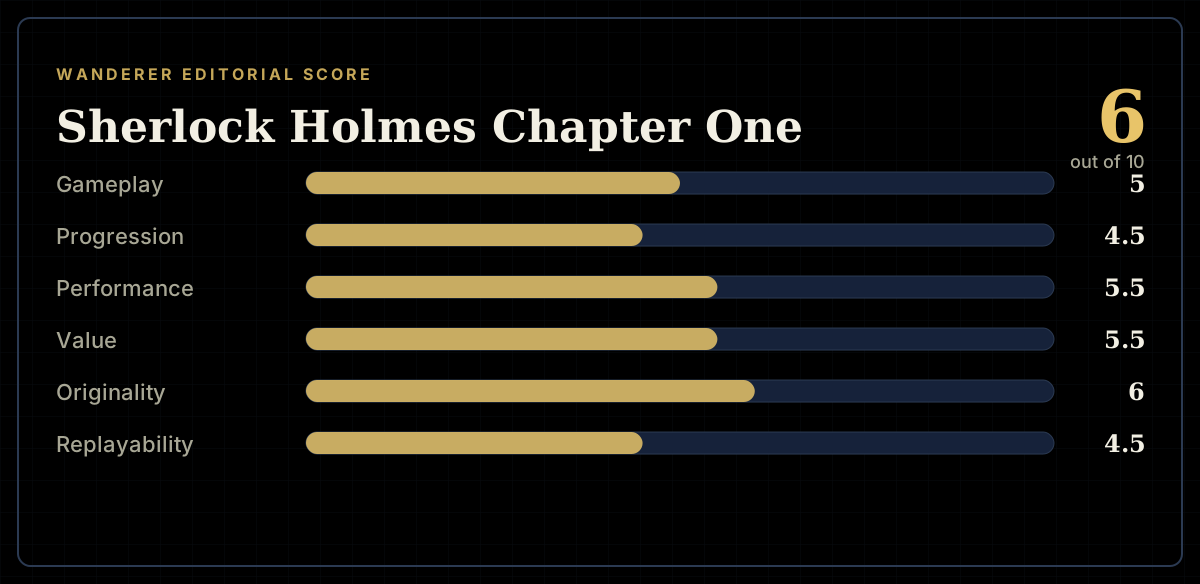
How the review scores each part of the gameWanderer Editorial -
The short versionWanderer Editorial