Game review
Shards of Order
7.5 / 10
- Developer
- Fardust
- Publisher
- Awaken Realms
- Released
- 28 July 2026
- Platforms
- Windows
- Genre
- Card-based RPG / Deckbuilder
- Monetisation
- One-time purchase; an optional Supporters Pack DLC adds a soundtrack, artbook, print-and-play tarot cards and a digital map, with no gameplay effect
- Players
- Single-player only
The short version
Shards of Order throws out the two things almost every card-based RPG leans on — turns and a mana pool — and replaces them with a countdown clock that every played card nudges in your favour. Combined with a single shared deck split across three heroes, it produces some of the most genuinely novel combat in the genre this year. The world underneath it, a setting undone by broken cosmic Laws, gets the dark fantasy tone right in its art, music and prose. What holds it back from the top tier is a second region that spikes in difficulty faster than the build tools keep up, a handful of launch-window bugs, and a story that runs out around the ten-hour mark with little pulling you back for a second pass.
Biggest strengths
- Combat spends time instead of mana — every card shortens or lengthens a visible countdown to the enemy's next action, turning sequencing into the core skill rather than resource management
- Three heroes draw from one shared deck, so every card you add to your collection is a real trade-off between specialising one hero and keeping the whole party viable
- Boss fights demand genuine planning around the countdown system rather than just a bigger stat check, and reviewers consistently call them the game's high point
Biggest weaknesses
- The game's second region spikes in difficulty well ahead of the gear and skill points available to meet it, and it's the single most common complaint in negative Steam reviews
- Healing is tied to levelling up rather than any resource you can manage mid-run, so a rough early stretch can snowball before the next level arrives to bail you out
- Respeccing a build means pulling skill points out one at a time instead of resetting the tree outright, turning experimentation into a chore
Who it's for: Deckbuilder fans who want a real story-driven RPG wrapped around the cards rather than a roguelike run-based structure, and dark fantasy readers who want their tone taken seriously.
Our recommendation: Worth the asking price for anyone curious about a genuinely different take on card combat, provided you're prepared for a mid-game difficulty wall and a handful of rough edges that a patch or two should smooth out.
7.5 / 10
Most card-based RPGs eventually ask the same question every turn: what can I afford this round? Shards of Order asks a different one — what can I afford to let happen next? Every enemy on screen carries a visible countdown to its next move, and every card you play either shaves time off that clock in your favour or costs you tempo you'll regret. There's no mana bar, no fixed number of actions per turn, and no waiting your turn in the traditional sense. Combat plays out as a running negotiation with the clock, and it's the reason this game is worth talking about at all.
Awaken Realms built its name at the tabletop, as the publisher behind sprawling Kickstarter campaigns like Nemesis, Tainted Grail and This War of Mine: The Board Game — games known for dense rulebooks, heavy thematic commitment and box inserts full of miniatures. Shards of Order is an original digital release rather than an adaptation of one of those board games, but the lineage shows in how seriously it treats its own systems: the countdown mechanic isn't a gimmick bolted onto a normal deckbuilder, it's the spine the entire combat model is built around, explained with the patience of a designer who assumes players will actually read the rules.
Cards that spend time, not mana
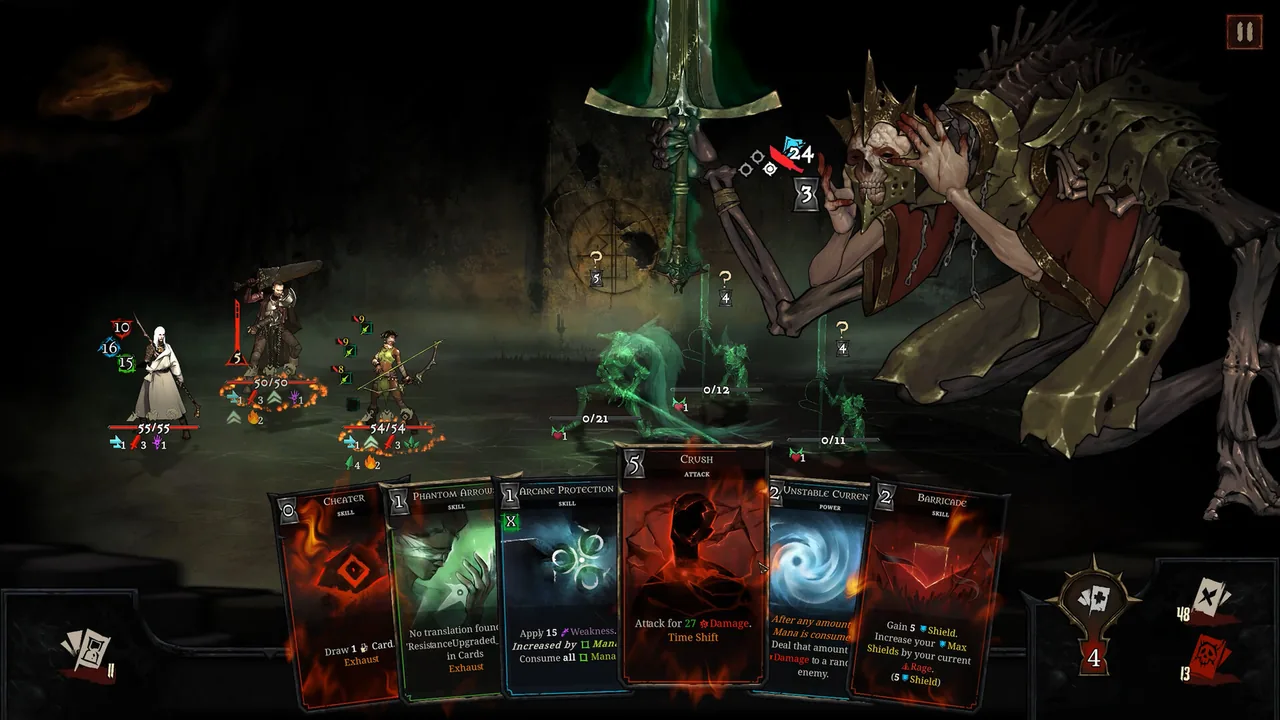
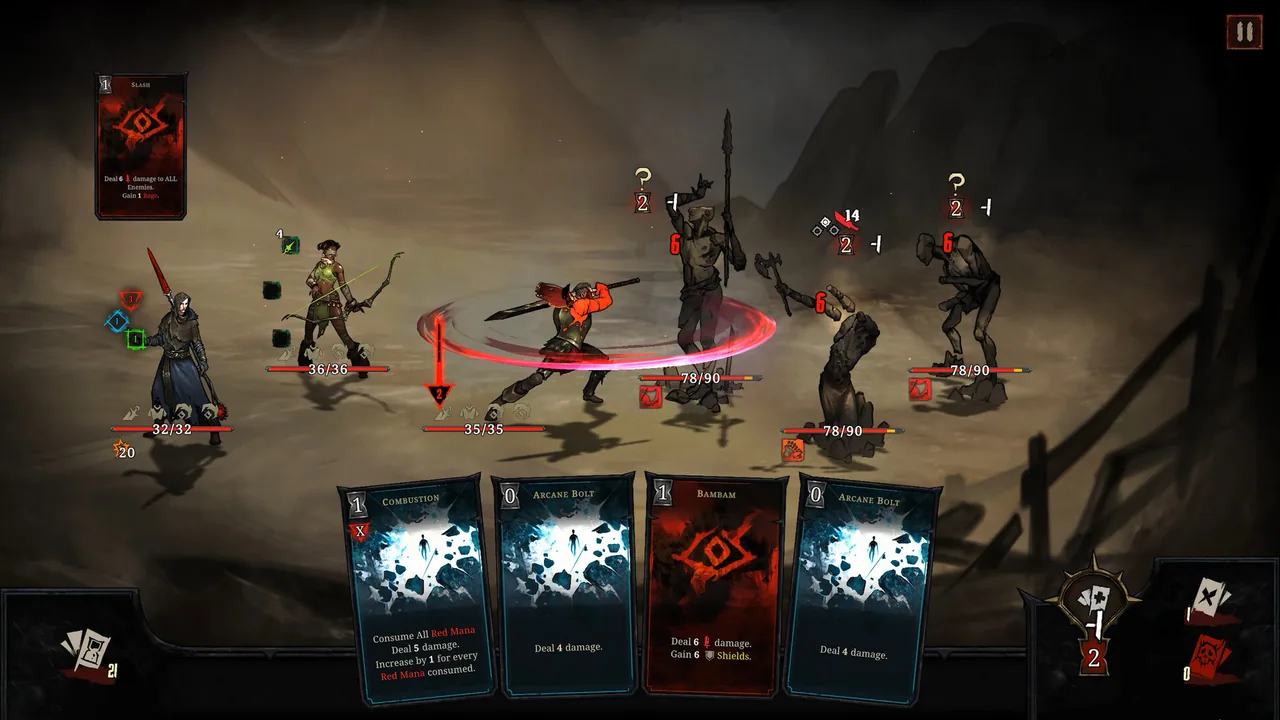
The core loop replaces the deckbuilder's usual resource management with something closer to scheduling. Enemies telegraph their next action and the turn on which it lands; your cards either delay that action, accelerate your own party's next move, or do both at once as a trade-off. A big, powerful card might cost you several ticks of the clock, handing the enemy an extra window to act, while a cheap card barely moves the timer at all but does correspondingly little. The decision that matters isn't "can I afford this" — it's "can I afford to be slow right now."
That framing changes what a good hand looks like. A deck that would be underpowered in a conventional mana-based system can be excellent here if its cards are fast, and a deck full of flashy, high-impact cards can lose fights it should win by handing the enemy too many free turns along the way. Boss encounters are where this earns its keep: several fights are built explicitly around forcing you to choose between a strong play that costs time and a weak one that buys it back, and reviewers consistently single out these fights as the game's strongest material.
One deck, three heroes, no easy split
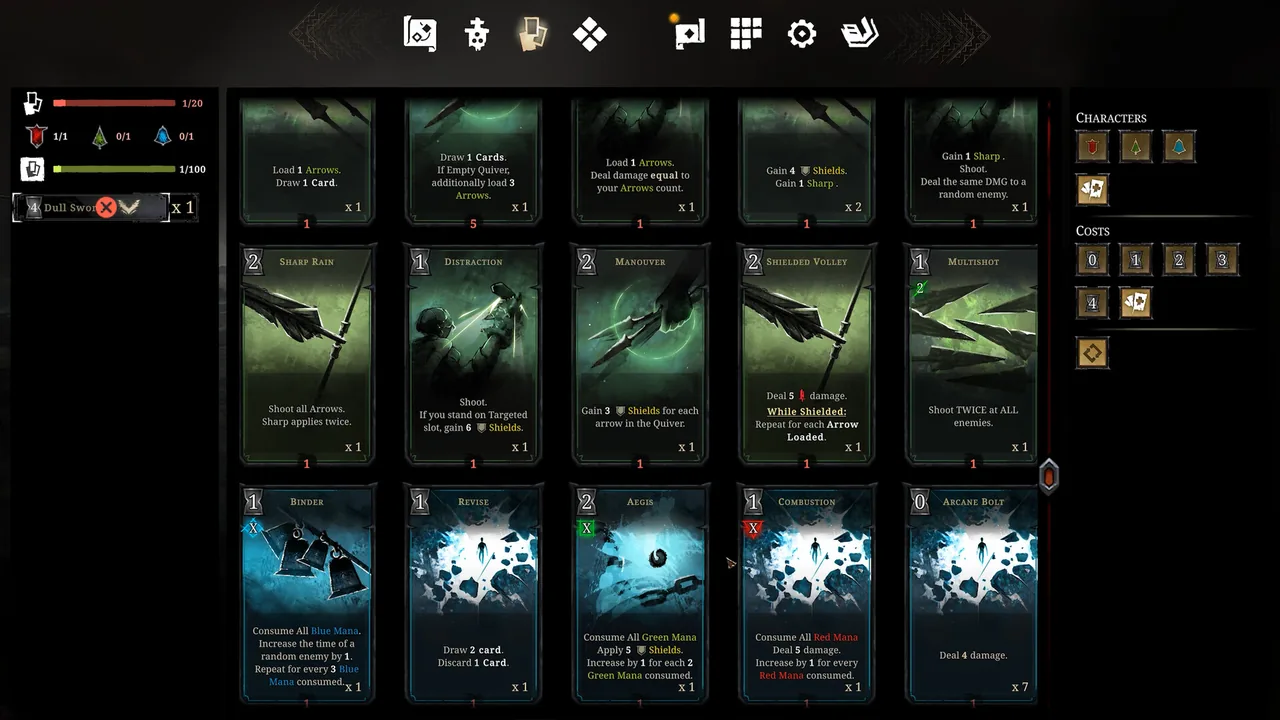
Shards of Order doesn't give each of its three heroes their own separate deck. All three draw from a single shared pool of cards, which means every card you add to your collection changes the draw odds for the whole party, not just the hero it was written for. Building toward one hero's strengths dilutes the other two's chances of drawing what they need; spreading the deck evenly keeps everyone functional but blunts any one hero's ceiling. It's a genuinely uncommon design choice for a party-based RPG, most of which either give each character an isolated resource or let the whole party share a single undifferentiated pool without this kind of tension attached to it, and it's the single mechanic reviewers point to most often as proof the game isn't just another turn-based deckbuilder wearing a new coat of paint.
Around that combat system sits a full RPG skeleton: levelling, equipment slots, dialogue choices and skill checks spread across three handcrafted regions, each ending in a boss built to test the deck you've assembled by that point. The campaign structure is deliberately not a roguelike — there's no run-based reset, no permadeath loop resetting your progress between attempts, just a single story played start to finish, closer in shape to a traditional RPG than to the deckbuilders it otherwise resembles.
Where the difficulty curve breaks
The most consistent complaint across negative Steam reviews lands on the game's second region, where the difficulty climbs sharply against a character build that hasn't had time to catch up. Enemies scale in power at a pace the available skill points and equipment upgrades don't comfortably match, and more than one player describes encounters there as feeling less like a fair test of the countdown system and more like a wall the build tools weren't ready for.
Two design choices make that spike worse than it needs to be. Healing is tied almost entirely to levelling up rather than being a resource you can manage mid-run, so a bad stretch of fights can spiral before the next level bails you out rather than being something you can plan around in the moment. And respeccing a build, when you decide your card mix isn't working, means removing skill points one at a time rather than resetting the tree outright — a small piece of friction that matters more than it should when the difficulty spike is actively pushing you to experiment.
Launch-window technical issues compound the frustration. Players have reported long load times on first boot, and one specific bug — experience not being awarded if a party member dies partway through a battle the party otherwise wins — is a serious problem in a game that autosaves, since it can permanently shortchange a run rather than something a reload can fix. None of these are fundamental design failures, and the kind of thing a post-launch patch typically resolves, but they land at exactly the point in the campaign where players are already fighting the difficulty curve.
Tone, art and a script that doesn't always match it
Shards of Order commits fully to its grimdark premise — a world unravelling because the cosmic Laws that governed it have shattered, with survivors trying to hold pieces of reality together while chasing a way to restore what broke. The art direction and score back that premise up convincingly; players routinely describe the presentation as closer to an interactive novel than a typical RPG cutscene reel, and it's easily the game's most consistently praised element outside the combat system itself.
The writing doesn't always sit as comfortably as the art does. A handful of dialogue beats lean into a jokier, lighter register than the rest of the script, and it reads as a genuine tonal clash against a story this committed to bleakness elsewhere — the kind of inconsistency that stands out precisely because everything around it is trying so hard to be taken seriously. Translation quality is also uneven later in the campaign, with occasional broken phrasing and at least one report of a dialogue line attributed to the wrong character, both suggesting the later regions got less editing attention than the opening hours.
Price and monetisation
At NZ$15.75, Shards of Order is priced well below what its production values and system depth would suggest, and there's nothing predatory sitting behind that price. The optional Supporters Pack DLC bundles a soundtrack, an artbook, print-and-play tarot cards based on the game's card art and a digital map — collector extras for players who want them, with zero effect on the actual game. For a genre where mobile-adjacent monetisation habits sometimes creep into PC releases, this is about as clean as it gets.
The trade-off is length. Most players report finishing the campaign in around ten hours, and the single shared-story structure that makes the game feel purposeful also means there's comparatively little pulling you back for a second playthrough once the Laws are restored and the credits roll. That's a fair exchange at this price for players who just want the one well-told story, but it's worth knowing going in if you're used to deckbuilders that expect dozens of hours of replayed runs to justify their cost.
Final verdict
Shards of Order's countdown-based combat and shared-deck party structure are genuinely rare ideas, executed with enough confidence that the game earns comparisons to bigger, more established deckbuilders despite its modest price and studio size. The tabletop pedigree behind Awaken Realms shows in how fully committed the systems are to their own internal logic rather than in any literal adaptation, and the dark fantasy presentation backs that commitment up convincingly.
It doesn't reach the very top tier because the second region's difficulty spike, a leveling-tied healing system that offers little room to recover from a bad stretch, and a set of launch bugs that should never have shipped in a game with permanent autosaves all land in the same stretch of the campaign and compound each other. A short campaign with limited replay value caps the value proposition a little further, even at a genuinely fair price.
Players who want the countdown-and-cards hook enough to push through a rough patch in the middle will find a campaign worth finishing, with boss fights that reward exactly the kind of sequencing thought the game asks of you from the opening hour. Players who bounce off unbalanced difficulty spikes should wait for a patch or two before jumping in.
Anyone who likes the idea of a party built around shared resources rather than isolated character sheets, but wants that tension to run through a persistent world instead of a single ten-hour campaign, might also want to look at Wanderer.
Pros and cons
Pros
- Combat spends time instead of mana — every card shortens or lengthens a visible countdown to the enemy's next action, turning sequencing into the core skill rather than resource management
- Three heroes draw from one shared deck, so every card you add to your collection is a real trade-off between specialising one hero and keeping the whole party viable
- Boss fights demand genuine planning around the countdown system rather than just a bigger stat check, and reviewers consistently call them the game's high point
- Dark fantasy art direction, score and prose sustain a genuinely oppressive tone that several players compare to reading an interactive novel
- A flat NZ$15.75 with no in-app purchases; the Supporters Pack DLC is soundtrack, artbook and print-and-play extras, not a gameplay shortcut
Cons
- The game's second region spikes in difficulty well ahead of the gear and skill points available to meet it, and it's the single most common complaint in negative Steam reviews
- Healing is tied to levelling up rather than any resource you can manage mid-run, so a rough early stretch can snowball before the next level arrives to bail you out
- Respeccing a build means pulling skill points out one at a time instead of resetting the tree outright, turning experimentation into a chore
- Launch-window issues including long load times and a reported bug that denies experience when a party member dies mid-victory, which matters more than usual given the game autosaves
- Around ten hours to finish the campaign with little pulling players back for a second run, short for a full RPG even at this price
Screenshots
-
Shards of OrderImage: Awaken Realms via Steam -
Shards of OrderImage: Awaken Realms via Steam -
Shards of OrderImage: Awaken Realms via Steam -
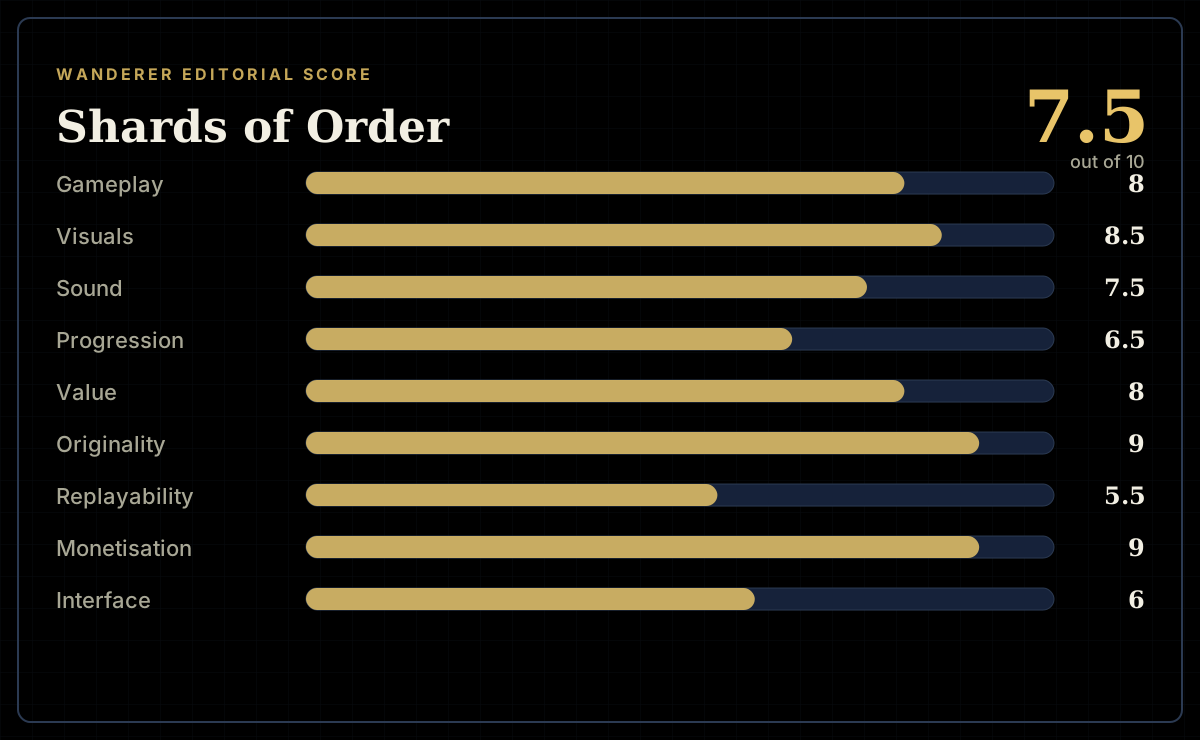
How the review scores each part of the gameWanderer Editorial -
The short versionWanderer Editorial