Game review
Samurai Conqueror Review
7.5 / 10
- Developer
- Miura Production
- Publisher
- Miura Production
- Released
- 15 July 2026
- Platforms
- ["Windows"]
- Genre
- Strategy
The Battlefield Is a Timeline, Not a Map
Samurai Conqueror's pitch sounds like a joke until you actually see it running: instead of a map of Japan, the entire playing field is the country's own history, laid out as a timeline from the Kofun period through the Meiji Restoration. One English-language reviewer summarized the core loop cleanly: "You fight to control the timeline as the faction you choose. You assemble forces, conduct diplomacy, and unlock events in order to unify and restore the timeline as someone, or something, has attempted to erase the history of Japan." A Japanese reviewer put the concept even more bluntly, comparing it to a genre classic: "古今東西のゲームを探しても、このゲームにしか登場しない歴史上人物・勢力がお" (search games from every era and country, and the historical figures and factions that only appear in this game are unmatched), and another simply called it "一風変わった歴史SLG" (a distinctly unusual historical strategy game) built around ruling a chart instead of a landmass.
Recruiting Yamato Takeru to Fight Alongside the Meiji Government
The mechanical hook is that historical figures aren't tied to a fixed side or era, they can be recruited and physically relocated along the timeline to serve wherever a player wants them. One reviewer marveled at the resulting absurdity in the best way: "鎌倉時代にいる源頼朝が、時代移動して明治政府に攻め入る" (Minamoto no Yoritomo, who lives in the Kamakura period, can travel through time to attack the Meiji government), calling that kind of scenario something only this specific game could produce. Each of the roughly 400 historical figures has their own stats and a finite "lifespan" tied to their real historical era, and moving them across the timeline costs a scarce currency the community nicknamed "houju" (treasure orbs). A veteran reviewer explained the resulting strategic tension: characters who are historically powerful tend to have short lifespans, while weaker figures often last much longer on the timeline, so "強いけど寿命が短い英傑(史実の有名武将はこのパターンが多い)と弱いけど寿命だけは長い英傑が同じくらいの価値を持つ" (a powerful hero with a short lifespan, the pattern for most famous historical generals, ends up roughly as valuable as a weak hero who simply lives a long time).
Spreadsheet Visuals, Deep Systems Underneath
The presentation is unapologetically minimal, one reviewer admitted upfront to being skeptical before playing: "I was a little unsure about the map of the game being a spreadsheet, but it works surprisingly well and the gameplay dynamic of conquering Japan across time still works well even with somewhat abstracted visuals." A Japanese reviewer used a food metaphor to capture the same idea from the other direction: "渋いゲームです。食べ物でいえば佃煮のような作品です。カワイイ女の子も派手な演出も一切ありません" (it's a subdued, austere game, in food terms it's like tsukudani, no cute girls, no flashy production values at all), while still recommending it warmly to anyone who likes territory-conquest strategy games. Underneath that plain interface, reviewers described real systemic depth: commerce and agricultural income get harder to balance as a faction's territory grows, a "culture" stat that barely matters early on becomes a significant late-game buff, and diplomacy options, while present, were flagged by more than one reviewer as thinner than the rest of the systems, one specifically wished for options like non-aggression pacts or requesting reinforcements.
A History Textbook Disguised as a Conquest Game
Several reviewers treated the game's roster of biographical entries, one for each of the roughly 400 historical figures, as a selling point in its own right, separate from the strategy gameplay. "本作では人物ごとに列伝が用意されており、ゲームを進めるだけでなく、列伝を読んで人物や出来事について学ぶこともできます" (the game includes a biography for every character, so beyond just playing, you can also learn about people and events by reading them), one wrote, while another went further: "個人的には人名録だけで値段以上の価値がありました" (personally, the biography index alone was worth more than the asking price). A reviewer who plays Nobunaga's Ambition and Romance of the Three Kingdoms-style strategy games specifically recommended it to that exact audience, calling it a good fit for "信長の野望で武将のステや武将の配置、列伝を読むのに必死になるような変態" (the kind of maniac who obsesses over stat sheets, unit placement, and biography entries in Nobunaga's Ambition).
Real Complaints: A Rough Early Game and a Thin Diplomacy Layer
Every one of the twenty reviews on file recommends the game, but several were specific about its rough edges rather than offering blanket praise. One reviewer described a genuinely brutal early difficulty spike on the default faction: "初級・天皇家でプレイしましたが、敵国が体験版とは比較にならないほどアグレッシブに領地を広げてきて詰んでしまいました" (I played the Imperial Family on easy, but enemy nations expanded their territory far more aggressively than in the demo, and I got completely stuck), and separately flagged that early builds made it hard to tell at a glance which faction was developing which tile, an issue the developer has since patched with added icons. Another reviewer, after logging over 27,000 minutes of playtime chasing every achievement, wished for late-game curveballs the current build doesn't offer: sudden natural disasters or surprise invasions that would keep long, successful campaigns from coasting on autopilot. These are the complaints of players deeply invested in the systems wanting them extended further, not players bouncing off a broken game, but they're worth weighing against the otherwise unanimous praise.
Priced Right for an Achievement Hunter's Timesink
At $13.99, several reviewers specifically praised the value proposition, one who bought after enjoying the free demo called it "お値段も2000円以下とコストパフォーマンスが高かった" (priced under 2,000 yen, it offers high value for money), and another simply noted "値段のわりには面白かった。ボリューム的にも適度でした" (it was fun for the price, and the amount of content was appropriately sized). Recorded playtimes in the review set range enormously, from a few hundred minutes for players still exploring the systems up to over 27,000 minutes for a completionist chasing every achievement and faction, with a single playthrough typically running around four hours. Steam's own achievement completion data was cited by one reviewer as evidence the harder content bites: despite completing achievements being described as close to mandatory to fully appreciate the design, only around 60 percent of players who tried had cleared certain milestones, a detail that reviewer suggested the game's own tutorial should surface earlier.
Verdict
Samurai Conqueror takes a genuinely novel premise, restaging the entirety of Japanese history as a single conquerable timeline instead of a map, and builds a surprisingly deep strategy game around it, one all twenty reviewers to date have recommended without exception. The spreadsheet-plain presentation and thin diplomacy options are real limitations, and the early difficulty curve on some factions can be brutal before the underlying systems click, but the payoff for strategy fans and Japanese history buffs alike is a conquest game that has, in its own words, no direct competitor. Anyone who has ever wanted to see Minamoto no Yoritomo lead troops against the Meiji government, or who simply enjoys reading historical biographies as much as playing strategy games, will find $13.99 well spent; anyone expecting flashy production values or robust diplomatic systems should adjust expectations accordingly.
Screenshots
-
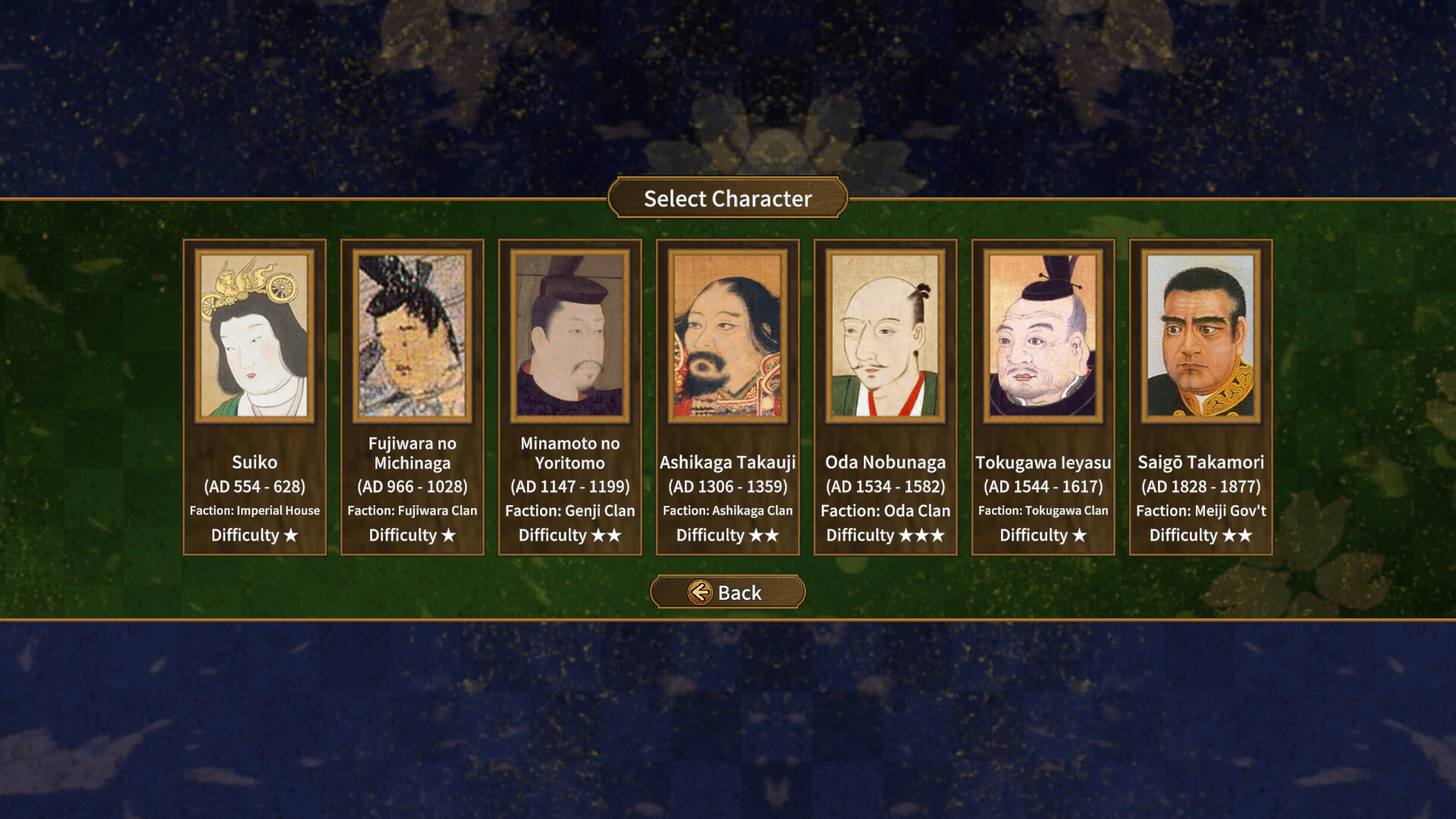
The character select screen: real historical figures like Minamoto no Yoritomo and Oda Nobunaga, each tied to a faction, era, and difficulty rating.Image: Miura Production via Steam -
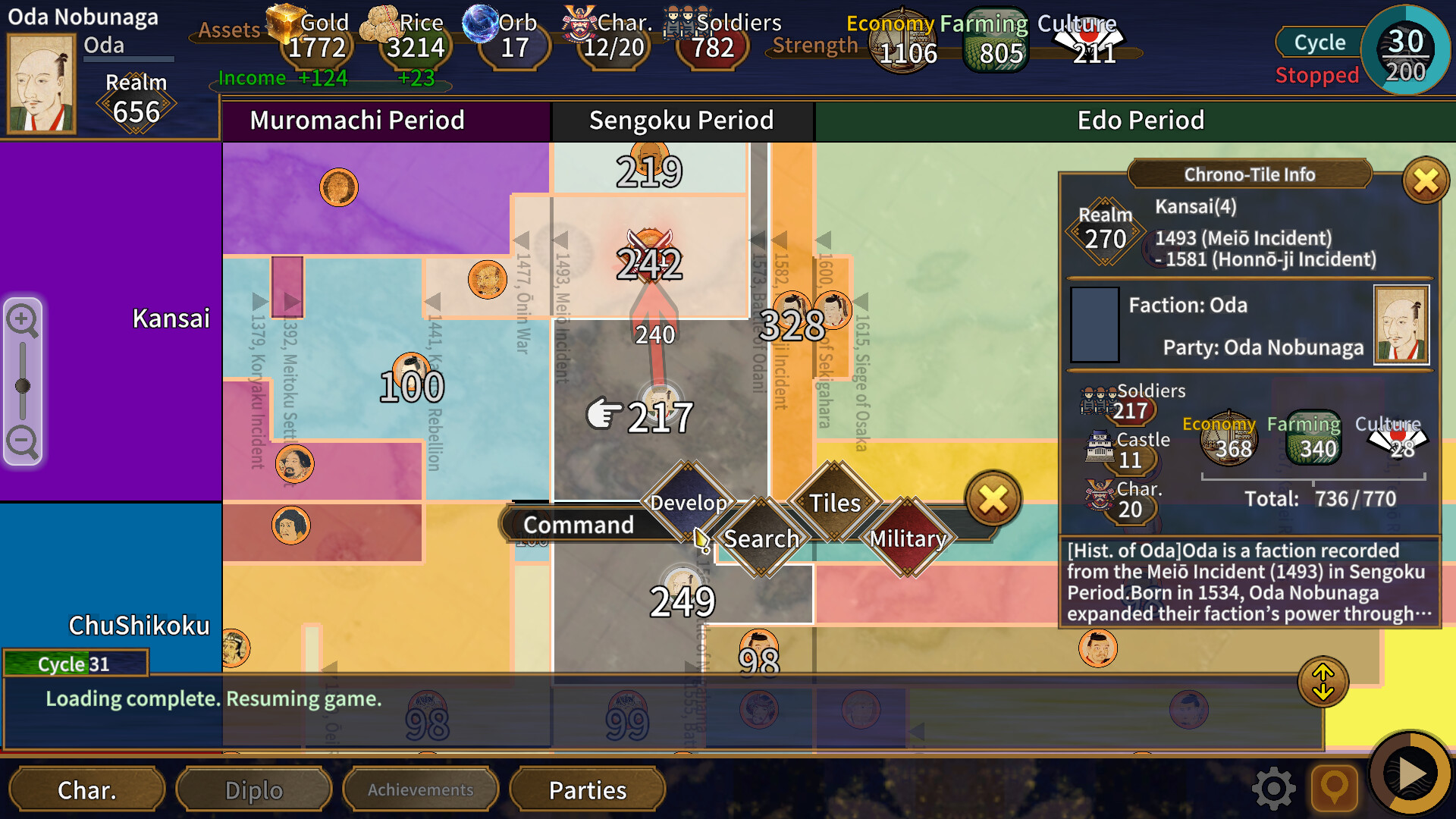
The timeline-as-map in action, territory tiles arranged across the Muromachi, Sengoku, and Edo periods rather than a conventional geographic map.Image: Miura Production via Steam -
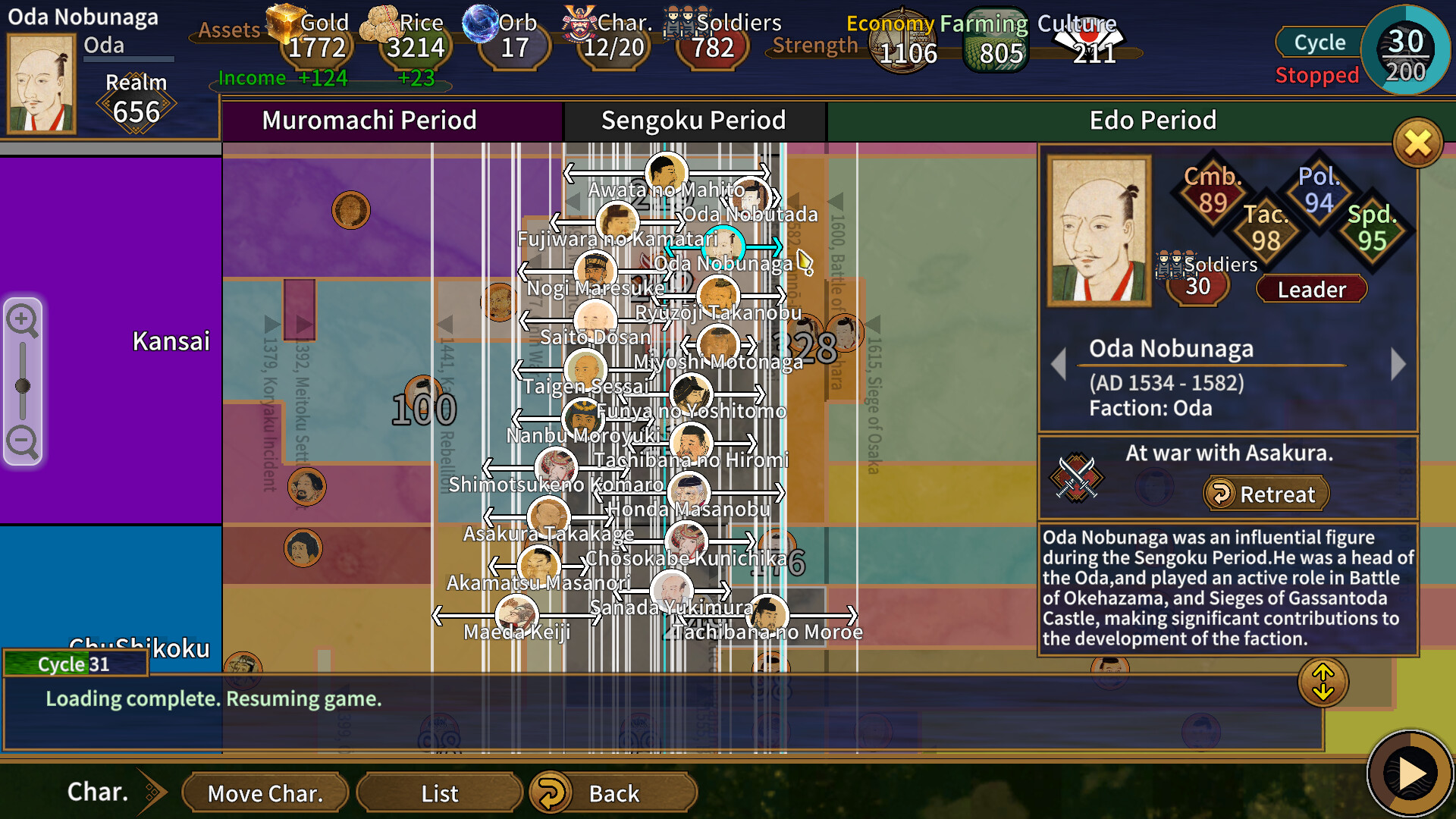
Oda Nobunaga's roster of generals arrayed along the timeline, with a detail panel showing his stats and a short biography.Image: Miura Production via Steam