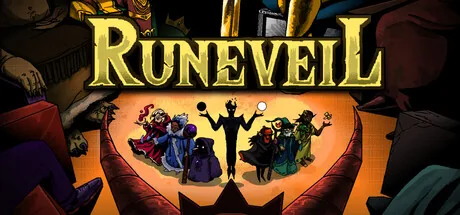
Game review
Runeveil
7 / 10
- Developer
- dicehit
- Publisher
- dicehit
- Released
- 23 June 2026
- Platforms
- Windows
- Genre
- Casual, Indie, Strategy
- Monetisation
- paid
- Players
- false
The short version
Biggest strengths
- A genuinely distinct core hook, sequencing a five-card hand into a specific left-to-right play order, that reviewers said adds a real extra layer of strategy over standard deckbuilders
- Strong build variety across elemental mage classes, with the option to mix deck types mid-run, that reviewers said keeps runs feeling fresh
- An ascension difficulty system reviewers praised for changing the shape of encounters rather than just inflating enemy stats
Biggest weaknesses
- Combat that can stall into damage-sponge stalemates, with some enemies blocking a large share of their health every other turn while a separate overtime-damage penalty punishes the player for taking too long
- Limited player agency within a run, since a locked-in hand order and a capped number of card swaps per fight left at least one reviewer feeling too constrained
- A card and reward pool some reviewers found repetitive across runs, an issue they attributed to the game's Early Access state
Who it's for: Deckbuilder roguelike fans who liked Slay the Spire or Balatro and want a mechanically distinct hook, arranging a fixed hand into a left-to-right sequence, and are comfortable buying into an Early Access card pool that's still filling out
Our recommendation: recommended
7 / 10
Sequencing, not just picking, your hand
Runeveil sends players into the Arena as an elemental wizard, drafting rune chains and artifact synergies across escalating trials on the way to the game's Sin Kings. Its hook, and the thing that separates it from the crowded deckbuilder-roguelike field, is how it handles the hand itself. One detailed reviewer explained the core loop precisely: "I enjoy the sequencing aspect of the game, which is that you need to arrange your 5 card hand to be played in a specific order from left to right. All of the cards in your hand are played each turn and I am a sucker for mana-less card systems. It's complex enough that it creates a lot of engagement while not being so hard to understand that you constantly feel like you're making misplays each turn." A second reviewer framed the same mechanic as the source of the game's replay pull: "I especially enjoy the card-ordering mechanic, as it adds an extra layer of strategy and makes every turn feel more engaging." For a genre built on card selection, building a game around sequencing what you've already drawn is a genuinely fresh angle, and it's the detail reviewers return to most often when explaining why Runeveil feels distinct from its obvious influences.
Build variety reviewers compared favorably to genre leaders
Beyond the sequencing hook, reviewers praised how much freedom the game gives around class identity and mid-run deck mixing. One wrote: "The game gives you a lot of freedom when building your deck. You can remove cards you no longer need, focus on specific combinations, or mix different deck types during a run to create some really fun and unexpected builds. It feels balanced enough that many different strategies can work, which makes each run feel fresh." Another reviewer detailed the specific mid-run branching that enables this: "After beating the first area of a run you can decide to stay with your deck type... or you can choose to start seeing cards from other characters in your shops." That same reviewer connected the payoff directly to snowballing power spikes: "My personal experience with the game that really hooked me was just how much power there is in mid-run and late-run cards and artifacts. If you can survive about half way through a run and land the right card or item, you can snowball into some neat stuff." A third reviewer, comparing it explicitly to genre touchstones, wrote: "Recommended if you like to draft and figure out the 'meta' (but without any mana screw problems)," and praised the ascension difficulty system specifically: "Higher ascension levels don't simply inflate enemy stats—they challenge you from different angles and push you to adapt your strategies."
Combat that can grind to a stalemate
The pool's most detailed critical review, itself still broadly positive, identified a specific pacing problem in how enemy defense and the overtime-damage penalty interact. That reviewer wrote: "There are a lot of times where I have found combat just stalls unnecessarily. Some enemies have an unnecessary amount of health for how slowly you are allowed to scale even on the base difficulty. I also dislike the overtime damage that ramps up exponentially. You are punished for taking too long in combat... but I think the rate at which you can scale doesn't play well with the fact that you still have to kill your enemies and survive while being so limited." That reviewer went further, suggesting a specific fix: "I think keeping the overtime damage would be far more engaging if enemies didn't throw up 50% of their health in block every other turn when they already have so much in the later stages." Notably, that same reviewer added the problem "aren't as apparent for the fire and plant element characters," suggesting the balance issue may be uneven across classes rather than universal, a useful nuance for an Early Access game still being tuned.
Repetitive rewards and a locked-in hand
A separate reviewer who came away unconvinced by the whole premise raised a cluster of related concerns about how much control the player actually has: "I do not like the concept of 'just' arranging your draws in a timeline. I feel that there is too little control (you can switch single cards a certain number per fight. Other than that, your possibilities are fixed). From what i experienced, there is too little variety, and card rewards always repeated themselves (which might be an EA problem)." That reviewer also flagged a specific friction point around reward pacing: "You can only skip card rewards a certain number of times. After that, you need to pick a card after a fight." Two shorter but pointed reviews echoed adjacent complaints: one said the game "lacks too much polish for my taste. Fonts are difficult to read and it feels slow to gather the necessary information each turn," while another found the later of the game's mage classes weaker than the first two and came away feeling short on replayability after roughly 3.7 hours. A separate reviewer flagged Steam Deck-specific friction: "playing on steamdeck gets a little challenging when in the shop... I found myself accidentally removing cards."
Verdict
Runeveil's sequencing hook, arranging a fixed hand into a left-to-right play order rather than simply choosing what to cast, is a genuinely distinct idea in a genre that can feel saturated, and reviewers consistently credit it, alongside strong cross-class build variety and an ascension system that changes encounters meaningfully, for making runs feel fresh. Its Early Access seams are real, though: combat that can stall into damage-sponge stalemates against high-block late-game enemies, a card reward pool some reviewers found repetitive, and UI and Steam Deck friction that a small, actively responsive team is still smoothing out. For deckbuilder roguelike fans willing to buy into an evolving Early Access card pool, Runeveil already offers a genuinely fresh hook worth trying.
Pros and cons
Pros
- A genuinely distinct core hook, sequencing a five-card hand into a specific left-to-right play order, that reviewers said adds a real extra layer of strategy over standard deckbuilders
- Strong build variety across elemental mage classes, with the option to mix deck types mid-run, that reviewers said keeps runs feeling fresh
- An ascension difficulty system reviewers praised for changing the shape of encounters rather than just inflating enemy stats
- An actively responsive developer reviewers credited with a surprisingly polished Early Access build
Cons
- Combat that can stall into damage-sponge stalemates, with some enemies blocking a large share of their health every other turn while a separate overtime-damage penalty punishes the player for taking too long
- Limited player agency within a run, since a locked-in hand order and a capped number of card swaps per fight left at least one reviewer feeling too constrained
- A card and reward pool some reviewers found repetitive across runs, an issue they attributed to the game's Early Access state
- Rough Steam Deck controller support in shop menus, and UI legibility reviewers described as hard to read and slow to parse each turn
Screenshots
-
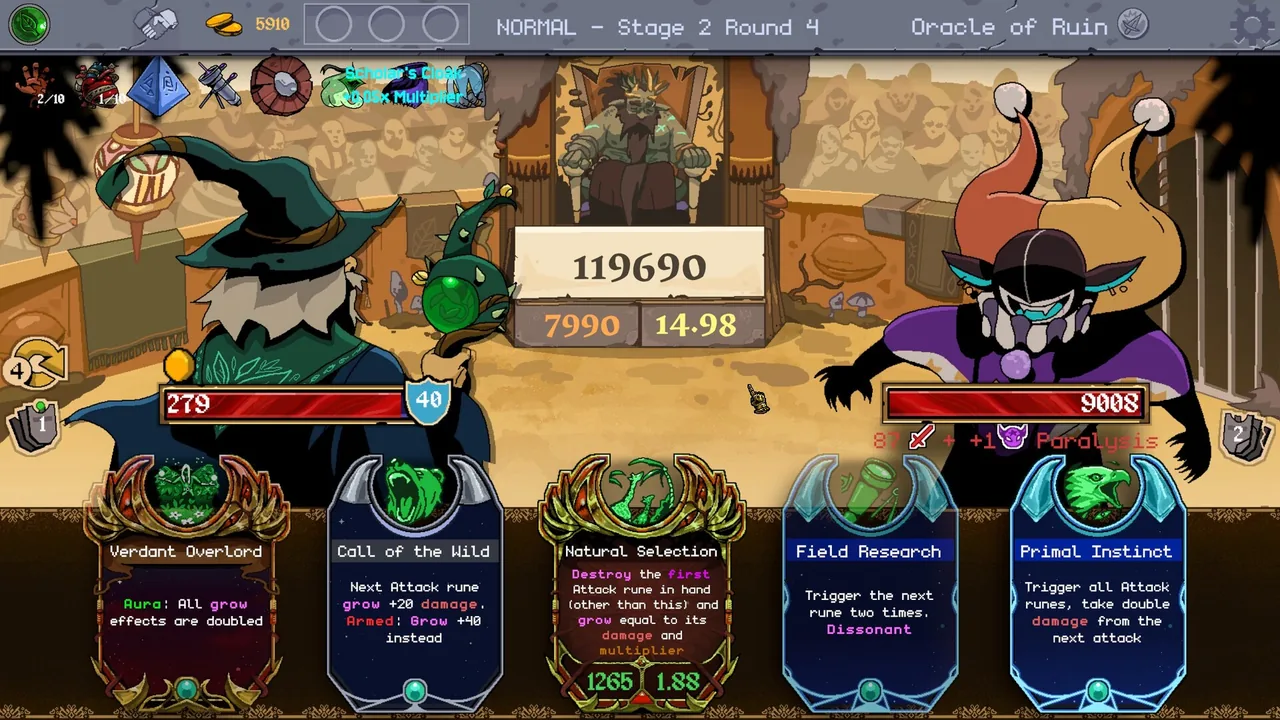
RuneveilImage: dicehit via Steam -
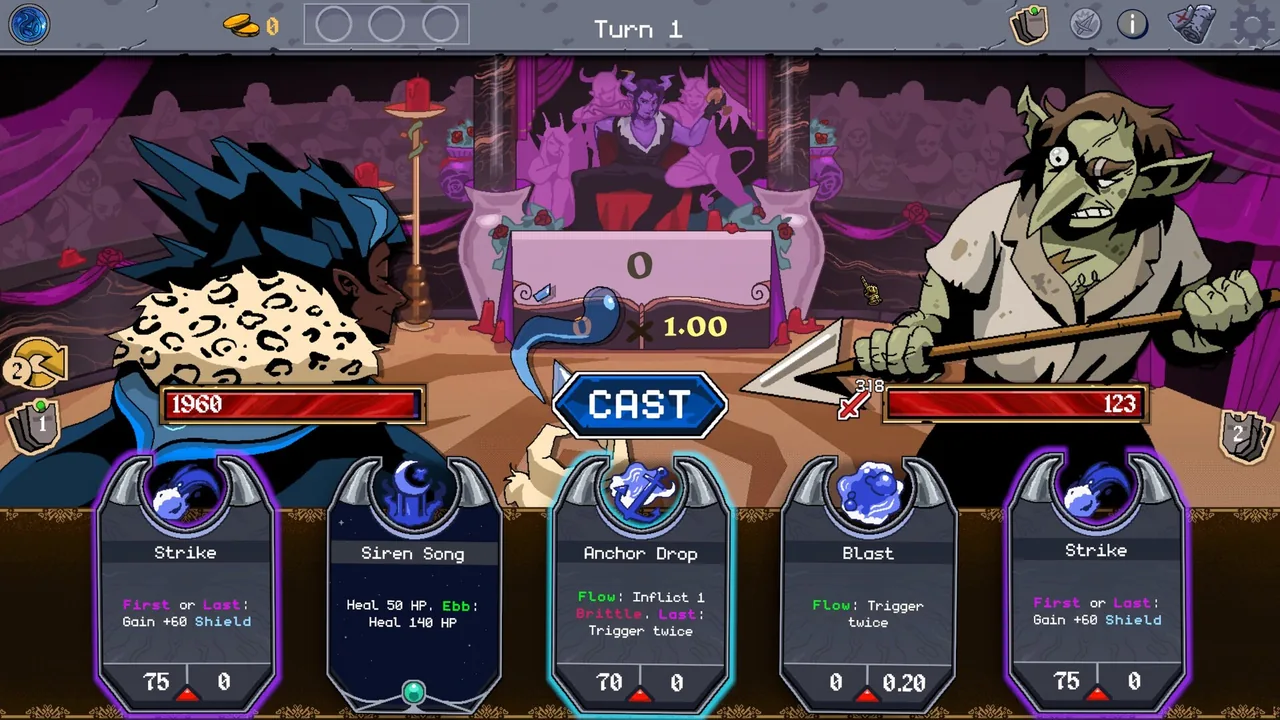
RuneveilImage: dicehit via Steam -
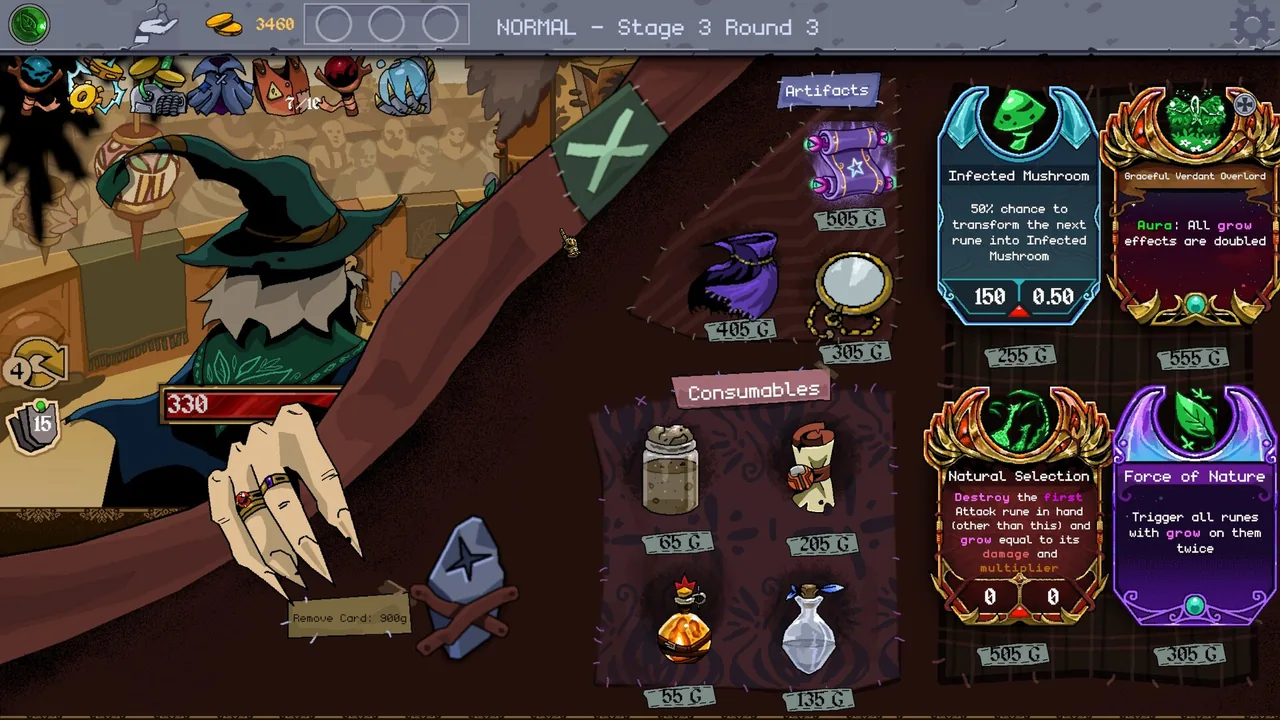
RuneveilImage: dicehit via Steam