Game review
Rollbound Review
5.5 / 10
- Developer
- Inner Realm Studios
- Publisher
- Inner Realm Studios
- Released
- 1 March 2026
- Platforms
- ["Windows"]
- Genre
- RPG
One Die, One Table, One Road to the Demon King
Rollbound reduces the tabletop RPG down to its most elemental gesture: rolling a single twenty-sided die. The store page describes it as "a short, table-top RPG inspired clicker set at a lonely tavern table, where a single die decides everything," and that framing is accurate almost to a fault. Every roll adds to or subtracts from a running point total needed to advance, and the same roll resolves random events and battles as the player pushes toward a confrontation with the Demon King. One reviewer, clearly a fan of the premise, put it well: "Roll to power up, progressing through the world as you go to defeat the Demon King... solid balance, impactful upgrades, multiple endings." It's an idea pulled almost directly from a tabletop session compressed into a single repeating click. The journey is broken into multiple biomes on the way to that final confrontation, each with its own set of roll-based events and encounters, giving the otherwise repetitive core action at least some visual and situational variety as a run progresses from area to area.
A Straightforward Loop That Rewards Not Overthinking It
The upgrade path is deliberately minimal: gold earned through encounters buys improvements to Attack, Defense, Luck, and Gold gain, and that's the entire character-building layer. Several reviewers found that simplicity worked in the game's favour rather than against it. "I honestly don't know what people are fussing about in the negative reviews. The game is explicitly introduced as a short, table top RPG inspired clicker. All you do is click to roll a dice, and that is exactly what you get," wrote one. Another described the appeal in practical terms: "Kill monsters, raise money, and use that money to raise your stats... Otherwise its a chill game. It's straightforward." For players wanting a low-effort session rather than a deep RPG, that directness reads as the point rather than a shortfall.
Six Endings, Painted Figurines, and an Idle Auto-Roll Payoff
Rollbound gives completionists a reason to run through the loop more than once. The store page promises six different endings depending on how a run plays out, alongside collectible enemy cards and "painted versions of the monster figurines" to unlock. One reviewer specifically praised this side of the game: "I love the designs of the mobs, especially how you can paint them... I especially like how you're able to customize your dice powerups, and the skin of the di." Once a player finishes the campaign once, the game unlocks an auto-roll idle mode with double speed specifically built for chasing the remaining endings — a genre-appropriate nod to the clicker/idle audience it's aiming at, even if the base game is a manual-click affair up to that point. The game also structures its Steam achievements as a set of "Achievement Quests" tied to unlocking specific dice skins, which gives the extremely simple core loop a light layer of external goals beyond just watching the point total climb.
A Thin Ceiling: Four Stats, One Real Decision
The most consistent criticism is that Rollbound's systems run out of depth fast. One detailed negative review broke the complaint down precisely: "There is an illusion of choice when upgrading the D20, as there are only 4 upgrade stats and you'll have all 4 of them [maxed quickly]." Another reviewer was blunter still: "There are 4 upgrades Attack, Defense, Gold, Luck. They all cap out at 10, and are all upgraded by the end. That is it. That is the sum of the game. You click roll and upgrade things." A third framed the whole experience as a missed opportunity given its hybrid premise: "The premise is excellent — who wouldn't be intrigued by a blend of trpg and incremental gameplay?... Ironically, though, if those two genres are exactly what drew you to the game, you may be better off not buying it." None of this reads as broken or buggy — the complaints are squarely about how little the system asks of the player once the initial hook wears off.
Cheap Enough That the Short Runtime Mostly Lands
At NZ$5.99, several reviewers judged Rollbound favourably on a value basis even where they found the systems thin. One calculated their own return directly: "I paid $2.99. Played for 1.7 hours. So it's $1.75/hour," while another called it "solid... especially for the price!" The reviewers most satisfied with Rollbound tended to be the ones who went in expecting exactly what the store page promises — a short, roll-based curiosity rather than a full RPG — while those disappointed had generally hoped the tabletop-inspired framing would translate into deeper tactical decisions than four capped upgrade stats can support.
Verdict
Rollbound delivers a genuinely novel hook — a whole miniature RPG campaign compressed into repeated rolls of a single die — but its systems are thin enough that the appeal wears off well before most of its six endings are unlocked. It's honest about what it is, cheap enough that the short runtime rarely feels like a rip-off, and has just enough collectible and idle-mode trimmings to reward a second or third run for completionists. Players drawn specifically to the "TTRPG meets incremental" pitch should know upfront that the incremental side is doing almost all of the work; if a single click-and-roll loop with light stat upgrades sounds appealing rather than repetitive, there's a curious few hours here.
Screenshots
-
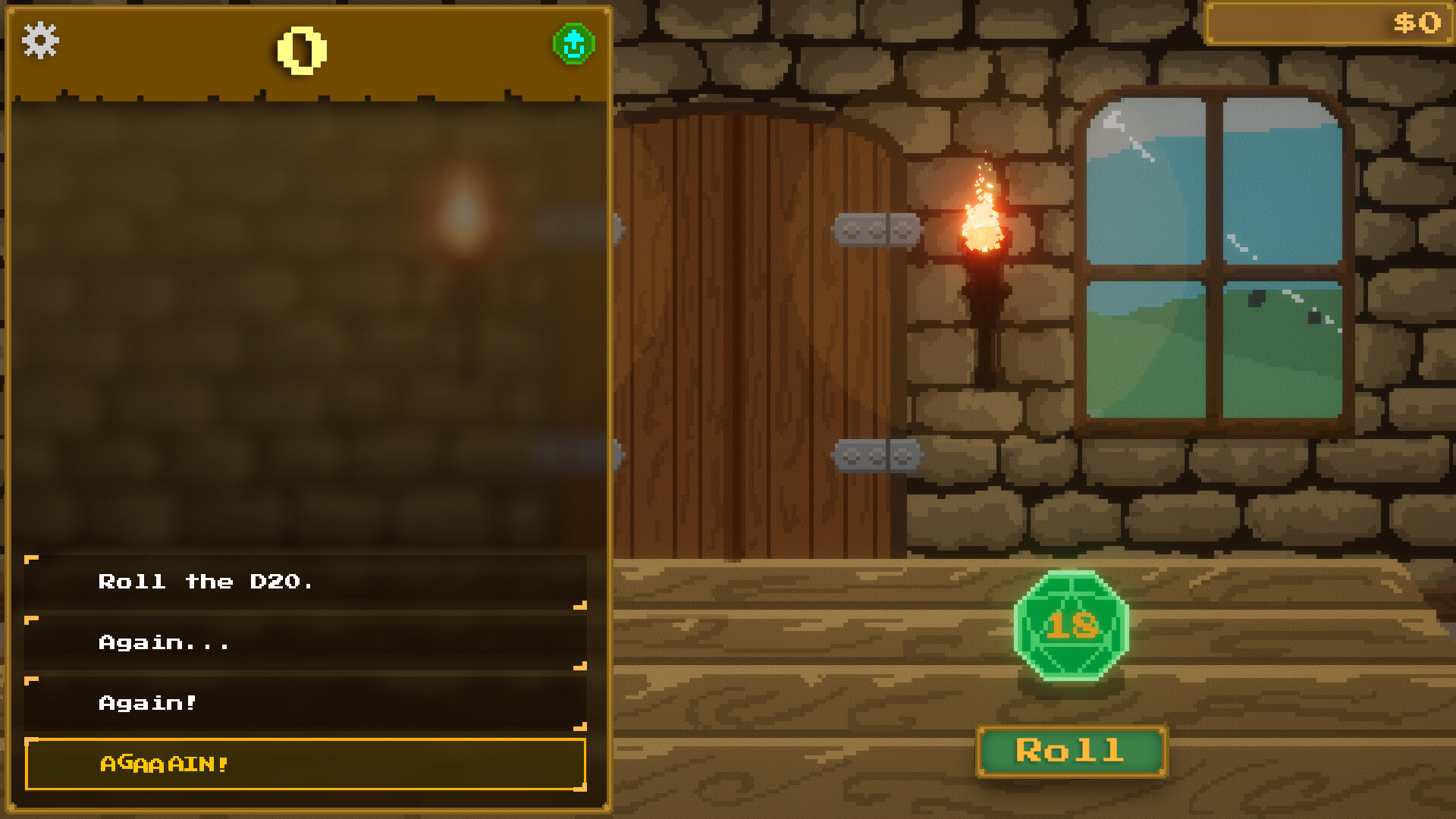
The opening tutorial explains the game's single mechanic — roll the D20 and see what happensImage: Inner Realm Studios via Steam -
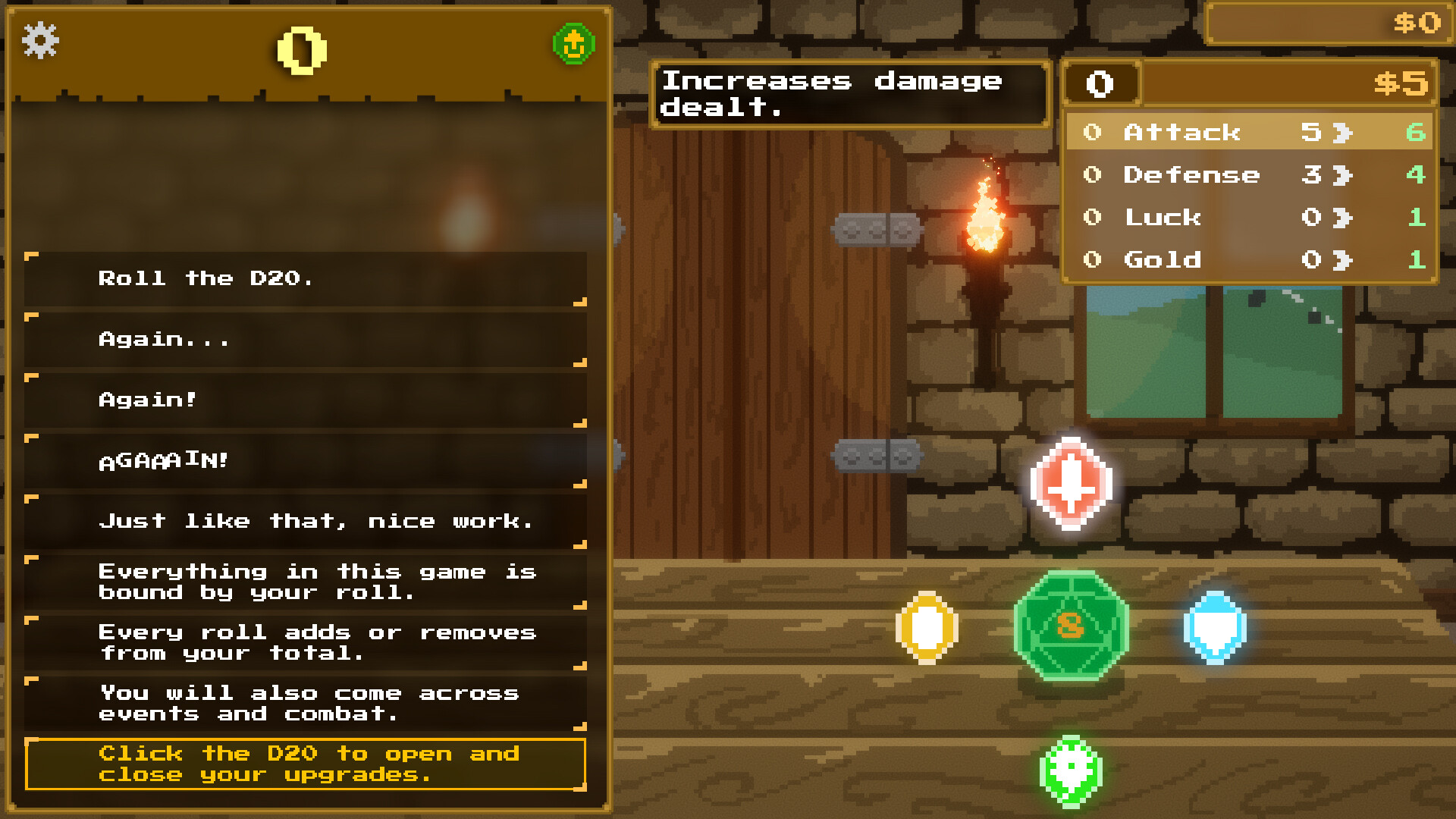
The upgrade panel — Attack, Defense, Luck, and Gold, the whole of Rollbound's character buildImage: Inner Realm Studios via Steam -
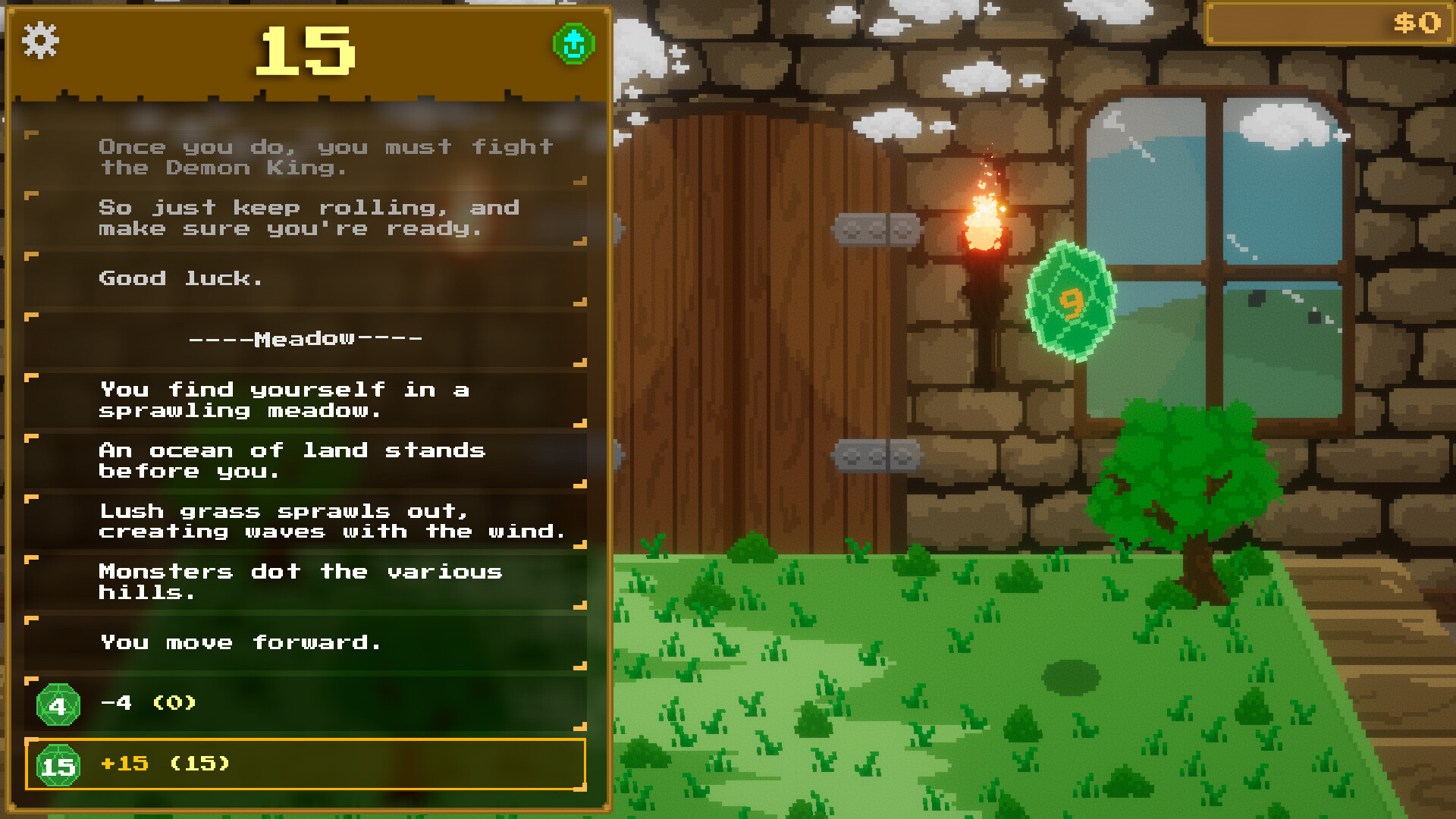
Travelling into a meadow biome on the way to the Demon King, narrated through dice-roll outcomesImage: Inner Realm Studios via Steam