
Game review
River City Girls
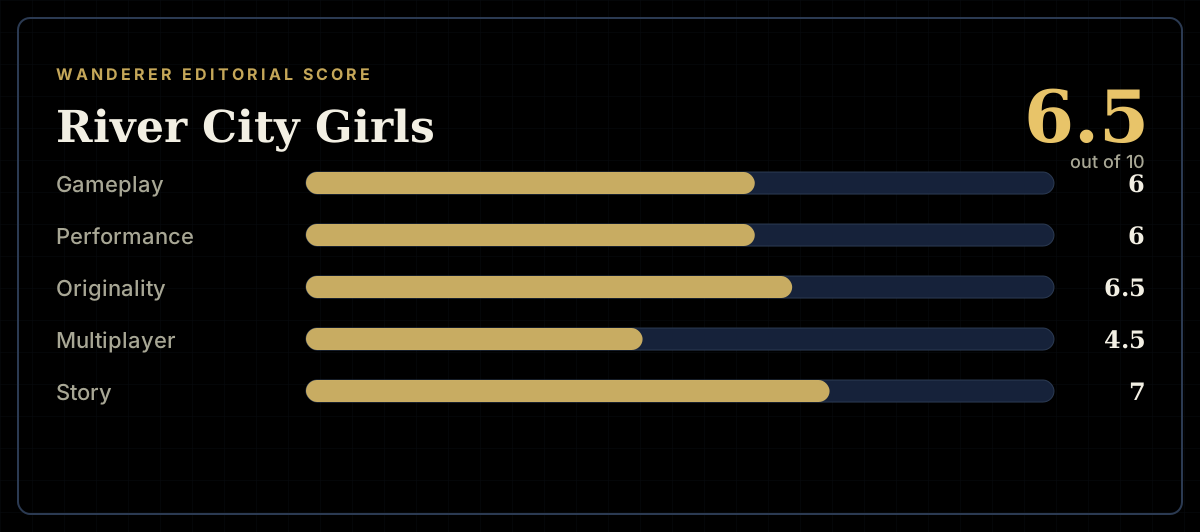
6.5 / 10
- Developer
- WayForward
- Publisher
- WayForward, Arc System Works
- Released
- 5 September 2019
- Platforms
- Windows
- Genre
- Action
- Monetisation
- Paid, no in-app purchases found
- Players
- true
The short version
River City Girls sends Kyoko and Misako punching their way across town to rescue their kidnapped boyfriends, blending River City Ransom's beat-em-up-with-RPG-stats structure with WayForward's own polished animation and a script this outlet's reviewers consistently call funny and charming. It's held back from an easy, uncomplicated recommendation by a specific, repeated complaint that stings more than most missing-feature gripes: no true online co-op, in a beat-em-up built entirely around two-player teamwork, from a studio whose own prior game solved this problem years earlier.
Biggest strengths
- Exceptional pixel art, character animation and voice acting that reviewers consistently call some of WayForward's best work, with a script full of genuine humour and memorable cameos
- A satisfying RPG layer of stat growth, shopping and leveling laid over classic beat-em-up combat, giving real structural depth beyond a straightforward brawler
- A well-regarded, wide-ranging soundtrack that multiple reviewers say is worth the price on its own
Biggest weaknesses
- No native online multiplayer despite being built around two-player co-op, forcing players who want to team up remotely to rely on third-party tools like Parsec — a complaint made more pointed by reviewers directly noting WayForward's own Double Dragon Neon shipped online co-op seven years earlier
- A specific, documented economy imbalance: health-restoring items are scarce and expensive relative to the money enemies drop, making solo play noticeably more punishing than the co-op experience it's clearly designed around
- An overloaded control scheme uses the same button for attacking, picking up items, picking up fallen enemies and progressing between areas, causing input conflicts reviewers find genuinely frustrating
Who it's for: Beat-em-up and RPG-hybrid fans who have a local co-op partner, or who are comfortable using third-party remote-play workarounds to play with someone remotely.
Our recommendation: A strong pick for the presentation and co-op-in-person experience; check your tolerance for third-party tools like Parsec if you specifically need to play with a remote friend.
6.5 / 10
What it is
River City Girls puts series regulars Kyoko and Misako in the spotlight, sending them punching, kicking and shopping their way through town after their boyfriends are kidnapped — a deliberately tongue-in-cheek premise treated with the same self-aware humour throughout. Developed by WayForward and published alongside Arc System Works, it carries forward the beat-em-up-with-RPG-stats formula the River City Ransom series has been known for since the NES era: fighting in the streets earns money and experience that feed into shopping trips, stat growth, and new moves, layered on top of combo-based brawling combat. It released on 5 September 2019 at NZD 36.99, designed from the ground up as a two-player co-op experience alongside solo play.
Its review corpus, 1,214 in English, sits at a strong Very Positive (1,016 to 198), and the writing throughout consistently credits WayForward's presentation as some of the studio's best work — but a specific, pointed structural complaint runs through enough of the corpus to shape how this game should actually be recommended.
Presentation and writing that reviewers consistently love
The pixel art, animation and voice work draw close to universal praise. One detailed pros-and-cons review opens simply: "high caliber pixel art and great expressions," crediting "funny non-serious story (as expected from WayForward)" and "nice easter eggs and cameos" alongside the visual polish. Another calls the soundtrack "well worth the price" on its own, unable to find "even a single track that is not satisfying." The RPG layer draws real, specific appreciation too — stat boosts, a leveling system, and shopping trips between fights giving the beat-em-up structure genuine progression rather than flat, repetitive combat encounters. Several reviewers frame the whole package as a worthy, faithful evolution of River City Ransom's original hybrid formula, with one longtime fan of the series calling that original game "one of the best games ever made" before praising this entry as a fitting continuation of its ideas.
The co-op gap that stings more than most
The single most pointed, specific complaint in the corpus concerns online multiplayer — or rather, its total absence. "It feels like a cross between River City and Double Dragon Neon so I dig it, but DDN had ONLINE CO-OP and it came out SEVEN YEARS AGO and was also made by WayForward," writes one reviewer, directly comparing this release unfavourably to the developer's own earlier catalogue rather than a competitor's game. That's a meaningfully sharper criticism than a generic "please add online" request — it's evidence that the studio itself had already solved this exact problem for this exact genre years before choosing not to include it here. Multiple reviewers independently note that Parsec, a third-party remote-play tool, is the only practical way to play with a friend who isn't physically present, with one detailed review specifically walking through the workaround for anyone hoping to play remotely despite the missing feature.
Balance and control friction
Beyond multiplayer, two more specific, concrete complaints recur. One concerns economy balance: a detailed review describes health-restoring items as "startlingly scarce and extremely expensive" relative to the money enemies actually drop, creating a punishing resource squeeze that hits solo players — who don't have a partner's shared resources and revival options — considerably harder than the co-op experience the game seems designed around. A separate, unrelated complaint concerns control scheme design: "it uses the same button for nearly everything, from picking items, attacking, picking bodies, moving to the next area," one reviewer notes, describing real frustration when these overlapping uses conflict with each other mid-fight.
A genuine, unresolved combat debate
Reviewers split meaningfully on whether the core fighting holds up under scrutiny. One detailed pros-and-cons list flags "AI easy to exploit after you figure them out" and "less chal[lenge]" as a real weakness once patterns are learned. A separate detailed review goes further, describing combat as simply "meh" despite loving everything else about the presentation. Others push back directly, describing "satisfying moves and combos" and specifically praising "non light-spam combos" as genuinely rewarding once explored — a distinction that suggests combat depth exists for players willing to engage with it deliberately, even if the path of least resistance (repeated light attacks against exploitable AI) undersells that depth for players who don't.
What the achievement data adds
The completion curve across River City Girls's 29 achievements offers a useful window into how the game is actually experienced by most buyers. Early achievements tied to basic story and combat milestones sit in a healthy 56-74% range, indicating most players who start the game engage seriously with its core loop rather than bouncing off immediately. But full completion sits at just 4.9%, with several late-game achievements — including one tied to a hidden final challenge — sitting in the single digits. That drop is consistent with a game whose main campaign is broadly accessible and enjoyable for most players, but whose harder optional content and full mastery are pursued by only a small, dedicated fraction — a fairly typical shape for a beat-em-up with real combo depth that most players don't fully explore, rather than evidence of a design problem specifically.
Weighing the co-op complaint against the base experience
It's worth being precise about what the missing-online-co-op complaint does and doesn't mean for a prospective buyer, since it's easy to overweight a single loud grievance. The base single-player and local co-op experience is, by the wide majority of this review corpus's account, genuinely well made — excellent presentation, a fun RPG-inflected combat loop, and a script reviewers consistently enjoy. The online gap is a real, legitimate complaint specifically for players whose intended co-op partner lives elsewhere, and it's fair to weigh that heavily if that's your exact use case. But it doesn't undermine the core experience for players with a local partner, or for solo players willing to work around the economy balance issues noted above. The sharpness of the complaint in this corpus comes specifically from the unfavourable comparison to WayForward's own back catalogue, not from the base game failing at what it actually set out to do for the audience closest to its design intent.
Verdict
River City Girls delivers genuinely excellent presentation and a fun, structurally satisfying RPG- beat-em-up hybrid that mostly succeeds at honouring its source material. A specific, well-documented absence — real online co-op, something this exact developer already shipped for this exact genre years earlier — is the complaint most worth weighing seriously before buying, alongside real economy and control friction that compound the experience for solo players specifically. Best enjoyed with a local co-op partner and reasonable expectations about remote play.
Pros and cons
Pros
- Exceptional pixel art, character animation and voice acting that reviewers consistently call some of WayForward's best work, with a script full of genuine humour and memorable cameos
- A satisfying RPG layer of stat growth, shopping and leveling laid over classic beat-em-up combat, giving real structural depth beyond a straightforward brawler
- A well-regarded, wide-ranging soundtrack that multiple reviewers say is worth the price on its own
- Rewarding combo-based combat for players willing to move past simple light-attack spam, according to reviewers who engaged with its deeper systems
Cons
- No native online multiplayer despite being built around two-player co-op, forcing players who want to team up remotely to rely on third-party tools like Parsec — a complaint made more pointed by reviewers directly noting WayForward's own Double Dragon Neon shipped online co-op seven years earlier
- A specific, documented economy imbalance: health-restoring items are scarce and expensive relative to the money enemies drop, making solo play noticeably more punishing than the co-op experience it's clearly designed around
- An overloaded control scheme uses the same button for attacking, picking up items, picking up fallen enemies and progressing between areas, causing input conflicts reviewers find genuinely frustrating
- A real, unresolved split in the corpus over combat depth: some reviewers find the AI easily exploited and the moment-to-moment fighting repetitive, while others find the combo system rewarding once mastered
- A short campaign, around 6 hours for a full playthrough, that some reviewers feel doesn't fully justify the asking price relative to genre alternatives
Screenshots
-

River City GirlsImage: WayForward via Steam -

River City GirlsImage: WayForward via Steam -

River City GirlsImage: WayForward via Steam -
How the review scores each part of the gameWanderer Editorial -
The short versionWanderer Editorial