Game review
RIG Riot Review
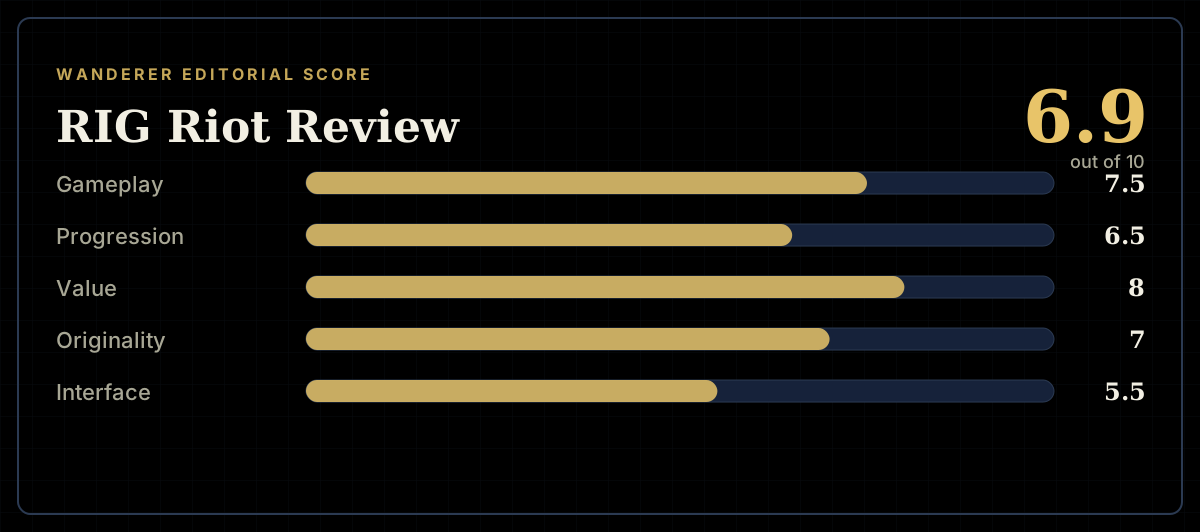
6.9 / 10
- Developer
- Sage Boatman
- Publisher
- Sage Boatman
- Released
- 14 September 2026
- Platforms
- ["Windows"]
- Genre
- Action
A One-Person Tribute to Armored Core, Built to Last Forever
RIG Riot wears its inspiration on its sleeve, and its inspiration is Armored Core, specifically the faster, dash-heavy feel of Armored Core 4 and For Answer, filtered through the boost-and-stagger combat that Armored Core 6 reintroduced to a whole new generation of players. Developer Sage Boatman has said outright that the game wouldn't exist without AC6, and that lineage is obvious within seconds of taking a custom-built mech, called a RIG here, into the sky: the acceleration, the lock-on, the dogfighting rhythm of boosting past an enemy and doubling back for another pass, all of it lands close enough to the source material that longtime Armored Core fans describe it as scratching an itch no other game has managed to reach. What sets RIG Riot apart from being a simple clone is the structure wrapped around that combat. Instead of a handcrafted mission list, the game is built as a roguelike, with procedurally assembled parts, randomized loot drops, and runs meant to be played dozens or hundreds of times over rather than finished once and shelved.
The scale of that parts system is the game's headline feature, and by most accounts it delivers. Head, torso, arms, legs, backpack, booster, targeting system, and generator all combine from thousands of individual component variants, each with its own stat spread, meaning two players' RIGs rarely end up looking or playing alike. Weapons layer on top of that, spanning melee blades, ballistic rifles, missile pods, and energy weapons, each usable in either hand or shoulder slot. It's a game that rewards players who enjoy min-maxing a build sheet as much as they enjoy the actual fighting, and reviewers consistently single out the sheer density of that system as the thing keeping them logged in well past their first few runs.
Raids, Arenas, and a Roguelike Loop That's Still Finding Its Footing
The core gameplay loop sends players into procedurally structured raid missions, choosing between a gentler "Mission" mode built around sequential objectives and a tougher "Assault" mode where enemy patrols roam the whole map regardless of what you're doing. Clearing side objectives builds toward major objectives, and clearing enough of those completes the raid, with the option to extract early and bank your loot rather than risk losing it all on a failed run. A separate Arena mode offers thirty-six scripted one-on-one duels against other RIGs, doubling as both a skill test and a guaranteed source of specific part unlocks that the randomized raid drops don't reliably provide.
Where the loop draws the most criticism is in its variety, or lack of it. With only a handful of maps and objective types in rotation, several reviewers report facing the same "destroy the checkpoint" objective back-to-back across multiple runs, and enemy AI is frequently described as either passive to the point of no threat or, at higher difficulty, prone to one-shotting an underprepared build with little warning in between. A significant balance patch that removed experience gained from killing regular enemies proved especially controversial with early players, since it was seen as gutting the pacing of progression during raids without a clear replacement system in place, though it's the kind of live-service-style adjustment that a solo developer patching quickly after launch can plausibly walk back or rework. The bones of the loop, hunting stronger gear, extracting to bank it, and building toward a next-tier RIG, are sound. The content filling that loop just isn't deep enough yet to survive the hundreds of hours the parts system is clearly designed to support.
An Impressive Solo Effort With the Rough Edges to Match
It's worth sitting with the fact that RIG Riot was built by one person in roughly two years, because nearly every criticism levied against it comes with that context attached. The melee combat lacks weight compared to its inspirations, the soundtrack is repetitive enough that some players mute it entirely, and the menus are a consistent sore point: overlapping text in the garage screen, unclear DPS values between comparable weapons, and control-scheme quirks that make some submenus difficult or impossible to navigate on a gamepad. Bugs show up too, from enemies clipping through geometry to a VTOL boss getting stuck inside a wall, though nothing rises to the level of blocking progress outright for most players.
A smaller but more serious set of reviews describe an experience closer to an unfinished alpha than a shipped release: broken UI elements, enemies that fail to spawn and softlock a mission, paint customization sliders that don't visually update, and no official bug-reporting channel at launch. These accounts sit at odds with the far more common "jank but joyful" reception, and the gap between the two suggests real variance in how individual systems are holding up under different hardware and play patterns rather than one universal experience. Boatman has been visibly active addressing feedback since release, which has bought considerable goodwill even from players frustrated by specific issues.
A Fair Price for an Ambitious, Unfinished-Feeling Debut
At $17.99 on a launch discount off its $19.99 list price, RIG Riot undercuts most full-priced action games while offering a loot system built for dozens of hours of chasing better parts. Players who tried the free public demo ahead of launch, which several reviews describe as more consistently tuned than the release build in certain respects, seem to have arrived with realistic expectations about what a one-person passion project can and can't deliver at this stage. For Armored Core fans starving for more of that specific fast, weighty, customization-obsessed mech combat, especially after the long gap since AC6, it's an easy recommendation despite its flaws. Players expecting a fully polished, content-complete package built by a full studio should wait for a few more patches first.
Verdict
RIG Riot is a remarkably accomplished solo debut that nails the specific feeling Armored Core fans have been chasing since AC6, wrapped in a roguelike structure with an enormous, genuinely creative parts system. It's also unmistakably a first game from a single developer: repetitive mission variety, an uneven difficulty curve, a controversial post-launch balance change, and a spread of UI and stability issues that range from minor annoyances to, for a smaller group of players, near game-breaking. None of that erases what's genuinely here, which is a fast, satisfying combat loop and a customization system with real depth behind it. Recommended for mech-action fans willing to be patient with a promising game that's still finding its final shape.
Pros:
- Combat and movement authentically capture the Armored Core feel across multiple eras of the series
- An enormous, genuinely creative mech-parts system built from thousands of combinable components
- Reasonably priced for the amount of build-crafting and replay value on offer
- A responsive solo developer already patching based on player feedback
Cons:
- Limited map and objective variety leads to repetitive raid missions
- A post-launch balance patch removing enemy-kill experience proved deeply unpopular
- Menus and UI are cluttered, hard to read, and occasionally broken on controller
- A smaller subset of players report bugs severe enough to threaten mission progress
Screenshots
-
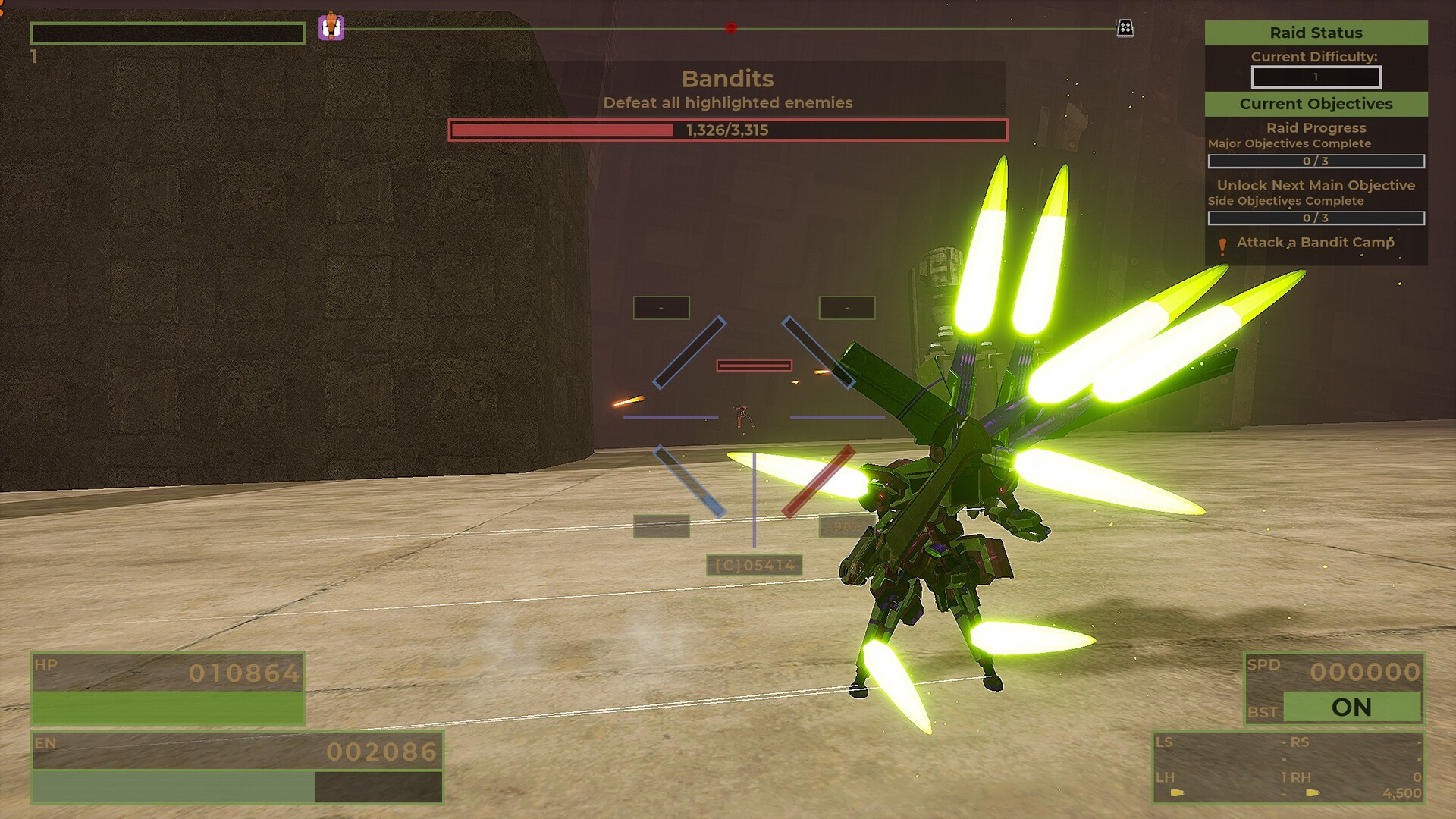
Unloading a missile volley on a bandit camp mid-raidImage: Sage Boatman -
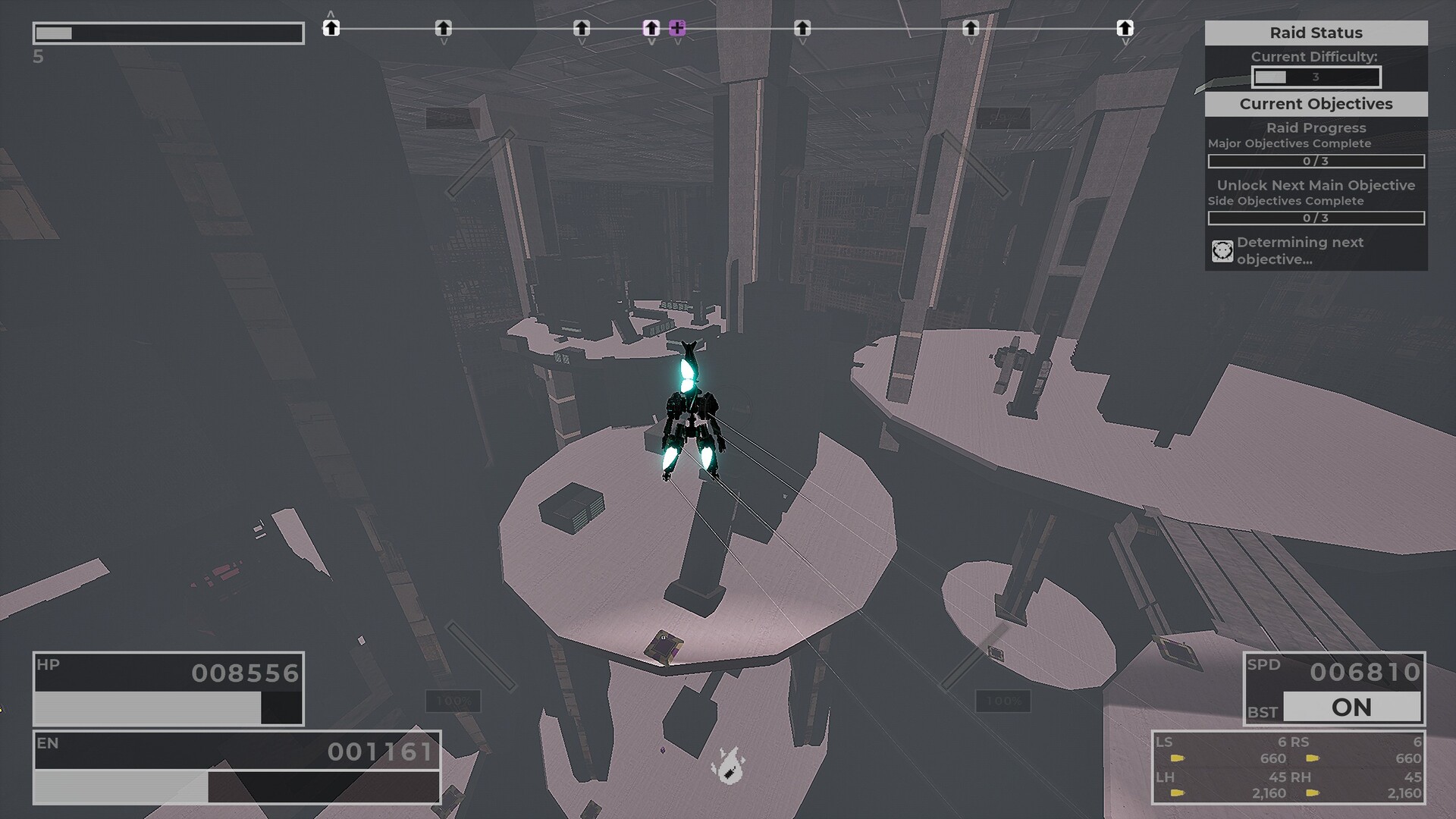
A lightweight RIG hovering above one of the game's raid platformsImage: Sage Boatman -
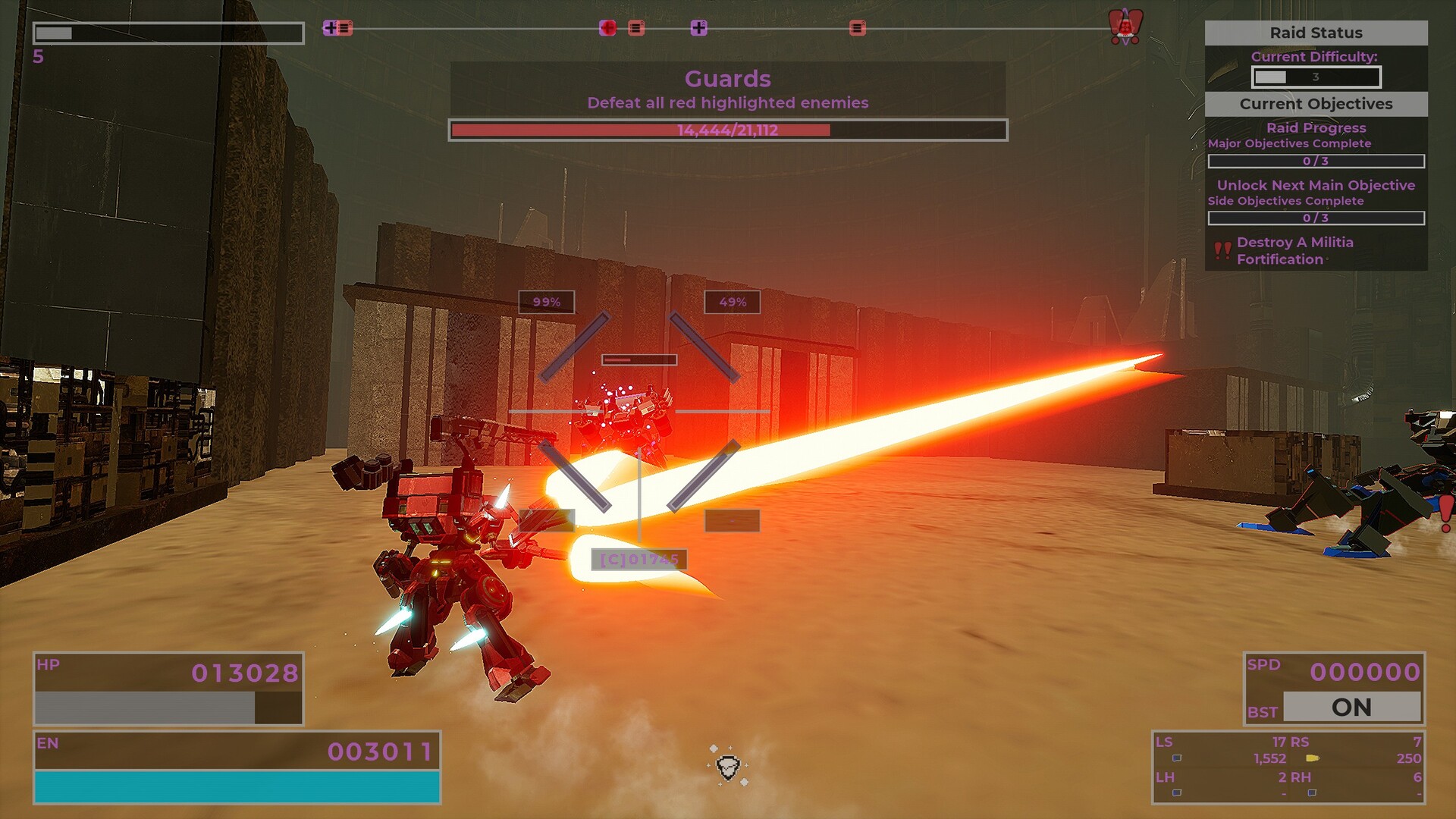
Close-range beam combat against a squad of enemy GuardsImage: Sage Boatman -
How the review scores each part of the gameWanderer Editorial -
The short versionWanderer Editorial