
Game review
Railway Empire
6 / 10
- Developer
- Gaming Minds Studios
- Publisher
- Kalypso Media
- Released
- 26 January 2018
- Platforms
- Windows, macOS, Linux
- Genre
- Railroad tycoon simulation
- Monetisation
- One-off purchase, with numerous DLC packs (additional maps, scenarios, trains) released across a long support life; at least one reviewer notes base content like additional maps is gated behind paid add-ons
- Players
- Online multiplayer is supported, though the review sample gathered for this piece focused primarily on single-player feedback
The short version
Railway Empire's core economic puzzle — feeding growing cities with the right resources via a rail network you design, while fending off aggressive AI competitors — genuinely works for a large share of its audience, and reviewers describe real satisfaction watching a well-planned network hum along without bottlenecks. The problem, described with unusual consistency across the review sample, is the one system a railway game can least afford to get wrong: track and signal placement. Reviewers independently call it "finnicky," describe "very bad hitboxes" that can block a connection after hours of planning, note the complete absence of a blueprint or undo system, and one detailed reviewer sums up the shared verdict directly: "the track laying sucks. It kills the game." Combined with UI complaints serious enough that one reviewer says it "feels like multiple teams designed different" parts of the interface without coordinating, and at least one report of a scenario becoming literally unbeatable after a patch, this is a game whose own fans repeatedly recommend its numbered sequel instead as the version that actually fixed the foundational mechanic.
Biggest strengths
- A genuinely engaging core economic puzzle — matching resource production to city demand across a growing rail network — that reviewers describe as satisfying once it clicks
- Over 40 detailed, distinctly modeled historical trains give real thematic and mechanical variety to network design
- Real, sustained challenge in later scenarios that several reviewers specifically praise as more demanding than the game's presentation initially suggests
Biggest weaknesses
- Track and signal placement — the foundational building mechanic — draws unusually consistent, specific criticism as imprecise and frustrating, including reports of building hitboxes (such as monuments) rendering visibly smaller than their actual blocking area
- No blueprint or undo system exists for rail construction, meaning planning mistakes discovered mid-build can't be corrected without manually tearing everything back down
- Multiple reviewers describe the UI as inconsistent and confusing, with one noting it took an embarrassingly long time to even locate the button to purchase a train
Who it's for: Railroad tycoon fans specifically drawn to the economic network-building puzzle who can tolerate real, well-documented friction in the core building tools. Less suited to players who want smooth, precise construction as a baseline expectation, or anyone unwilling to budget for a DLC catalogue that gates some base content like additional maps.
Our recommendation: Worth trying at a discount for the underlying economic puzzle specifically; strongly consider the sequel instead if track-laying precision matters to you, since that's the exact fix multiple of this game's own fans say it needed.
6 / 10
Railway Empire tasks players with building an American rail network across the late 19th and early 20th centuries, connecting growing cities, hauling resources to the factories that need them, and fending off rival companies racing for the same territory. Released in January 2018, it built a large, Very Positive following — 80.5% across 3,763 English reviews — around an economic puzzle its fans genuinely enjoy solving. Reading through the sample reveals something unusually specific for a tycoon game this well-received: near-unanimous agreement on exactly which single system undermines the experience, named the same way by reviewer after reviewer.
An economic puzzle that works
The praise across the sample centers on the underlying resource-and-demand loop. One reviewer calls it "excellent and more challenging than what it looks like at first glance." Another describes the appeal precisely: "seeing trains running smoothly (not a lot of wait time) is satisfying but not easy... the main goal of the game is to grow cities. You accomplish that by providing resources scattered around the map." A third, despite frustrations elsewhere, admits: "I had no idea how fun it would be to plan railway networks and manage the economies of different cities and farms. There's a really engaging and satisfying game at the core." That's consistent, specific praise for the game's central design idea — matching supply to demand across an expanding map — independent of how reviewers feel about anything built to execute it.
The one system reviewers can't forgive
What that same reviewer immediately adds, and what recurs across the sample with unusual consistency, is a direct verdict on track construction itself. One reviewer states it as plainly as a review can: "The track laying sucks. It kills the game." Another gives the specific mechanical detail behind that frustration: "Very bad hitboxes, intersections of railways are really hard to build... I lost my scenario because a monument hitbox is twice as large as the red square displayed, so you can't connect to a train station you built 3 hours ago." A third reviewer identifies a structural gap compounding the problem: "There is no blueprint system either, so you can't design much of your railway before building it." This isn't three unrelated complaints about difficulty — it's the same specific system, named independently and in matching detail, described as the primary obstacle standing between players and the satisfying core loop everyone agrees exists underneath it.
An interface several reviewers call actively hostile
Compounding the track-building frustration, UI complaints appear with real specificity across the sample. One detailed, heavily-upvoted review states: "Very high production budget for visuals and sound, very poor execution on the technical side of things in terms of UI/UX, functionality, track placement and gameplay." Another describes a concrete example of the confusion: "Took an embarrassingly long time to even see the 'buy train' button... the buy button is a slightly transparent dollar sign in the middle of screen." A third puts the overall impression memorably: "it genuinely feels like multiple teams designed different [parts of the interface]" without coordinating with each other. Combined with the track-laying complaints above, this paints a coherent picture of a game whose central economic idea survived a genuinely rough execution layer rather than being let down by any single isolated flaw.
A patch that reportedly broke a scenario entirely
One detailed reviewer raises a more serious, specific technical claim: after trying "multiple times to beat the first Chapter tutorial" and even "followed a YouTube guide move for move" without success, they concluded "guess they patched the game and made it impossible to beat." This review found no way to independently confirm which patch might have introduced this regression, but a specific, methodical account like this — including the detail that an external guide known to have worked previously no longer did — is worth reporting as a credible, serious claim rather than an unverified complaint, distinct from the ordinary difficulty and UI frustrations documented above.
What the numbers say about real engagement
Global achievement data shows the core loop does hold attention for a broad share of players despite everything above: completion for the earliest milestones sits near 90%, and the curve tapers gradually through the mid-range rather than collapsing sharply, consistent with reviewers' account of a genuinely engaging core game that many players push through the frustrating tools to keep enjoying.
An AI rivalry with no difficulty floor
A separate, specific complaint concerns the competing AI companies players race against. One detailed reviewer describes the imbalance directly: "in order to survive against the AI, which cannot be decreased in strength, you must assemble a spaghetti mess of tracks and trains" just to stay competitive, adding this makes the game hard to recommend "to someone who just wants a fun game to play" rather than a serious optimization challenge. A separate reviewer's account, less detailed but pointing at the same frustration, calls the AI competitors "a bit annoying" even while otherwise enjoying the game. That's a fair distinction worth preserving: the game's difficulty isn't uniformly a problem, but the specific inability to scale AI aggression down means players who want a relaxed city-building experience rather than a tight competitive race may find themselves fighting a battle they never asked for.
Verdict
Railway Empire built a real, satisfying economic puzzle around growing cities and competing rail networks, and its Very Positive reception reflects genuine engagement with that core idea. What keeps it from a stronger recommendation is an unusually consistent, well-documented failure in the one system a train game depends on most: track and signal construction, described the same specific way by reviewer after reviewer, without a blueprint or undo system to soften the learning curve. Multiple of the game's own fans recommend its sequel as the fix; approach this original with that context in mind.
Sources: Steam store page and appdetails API (release date, pricing, platform data); Steam's aggregate review data (query_summary totals, English-language sample); individually read user reviews, both positive and negative, sorted by helpfulness and recency; Steam's global achievement statistics API.
Pros and cons
Pros
- A genuinely engaging core economic puzzle — matching resource production to city demand across a growing rail network — that reviewers describe as satisfying once it clicks
- Over 40 detailed, distinctly modeled historical trains give real thematic and mechanical variety to network design
- Real, sustained challenge in later scenarios that several reviewers specifically praise as more demanding than the game's presentation initially suggests
- Achievement data confirms broad engagement across a wide range of milestones, evidence the core loop holds attention for a meaningful share of the playerbase despite its friction
- A large ecosystem of maps and scenario DLC gives dedicated fans a long tail of additional content to purchase over time
Cons
- Track and signal placement — the foundational building mechanic — draws unusually consistent, specific criticism as imprecise and frustrating, including reports of building hitboxes (such as monuments) rendering visibly smaller than their actual blocking area
- No blueprint or undo system exists for rail construction, meaning planning mistakes discovered mid-build can't be corrected without manually tearing everything back down
- Multiple reviewers describe the UI as inconsistent and confusing, with one noting it took an embarrassingly long time to even locate the button to purchase a train
- At least one detailed reviewer reports a scenario becoming literally unbeatable after a patch, confirmed by following an external video guide move-for-move without success
- Some base functionality, such as access to additional maps, is gated behind separate paid DLC rather than included with the base purchase, a specific value complaint from more than one reviewer
Screenshots
-

Railway EmpireImage: Kalypso Media via Steam -

Railway EmpireImage: Kalypso Media via Steam -

Railway EmpireImage: Kalypso Media via Steam -
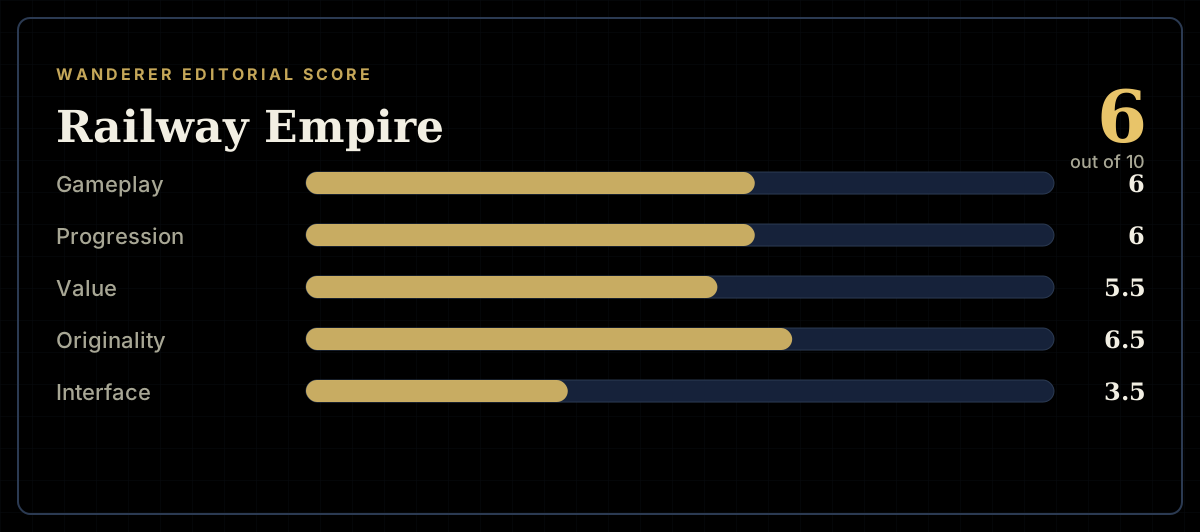
How the review scores each part of the gameWanderer Editorial -
The short versionWanderer Editorial