
Game review
Profit Sea Incremental
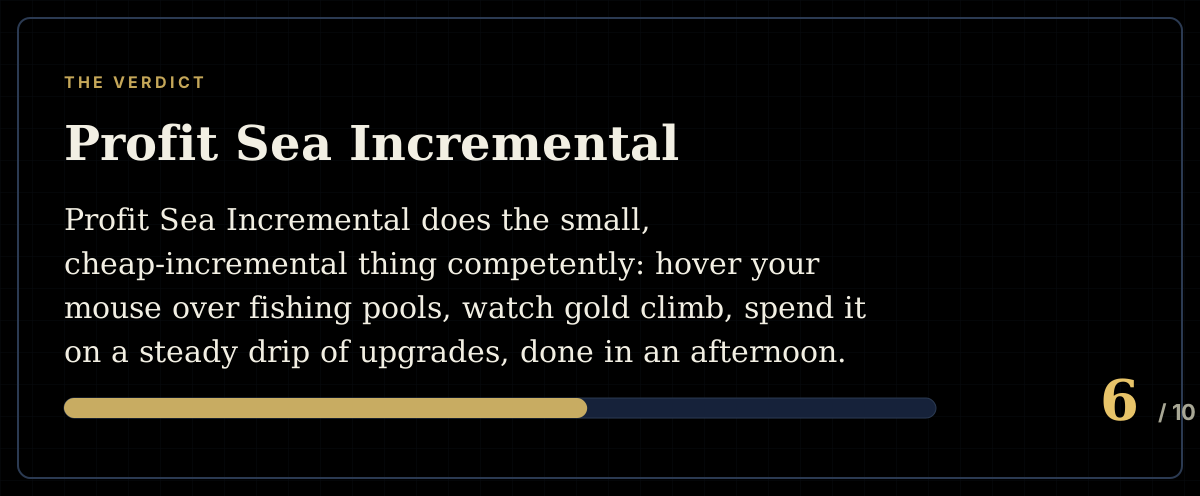
6 / 10
- Developer
- Monkey Cube
- Publisher
- Monkey Cube
- Released
- 31 March 2026
- Platforms
- Windows
- Genre
- Incremental
- Monetisation
- One-time purchase, plus an optional NZ$4.49 cosmetics-only Supporter Pack DLC.
- Players
- Single-player
The short version
Profit Sea Incremental does the small, cheap-incremental thing competently: hover your mouse over fishing pools, watch gold climb, spend it on a steady drip of upgrades, done in an afternoon. It sits at Mostly Positive — 76% of 159 English reviews, 79% across all 303 — and the positive write-ups are genuinely warm about its pacing and its low asking price.
The negative reviews converge on one specific complaint with unusual consistency: the upgrade tree only ever offers one real path forward, so a game built to look like a tree of choices plays like a corridor. **I read every English-language negative review this game has — all 38 of them** — and "linear" or "no choice" appears in roughly half. A third complaint recurs too: this looks like a close reskin of "A game about feeding a black hole," a similar incremental from December 2025, right down to the electric-fish/electric-eel mechanic and the money-milestone achievement names.
Biggest strengths
- Cheap, short and honest about what it is — most reviewers finish it in one sitting
- Pleasant maritime art direction and a soundtrack several reviewers single out by name
- Runs cleanly, with no widely reported performance problems
Biggest weaknesses
- The upgrade tree is close to a straight line — roughly half of negative reviews call it linear or say it offers no real choice
- Most players 100% it in three to five hours, and there is no prestige or endless mode to extend it
- Multiple reviewers flag it as a close mechanical copy of December 2025's "A game about feeding a black hole"
Who it's for: Anyone who wants a self-contained, two-to-four-hour incremental for the price of a coffee and doesn't mind a single guided path through it. Not for players who want the genre's usual build-planning, branching upgrade trees, or a reason to come back after the credits.
Our recommendation: An easy buy at NZ$7.39 if you want a short, undemanding incremental and know going in that "upgrade tree" mostly means "upgrade queue." Skip it if illusion-of-choice progression is a dealbreaker for you, or if you were hoping for genuine build variety between runs.
6 / 10
The most detailed positive review in the whole English-language corpus — a 12.7-hour, 2-vote write-up — sums the game up better than the store page does: "a small-scale idle game that embraces simplicity and structure in a genre often defined by endless escalation." Then, three paragraphs later, the same review turns on itself: "the same design choices that make the game approachable also limit its depth… once you've grasped the core loop, there are no major systems introduced later on to redefine the experience."
That tension — a well-liked, well-paced two-hour game whose own fans keep describing its ceiling — is the whole review in miniature.
What it actually is
Profit Sea Incremental is a mouse-over fishing incremental: hover pools to catch fish, sell them for gold, spend gold on a node-based upgrade tree that raises catch rates, unlocks new fish types (electric eels, storm fish, legendaries) and automates more of the loop as you go. Twenty-seven Steam achievements track milestones — first big catch, fishing 100,000 times, earning a trillion gold in a single day — and the whole thing is built, deliberately, to have an ending rather than run forever. It's Casual and Indie by Valve's own genre tags, Windows-only, single-player, with Steam Cloud saves and a set of accessibility options (mouse-only play, no timed inputs, play at your own pace) that a lot of bigger incrementals don't bother shipping.
The complaint that shows up in half the negatives
I read every English-language negative review this game has — all 38 of them, using Steam's own review-type filter rather than a sample — and the same word keeps recurring: linear. A 9-vote review puts it plainly: "Could be a fun game, but it is more of a ride than a game. No real choices to make, just zip through and get everything 1 at a time. Very much 'on rails.'" Another, also at 9 votes: "The tree is effectively linear, there's little to no strategy, there's little to no feedback about how any given upgrade is performing."
A 6-vote review gets specific about why that matters for replay value: "the upgrade path is very linear so 1. you dont have real choice on what to upgrade and follow a linear progress and 2. makes it pointless to replay the game because you cant take a different path or try a new build." That's not one disappointed player — it's the load-bearing complaint of the negative corpus, and it lines up with what the positive reviews say too, just phrased more gently: the 12.7-hour review above calls the same thing "limited depth," and a different positive reviewer notes "the same upgrades you've had the whole time" reappear in each new tree section.
To be fair to the design, a game doesn't have to be strategic to be worth NZ$7.39 for an afternoon, and several reviewers say exactly that — it's relaxing, it's "satisfying," the loop of watching numbers climb works even without real decisions attached to it. But a node-based tree that visually promises branching choice and mechanically delivers a queue is a specific kind of overselling, and it's the single most common reason people who otherwise liked the game still marked it down.
A familiar shape
A smaller thread, but a pointed one: multiple reviewers flag Profit Sea Incremental as a close mechanical relative of "A game about feeding a black hole," a similarly-scoped incremental released in December 2025. One 3-vote review lays out the specifics: "Has the same mechanics and even electric fish, just this is fishing instead of space. As well as the whole leveling up the ship. Achievements are basically the same with 'earn this amount of money in one round.' Its the same game just fishing instead of being in space." I haven't played either game and can't independently verify a line-by-line mechanical match — that's a claim about another studio's IP I'm repeating, not confirming — but it's specific enough, and repeated by enough different reviewers independently, that it's worth flagging before you buy rather than after.
How short is short
Steam's own completion numbers back up what the reviews say about length. The "Completionist"-tier achievement (milestone_all) sits at 60.6% — a strikingly high completion rate for any game, and a sign that most buyers do see the whole thing through. Review playtimes cluster the same way: reviewers report finishing in two to four hours and reaching 100% in three to five, and one positive review opens with exactly that math: "It took me 2 hours to finish the game, Around 5 to 100%, only because I had to grind the 300 runs achievement."
Then the curve falls off a cliff. Three "buster" achievements — catch_shark, milestone_all_buster, unlock_all_nodes_buster — sit at 7.4%, 6.6% and 5.8% respectively, against 60.6% for the base completion milestone. The reviews explain the gap: those achievements sit behind a second, near-identical playthrough. "Dislike when achievements are behind a different game mode which is esentially the same game," one review says. "Aka play the game twice fully to get the achievements." A 7.2-hour review is blunter: "the achievements were awful, devs force you to sit there and replay over and over for the last 2 achievements. SO BORING." For a game whose whole pitch is a tight, self- contained two-hour sitting, asking for a second full clear to see the achievement list through is a strange note to end on — and it's the reason replayability scores a 3 here rather than something closer to the value score.
Two smaller things worth knowing
It shipped with at least one real bug, and the developer fixed it fast. A launch-week achievement glitch blocked 100% completion for some players; a positive review notes "Dev released an update to fix that in 2 days." A handful of later reviews still mention "achievement bugged" and one reports the game failing to start entirely (black screen), so it's not spotless, but the pattern is a small studio patching promptly rather than going quiet.
The Supporter Pack DLC is what it says it is. NZ$4.49 for pirate-themed ships, tools, a cursor and a background — Monkey Cube's own store description states it "does not grant any boosts to in-game progression," and nothing in the review corpus contradicts that. One wary reviewer who hit the launch-day black screen was relieved they "didn't bought supporter pack" before hitting the bug, but that's caution about the base game's stability, not a complaint about the DLC being predatory.
The verdict
Profit Sea Incremental earns a 6. It's cheap, it's polished enough that performance and launch stability are non-issues for most buyers, and the positive reviews are sincere about how relaxing a two-hour sitting with it can be — the pacing and the maritime art direction both land. It doesn't score higher because the thing that makes an incremental's upgrade tree interesting — genuine build choice — isn't really here, because the achievement list asks for a second full playthrough of a game explicitly built to be a single short sitting, and because enough reviewers independently flag it as a close reskin of another December 2025 incremental that the originality question deserves airing before you buy. At NZ$7.39 for a contained, undemanding afternoon it's a fair trade. Go in expecting a guided walk rather than a build to plan, and you'll get exactly what most of the positive reviews describe.
Pros and cons
Pros
- Cheap, short and honest about what it is — most reviewers finish it in one sitting
- Pleasant maritime art direction and a soundtrack several reviewers single out by name
- Runs cleanly, with no widely reported performance problems
- The one achievement-blocking bug reported at launch was patched within two days
- Supporter Pack DLC is explicitly cosmetic-only, with no progression boosts, at a fair NZ$4.49
Cons
- The upgrade tree is close to a straight line — roughly half of negative reviews call it linear or say it offers no real choice
- Most players 100% it in three to five hours, and there is no prestige or endless mode to extend it
- Multiple reviewers flag it as a close mechanical copy of December 2025's "A game about feeding a black hole"
- The last few achievements gate behind a near-identical "buster" mode — Steam's own completion stats show 60.6% of players clear the base game but only 5.8–7.4% clear the buster achievements
- A handful of players report a black-screen launch failure and other achievement bugs
Screenshots
-
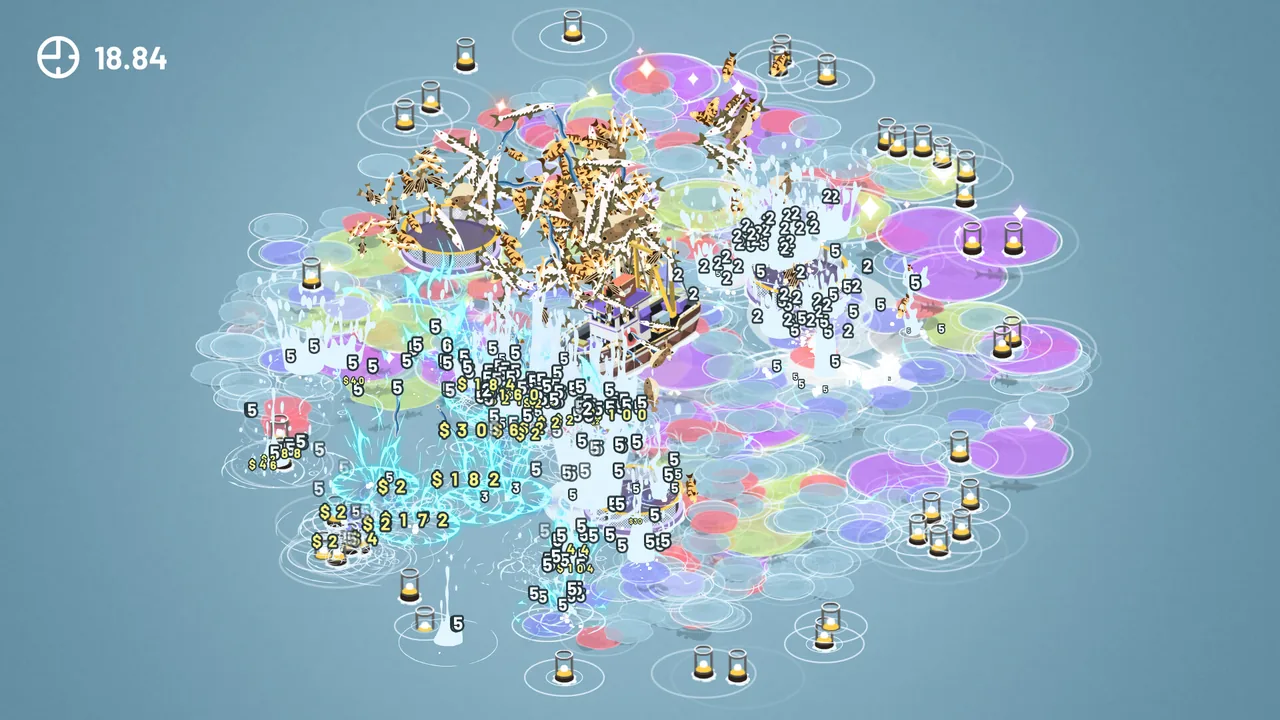
Profit Sea IncrementalImage: Monkey Cube via Steam -
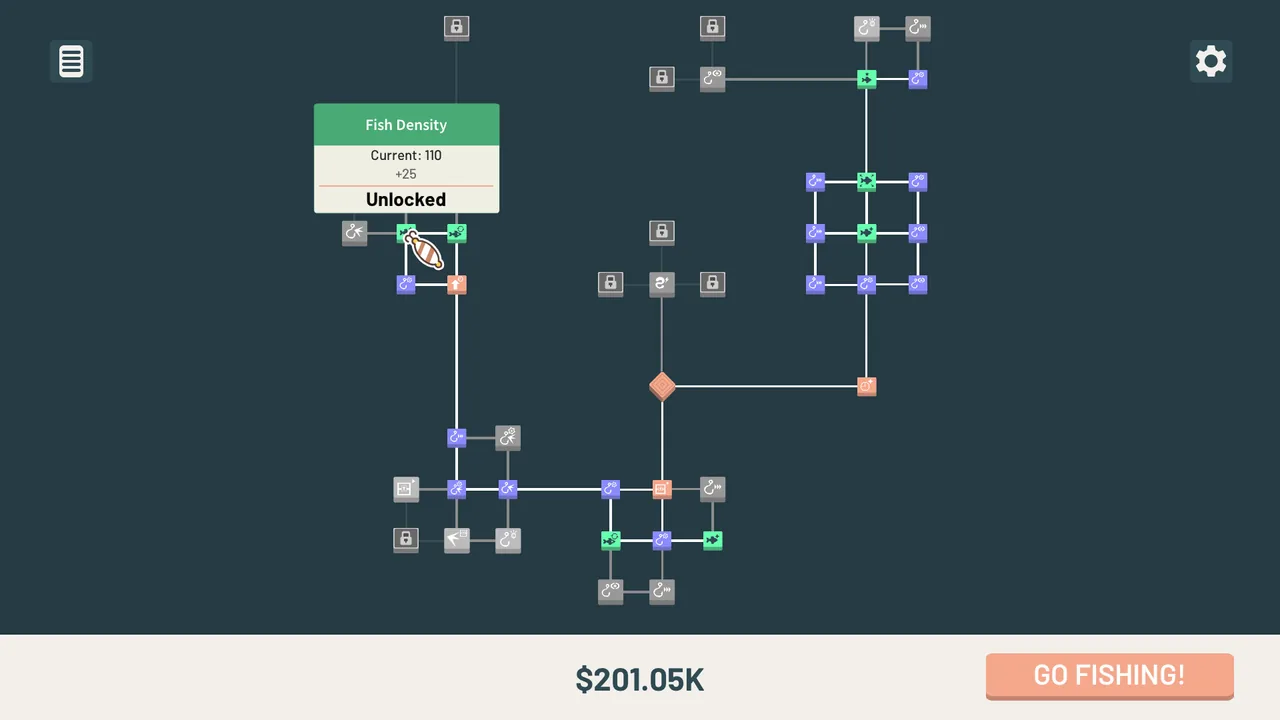
Profit Sea IncrementalImage: Monkey Cube via Steam -

Profit Sea IncrementalImage: Monkey Cube via Steam -
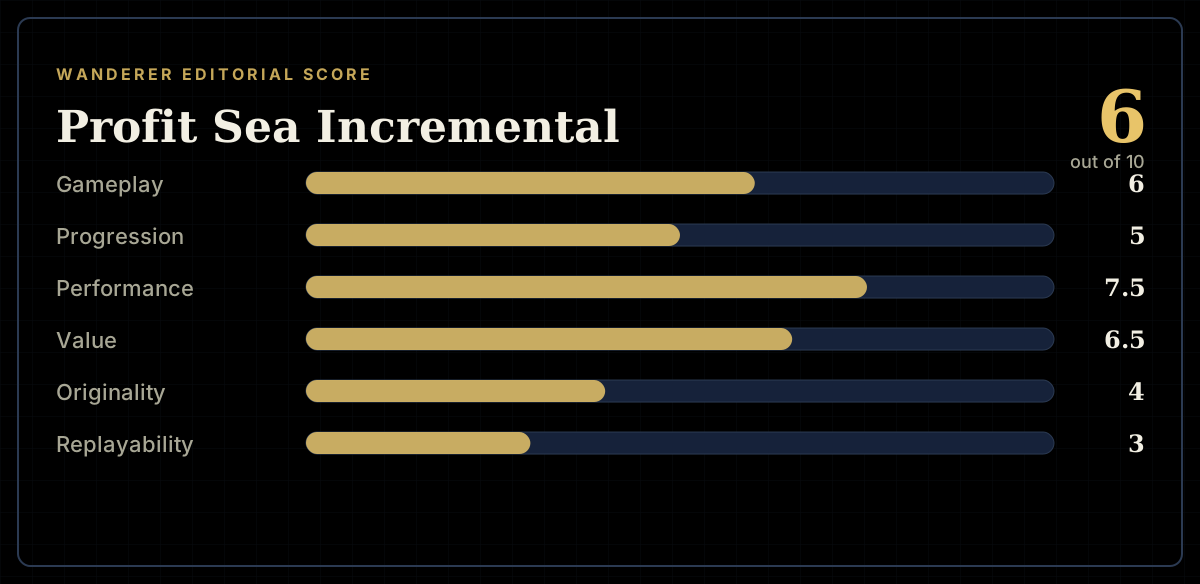
How the review scores each part of the gameWanderer Editorial -
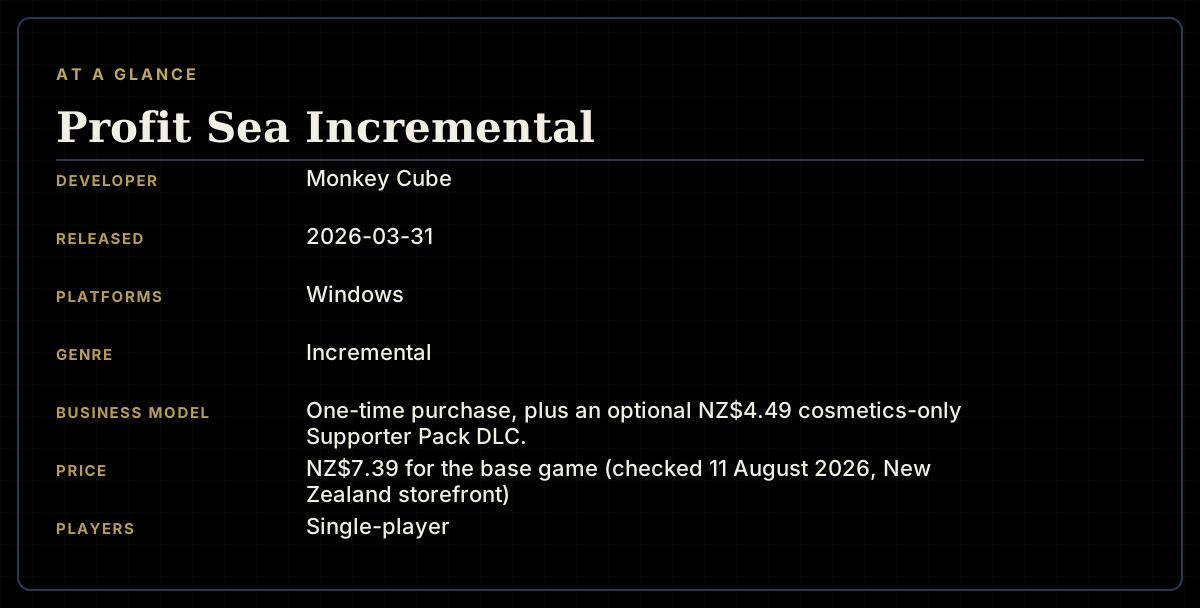
The game at a glanceWanderer Editorial -
The short versionWanderer Editorial