
Game review
Pizza Tower
8.5 / 10
- Developer
- Tour De Pizza
- Publisher
- Tour De Pizza
- Released
- 26 January 2023
- Platforms
- Windows
- Genre
- 2D Platformer
- Monetisation
- One-time premium purchase; no ads, DLC or in-game store found
- Players
- Single-player only; no online, co-op or PvP modes
The short version
Pizza Tower casts Peppino, an anxious Italian pizzeria owner, through a tower of increasingly frantic, momentum-driven levels built explicitly in the spirit of the long-dormant Wario Land series. Released after roughly five years of public demo iteration and community anticipation, it earned one of the most overwhelmingly positive receptions of any recent indie platformer, with reviewers consistently praising its distinctive 90s-cartoon art style, an outstanding soundtrack, and movement systems built specifically to reward mastery and speedrunning.
What's genuinely notable is how self-aware the small minority of negative reviews are: rather than disputing the game's quality, most explicitly frame their criticism as a personal mismatch with its relentless pace and demanding precision requirements, several going out of their way to say the near-universal acclaim is deserved even as they personally bounce off it. A smaller cluster of complaints concerns controller input precision and at least one specific, credible account of a Steam Deck save-sync issue.
Biggest strengths
- A distinctive, meticulously animated 90s-cartoon art style that reviewers consistently praise as one of the most stylistically ambitious indie platformers released in years
- An outstanding, widely-praised soundtrack that reviewers repeatedly cite among their favourites in recent memory across any genre
- Deep, momentum-driven movement mechanics explicitly built in the spirit of the Wario Land series, rewarding mastery and replayability through a robust scoring and rank system
Biggest weaknesses
- The relentless pace and precision demands are explicitly not for everyone, and a self-aware minority of reviewers who otherwise respect the game's craft report feeling stressed or overwhelmed rather than exhilarated by its speed
- Controller input precision draws specific complaints, including finicky analog-stick inputs and a comparatively sparse initial set of remappable actions, though a dedicated gamepad settings patch added custom bindings and deadzone sliders in response
- At least one specific, credible account describes a Steam Deck cloud save conflict wiping all PC progress when switching between platforms, a real risk this review can't confirm has been resolved
Who it's for: Fans of momentum-based platformers, Wario Land veterans specifically, and anyone drawn to score-attack, speedrun-friendly level design. Less suited to anyone who prefers a slower, methodical platforming pace or gets overwhelmed by fast-moving, high-stimulation visuals.
Our recommendation: An easy recommendation for platformer fans broadly and essential for anyone who misses Wario Land specifically — just know upfront that its speed and precision demands are the entire point, not an incidental difficulty spike.
8.5 / 10
Roughly five years of public demos, community anticipation and steadily building hype preceded Pizza Tower's January 2023 launch, and the reception that followed is about as close to frictionless as an indie release gets: an Overwhelmingly Positive rating across more than 72,000 reviews, with barely 2% landing negative. Cast as Peppino, an anxious small-business-owner pizzeria proprietor racing through a tower of increasingly chaotic levels, the game is built explicitly in the spirit of the long-dormant Wario Land series, and reviewers who grew up on that lineage consistently describe it as the spiritual successor they'd stopped hoping for.
That extended public development period is itself part of the story reviewers tell about the game. Years of iterative demos meant a substantial, invested community had already formed expectations long before release, and reviewers who followed that process describe the finished product as genuinely exceeding what years of demo footage had promised, rather than the more common outcome of a long-hyped indie release failing to live up to its own anticipation.
Craft that earns its acclaim
The praise clusters around a few consistent points. The 90s-cartoon-inspired art style draws essentially unanimous admiration, with reviewers describing an exceptional level of animation detail and stylistic ambition rare even among stylish indie platformers. The soundtrack draws equally strong, specific praise, with several reviewers ranking it among their favourites in any game they've played recently, genre notwithstanding. Underneath that presentation sits a genuinely deep momentum-based movement system, built to reward mastery through score-attack ranks and speedrunning rather than simple linear completion — reviewers who've beaten the game multiple times over describe continuing to discover new techniques and shortcuts well past their first clear. A specific, relatable story premise, following a small-business owner pushed to his limit by a bigger competitor, gives the game a surprising amount of character-driven heart that reviewers say elevates it past a typical wordless platformer plot.
An unusually self-aware minority
What stands out about the small share of negative reviews is how consistently self-aware they are. Rather than disputing the game's quality or craft, the large majority of critical reviews explicitly frame their complaint as a personal mismatch with the game's relentless pace, several going out of their way to affirm that the near-universal acclaim is deserved even as they personally found the speed and precision demands overwhelming or stressful rather than exhilarating. That's a genuinely useful signal for prospective buyers: this isn't a case of a polarizing game masked by review-bombing or unrepresentative outliers, but a case where a small, consistent minority accurately identifies exactly what kind of player the game isn't built for, without disputing what it does for everyone else.
Real, specific technical complaints
Separately from taste-based criticism, this review's research turned up a smaller cluster of concrete technical complaints. Controller precision draws specific pushback, with reviewers describing imprecise analog-stick inputs and a comparatively sparse initial set of remappable actions making fast, exact movement harder than intended on gamepad. To the developer's credit, a dedicated Gamepad Settings patch shipped within weeks of launch, adding custom button bindings, adjustable deadzone sliders, and the ability to separate superjump and groundpound inputs from the joystick specifically in response to this feedback. More seriously, at least one detailed, credible account describes a Steam Deck cloud save conflict that wiped all progress from a PC save when switching to Deck — a real, specific risk this review found no confirmed fix for in the public patch record, worth flagging plainly to anyone planning to play across both platforms.
What the achievement data confirms about difficulty
Global achievement figures back up the game's genuinely steep skill curve. The very first level's completion achievement sits at 83.4% of the playerbase, but that figure drops sharply as the tower's later floors introduce more demanding platforming — completion rates for levels several floors in fall into the 10-15% range, and some of the hardest late-game and secret-level achievements sit in the single digits. That's a real, substantial decline consistent with reviewer accounts that later floors ask considerably more of players than the earlier, more forgiving introduction suggests, and it reinforces that the "not for everyone" framing from the game's own critical minority reflects a genuine, measurable difficulty ramp rather than just first-level jitters.
Sustained free support beyond launch
Independent of any specific complaint, Pizza Tower's post-launch record reflects a developer genuinely still invested in the project well past its initial release. Official Steam Deck Verified status was confirmed within about six weeks of launch, alongside dozens of incremental patches addressing crashes, softlocks and achievement-tracking bugs throughout 2023. Over a year after release, a substantial free content update — The Noise Update — added a new playable character with a distinct moveset to the game's post-campaign content, a genuinely rare commitment for a linear single-player platformer that could easily have been considered commercially complete at launch. That continued investment is worth weighing alongside the specific technical complaints above: this is a developer that has kept responding to feedback rather than treating the initial release as the finished product.
Where it lands
Pizza Tower earns its extraordinary reception through genuine craft across art, music and movement design, built by a small team clearly working from deep, specific love for a dormant genre lineage. The rare negative reviews are unusually honest about being a matter of personal fit rather than a quality dispute, and the concrete technical complaints — controller precision and a documented Steam Deck save risk — are real but narrow enough not to undercut the broader recommendation. For fans of momentum platforming generally, and Wario Land veterans specifically, this is an essential, extremely easy recommendation.
Pros and cons
Pros
- A distinctive, meticulously animated 90s-cartoon art style that reviewers consistently praise as one of the most stylistically ambitious indie platformers released in years
- An outstanding, widely-praised soundtrack that reviewers repeatedly cite among their favourites in recent memory across any genre
- Deep, momentum-driven movement mechanics explicitly built in the spirit of the Wario Land series, rewarding mastery and replayability through a robust scoring and rank system
- A genuinely funny, character-driven story built around a specific, relatable small-business anxiety premise that reviewers say elevates it well past a typical wordless platformer plot
- Sustained free post-launch content, including a large character-focused update roughly a year after launch, alongside dozens of bug-fix and quality-of-life patches
Cons
- The relentless pace and precision demands are explicitly not for everyone, and a self-aware minority of reviewers who otherwise respect the game's craft report feeling stressed or overwhelmed rather than exhilarated by its speed
- Controller input precision draws specific complaints, including finicky analog-stick inputs and a comparatively sparse initial set of remappable actions, though a dedicated gamepad settings patch added custom bindings and deadzone sliders in response
- At least one specific, credible account describes a Steam Deck cloud save conflict wiping all PC progress when switching between platforms, a real risk this review can't confirm has been resolved
- Achievement data confirms a genuinely steep difficulty curve, with completion rates for later floors dropping into the single digits, reflecting real demands on player skill beyond the early, more forgiving levels
- As a single-player-only experience with no story branching, its appeal narrows sharply for anyone not specifically drawn to score-attack replayability once the main campaign is finished
Screenshots
-

Pizza TowerImage: Tour De Pizza via Steam -

Pizza TowerImage: Tour De Pizza via Steam -

Pizza TowerImage: Tour De Pizza via Steam -
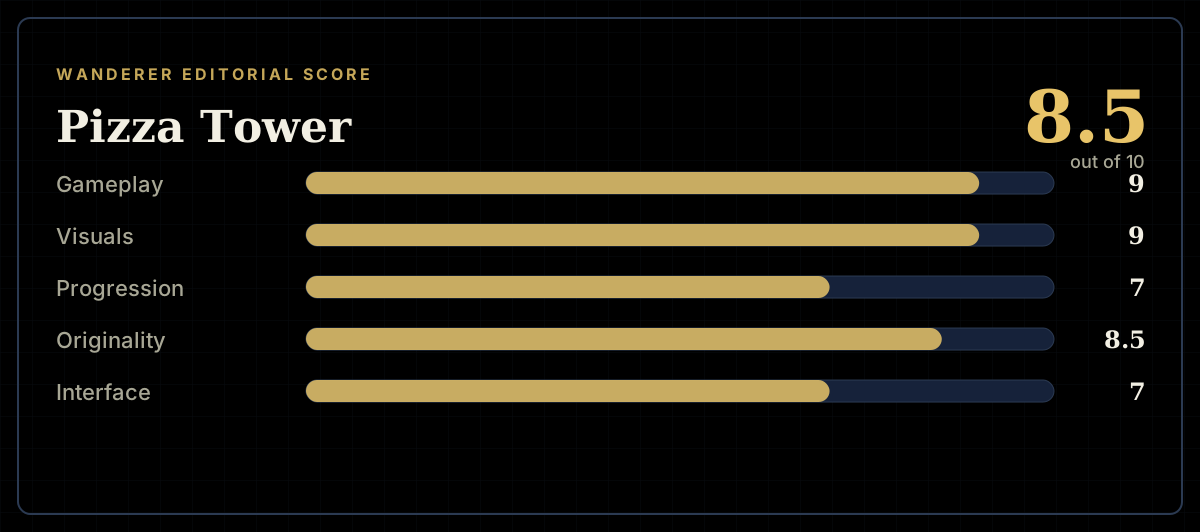
How the review scores each part of the gameWanderer Editorial -
The short versionWanderer Editorial