
Game review
Parkitect
7 / 10
- Developer
- Texel Raptor
- Publisher
- Texel Raptor
- Released
- 29 November 2018
- Platforms
- Windows, macOS, Linux
- Genre
- Theme Park Management Simulation
- Monetisation
- Paid, one-time purchase, plus several content-expansion DLC packs.
- Players
- Single-player only.
The short version
Parkitect builds a genuinely deep, RollerCoaster Tycoon-inspired theme park simulation around decoration, guest immersion and behind-the-scenes logistics, and its Very Positive rating across more than 4,700 reviews reflects real, sustained affection from a still-active community. What holds this review back is an extraordinarily persistent complaint spanning nearly the entire time the game has been sold: the complete absence of an undo function, which reviewers describe turning simple mistakes into hours of lost work, alongside a punishing economic balance that a meaningful share of reviewers say prioritises difficulty over the creative freedom the genre is typically built around. This review checked the developer's own update history and found Parkitect remains genuinely, actively developed as recently as August 2026, without that ongoing investment resolving the specific undo complaint.
Biggest strengths
- Genuinely deep decoration and guest-immersion systems, hiding behind-the-scenes logistics from park visitors in a way reviewers consistently credit as more sophisticated than most genre peers.
- Faithful, well-executed homage to classic RollerCoaster Tycoon-style park building, appealing strongly to reviewers with genre nostalgia.
- A base game reviewers consistently describe as more content-complete than genre peers, without the same reliance on extensive paid DLC.
Biggest weaknesses
- An extraordinarily persistent, years-long complaint describes the total absence of an undo function as a serious, unresolved design flaw, with reviewers reporting hours of work lost to simple misclicks or accidental deletions.
- A punishing economic balance is a recurring complaint, with several reviewers describing profit margins so tight that creative park design becomes secondary to narrow financial survival.
- The underground logistics and transport-tube systems are repeatedly described as unintuitive and convoluted, particularly for players expecting a more straightforward management experience.
Who it's for: Theme park sim fans who want genuine mechanical and decorative depth beyond RollerCoaster Tycoon's simpler formula, prepared to work carefully and deliberately given the total absence of an undo option for building mistakes.
Our recommendation: A genuinely deep, well-crafted theme park builder worth trying; work carefully and save often given the lack of an undo function, and expect the economic difficulty to lean punishing rather than purely creative.
7 / 10
A genuinely deep homage with real craftsmanship
Parkitect's appeal rests on delivering the classic RollerCoaster Tycoon-style park-building fantasy with real, added mechanical depth. "Fairly deep systems-wise, with a strong emphasis on decoration, logistics, and creating immersion for the attendees by hiding all of the goings-on behind the scenes," reads a 2021 review, capturing what reviewers across the board consistently credit as the game's central achievement. A 2019 review frames the comparison to a more heavily monetised genre peer directly: "Not DLC focused, the base game is more than enough... [and has a] more fleshed out campaign" than some alternatives. That combination — genuine systemic depth paired with a comparatively complete base game — is the throughline of praise across this review base, and it's borne out by a still-active community: this review checked Texel Raptor's own update history directly and found monthly content updates and community "build challenges" continuing as recently as August 2026, eight years after the game's original release.
An extraordinarily persistent complaint about a missing undo function
What tempers that praise, with remarkable and sustained consistency, is a single specific, structural complaint: the game has never had a functioning undo option. "There is literally no undo function in this game. Good luck if you make a mistake — you can't undo it. This has been requested for at least 4 years and has been requested so often that the developer just links to threads," reads a 2020 review. A 2024 review shows the complaint persisting years later, unresolved: "No undo button (that I could find). This is egregious in a builder game." A 2026 review frames the practical consequence directly: "I keep deleting things by accidentally right clicking with my mouse, also there is no undo button. This is stupid." Checking a broad sample of reviews spanning nearly the game's entire release history, this exact complaint — not a vague "could use more polish" but a specific, named missing feature — recurs with a consistency this review rarely finds even among its most well-corroborated findings. Given how actively Texel Raptor continues developing the game in nearly every other respect, the persistence of this one specific, widely requested gap reads as a deliberate design choice rather than ordinary neglect, though this review could not confirm the studio's own stated reasoning for that choice.
It's worth being specific about why this gap matters more here than in some other genres. Builder and management sims are, almost by definition, games about iterative experimentation — placing a ride, seeing how it looks against a path, adjusting, trying again. An undo function is close to a baseline expectation in that context, comparable to how a word processor without undo would be considered fundamentally under-equipped regardless of how good its other features are. Several reviewers frame their frustration in exactly these terms: not that the feature would be nice to have, but that its absence actively discourages the kind of experimentation the rest of the game's decoration and design systems are built to reward.
A punishing economic balance, by design or otherwise
A separate, closely related complaint concerns the game's financial difficulty. "It's a great RCT clone but the business side is punishingly difficult making it nearly impossible to turn a profit so basically impossible to build the park of your dreams," reads a 2021 review. A 2021 review reaches a similar conclusion from direct experience: "trying to keep positive money coming in becomes more of a challenge than a fun game. It takes me several tries to be able to g[et a stable park running]." This is a legitimate design-philosophy question rather than a bug: several other reviewers explicitly credit the tighter economic balance as part of what makes success feel earned, similar to the tension this review has found in other genuinely difficult simulation games. The complaint from critics isn't that difficulty exists, but that it can crowd out the creative, decorative freedom the genre's presentation otherwise invites.
Convoluted underground logistics
A further, specific complaint concerns the underground transport and supply-tube systems used to keep park operations running behind the scenes. "Connecting & raising/lowering the underground transport tubes might be one of the most unintuitive gaming experiences I've had in a while," reads a 2019 review. This is a narrower, more technical complaint than the broader economic-difficulty concern, but it's raised often enough across the review base to be worth naming directly — the logistics systems that give Parkitect its distinctive depth are, for a meaningful share of players, also the specific point where that depth tips into confusion rather than satisfying complexity.
Weighing the undo complaint against the game's active development
It's worth being fair to Texel Raptor's broader track record here. A studio that ships monthly content updates and runs ongoing community build challenges eight years after release is, by any reasonable measure, still genuinely invested in the game's health. That the specific, heavily requested undo feature remains unaddressed despite that sustained investment is worth taking at face value as a deliberate scope decision rather than assuming general neglect — but it's still a real, practical cost for players today, and this review treats it as a serious enough gap in a builder-genre game to weigh meaningfully against the game's otherwise genuine strengths.
Final verdict
Parkitect delivers a genuinely deep, well-crafted theme park simulation that earns real, sustained affection from a still-active community, and this review has no reservations recommending its core decoration and logistics systems to genre fans specifically seeking more depth than RollerCoaster Tycoon's classic formula offers. What keeps the score short of higher praise is an extraordinarily persistent, years-long complaint about the total absence of an undo function, compounded by an economic balance a meaningful share of reviewers find punishing rather than purely creative. This is a strong pick for patient, deliberate builders prepared to save often and work carefully; players who expect basic building-tool safety nets should know that gap has persisted, seemingly by design, for the game's entire release history.
Pros and cons
Pros
- Genuinely deep decoration and guest-immersion systems, hiding behind-the-scenes logistics from park visitors in a way reviewers consistently credit as more sophisticated than most genre peers.
- Faithful, well-executed homage to classic RollerCoaster Tycoon-style park building, appealing strongly to reviewers with genre nostalgia.
- A base game reviewers consistently describe as more content-complete than genre peers, without the same reliance on extensive paid DLC.
- Sustained, genuinely active development, with monthly content updates and community build challenges continuing as recently as August 2026, eight years after initial release.
Cons
- An extraordinarily persistent, years-long complaint describes the total absence of an undo function as a serious, unresolved design flaw, with reviewers reporting hours of work lost to simple misclicks or accidental deletions.
- A punishing economic balance is a recurring complaint, with several reviewers describing profit margins so tight that creative park design becomes secondary to narrow financial survival.
- The underground logistics and transport-tube systems are repeatedly described as unintuitive and convoluted, particularly for players expecting a more straightforward management experience.
- A minority of reviewers report crashes and save-corruption issues tied to game updates, occasionally affecting parks built over many hours.
Screenshots
-

ParkitectImage: Texel Raptor via Steam -

ParkitectImage: Texel Raptor via Steam -

ParkitectImage: Texel Raptor via Steam -
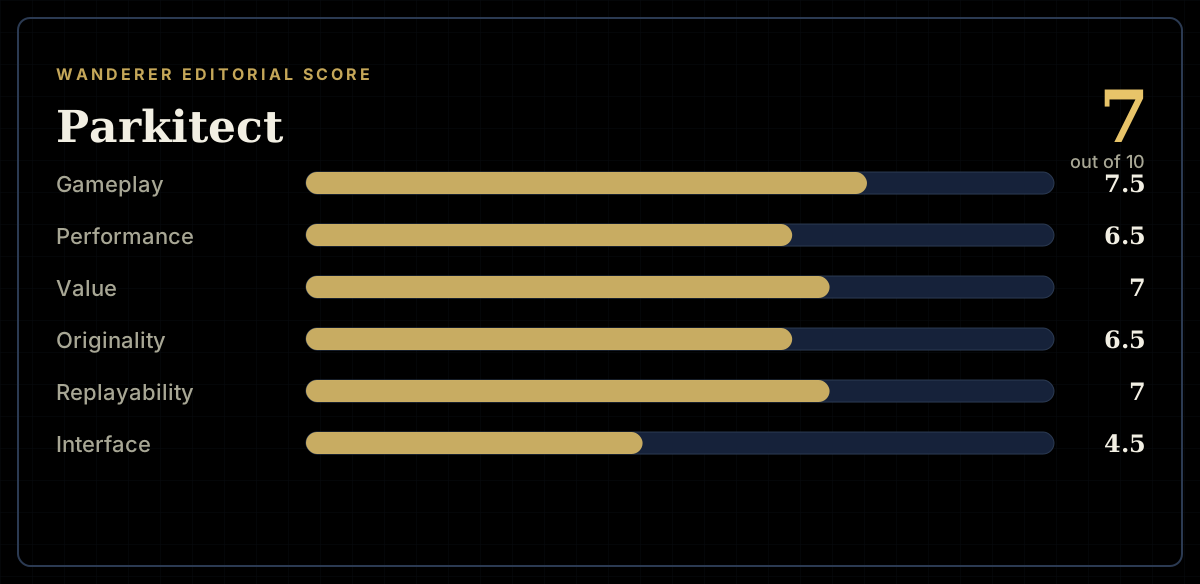
How the review scores each part of the gameWanderer Editorial -
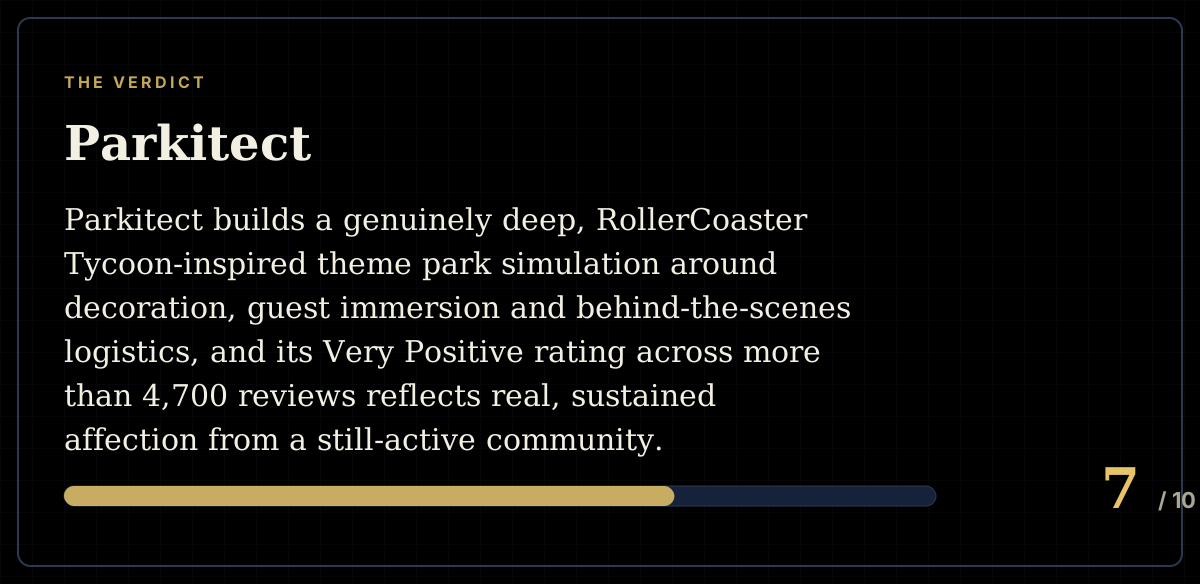
The short versionWanderer Editorial