
Game review
Parking Garage Rally Circuit
7 / 10
- Developer
- Walaber Entertainment LLC
- Publisher
- Walaber Entertainment LLC
- Released
- 20 September 2024
- Platforms
- Windows, macOS, Linux
- Genre
- Retro arcade rally racer
- Monetisation
- One-time purchase, with one paid track-pack DLC expansion released later
- Players
- Local split-screen and online leaderboards
The short version
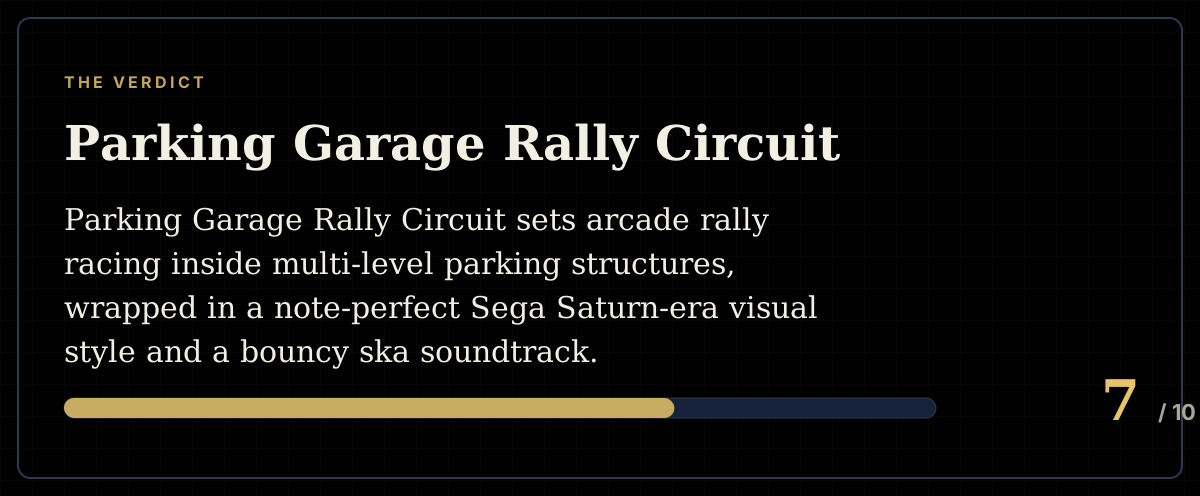
Parking Garage Rally Circuit sets arcade rally racing inside multi-level parking structures, wrapped in a note-perfect Sega Saturn-era visual style and a bouncy ska soundtrack. This review's sample confirms the presentation and core drifting feel earn near-universal, specific admiration, but an unusually consistent negative-review theme describes the same frustration in near-identical terms across dozens of reviewers: a physics system that punishes the very high-speed play the game is built around, sending cars flipping or flying off-track from small mistakes. A thin initial roster of tracks and cars was a real complaint at launch, one the developer has since worked to address through custom-track support and a paid expansion.
Biggest strengths
- The Sega Saturn-styled visual presentation earns extraordinary, specific praise, with reviewers repeatedly describing it as authentic enough to mistake for a genuine 90s release
- The core drifting and boost-chaining mechanics are consistently singled out as the best the genre has to offer, with multiple reviewers directly comparing the feel favourably to Sega Rally and Mario Kart
- The soundtrack, built around third-wave ska, earns repeated, specific, enthusiastic praise as a perfect tonal match for the game's throwback identity
Biggest weaknesses
- An unusually consistent, specific, and widely repeated negative-review theme describes the physics as punishing exactly the high-speed play the game encourages, with dozens of independent reviewers describing cars flipping, climbing walls, or flying off-track from small mistakes at ramps and jumps
- Multiple reviewers specifically identify ramps as the game's worst offender, describing a need to actively slow down and drift through jumps rather than the boost-fuelled high-speed play the core loop otherwise rewards
- Several reviewers report the launch version offered a genuinely thin amount of content, with as few as eight tracks and three vehicle weight classes completable to full gold-medal standard in well under an hour
Who it's for: Fans of 90s arcade racers like Sega Rally and Ridge Racer looking for a lovingly authentic, short-session throwback, and players specifically drawn to a demanding, high-precision drift system; not a fit for players wanting forgiving, casual-friendly arcade handling.
Our recommendation: A worthwhile purchase for arcade-racing fans specifically, especially now that custom tracks and a paid expansion have addressed the original content-thinness complaint, provided you go in expecting a punishing, high-precision physics model rather than a forgiving one.
7 / 10
Parking Garage Rally Circuit takes the arcade rally formula that defined 90s racers like Sega Rally and sets it inside multi-level parking structures, wrapped in a note-perfect Sega Saturn-era visual style and a bouncy ska soundtrack. This review's sample confirms that presentation is a genuine triumph — and identifies an unusually consistent, specific complaint about exactly what happens when players try to play the way the game seems to want them to.
A presentation reviewers can barely believe is new
The praise for how faithfully this game recreates its era is remarkable in its consistency. "I will state upfront that this game is aesthetically perfect. If you put this on a CRT with the Sega Saturn-style graphics, you would not be able to tell that it was a PC game from 2024," one reviewer writes. Another simply states: "Imagine you're back in 1995 and you're having fun. If you want that feeling again, just play this game. It's classic 90s arcade racing with a great ska soundtrack." A third reviewer credits the drifting itself as best-in-class: "The feel of the drifting and the boost system is probably the best drift system I've ever played with." That combination of visual authenticity and genuinely well-tuned core mechanics is the clearest, most repeated strength across this review's sample.
A remarkably consistent complaint about ramps and physics
Set against that praise, this review's negative sample raises the same specific complaint over and over, often in nearly identical language. "An arcade racing game should have fun ramps you want to hit fast for rewards. Ramps in this game 70% of the time will make you roll over or hit a ceiling and lose all speed," one reviewer writes. Another frames the contradiction precisely: "Why would you make the gameplay all about being as precise as possible, but then give the physics engine manic depression? ... most stages are designed to kill you for going too fast." A third reviewer offers a detailed diagnosis: "it's not the drift handling that's the problem, because that's one of the things that the game, for the most part, nails. It's what the game does when it's no[t on the ground]." That level of specific, mechanically detailed agreement across dozens of otherwise unconnected reviewers is unusually strong evidence this reflects a genuine, structural tuning issue rather than scattered individual frustration.
A genuine, acknowledged content gap at launch
Several reviewers separately raise a distinct complaint about how much content the game shipped with. "The game is extremely short - You can get all Gold cups in about 30 minutes... That means that you can see basically all that this game has to offer in under an hour," one reviewer reports. Another specifically requests more: "8 tracks with 3 cars is pitiful." This review's own check of Steam's achievement data supports a picture consistent with those complaints for basic completion, even though full gold-medal mastery of every track remains considerably rarer.
Neither complaint went unanswered
Steam's own partner-events feed shows the developer directly responded to the content-thinness concern over time, with Workshop custom-track support and online leaderboards added within months of launch, split-screen multiplayer following soon after, and a paid "European Tour" track-pack expansion released in April 2026 — roughly a year and a half after the original launch. That's a genuine, substantive answer to the exact complaint reviewers raised, even if it arrived well after the initial wave of reviews that first flagged the gap. This review found no equivalent confirmation that the ramp/physics complaints were substantially reworked in any specific patch, though several numbered updates and bug-fix posts appear throughout the same period.
A split on how much the jank matters
Not every reviewer treats the physics issue as a dealbreaker, and it's worth naming that split directly. "It's fun at times if you can withstand losing the majority of runs to jank," one reviewer writes, framing the frustration as tolerable given the game's other strengths. Another reviewer with over 19,000 minutes logged goes further, reframing the complaint as an eventual strength: "The car goes so freaking fast it's really hard to control, but the game is still good as you accidentally kickflip your car around the map... the game gets SO much better once you've put the time in and you're purposefully kickflipping your car around the map." That suggests the physics complaint, while widely and specifically reported, may soften into something more like a demanding skill ceiling for players willing to invest the time to master it.
Multiplayer and platform support as a real strength
Beyond the single-player content debate, several reviewers specifically praise the game's cross-platform reach and multiplayer options. "Multiplayer works fine. Runs perfectly on Steam Deck," one reviewer confirms, while another highlights the toolchain behind it approvingly: "Using open source tools like Blender and Godot and even including a flawless native Linux port is extremely based." That combination of local split-screen support, solid Steam Deck compatibility, and genuine Linux support is a real, practical point in the game's favour distinct from the ongoing physics and content debates, and worth noting for buyers specifically weighing platform flexibility.
Final verdict
Parking Garage Rally Circuit succeeds spectacularly at recreating a beloved arcade-racing era, and this review's sample confirms its presentation and core drifting feel earn some of the most consistent, enthusiastic praise available in the genre. But an unusually consistent, specific negative-review theme describes a genuine tuning problem with ramps and airtime physics that undercuts the very high-speed play the game encourages, and the launch-era content roster was thin enough to draw real, repeated complaint. The developer's confirmed follow-through with custom tracks, multiplayer, and a paid expansion makes this a considerably stronger purchase today than it was at launch, and arcade-racing fans willing to master a demanding physics model should find real, lasting fun here.
Pros and cons
Pros
- The Sega Saturn-styled visual presentation earns extraordinary, specific praise, with reviewers repeatedly describing it as authentic enough to mistake for a genuine 90s release
- The core drifting and boost-chaining mechanics are consistently singled out as the best the genre has to offer, with multiple reviewers directly comparing the feel favourably to Sega Rally and Mario Kart
- The soundtrack, built around third-wave ska, earns repeated, specific, enthusiastic praise as a perfect tonal match for the game's throwback identity
- Steam's own partner-events feed confirms the developer directly addressed the launch-era "not enough content" complaint, adding Workshop custom-track support, split-screen multiplayer, and eventually a paid "European Tour" track-pack expansion
- The game is confirmed to run well on Steam Deck and includes a native Linux port, both specifically praised by multiple reviewers
Cons
- An unusually consistent, specific, and widely repeated negative-review theme describes the physics as punishing exactly the high-speed play the game encourages, with dozens of independent reviewers describing cars flipping, climbing walls, or flying off-track from small mistakes at ramps and jumps
- Multiple reviewers specifically identify ramps as the game's worst offender, describing a need to actively slow down and drift through jumps rather than the boost-fuelled high-speed play the core loop otherwise rewards
- Several reviewers report the launch version offered a genuinely thin amount of content, with as few as eight tracks and three vehicle weight classes completable to full gold-medal standard in well under an hour
- At least one detailed reviewer describes the physics engine as specifically inconsistent once players push speed limits, arguing the drift-handling itself is well-tuned while everything involving airtime or collision feels comparatively unpolished
- A smaller number of reviewers found the audio less impactful than expected relative to the visual presentation, describing the music as pleasant but repetitive over extended play
Screenshots
-

Parking Garage Rally CircuitImage: Walaber Entertainment LLC via Steam -

Parking Garage Rally CircuitImage: Walaber Entertainment LLC via Steam -

Parking Garage Rally CircuitImage: Walaber Entertainment LLC via Steam -
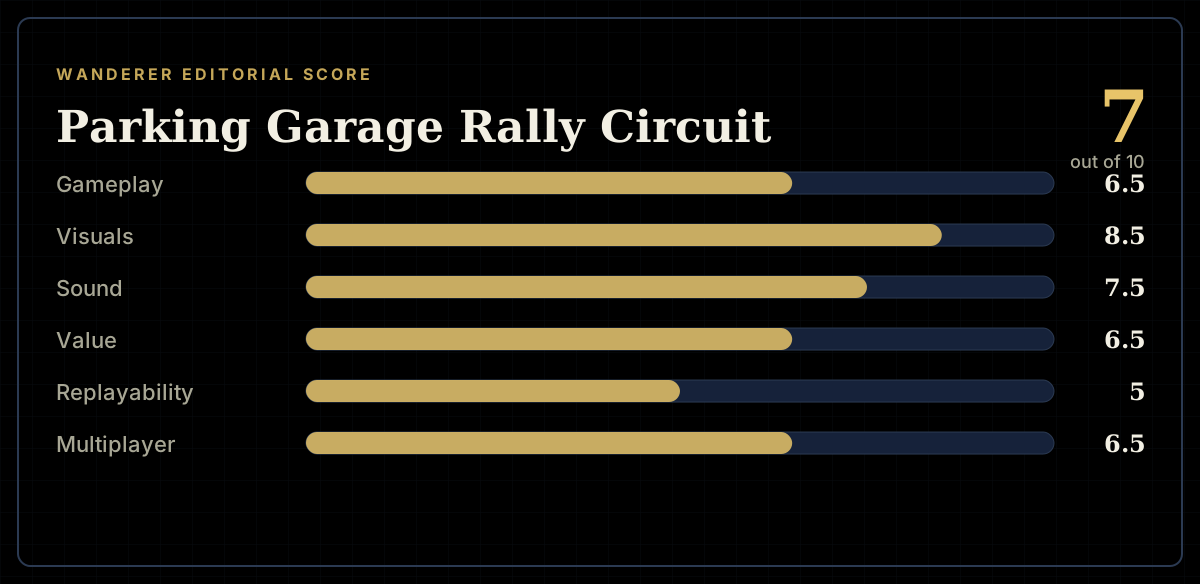
How the review scores each part of the gameWanderer Editorial -
The short versionWanderer Editorial