
Game review
ONE PIECE World Seeker
6 / 10
- Developer
- GANBARION Co., Ltd.
- Publisher
- BANDAI NAMCO Entertainment
- Released
- 14 March 2019
- Platforms
- Windows
- Genre
- Action
- Monetisation
- Paid, with 6 DLC items including an Episode Pass
- Players
- false
The short version
ONE PIECE World Seeker sends Luffy across Prison Island using his signature stretching powers for genuinely enjoyable, Spider-Man-adjacent traversal through a colourful open world. That movement system draws close to universal praise, but the combat built around it splits reviewers sharply down the middle — one detailed camp calls it inordinately bad and clunky, an equally confident camp calls it solid and satisfying — while side content on both sides of that divide is consistently described as thin, generic filler around a main story fans call decent but casual critics call a wild goose chase.
Biggest strengths
- Genuinely fun, Spider-Man-style traversal using Luffy's stretching powers to swing and leap across a stylised, colourful open world, drawing close to universal praise across the review corpus
- Strong, consistently well-received visual presentation and art direction faithful to the source material
- A real sense of playing through "a One Piece arc" for fans of the anime and manga, with familiar Straw Hat crew dialogue and character dynamics
Biggest weaknesses
- A genuinely unresolved split over combat quality: detailed critics describe Luffy as "very slow and clunky," citing a gunfire-stagger mechanic that locks the player out of action, while equally detailed defenders call the same combat "solid and satisfying"
- Side quests and open-world activities are repeatedly described as generic filler — "beat five enemies and that's it" — even by reviewers who otherwise recommend the game
- The main story is called "bite-sized" and a "wild goose chase" by several reviewers, seen as thin scaffolding for the open-world exploration rather than a substantial narrative in its own right
Who it's for: One Piece fans specifically, who are more likely to forgive generic side content and divisive combat for the chance to explore a well-realized version of the source material's world.
Our recommendation: Only worth it at a steep discount, and mainly for committed franchise fans — several detailed reviewers make exactly this calculation explicitly.
6 / 10
What it is
ONE PIECE World Seeker marks the franchise's first open-world entry, putting players in control of Monkey D. Luffy as he explores Prison Island, using his signature Gum-Gum stretching powers both in combat and for traversal — grabbing distant ledges, launching across gaps, and covering ground in a way multiple reviewers directly compare to Spider-Man's web-swinging. Developed by Ganbarion and published by Bandai Namco, it released on 14 March 2019 with a list price of NZD 83.95, backed by six DLC add-ons including a season-pass-style Episode Pass offering additional story content and, per several reviewer accounts, a playable version of fan-favourite character Trafalgar Law.
Its review corpus of 2,159 English-language reviews sits at a solid Mostly Positive 78.8% (1,701 to 458), and reading through it in depth reveals a game whose reception splits cleanly along specific, identifiable lines rather than settling into vague general satisfaction or dissatisfaction.
Movement that nearly everyone agrees on
The traversal system draws consistently enthusiastic praise regardless of how a given reviewer feels about the rest of the game. "Movement is really fun and smooth," writes one reviewer in an otherwise brief assessment; another specifically frames exploring the island "with your power" as the clearest highlight of the whole experience. The open world itself earns real credit for scale calibrated to what it needs to do — "the Open World is big enough for exploration to be engaging but not overwhelming," writes one reviewer who finished the story on Extreme difficulty and all DLC on Very Hard, suggesting the environment design holds up even for players pushing well past a casual first playthrough.
The combat divide
Where this corpus genuinely splits is combat quality, and both sides argue their position with real specificity rather than vague preference. The most detailed critical review opens by calling the combat "inordinately bad," cataloguing specific complaints: Luffy feels "very slow and clunky," and getting shot triggers a stagger animation that "prevents you from doing anything" — a serious complaint about basic responsiveness in an action game's core system. A separate detailed critique independently agrees combat is "uninteresting even with upgrades," despite finding the exploration itself worthwhile. Set against that, an equally confident, equally detailed camp reaches the opposite conclusion: "combat is very solid and satisfying," writes one reviewer specifically pairing that verdict with high praise for movement; another calls it "easy but fun." That's not a case of one side being clearly right — it's a genuine, unresolved disagreement about fundamental feel that a prospective buyer should weigh by trying the game directly (or watching detailed gameplay footage) rather than trusting either camp's characterization alone.
Thin content around a divisive core
Independent of the combat debate, reviewers on both sides converge on a shared complaint about content depth. Side quests are repeatedly described in nearly identical terms across different reviews: "most side quests are fetch quests or is just beat five enemies and that's it," writes one otherwise positive reviewer. The main story draws similar treatment — "bite-sized," "a wild goose chase" — from reviewers less invested in the source material, though committed franchise fans describe the same story as "decent" and "pretty satisfying," suggesting familiarity with the wider One Piece universe meaningfully changes how forgiving a player is likely to be of a comparatively slight main narrative.
A specific, detailed value warning
One especially thorough review lays out a direct purchasing calculation worth repeating in full: "get it if under $20/€20 AND you're a big One Piece fan, and are fairly up to date. Otherwise, not worth it right now," rating the game "6/10, but if it wasn't One Piece related, it'd be a 4/10." That's an unusually candid, self-aware piece of guidance — a reviewer explicitly separating their fondness for the license from their assessment of the game's standalone quality, and it's a useful frame for anyone without strong existing attachment to the source material deciding whether to buy in.
What the achievement data suggests about the combat debate
The completion curve across World Seeker's 63 achievements offers an indirect but useful data point for weighing the combat dispute above. Early achievements sit in a healthy 37-74% range, and the game's harder challenge achievements — including several tied to completing content on higher difficulties — drop to a still-reachable 1.6-1.8%, rather than collapsing to the near-zero levels this lane has documented in some other divisive action games. That's a meaningfully gentler late-game cliff than titles where a genuinely broken core system drives mass abandonment, and it's consistent with several detailed reviewers documenting full 100% completions on Extreme difficulty — a sustained, voluntary engagement with the hardest available combat encounters that would be difficult to reconcile with a combat system as fundamentally "inordinately bad" as its harshest critics describe. That doesn't resolve the debate outright, since a small, dedicated minority of committed genre fans could plausibly push through disliked combat purely for franchise loyalty — but it's a real, checkable data point suggesting the combat, whatever its flaws, doesn't uniformly repel sustained play the way the most severe negative reviews might imply.
Weighing the DLC structure directly
It's worth being specific about what the season-pass-style Episode Pass actually adds, since "cash grab" is a strong characterization worth grounding in detail rather than repeating uncritically. Reviewers describe the Episode Pass content as extending the story with additional playable characters (Trafalgar Law specifically drawing repeated, enthusiastic mention) and extra narrative episodes rather than gating core gameplay systems behind a paywall. That's a meaningfully different, less severe pattern than titles in this lane whose DLC withholds core content or currency needed for basic progression — the complaint here is more about the base game's premium list price relative to its content volume than about the DLC structure actively degrading the base experience. Buyers specifically motivated by the Law content or additional story episodes should weigh that DLC on its own merits rather than assuming it's a cynical afterthought, while buyers uninterested in extra content can reasonably treat the base game and its price tag as the primary purchasing decision.
Verdict
ONE PIECE World Seeker delivers genuinely satisfying open-world traversal and a faithful, well- realized take on its source material's world, wrapped around combat its own dedicated audience can't agree is a strength or a serious flaw, and side content that reviewers on both sides describe as thin filler. Worth it specifically for committed One Piece fans prepared to look past generic quest design and a divisive combat system, and best bought at a steep discount rather than anywhere near its original asking price.
Pros and cons
Pros
- Genuinely fun, Spider-Man-style traversal using Luffy's stretching powers to swing and leap across a stylised, colourful open world, drawing close to universal praise across the review corpus
- Strong, consistently well-received visual presentation and art direction faithful to the source material
- A real sense of playing through "a One Piece arc" for fans of the anime and manga, with familiar Straw Hat crew dialogue and character dynamics
- Meaningful difficulty options and post-game content, with several reviewers documenting full completion runs on Extreme difficulty including all DLC episodes
Cons
- A genuinely unresolved split over combat quality: detailed critics describe Luffy as "very slow and clunky," citing a gunfire-stagger mechanic that locks the player out of action, while equally detailed defenders call the same combat "solid and satisfying"
- Side quests and open-world activities are repeatedly described as generic filler — "beat five enemies and that's it" — even by reviewers who otherwise recommend the game
- The main story is called "bite-sized" and a "wild goose chase" by several reviewers, seen as thin scaffolding for the open-world exploration rather than a substantial narrative in its own right
- A specific, detailed value complaint frames the game as a "cashgrab" at its full Deluxe pricing, given a season-pass-style Episode Pass DLC structure, with even a generally positive reviewer estimating it would rate meaningfully lower if it weren't licensed One Piece content
- No ability to freely switch between different Straw Hat crew members in the base campaign, a specific, repeated wish among reviewers who wanted more variety than playing exclusively as Luffy
Screenshots
-

ONE PIECE World SeekerImage: BANDAI NAMCO Entertainment via Steam -

ONE PIECE World SeekerImage: BANDAI NAMCO Entertainment via Steam -

ONE PIECE World SeekerImage: BANDAI NAMCO Entertainment via Steam -
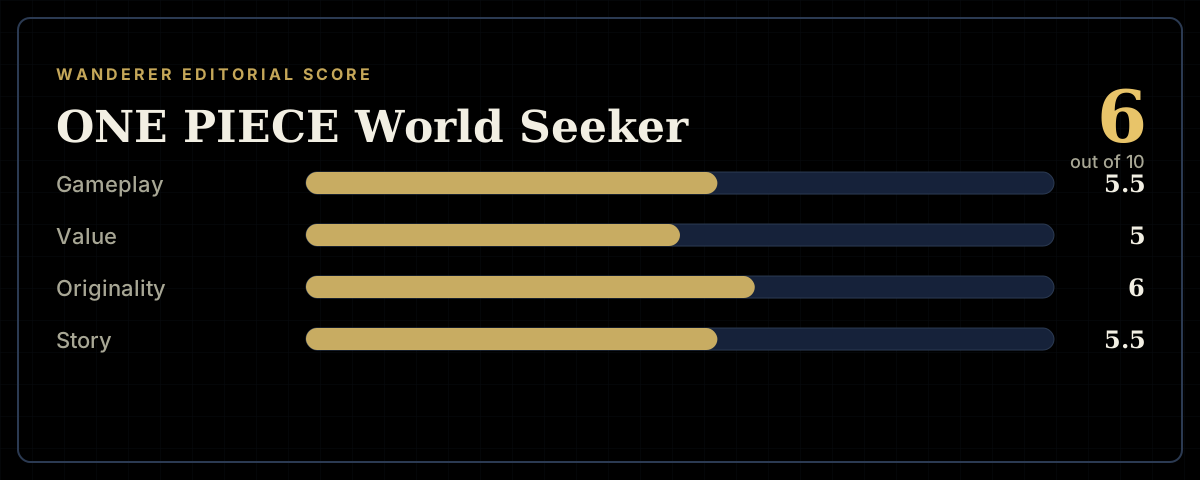
How the review scores each part of the gameWanderer Editorial -

The short versionWanderer Editorial