Game review
Oasis Mission: Colony Sim
5.5 / 10
- Developer
- Lunar pug studio
- Publisher
- Lunar pug studio
- Released
- 10 March 2025
- Platforms
- Windows, macOS
- Genre
- Colony Sim
- Monetisation
- Premium, one-time purchase
- Players
- Single-player
The short version
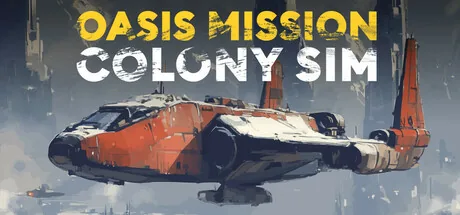
Oasis Mission: Colony Sim has a genuinely distinctive pitch — a colony builder where the workhorses are modular, self-directing ships and the endgame threat is a spreading machine infection that hijacks your own automation against you. That idea is sound, the sci-fi poster art is properly attractive, and a long Early Access run visibly sanded off a lot of the game's rough edges before it hit 1.0 in March 2025.
What it hasn't shaken is the shape of an Early Access project that stopped mid-sentence: a linear tech tree, an economy that stays shallow past the opening hours, ship AI that a chunk of reviewers still describe as unreliable, and — as of this review — no visible content update in a year, with the solo developer's own news feed now promoting a different game entirely.
Biggest strengths
- A genuinely distinctive hook — modular, self-tasking ships that mine, trade, build and fight are the actual protagonists, not just a logistics afterthought
- Clean, distinctive sci-fi poster art and a UI several reviewers single out for good typography and readability
- The Oblivion machine-infection threat gives the back half of a run real tension instead of a generic wave-defence bolt-on
Biggest weaknesses
- The developer's own Steam news feed shows no Oasis Mission update since August 2025, and that post was announcing a different, unrelated game to bundle alongside it
- Multiple 2025-2026 reviews report unresolved bugs, ships ignoring logistics orders, and buildings starved of resources sitting in full warehouses
- The tech tree is widely described as a straight line of incremental upgrades rather than branching choices, and the economy that feels promising for the first few hours stays thin across a full run
Who it's for: Colony-sim fans who want something with a real sci-fi hook and don't mind that development has visibly stalled, and who are buying for what's on disk today rather than a roadmap.
Our recommendation: Worth a look on sale for genre fans curious about the ship-automation angle; go in expecting a finished-feeling but thin 1.0, not a game still being actively built.
5.5 / 10
Introduction
Oasis Mission: Colony Sim spent roughly two and a half years in Early Access — reviews on its Steam page date back to mid-2024 and reference build numbers as early as 0.7 — before Lunar pug studio, a solo Polish developer working under the name Piocan, pushed the "0.99.0 Almost Full Release" update on 4 March 2025 and the official 1.0 launch six days later, on 10 March 2025. The pitch is a sci-fi colony sim wrapped around a machine-uprising story: you land a small crew on an alien world, build districts to house and feed them, and gradually assemble a fleet of modular ships that mine, trade, ferry cargo and eventually fight off Oblivion, a spreading network of corrupted AI nodes that hijacks your own infrastructure the longer you leave it unchecked. It's a sound premise, and on the strength of its Steam store description and its user reviews, it's also one of the more distinctive colony sims released this year — right up until you notice how long it's been since anyone updated it.
This review draws on the game's Steam store listing, its official patch-note history, and its full run of 49 English-language user reviews out of 88 across all languages — including every one of the 20 negative English reviews on the page, which is a small enough set to read in full rather than sample.
Building the colony: districts, logistics and a modular fleet
The core loop will be familiar to anyone who's played a settlement builder: colonists need housing, food and a growing web of specialised districts — industrial, agricultural, residential — each of which scales differently and pulls on a shared pool of raw materials. What sets Oasis Mission apart is that the game's real unit of production isn't a building, it's a ship. You design and build vessels out of interchangeable modules — cargo bays, mining lasers, shield generators, repair drones — and assign them tasks; a properly kitted ship will remember where you sent it and keep working that route on its own, whether that's hauling ore from an asteroid field or running a trade circuit between colonies. It's an unusual amount of mechanical depth to hang on ship design in a genre that usually treats vehicles as a late-game add-on, and several long-playtime reviewers single it out as the game's best idea — one 46-hour player calls the ships "the work horses in the game" and praises how customisation ties directly into technological progress rather than being cosmetic.
The trouble, according to a consistent thread running through the negative reviews, is that the autonomy this system depends on doesn't always hold up. Multiple reviewers — including some writing well after the 1.0 launch, not just during early access — describe mining ships that "refuse to just serve as ferries," warships that get "constantly reordered automatically" and require repeated manual intervention to actually fight, and at least one report of an automated ship hauling the wrong resource entirely and stalling a construction project that had the right material sitting in a warehouse the whole time. One 2026 review states it more bluntly: buildings sit idle with no resources "eventhough there is a weahouse full of them next to the building." When the automation clicks, it's the game's strongest idea. When it doesn't, it undermines the one system the whole colony depends on.
The Oblivion threat and combat
The machine-uprising angle is Oasis Mission's other real point of difference. Oblivion isn't a generic wave of raiders; it's described as a network of corrupted nodes that expands across the map, attacks your buildings and ships with viruses that temporarily strip your control of them, and forces a genuine strategic trade-off between expanding your economy and reinforcing your perimeter. Destroying an infected node means committing offensive resources you could otherwise spend on growth, and a detailed positive review from late 2025 calls this tension the game's strongest moment — "your carefully designed logistics system is tested by unpredictable assaults." That's exactly the kind of systemic payoff a colony sim needs from its threat mechanic, and on paper Oblivion delivers it.
Combat itself is where the idea comes apart. The weapon system leans heavily on missiles, and several reviewers — across both early access and the 1.0 build — describe ships firing at empty space where an enemy used to be, or launching a full salvo and then sitting motionless for twenty seconds waiting for it to resolve. One reviewer with over 200 minutes logged after the full release specifically calls the combat "boring," noting ships "don't even move" once an engagement starts. For a system built to be the release valve for all that economic tension, combat reads across the review corpus as the part of the game furthest from finished.
Progression, economy and how far a run actually goes
Reviewers who put real time in are consistent on one point: the opening hours promise more than the mid-game delivers. The research tree is repeatedly described as linear rather than branching — one detailed critical review with 353 minutes logged sums it up as upgrades that make "your options slightly better," like a one-person house becoming a two-person house and later a four- or five-person house, rather than opening genuinely different strategies. A longer written review posted after 1.0 goes further, calling the economy "very simple and undetailed" once the early rush wears off, and flagging a near-total absence of hotkeys — no pause on spacebar, no quick way to manage a growing ship roster — as a quality-of-life gap that turns route management into "a pain" at scale.
That's a real problem for a genre whose whole appeal is a progression ladder that keeps opening up, and it's the review's lowest-scoring category for exactly that reason: the systems are there, but several independent reviewers, writing months apart, describe reaching the same wall — a functional colony with nowhere further interesting to take it.
Interface, stability and the bright white problem
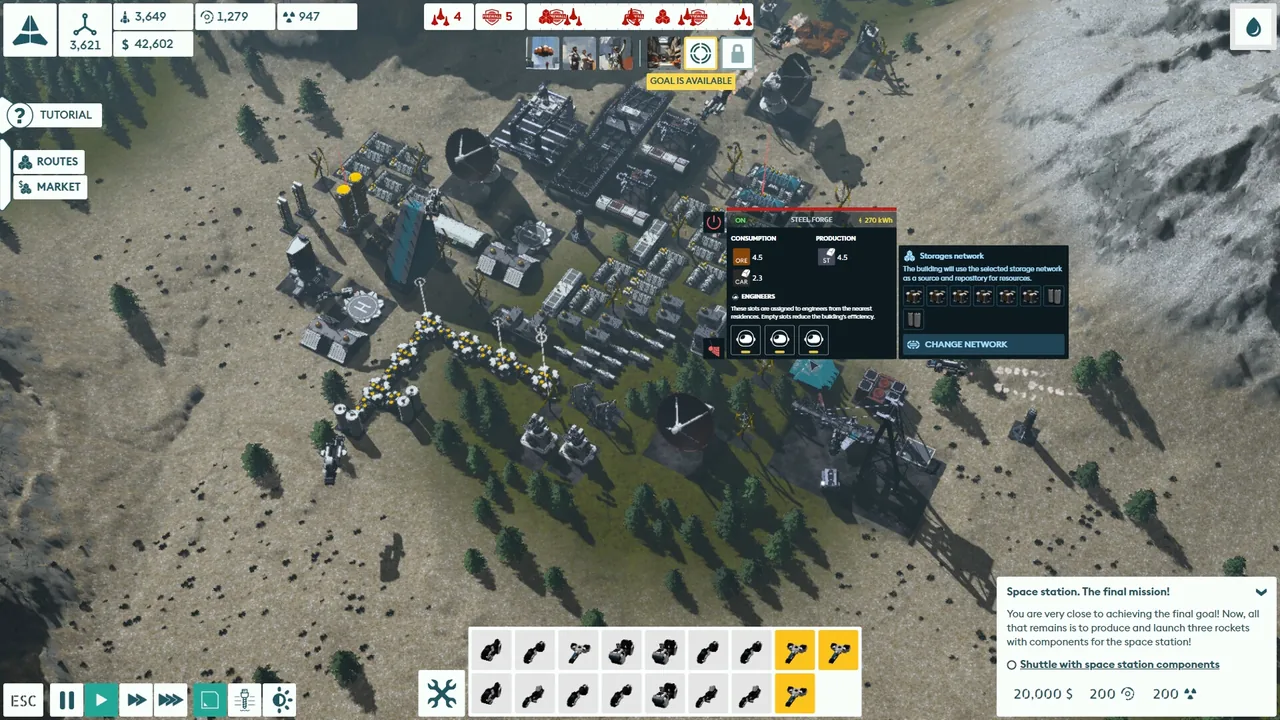
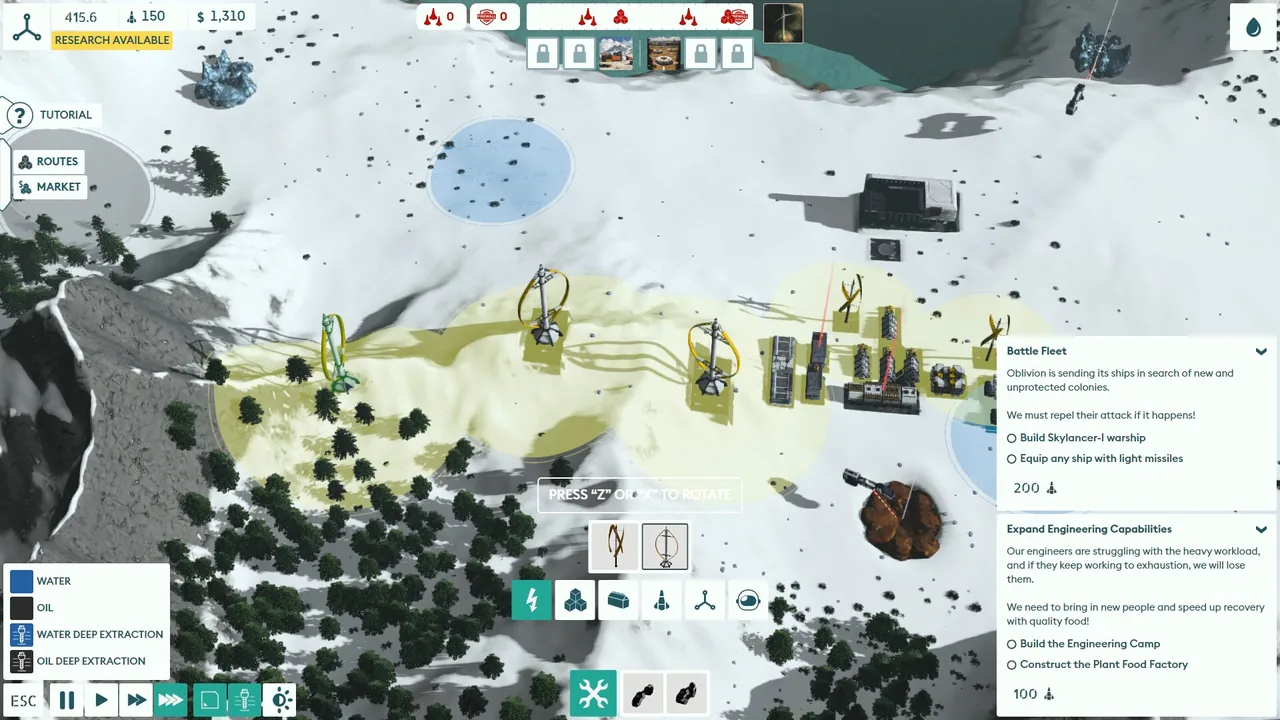
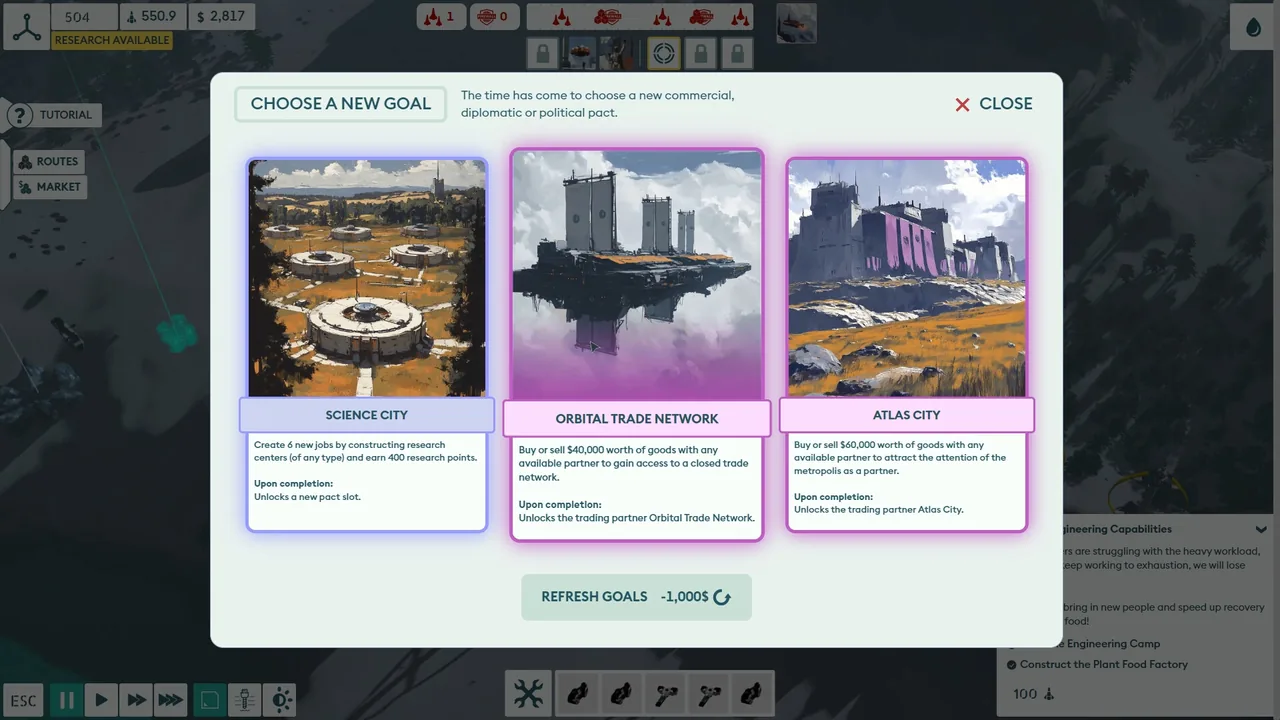
Visually, Oasis Mission earns some of its most consistent praise. Multiple reviews call out clean sci-fi poster-style art, sharp building and ship designs, and — more than once — genuinely good UI typography and spacing, which is a specific enough compliment across unrelated reviewers to trust. Set against that: one detailed and heavily upvoted review asks for an option to remove "a bright white background everywhere," describing it as uncomfortable to look at for extended sessions, and other reviews mention overlapping click-boxes — a warehouse rendered "behind" a shipyard's empty model becomes unclickable — and, in one case, a "broken pipe" error that prevented saving altogether. None of this reads as a game that crashes constantly; it reads as a game with a normal Early Access density of rough edges that a full release should have sanded down further than it has.
Abandoned in plain sight
The most important fact about Oasis Mission: Colony Sim in August 2026 isn't in the game files — it's in the developer's own Steam news feed. The last substantive update was 0.99.0 on 4 March 2025, immediately followed by the 1.0 launch on 10 March. Since then, the single subsequent post to the app's news feed, dated 8 August 2025, isn't a patch note at all: it's Piocan announcing a new, unrelated game called Sherpa's Caravan, with a note that the two titles would be bundled together. There has been no further Oasis Mission news since.
Later user reviews say plainly what that timeline implies. A March 2025 review calls the game abandoned outright and recommends buying only "for some gameplay" with no expectation of new content. An April 2026 review reports the same unresolved warehouse-logistics bug described above and says it forced a refund request after "no update in over a year." A November 2025 review references a community discussion titled, in the reviewer's own words, "Bloke abandoned the game." None of these are isolated cranks — they're a consistent pattern spanning a year, on a solo-developed game whose only sign of life in that period is a plug for the developer's next project. That's the context every other section of this review needs to be read inside: a colony sim with real ideas, released as a finished 1.0, that its own creator appears to have quietly stopped supporting within months.
Reading the review score
Oasis Mission: Colony Sim sits at Mixed on Steam — 50 of 88 reviews positive across all languages (57%), and 29 of 49 positive among English-language reviews specifically (59%). Neither number is a disaster, and it's worth noting how much of the positive side comes from the long Early Access run, when players were reviewing the game against what it promised to become rather than what it settled into. Reviews written closer to and after the 1.0 launch skew more critical, which lines up with a developer who visibly stopped iterating right around the point the reviews needed it most.
Final verdict
Oasis Mission: Colony Sim has a better idea at its centre than most colony sims manage — ships as autonomous, modular protagonists, and a machine-uprising threat that turns your own automation into a liability if you let your guard down. Executed fully, that's a genre standout. Executed as it currently ships, it's a game whose automation still misbehaves often enough to undercut the pitch, whose tech tree and economy thin out well before a long session is over, and whose developer appears, on the evidence of a year-long silence and a news post advertising a different project, to have moved on. Buy it for what it is today — a solid, good-looking, occasionally frustrating sci-fi colony sim with roughly ten to fifteen hours of real engagement in it — and not for what its store page still implies it might become.
Pros and cons
Pros
- A genuinely distinctive hook — modular, self-tasking ships that mine, trade, build and fight are the actual protagonists, not just a logistics afterthought
- Clean, distinctive sci-fi poster art and a UI several reviewers single out for good typography and readability
- The Oblivion machine-infection threat gives the back half of a run real tension instead of a generic wave-defence bolt-on
- A long, responsive Early Access period visibly improved the tutorial, pathing and UI before 1.0, according to reviews written across that stretch
Cons
- The developer's own Steam news feed shows no Oasis Mission update since August 2025, and that post was announcing a different, unrelated game to bundle alongside it
- Multiple 2025-2026 reviews report unresolved bugs, ships ignoring logistics orders, and buildings starved of resources sitting in full warehouses
- The tech tree is widely described as a straight line of incremental upgrades rather than branching choices, and the economy that feels promising for the first few hours stays thin across a full run
- Missile-based combat draws repeated complaints for feeling passive and poorly aimed, undermining the one system meant to create late-game tension
Screenshots
-
Oasis Mission: Colony SimImage: Lunar pug studio via Steam -
Oasis Mission: Colony SimImage: Lunar pug studio via Steam -
Oasis Mission: Colony SimImage: Lunar pug studio via Steam -
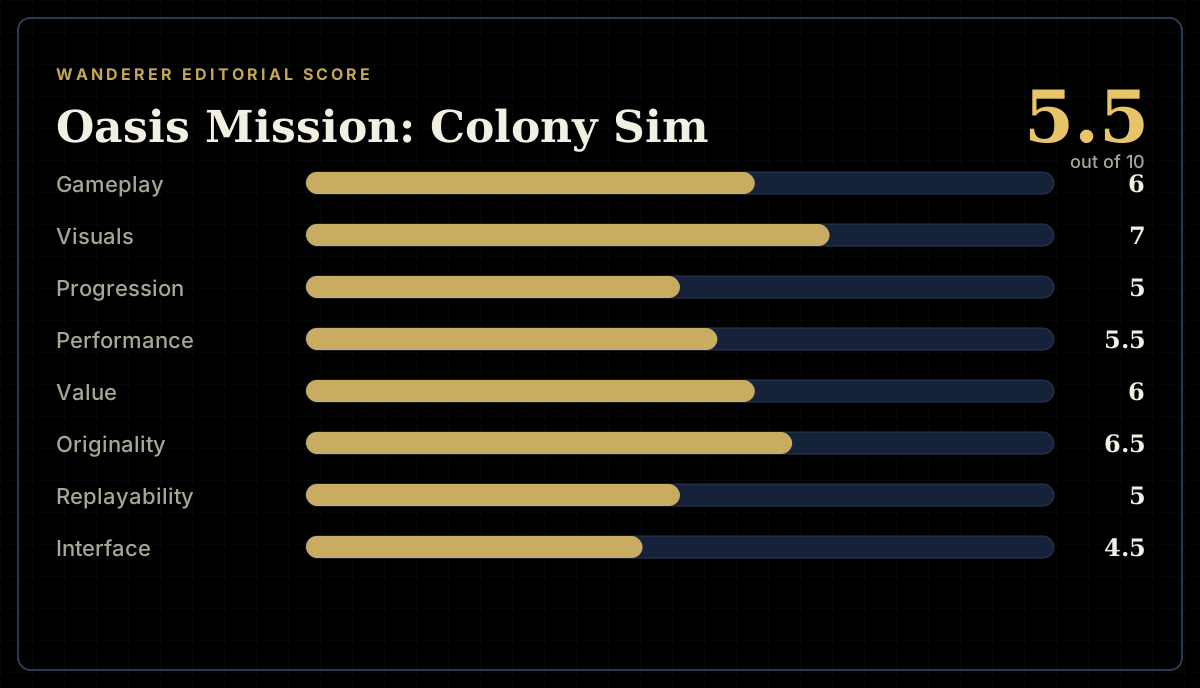
How the review scores each part of the gameWanderer Editorial -
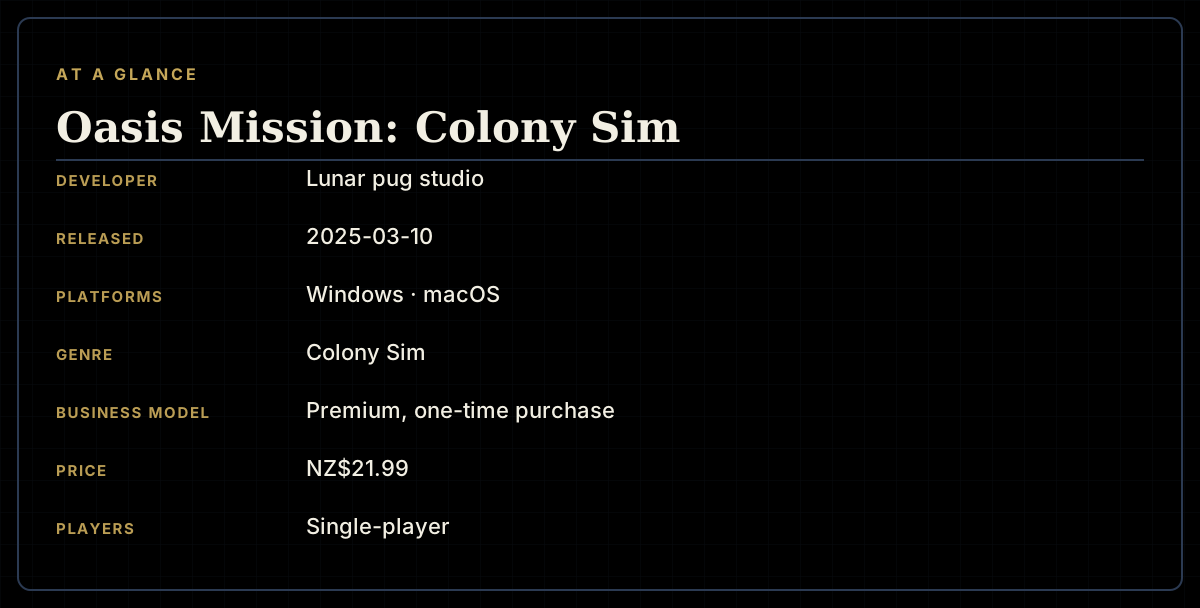
The game at a glanceWanderer Editorial -
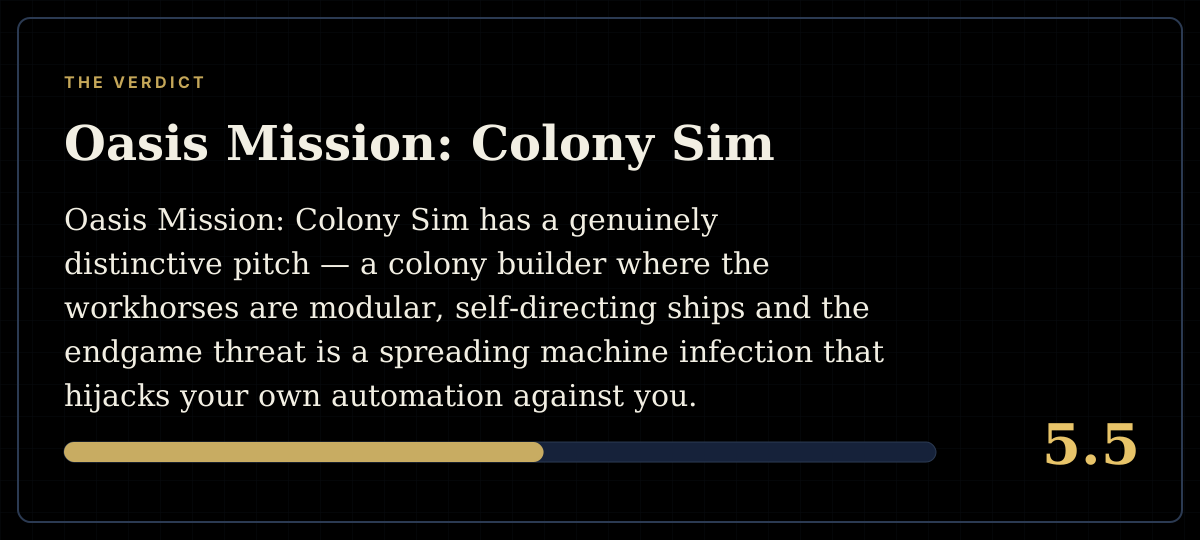
The short versionWanderer Editorial