
Game review
Nyaruru Fishy Fight
7 / 10
- Developer
- Chitong Dabaimao
- Publisher
- Chitong Dabaimao
- Released
- 13 June 2023
- Platforms
- Windows
- Genre
- Metroidvania Action-Platformer
- Monetisation
- One-time premium purchase; substantial free content updates continuing years after launch
- Players
- Single-player only; no online, co-op or PvP modes
The short version
Nyaruru Fishy Fight follows its title character, a real cat-girl investigating a curse that's given an entire town's residents cat ears, through a large, detailed metroidvania world filled with creative environmental puzzles and satisfying movement-based platforming. Reviewers consistently praise the charming, detailed art style inherited from developer Chitong Dabaimao's earlier cult favourite, alongside genuinely strong original music that draws warm praise even from otherwise critical reviewers.
A substantial share of reviewers describe real frustration with two specific elements at launch: boss encounters many call among the worst they've experienced in the genre, built around dual- focus "gimmicks" that leave little room to dodge, and a story conclusion that proved genuinely controversial among the game's own fanbase. This review's research confirms the developer responded directly and repeatedly — reworking the story and reducing named boss difficulty within weeks of the full release, then adding an entirely new, additional ending as free content roughly two years later.
Biggest strengths
- A charming, richly detailed anime art style inherited and improved from the developer's earlier cult favourite, praised consistently even by reviewers critical of other aspects of the game
- Genuinely strong, well-composed original music that reviewers describe as deceptively good for a game of this scope and budget
- Creative environmental puzzle design using objects like boxes, seesaws and mushrooms in ways reviewers describe as inventive within the metroidvania genre
Biggest weaknesses
- Boss fights draw some of the harshest criticism this lane has documented for the genre, with multiple reviewers describing dual-focus "gimmick" mechanics that leave little room to dodge attacks, compounded by hitbox complaints affecting both the player character and certain bosses
- English localization is widely and consistently described as poor, though several reviewers note the relatively light story focus limits how much this actually detracts from the experience
- The original story conclusion proved genuinely controversial among reviewers, with the developer confirming a full story rework shortly after the full release specifically in response to that feedback
Who it's for: Metroidvania fans specifically drawn to distinctive anime-inspired art and exploration- focused puzzle design, with tolerance for a poor English translation and demanding, unevenly designed boss fights. Less suited to anyone who needs precise hitboxes or a tightly linear genre structure despite the open-world framing.
Our recommendation: A charming, worthwhile metroidvania today given the developer's continued investment in reworking its most criticized elements — just pick Easy mode for boss fights if precision platforming isn't your priority.
7 / 10
A magic curse gives an entire town's residents cat ears, and Nyaruru — a genuine cat-girl caught up in the mystery — sets out to uncover the truth in a large, detailed metroidvania world built by Chitong Dabaimao, the developer behind the earlier cult favourite Nyakori's Rabbit Doll. The premise leans into a distinctly anime-inspired tone from the outset, blending lighthearted humor with genuine mystery-solving stakes. Reviewers who followed that earlier game describe genuine excitement seeing its distinctive art style carried forward and improved, and the resulting reception landed as Very Positive — though a substantial, specific share of criticism concentrated on exactly two elements the developer would go on to directly address.
Charm and craft reviewers consistently praise
The art direction draws close to unanimous admiration, with reviewers describing detailed, expressive character and monster designs that clearly show real investment from the development team. Music earns equally strong, specific praise, with more than one reviewer calling it "deceptively good" for a game of this scope. Environmental puzzle design draws real credit for creativity, using interactive objects like boxes, seesaws and mushrooms in inventive ways that several reviewers say stand out even within a genre known for clever traversal puzzles. The game's world is large and detailed enough that reviewers note it can be genuinely difficult to remember specific areas, a double-edged point that speaks to real scale even as it draws its own minor navigation complaint.
Boss fights reviewers call among the genre's worst
Set against that praise, boss encounters draw some of the harshest, most specific criticism this lane has documented for the metroidvania genre. Multiple reviewers describe bosses built around dual-focus "gimmick" mechanics that force players to manage two threats simultaneously without enough room to actually dodge either, with attacks that overlap in ways reviewers describe as leaving no viable escape. Hitbox complaints compound the frustration, with at least one reviewer noting the player character's hitbox effectively covers her entire body, and describing at least one specific boss whose attacks fill enough of the screen to make evasion nearly impossible regardless of skill. One reviewer summarizes the resulting encounters bluntly as "hands-down the worst I've ever experienced in any metroidvania."
A story conclusion the developer directly reworked
A separate, equally consistent complaint concerns the game's original ending, which several reviewers describe as genuinely controversial among the fanbase, built around a specific plot moment multiple reviewers say felt poorly handled despite being foreshadowed throughout. Checking that complaint against the public patch record confirms a direct, dated response: a "Story Optimizations" update released roughly two weeks after the full release explicitly states "the story has been remade" due to community feedback, and — notably — the same patch simultaneously reduces the difficulty of four specifically named bosses, directly addressing both major launch complaints in a single, dated update.
A substantial free update, years later
What distinguishes Nyaruru Fishy Fight from many similarly-received indie metroidvanias is the scale of what followed even after that initial response. Roughly two years after the full release, a major Version 1.10 update added an entirely new, additional ending — reachable through a specific new story path — alongside new songs and a new boss encounter, all delivered as free content. At least one reviewer with well over 300 hours in the game specifically credits this update as a genuine, unexpected gift this long after release, describing new content of this scale arriving for free two years later as "insane." That's a rare, well-documented level of continued investment for a game this size.
What the achievement data suggests
Global achievement figures show a fairly typical metroidvania decline, from around 65.6% of the playerbase earning early milestones down to under 20% for the achievements tied to specific story endings — consistent with a real, if not extreme, drop-off that lines up with reviewer accounts of difficulty and translation friction affecting how many players see the game through to its conclusion, even accounting for the difficulty reductions the story-rework patch introduced.
A metroidvania that's more linear than it looks
A separate, smaller complaint concerns genre expectations specifically. Despite being labelled and marketed as a metroidvania with open exploration, multiple reviewers note that boss progression is strictly linear — you can explore the world freely and collect movement upgrades early, but you cannot fight bosses out of the game's intended order, unlike genre touchstones that allow more flexible sequencing. Reviewers are split on how much this matters: some describe it as a genuine limitation given the genre label, while others argue the exploration and puzzle-solving remain satisfying enough on their own terms regardless of boss ordering. A related complaint concerns the game's horror elements, introduced early with genuine atmosphere and jump scares, which at least one reviewer felt weren't developed with enough follow-through to land as a fully realized horror narrative rather than an initial hook that fades.
Where it lands
Nyaruru Fishy Fight earns its warm reception through genuine artistic and musical craft, backed by creative puzzle design that stands out within its genre. The boss design and original ending complaints that dominated its launch-era criticism were real and well-founded, but this review's research confirms the developer responded directly and specifically — first with a dated difficulty and story rework within weeks of release, then with substantial additional free content years later. For metroidvania fans specifically drawn to its distinctive art and willing to select Easy mode for its more demanding boss encounters, this remains a charming, worthwhile pickup.
Pros and cons
Pros
- A charming, richly detailed anime art style inherited and improved from the developer's earlier cult favourite, praised consistently even by reviewers critical of other aspects of the game
- Genuinely strong, well-composed original music that reviewers describe as deceptively good for a game of this scope and budget
- Creative environmental puzzle design using objects like boxes, seesaws and mushrooms in ways reviewers describe as inventive within the metroidvania genre
- A large, detailed explorable world with real content depth for players willing to invest the time in full exploration and completion
- Substantial, continued free content updates years after launch, including an entirely new ending added in a 2025 update, reflecting genuine ongoing developer investment
Cons
- Boss fights draw some of the harshest criticism this lane has documented for the genre, with multiple reviewers describing dual-focus "gimmick" mechanics that leave little room to dodge attacks, compounded by hitbox complaints affecting both the player character and certain bosses
- English localization is widely and consistently described as poor, though several reviewers note the relatively light story focus limits how much this actually detracts from the experience
- The original story conclusion proved genuinely controversial among reviewers, with the developer confirming a full story rework shortly after the full release specifically in response to that feedback
- Despite being marketed as a metroidvania with open exploration, boss progression is reported as strictly linear, preventing players from tackling encounters out of the game's intended order
- Difficulty spikes are reported as sudden and uneven across different sections and bosses, with at least one detailed reviewer describing an experience that felt "so good and so bad at the same time"
Screenshots
-

Nyaruru Fishy FightImage: 赤瞳大白猫 via Steam -
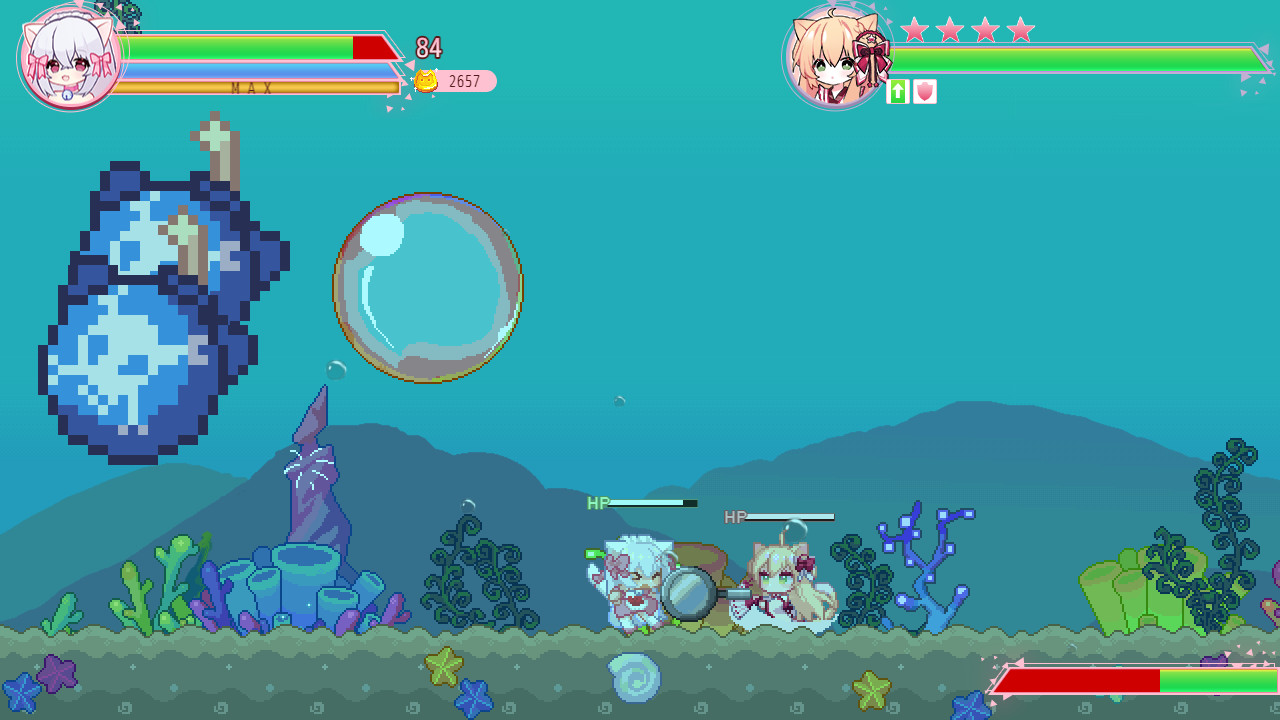
Nyaruru Fishy FightImage: 赤瞳大白猫 via Steam -

Nyaruru Fishy FightImage: 赤瞳大白猫 via Steam -
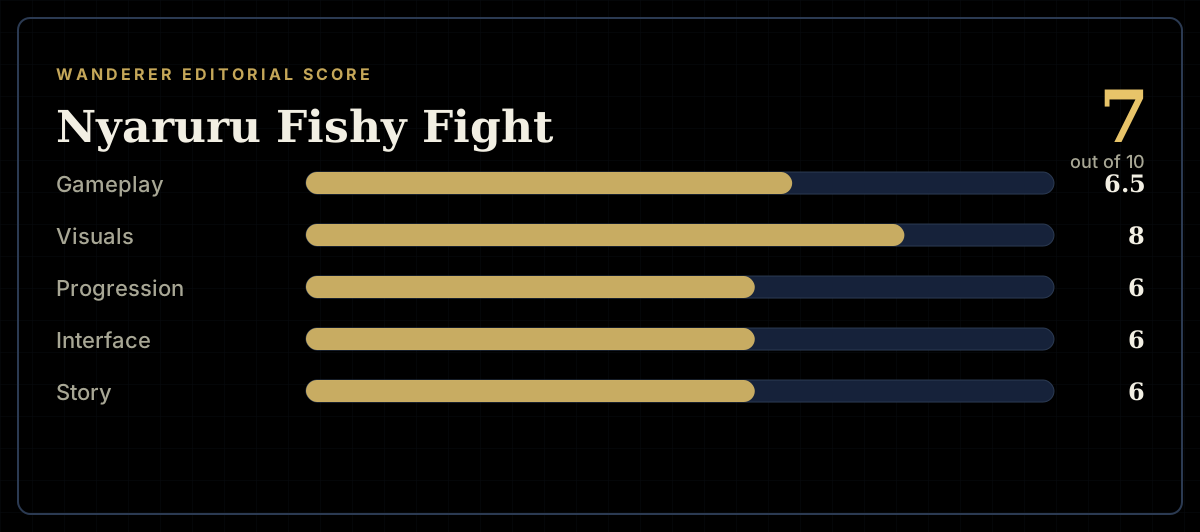
How the review scores each part of the gameWanderer Editorial -
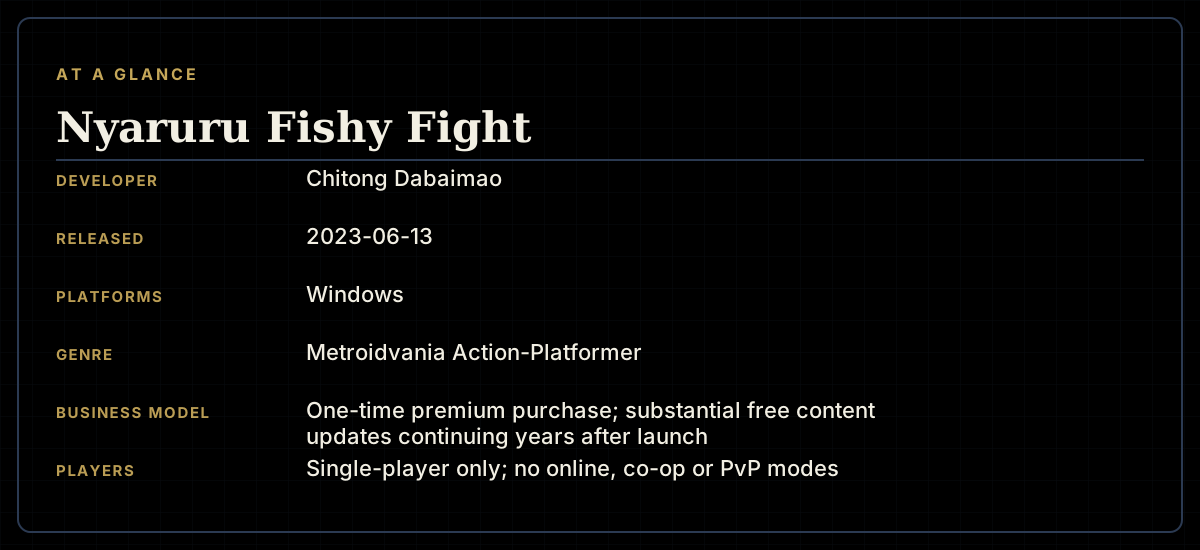
The specsWanderer Editorial -
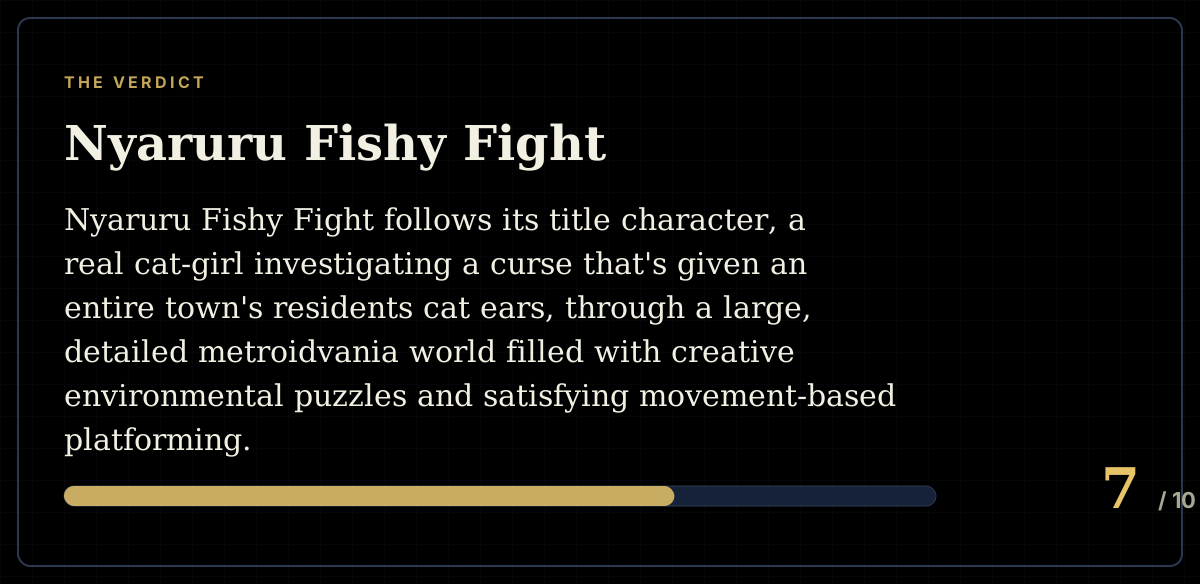
The short versionWanderer Editorial