
Game review
Nour: Play with Your Food
5.5 / 10
- Developer
- Terrifying Jellyfish
- Publisher
- Panic
- Released
- 12 September 2023
- Platforms
- Windows, macOS
- Genre
- Experimental Physics Sandbox
- Monetisation
- One-time premium purchase; no ads, DLC or in-game store found
- Players
- Single-player only; no online, co-op or PvP modes
The short version
Nour: Play with Your Food is exactly what its title promises: a physics-based sandbox where players manipulate photorealistic, exaggerated food objects across a series of surreal, music-driven scenes, with no explicit goals or objectives to complete. Reviewers who click with that premise describe a genuinely satisfying, hypnotic experience, comparing it to the appeal of "extremely satisfying" internet videos brought to life as an interactive toy, backed by a strong original soundtrack.
A substantial share of reviewers, including several who backed the game's original 2018-era Kickstarter campaign, describe a frustrating gap between that premise and its execution. Controls are widely reported as unexplained and unintuitive even after the developer's own quality-of-life patches, and physics objects are reported as breaking or behaving unpredictably often enough to undercut the sandbox's central promise. Long-time backers in particular describe disappointment after a five-plus-year wait for a project that still feels, to them, incompletely realized.
Biggest strengths
- A genuinely distinctive concept executed with striking, photorealistic visual detail applied to exaggerated, surreal food objects unlike anything else on Steam
- A strong original soundtrack, including a launch trailer track from musician Tobi Lou, that reviewers describe as core to the game's hypnotic, satisfying appeal
- Goal-free sandbox design that reviewers who enjoy open-ended physics toys describe as genuinely relaxing and endlessly replayable without external pressure
Biggest weaknesses
- Controls are widely and consistently reported as unexplained and unintuitive, with several reviewers describing genuine difficulty figuring out basic interactions even after consulting external guides
- Physics objects are reported as breaking or behaving unpredictably by multiple reviewers, particularly in busier scenes, undercutting the sandbox's core promise of freeform, satisfying manipulation
- A substantial share of reviewers, including original Kickstarter backers who funded the project around 2018, describe real disappointment that the final release still feels underbaked relative to the length and scope of its development
Who it's for: Fans of experimental, goal-free sandbox toys and satisfying-physics content specifically, who are willing to tolerate real friction learning the controls. Less suited to anyone expecting clear guidance, stable physics, or a traditional sense of progression.
Our recommendation: A genuinely unique experience worth trying if the concept appeals to you specifically, but temper expectations about polish and clarity, especially if you were hoping for the more expansive vision originally promised during its long crowdfunded development.
5.5 / 10
Nour: Play with Your Food does exactly what its name suggests and nothing more: it drops you into a series of surreal, music-driven scenes filled with photorealistic, physics-simulated food, and lets you do whatever you want with it, with no goals, no failure states, and no explicit objectives. That premise had a long road to release — the project traces back to a 2018-era Kickstarter campaign — and reviewers today are split on whether the finished product delivers on either the original pitch or the years of anticipation that preceded it.
A genuinely distinctive sandbox toy
For reviewers who click with the concept, the appeal is real and specific. Striking, exaggerated food visuals rendered with genuine photorealistic detail create scenes reviewers compare to the appeal of "extremely satisfying" internet content brought to interactive life, and a strong original soundtrack — including a launch trailer track from musician Tobi Lou — does real work selling the hypnotic, music-driven atmosphere. Reviewers who enjoy goal-free physics sandboxes describe genuine, open-ended fun discovering the game's hidden interactions and effects through experimentation, treating the lack of explicit direction as a feature rather than a flaw.
Controls that a substantial share of reviewers can't get past
Set against that appeal, this review's research turned up a specific, widely repeated complaint: the controls are unexplained and unintuitive, forcing players to guess at basic interactions rather than learning them through any in-game guidance. Multiple reviewers describe consulting outside sources for help and still struggling, and at least one reviewer describes the experience as outright "unpleasant" as a direct result, distinct from any complaint about the game's lack of traditional objectives. Physics reliability compounds the frustration, with reviewers reporting objects breaking or behaving unpredictably in busier scenes, undercutting the core sandbox promise that freeform manipulation should feel satisfying rather than fragile.
A long-delayed Kickstarter project some backers feel let down by
A distinct thread running through the negative reviews comes specifically from original Kickstarter backers, several of whom funded the project around its initially estimated 2018 release window. More than one describes real disappointment that a final release arriving five-plus years later still feels, to them, underbaked relative to that development timeline. At least one reviewer raises a specific, serious claim — that a higher-tier alpha access reward promised during the crowdfunding campaign never materialized — which this review has no way to independently verify and reports plainly as a direct, attributed backer account rather than a confirmed fact.
A developer that responded candidly, if imperfectly
To the developer's real credit, the post-launch patch record shows genuine, sustained attention to the control complaints specifically. Within weeks of launch, updates added a dedicated Move Tool for directly repositioning food items, a mouse sensitivity slider, fixes for a particularly awkward default keybinding, and improved magnet-tool responsiveness. A later update, roughly a year after launch, directly addressed the "low entity limit" complaint by adding an adjustable spawn cap specifically for PC players. Notably, the developer was also unusually transparent about a separate shortcoming: Kickstarter backer credits were missing from the game at launch, and the patch notes introducing them include a direct, unprompted apology acknowledging the team "dropped the ball on prioritizing them." That kind of candor is worth crediting even as it confirms some of the backer frustration was, in fact, warranted at launch.
What the achievement data can and can't tell us
Achievements were also added to Nour after launch rather than at release, per the developer's own patch notes, so global completion figures here — ranging from roughly 37% for the most common tracked action down to single digits for rarer discoveries — should be read with the same caveat applied elsewhere in this lane: any player who finished exploring the game before achievements existed never had the chance to unlock them, making the figures suggestive of engagement patterns rather than a precise difficulty or completion measure.
Weighing "is this even a game" fairly
Part of what makes Nour genuinely divisive is a question some reviewers raise explicitly: whether a goal-free physics toy with no objectives, failure states or progression system counts as a "game" in the way Steam reviewers typically evaluate one. Reviewers who approach it expecting a game with clear tasks to complete report frustration and confusion almost immediately, while reviewers who approach it more like an interactive art piece or digital toy — closer to a music visualizer or a fidget object than a traditional simulation — report a considerably more forgiving, satisfying experience. That framing matters for a buying decision: this isn't a case where reviewers disagree about execution quality so much as one where the fundamental category of experience being offered splits opinion before execution even enters the picture.
Continued support tied to a console launch
The most substantial post-launch update, addressing the spawn-cap and entity-limit complaints directly, arrived roughly a year after the PC release and was explicitly tied to Nour's expansion to Nintendo Switch. That's a useful piece of context: rather than abandoning the PC version, the developer used the console port as an opportunity to revisit and improve technical limitations that PC reviewers had specifically flagged, a genuinely positive pattern worth noting given how many small studios treat a platform expansion as a one-way process rather than a chance to improve the original release.
Where it lands
Nour: Play with Your Food succeeds at being something genuinely unlike anything else on Steam — a striking, music-driven physics toy for players specifically drawn to unstructured, goal-free experimentation. The control and clarity complaints are real, consistent, and only partially addressed by an otherwise genuinely responsive developer, and the disappointment expressed by original backers after such a long development road is a legitimate, well-documented part of this game's story rather than incidental grumbling. For players specifically curious about its unusual premise and willing to push through real friction to find its satisfying moments, this remains a worthwhile, if imperfect, curiosity.
Pros and cons
Pros
- A genuinely distinctive concept executed with striking, photorealistic visual detail applied to exaggerated, surreal food objects unlike anything else on Steam
- A strong original soundtrack, including a launch trailer track from musician Tobi Lou, that reviewers describe as core to the game's hypnotic, satisfying appeal
- Goal-free sandbox design that reviewers who enjoy open-ended physics toys describe as genuinely relaxing and endlessly replayable without external pressure
- A responsive developer that shipped multiple genuine quality-of-life patches after launch, including a dedicated move tool, mouse sensitivity options and an adjustable spawn cap
- Achievements and Kickstarter backer credits, though both arrived later than promised, were eventually delivered with a candid, direct apology from the developer for the delay
Cons
- Controls are widely and consistently reported as unexplained and unintuitive, with several reviewers describing genuine difficulty figuring out basic interactions even after consulting external guides
- Physics objects are reported as breaking or behaving unpredictably by multiple reviewers, particularly in busier scenes, undercutting the sandbox's core promise of freeform, satisfying manipulation
- A substantial share of reviewers, including original Kickstarter backers who funded the project around 2018, describe real disappointment that the final release still feels underbaked relative to the length and scope of its development
- Progression between the game's scenes is unclear within the levels themselves, requiring players to exit to a menu to change scenes rather than offering any in-world guidance
- At least one reviewer reports specific unfulfilled crowdfunding promises, including a higher- tier alpha access reward that reportedly never arrived — a serious claim this review can't independently verify but reports as a direct, attributed backer account
Screenshots
-

Nour: Play with Your FoodImage: Panic via Steam -

Nour: Play with Your FoodImage: Panic via Steam -

Nour: Play with Your FoodImage: Panic via Steam -
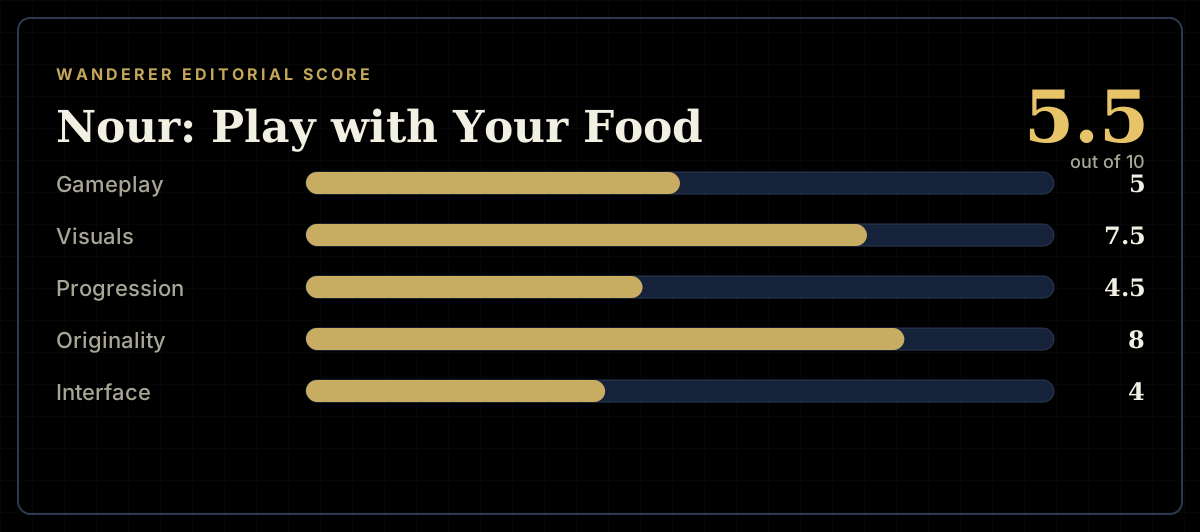
How the review scores each part of the gameWanderer Editorial -
The short versionWanderer Editorial