
Game review
Music Band Manager
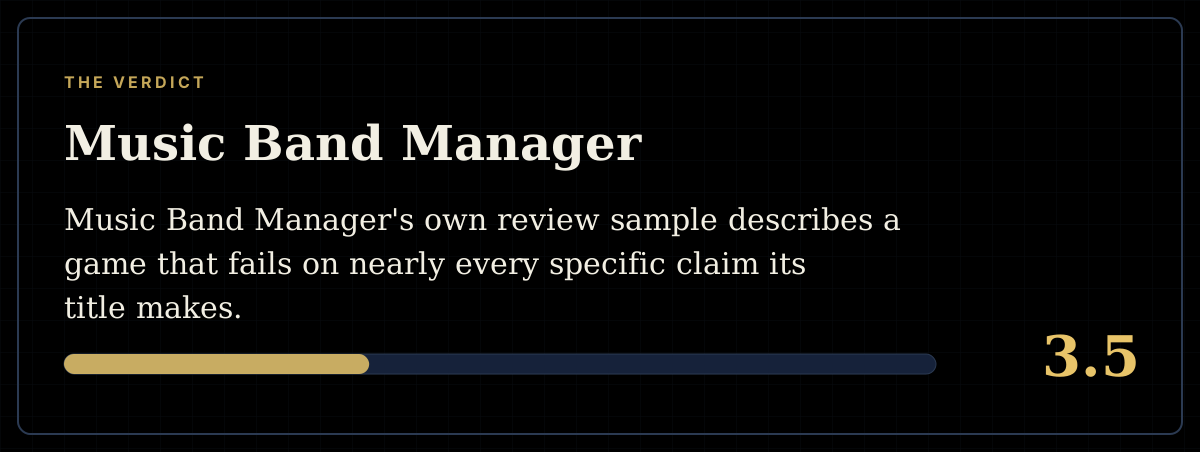
3.5 / 10
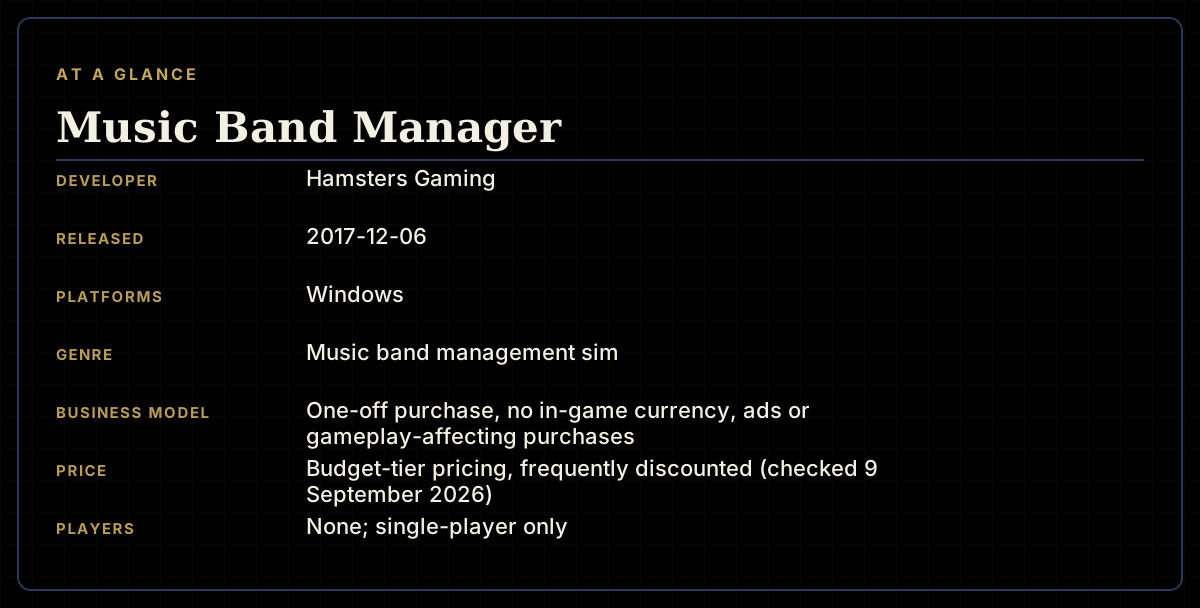
- Developer
- Hamsters Gaming
- Publisher
- Hamsters Gaming
- Released
- 6 December 2017
- Platforms
- Windows
- Genre
- Music band management sim
- Monetisation
- One-off purchase, no in-game currency, ads or gameplay-affecting purchases
- Players
- None; single-player only
The short version
Music Band Manager's own review sample describes a game that fails on nearly every specific claim its title makes. Reviewers who came expecting a band-management sim in the vein of the genre's real touchstone, the web-based RPG Popmundo, instead found what one detailed review calls "a typical mobile clicker" — a loop that reduces to choosing whichever available job pays the most per hour, with no meaningful control over band composition, no character customization, and a money system multiple independent reviewers describe as fundamentally broken, trapping players in permanent debt regardless of play skill. The game's own Steam achievement list, left with generic, never-renamed placeholder titles like "NEW_ACHIEVEMENT_1_8" across all 33 entries, is about as direct a piece of evidence of unfinished polish as this fleet has documented. A real, dense patch cycle did follow launch through mid-2018, but reviewers posting well after that point describe unaddressed feedback and, in at least one case, a game that stopped being playable entirely.
Biggest strengths
- The core concept — building a band from nothing to worldwide fame — is a genre premise with real potential, evidenced by reviewers who wanted this exact experience and gave it a fair try
- Steam Trading Card support and a genuinely dense patch cycle through the first half of 2018 show at least an initial period of real development attention
- Supports seven languages, more localization effort than many games at this budget tier attempt
Biggest weaknesses
- Multiple independent, detailed reviews describe the core loop as an idle clicker in disguise — the central "challenge" reduces to picking whichever available job pays the most per hour to cover salaries, not the band-building and creative decisions the marketing implies
- A specific, repeated, and serious complaint: the game's economic balance is broken in a way that traps players in permanent debt regardless of skill, described by one reviewer as being "left with a broken economic model" the developer never fixed
- No character customization or band-member choice of any kind, a gap multiple reviewers single out directly against genre expectations, including one noting the lead singer must be female with no option to change it
Who it's for: Nobody currently in the market for a band-management game — even reviewers who wanted to like this one describe it as an inferior, less customizable version of games already available in the genre. Only relevant as an example of how thin a "management sim" pitch can be once the actual mechanics turn out to be an idle clicker underneath.
Our recommendation: Skip it. The genre has better, more customizable options, and this one's own players are unusually consistent that the title oversells what's actually inside.
3.5 / 10
Music Band Manager sells a simple, appealing fantasy: start a band, record songs, tour the world, and claw your way into the top 100. It's a real genre with real precedent — reviewers repeatedly invoke Popmundo, the long-running web-based band-management RPG, as the touchstone this game is implicitly competing with. Released in December 2017 to a since-settled Mostly Negative score (38% of 146 English reviews), its own review sample makes an unusually consistent, specific case for exactly where that comparison falls apart.
A management game that plays like a clicker
The single most repeated observation across the review sample, positive and negative alike, is that the actual moment-to-moment gameplay bears little resemblance to band management. One detailed review states it plainly: "Music Band Manager turned out to be not a manager game at all, but a typical mobile clicker. The main challenge the game presents is paying your band members' weekly salaries. Early on, concerts and record sales generate almost no income. So, what's the solution? There's an option to 'go to work.'" Another reviewer describes the loop even more bluntly: "This game is a 2 click action - open jobs and choose the one with most money per time. Nothing else." A third, expecting music-focused gameplay based on the title alone, found instead "click this button, NEW UNLOCK!, click this button, NEW UNLOCK!... over and over and over." That's three independent reviewers, writing at different times, converging on the same specific description of the core loop — strong enough agreement to treat as an accurate account of the actual game rather than a matter of taste.
An economy several reviewers call broken, not just hard
Beyond the genre mismatch, a more serious and specific complaint recurs: the money system itself doesn't function as a fair challenge. One reviewer states directly that "the game has been left with a broken economic model so you will go broke all the time," adding pointedly that the developer "clearly don't care about leaving you with a joke of a game." Another calls the game "impossable to beat" due to the same underlying issue. A third, more measured review attributes part of the problem to "quite bad translation" compounding a money system that "makes very little sense." These aren't difficulty complaints in the ordinary sense — they describe a system that traps players in a losing position regardless of decisions made, which is a design failure distinct from and worse than a game simply being hard.
Evidence the game was never really finished
One piece of checkable, objective evidence supports the "unfinished" reading directly: every single one of the game's 33 tracked Steam achievements carries a generic, unedited placeholder name — "NEW_ACHIEVEMENT_1_8," "NEW_ACHIEVEMENT_2_10," and so on, all the way through the list. Steam's achievement system requires developers to name each entry manually; leaving every single one at its default placeholder text is a concrete, verifiable sign that basic polish steps were skipped rather than an inference from vague dissatisfaction. It lines up precisely with reviewer complaints about spelling errors "everywhere" and a game that "looks like its made in Flash instead of a game engine" — independent evidence pointing the same direction.
Real early support, then reviewers describe going quiet
To be fair to what did happen: the partner-events feed shows a genuinely dense patch cycle immediately after launch — daily fixes through December 2017, a "massive update" in early 2018, and continued patches through mid-2018 — before Hamsters Gaming moved on to a string of other management-sim titles (Last Day of Rome, US Spy: Mission in Russia, Shelter Manager) over the following years. That's a real, if short, window of attention, not zero support. But reviewers posting well after that window closed describe a developer who stopped listening specifically where it mattered most: one notes "the dev's do not listen to feedbacks (see comments below last update 2018 too)," and a separate, detailed account reports the game eventually became entirely unplayable — stuck on its intro screen with no way to proceed — with no fix ever following. A short early support window followed by genuine unresponsiveness to a game-breaking report is a worse outcome than either extreme on its own.
A recognizable shape from a studio that kept making the same one
One detailed review calls the game "an exact clone of several other games in the same genre," and Hamsters Gaming's own subsequent output supports treating that as more than a throwaway insult: the studio went on to release Last Day of Rome (2019), US Spy: Mission in Russia (2020), and Shelter Manager (2021), each announced through the same partner-events channel with the same brisk, low-ceremony style as this game's own launch posts. That's a real, small studio with a genuine, sustained output — not a one-off scam — but it's a pattern worth naming plainly: a developer repeatedly producing similarly-scoped management/strategy sims across different themes, with this entry's specific complaints (thin customization, an economy that doesn't hold up, unfinished production details like the placeholder achievements) reading less like a one-time misstep and more like the studio's general level of polish at this stage of its output. Nothing in this review's research extended to checking whether the later titles improved on these specific issues, but the pattern is worth flagging for any reader who liked this game's premise enough to consider one of the studio's other releases instead.
Verdict
Music Band Manager's title promises a band-management fantasy its own mechanics don't deliver — by wide reviewer consensus, it's an idle clicker about paying salaries wearing a music-industry skin, hobbled further by a money system multiple independent players call genuinely broken and finished with production polish thin enough to leave every achievement at its default placeholder name. A real early patch cycle earns some credit, but reviewer accounts of unaddressed feedback and at least one confirmed game-breaking bug after that window closed outweigh it. The genre has real, better-regarded alternatives; this isn't one of them.
Sources: Steam store page and appdetails API (release date, pricing, platform and language data); Steam's aggregate review data (query_summary totals, English-language sample); individually read user reviews, both positive and negative, sorted by helpfulness and recency; Steam's global achievement statistics API (achievement name list); Hamsters Gaming's own partner-events patch notes from launch in December 2017 through mid-2018, and subsequent announcements for the studio's later, unrelated titles.
Pros and cons
Pros
- The core concept — building a band from nothing to worldwide fame — is a genre premise with real potential, evidenced by reviewers who wanted this exact experience and gave it a fair try
- Steam Trading Card support and a genuinely dense patch cycle through the first half of 2018 show at least an initial period of real development attention
- Supports seven languages, more localization effort than many games at this budget tier attempt
- Cheap enough that even a disappointed purchase costs little
- A minority of reviewers report a relaxed, "zone out and listen to a podcast" experience they were specifically looking for and got, suggesting the loop works for a narrow audience with low expectations of depth
Cons
- Multiple independent, detailed reviews describe the core loop as an idle clicker in disguise — the central "challenge" reduces to picking whichever available job pays the most per hour to cover salaries, not the band-building and creative decisions the marketing implies
- A specific, repeated, and serious complaint: the game's economic balance is broken in a way that traps players in permanent debt regardless of skill, described by one reviewer as being "left with a broken economic model" the developer never fixed
- No character customization or band-member choice of any kind, a gap multiple reviewers single out directly against genre expectations, including one noting the lead singer must be female with no option to change it
- Every one of the game's 33 Steam achievements retains a generic, unedited placeholder name ("NEW_ACHIEVEMENT_1_8" and similar), a concrete, checkable sign of unfinished production polish rather than an isolated complaint
- Reviewers posting well after the last confirmed 2018 patch describe the developer as unresponsive to feedback, and at least one detailed account reports the game becoming entirely unplayable (stuck on an intro screen with no way to proceed)
Screenshots
-
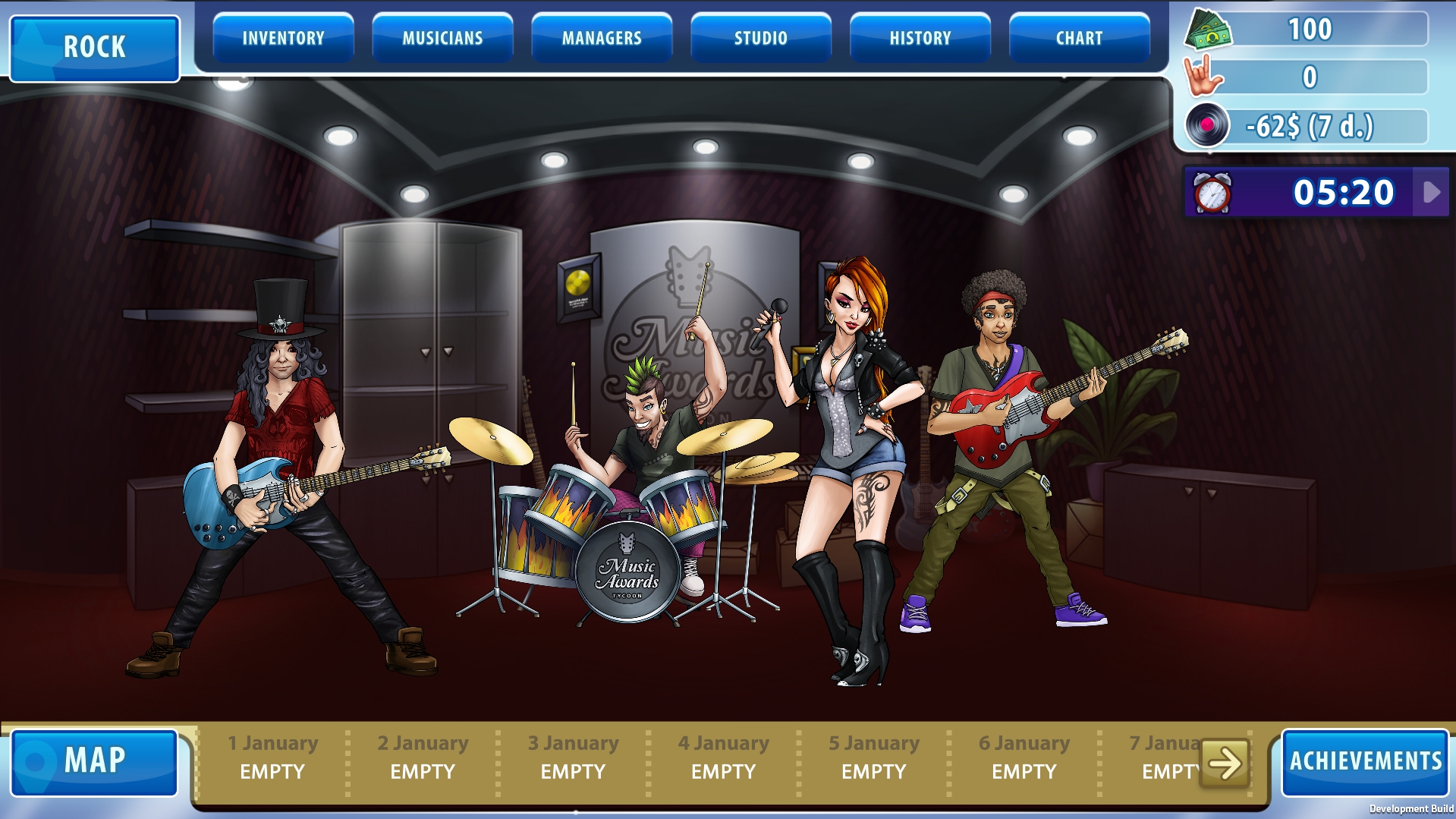
Music Band ManagerImage: Hamsters Gaming via Steam -
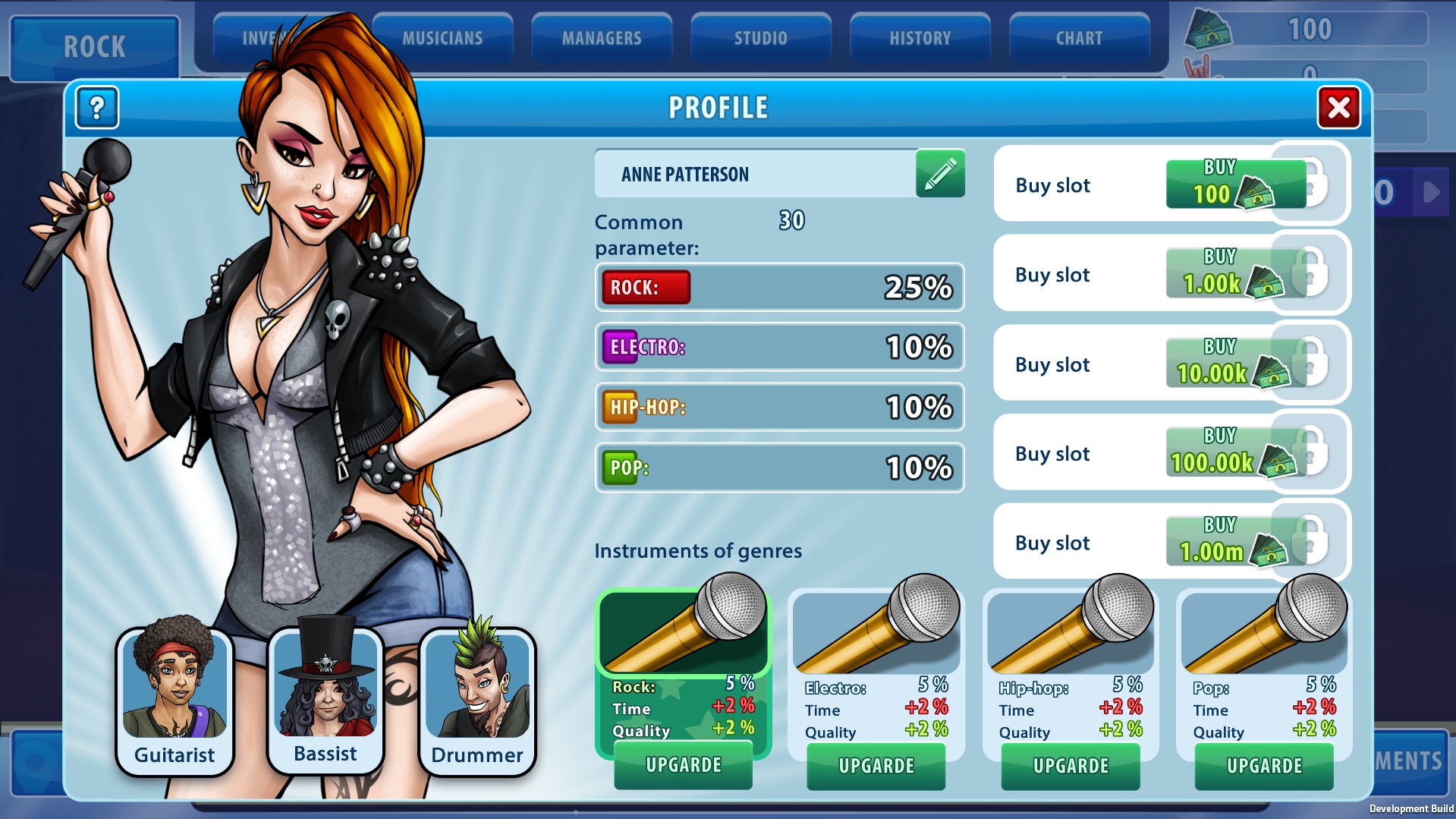
Music Band ManagerImage: Hamsters Gaming via Steam -
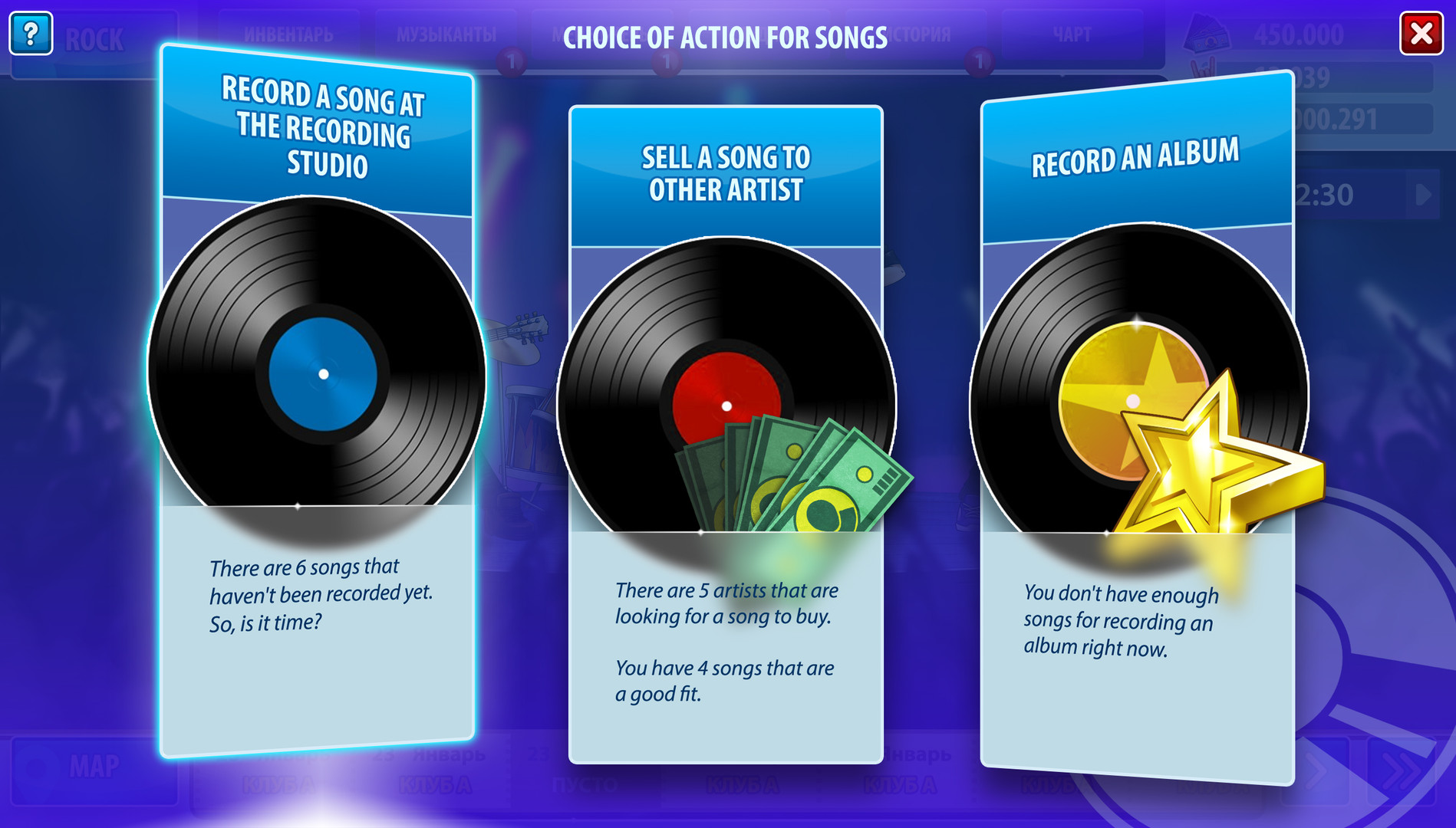
Music Band ManagerImage: Hamsters Gaming via Steam -
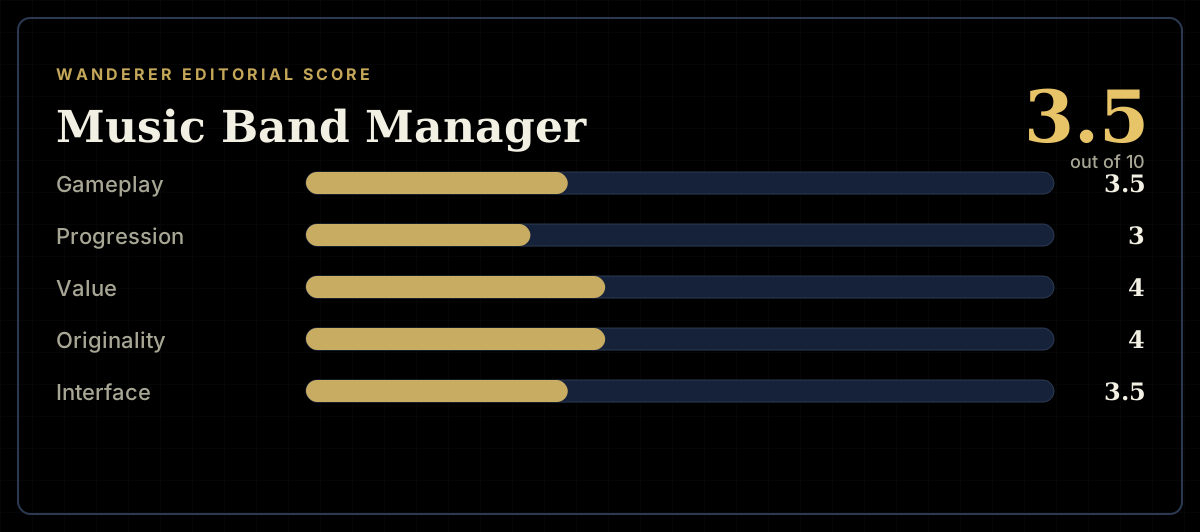
How the review scores each part of the gameWanderer Editorial -
The specsWanderer Editorial -
The short versionWanderer Editorial