Game review
Mosaic of The Pharaohs
7.2 / 10
- Developer
- Mark Ffrench
- Publisher
- Divide The Plunder
- Released
- 28 March 2025
- Platforms
- Windows, macOS
- Genre
- Picross / Minesweeper Puzzle
- Monetisation
- One-time purchase. No in-game purchases, ads, subscriptions or DLC of any kind.
- Players
- Single-player only.
The short version
Mosaic of The Pharaohs is not a clicker. It is a single, enormous nonogram: a 60,000-plus-tile grid split into more than 200 numbered regions, solved with minesweeper-style numbered clues, slowly revealing a pixel-art collage of Ancient Egypt and unlocking one historical fact card per region. It is the third entry in Mark Ffrench's Mosaic series, and Steam's own achievement data shows most owners take it seriously — a clean 64-77% band clears the ordinary discovery milestones, and just over half (50.9%) push all the way to full completion, a striking finish rate for a puzzle this size.
The asking price is real money for this corner of Steam, and the honest answer is that the size of the thing mostly earns it: reviewers on both sides of the score cluster around 15-30 hours logged, which puts the cost per hour of engagement well below several cheaper games in this batch. What keeps it from scoring higher is a live, unresolved integrity question — three of the game's only eleven English-language negative reviews, its three most-upvoted, all independently allege the historical trivia was written or rewritten by generative AI, and the store page currently carries no AI-content disclosure to weigh against that.
Biggest strengths
- A single continuous 60,000-plus-tile puzzle spans 200-plus numbered regions, and achievement data shows just over half of all owners (50.9%) push through to full completion
- The May 2026 update added full gamepad support with an official Steam Deck configuration, an onscreen undo button, countdown mode and scroll-sensitivity controls, directly answering earlier accessibility complaints
- Median playtime sits near 15-30 hours across both positive and negative reviewers, putting the cost per hour of engagement below several cheaper games reviewed alongside it
Biggest weaknesses
- Three of the game's only eleven English negative reviews, its three most-upvoted, independently accuse the near-100 historical trivia entries of being undisclosed generative AI text, and the store page carries no AI-content disclosure section
- The entire game is one puzzle: once it's solved there is nothing left to replay, and the design has no mechanical escalation beyond sheer duration
- Steam's own vote-weighted community tags rank Incremental and Collectathon ahead of Puzzle, showing the aggregator's Clicker label isn't the only genre mismatch this game attracts
Who it's for: Fans of long-form logic puzzles, nonograms and picross who want one big project to chip away at over weeks rather than a stack of short levels, and who don't mind a slow-burn history lesson alongside the grid. Not for anyone who wants replay value once it's solved.
Our recommendation: Worth the NZ$13.25 for what it actually is — a huge, well-supported picross puzzle, not a clicker — provided the AI-authorship question around its trivia text doesn't bother you. If it does, that's a fair reason to wait for the developer to address it directly.
7.2 / 10
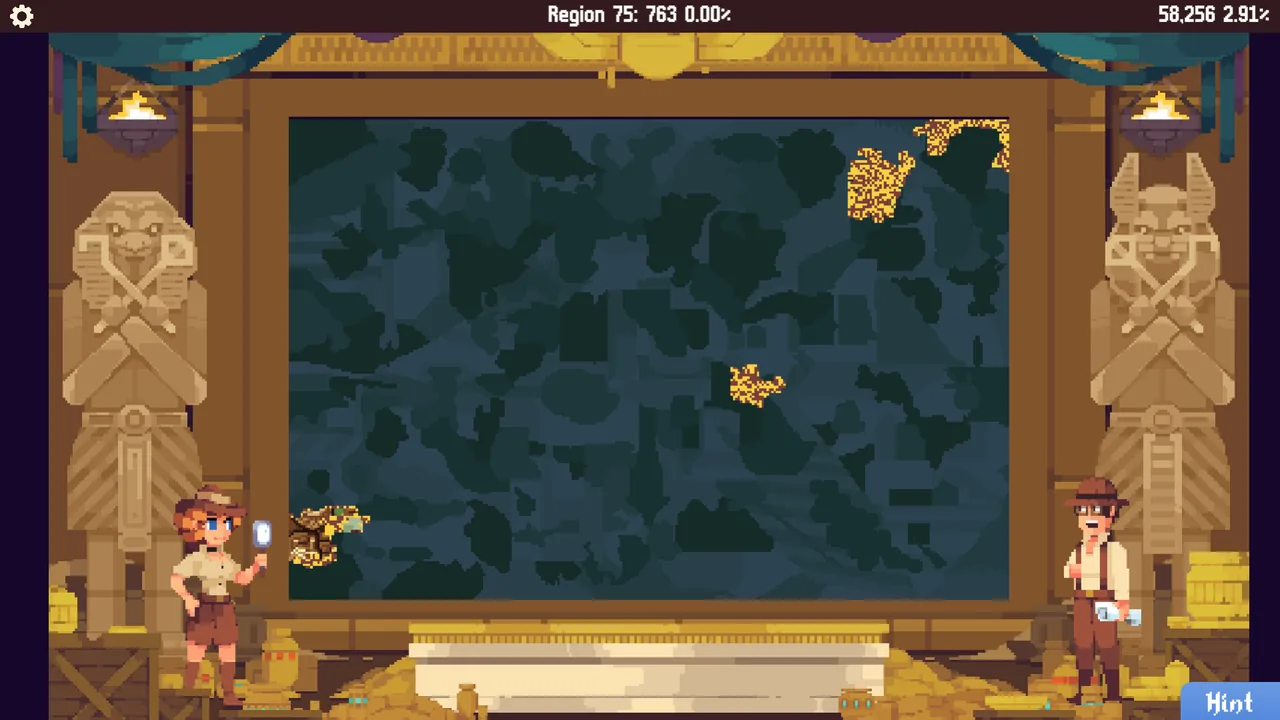
Ninety seconds with Mosaic of The Pharaohs' Steam page and the aggregator tag that sent this review here — Clicker — stops making sense. There's no button to mash and no number ticking up on its own. What's actually on screen is a single dark grid the size of a small city block, seeded with numbered clues, and a counter in the corner that reads "58,256" tiles remaining out of a total that only ever gets smaller by hand. This is a nonogram, built the way Minesweeper teaches you to read numbers, and it is enormous.
What it actually is
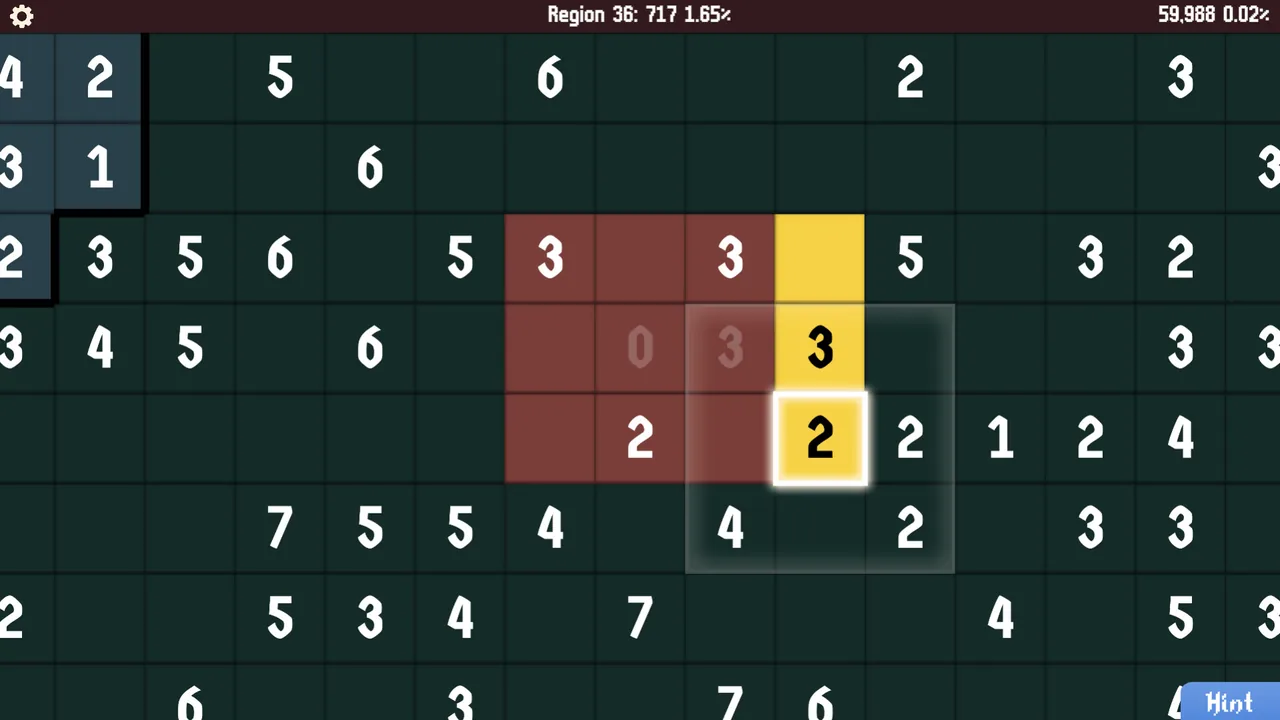
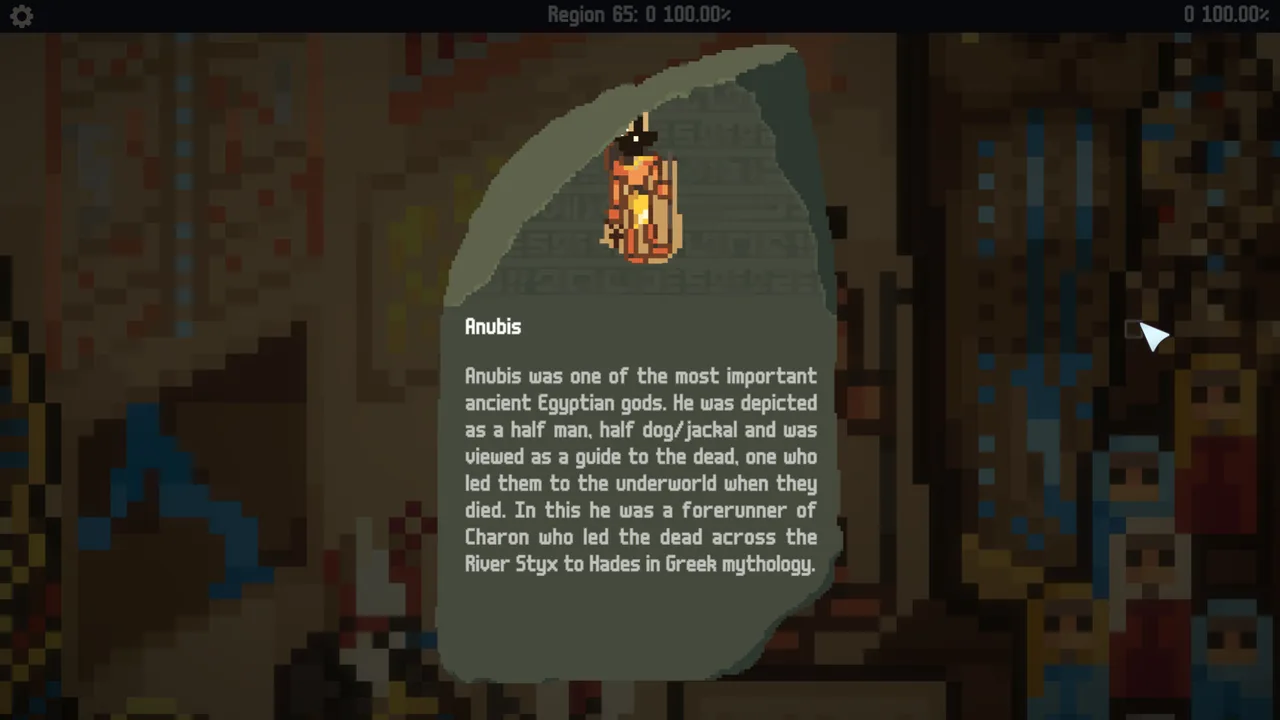
The store page says it plainly, if you read past the genre field: "digital cross-stitch," a single 60,000-plus-piece grid puzzle. Each cell carries a clue from 0 to 9, exactly like a Minesweeper mine count, except instead of avoiding mines you're identifying which neighbouring tiles belong to the finished picture. Solve enough of a region and it locks in, a chunk of a much larger pixel-art scene resolves out of the dark, and a short history-fact card pops up naming whatever you've just uncovered — a monument, a god, an artefact. The full grid is broken into more than 200 of these numbered regions (the screenshots alone show Region 3, Region 36, Region 65, Region 75 and Region 219), each with its own local completion percentage sitting inside a global one that creeps up a fraction of a percent at a time.
Steam's official genre field just says Casual, which explains nothing, so the vote-weighted community tags — pulled from the store page's tag-modal script rather than the ordered pills underneath the screenshots — are the more honest source. They tell an odd story: Incremental (190 votes) and Collectathon (185) actually outrank Puzzle (182), with Education (183) and Historical (163) close behind and Logic sitting further down at 105. Read uncharitably, that looks like confirmation of the Clicker mislabel. Read against what the game actually does, it's closer to Steam's tagging culture reacting to the shape of the experience — a slow number climbing over dozens of hours, a long collectible run of history facts — rather than to its core mechanic, which is unambiguously a logic-deduction puzzle. This is the developer's third release in a self-described "Mosaic" series, and multiple reviewers reference an earlier one, Proverbs, as the reason they bought this one on sight — this isn't a new designer improvising a genre, it's an established format being run again with a new theme.
A puzzle the size of a small city
The value question this review was asked to answer directly starts here, because content volume is the argument at this price. This is not a level pack. It's one image, built from 60,000-plus individually solvable tiles, sliced into 200-plus discrete puzzle sections each with its own clue grid, discovery fact and completion percentage. Reviewers who finished it report totals in the 15-30 hour range, and that holds on both sides of the recommendation split: the median playtime among the game's English negative reviews is 15.2 hours, and among positive reviews 19.9 hours — people who disliked it and people who loved it put in comparable, substantial time either way, which is a marker of a puzzle that resists getting finished by accident. One five-vote positive review, candid about the whole genre rather than just this entry, calls Ffrench's mosaic games "probably slightly pricey for what they are, but there just isn't anything else quite like them." That's close to this review's own conclusion: NZ$13.25 for 20-plus hours of engaged puzzle-solving is a defensible rate next to games charging a third of that for a fraction of the content, even if it's not an outright bargain.
Where the difficulty curve actually breaks
Valve's achievement data backs the size claim up with numbers rather than anecdote. Ninety-seven of the game's 99 achievements are per-region "discovery" awards, and they sit in an unusually tight band — 76.6% down to 64.0% — which tracks with what you'd expect from a puzzle solved piecemeal: almost everyone who buys it clears a comparable chunk of the map before deciding whether to keep going. There's no early cliff here, no first-hour dropout the way many of this library's shorter idle and incremental titles show.
The two outliers are the two hardest achievements by design, not by accident: a 100%-completion award sitting at 50.9%, and a further secret achievement at 42.0%. Just over half of everyone who owns this game finishes the entire 60,000-tile grid, and over four in ten go past that into whatever the secret unlock rewards. For a single-puzzle game this size, that's a genuinely high finish rate — most open-world completion achievements in games this library has reviewed sit in the single digits. The trade-off is honest, too: this is the flip side of having no replayability. Once you've filled in the picture, that's the whole game, and the achievement curve shows most buyers actually see it through to the end rather than shelving it halfway.
The AI-text question
The corpus here is small enough to read completely — eleven English-language negative reviews in total, against 175 positive — and that smallness makes a pattern in the top three unusually loud. All three of the highest-voted negatives (29, 25 and 15 votes, dated February, April and May 2026 respectively — recent, not a launch-week cluster) independently raise the same specific accusation: that the roughly 100 historical fact cards were written, or partly rewritten, by generative AI. One points to "classic Gen AI sentence structures," another to misplaced closing quotation marks and phrasing that echoes AI-generated search summaries, and notes that while the designer and artists are credited, no writer is credited anywhere. A third, at 13.8 hours played, extends the same suspicion to the puzzle layout itself, guessing some regions are algorithmically generated because a handful run five tiles or smaller.
None of this is something a review corpus can verify — nobody outside the studio can audit where a sentence came from — and this review won't assert it as settled fact. What can be checked is the store page itself, and as of this review it carries no AI Generated Content Disclosure section at all, so there is no developer statement on record either way. That's worth knowing plainly: three unrelated players reached the same specific, detailed suspicion independently, on a game that markets its trivia as one of its two headline features, and the publisher hasn't addressed it on the page where a buyer would see it.
A developer who kept patching
Set against that, the update history is a point in the game's favour. Six posts run from launch on 29 March 2025 through to 27 May 2026 — over a year of continued support, not the three-day burst this library has flagged on cheaper games in the same price bracket. The most substantial update, 1.1.05195, rewrote in-game descriptions, added full gamepad support with an official Steam Input configuration for Steam Deck, fixed achievements that weren't popping until a restart, added an onscreen undo button, a countdown mode and scroll-sensitivity controls. Two of the eleven English negatives complain the game was unplayable with default controls on Steam Deck — both dated October and December 2025, both before that patch landed. The complaint was real when it was written and the fix genuinely answers it, even though it came too late for the reviewers who'd already bounced off.
Sound and visuals
The pixel-art scenes that resolve out of each completed region are the game's best-looking asset — warm, detailed, and worth the slow reveal — and the presentation around them, painted-stone lore cards and torch-lit museum framing, sells the Egyptology theme well. It isn't flawless: one reviewer flagged sound effects mixed inconsistently loud against the rest of the audio, and the built-in Egyptian soundtrack is more functional backdrop than a reason to buy on its own — the store page itself pitches the game as something to run under a podcast rather than for its music. None of this is a serious mark against a puzzle game whose main visual job is legibility of numbers on a grid, which it handles cleanly throughout.
The verdict
Mosaic of The Pharaohs earns a 7.2. It is exactly as big as it claims to be — a single 60,000-tile puzzle that the achievement data proves most buyers actually finish — built on a clean, easy-to-learn hybrid of minesweeper logic and nonogram deduction, and supported by a developer who kept shipping fixes and accessibility features more than a year after launch. NZ$13.25 is a real price for this genre, but the hours-per-dollar case holds up against cheaper games with far less content behind them.
What keeps it out of the 8s is that unresolved question sitting at the top of its own review page: three independent, detailed accusations of undisclosed AI-written trivia, on a game that sells its educational angle as hard as its puzzle design, with no statement from the publisher either way. Buy it for the puzzle, which is real, huge, and genuinely well-supported. Go in with open eyes about the facts scrolling past as you solve it.
Pros and cons
Pros
- A single continuous 60,000-plus-tile puzzle spans 200-plus numbered regions, and achievement data shows just over half of all owners (50.9%) push through to full completion
- The May 2026 update added full gamepad support with an official Steam Deck configuration, an onscreen undo button, countdown mode and scroll-sensitivity controls, directly answering earlier accessibility complaints
- Median playtime sits near 15-30 hours across both positive and negative reviewers, putting the cost per hour of engagement below several cheaper games reviewed alongside it
- The minesweeper-clue-plus-nonogram-grid hybrid is easy to learn and reviewers describe it as an oddly effective way to unwind, one calling it "the perfect way to decompress"
- Clean, one-time NZ$13.25 purchase with no ads, in-app purchases, subscriptions or DLC of any kind
Cons
- Three of the game's only eleven English negative reviews, its three most-upvoted, independently accuse the near-100 historical trivia entries of being undisclosed generative AI text, and the store page carries no AI-content disclosure section
- The entire game is one puzzle: once it's solved there is nothing left to replay, and the design has no mechanical escalation beyond sheer duration
- Steam's own vote-weighted community tags rank Incremental and Collectathon ahead of Puzzle, showing the aggregator's Clicker label isn't the only genre mismatch this game attracts
- Two negative reviews, both dated before the May 2026 patch, reported the game was effectively unplayable with default controls on Steam Deck
- The developer is credited only as designer and artist, with no writer credited anywhere, which is exactly the gap the AI-authorship complaints are pointing at
Screenshots
-
Mosaic of The PharaohsImage: Divide The Plunder via Steam -
Mosaic of The PharaohsImage: Divide The Plunder via Steam -
Mosaic of The PharaohsImage: Divide The Plunder via Steam -
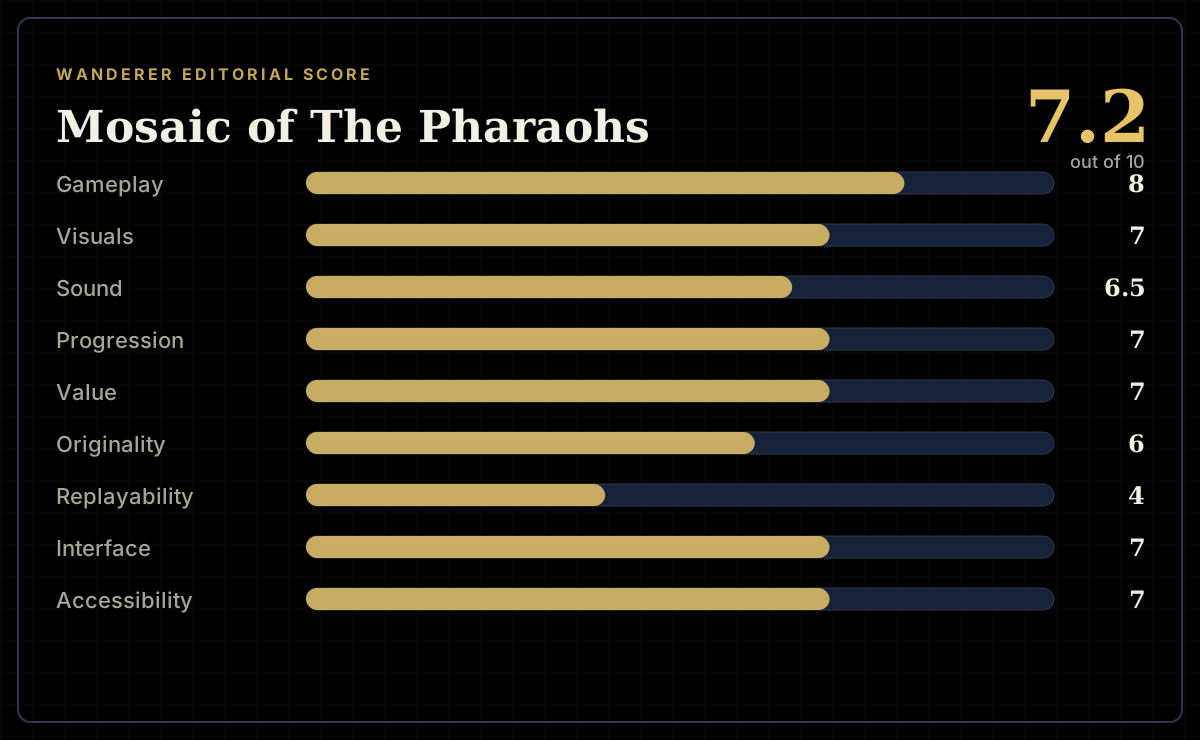
How the review scores each part of the gameWanderer Editorial -
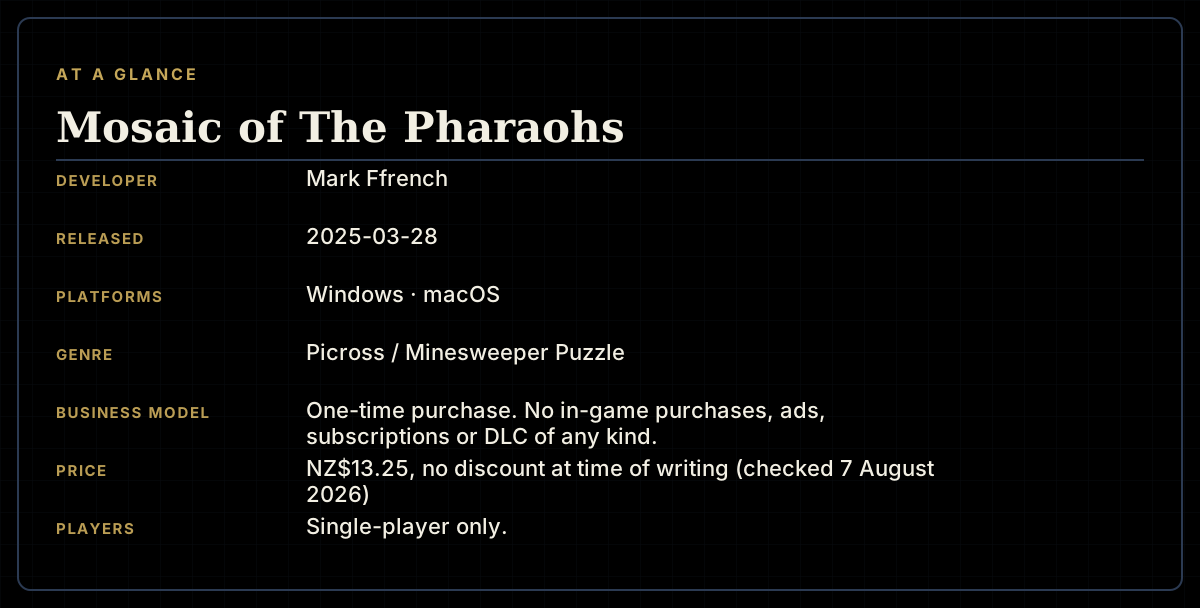
At a glanceWanderer Editorial -
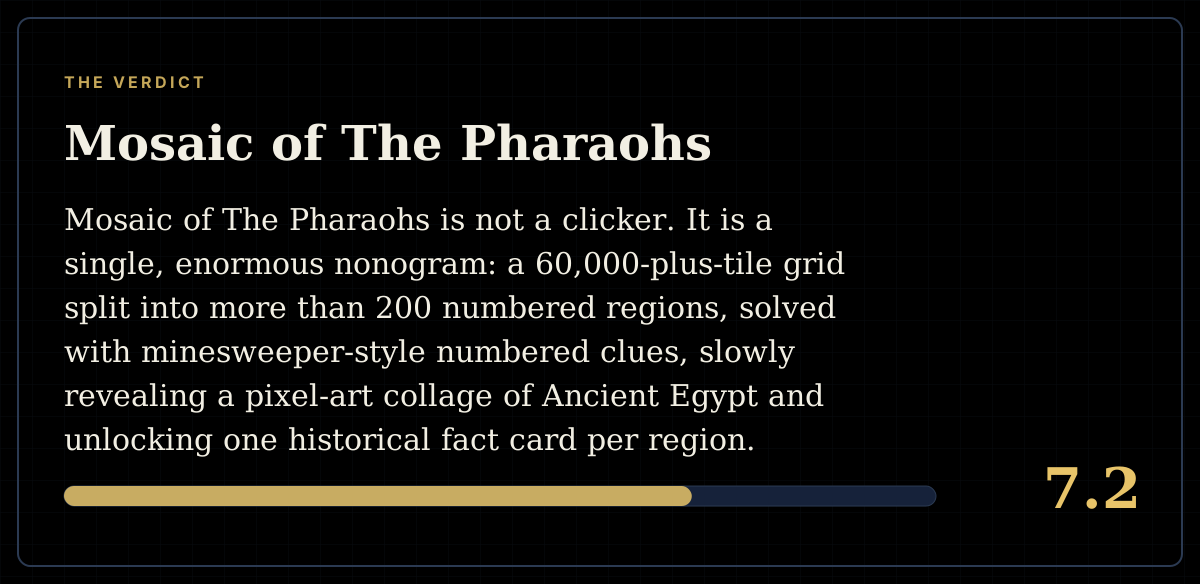
The short versionWanderer Editorial