
Game review
Mortal Kombat 11
6 / 10
- Developer
- NetherRealm Studios
- Publisher
- Warner Bros. Games
- Released
- 23 April 2019
- Platforms
- Windows
- Genre
- Fighting
- Monetisation
- Paid, with 27 additional purchasable DLC items and an in-game multi-currency loot system
- Players
- true
The short version
Mortal Kombat 11's fighting itself is, by wide agreement even among its harshest critics, one of the best in the series — smooth combat flow, a genuinely strong tutorial system, a large and varied cast, and an unusually well-regarded story mode. None of that is the reason its Steam review corpus's most-upvoted entries, by a wide margin, are about business practices instead: a multi-currency Krypt loot system built around expensive RNG chests, an always-online requirement that can cut off singleplayer content mid-session, and Premium Edition buyers who say the DLC they thought they'd paid for wasn't actually included.
Biggest strengths
- Combat widely described as the best in the franchise's history, with smooth, satisfying flow and improved feel over the previous entry
- An unusually strong, structured tutorial system that reviewers credit with genuinely teaching mechanics rather than just listing move lists
- A large, diverse cast with distinct playstyles that reviewers say meaningfully supports replayability
Biggest weaknesses
- A Krypt reward system built around multiple currencies (Koins, Hearts, and crafting resources among them) and expensive randomised loot chests that don't refresh without spending yet more currency, described by one detailed reviewer as making it "absolutely absurd" to get anything specifically wanted
- An always-online requirement that, per multiple reviewers, can interrupt or fully lock players out of singleplayer content if the connection to NetherRealm's servers drops
- Reviewers who purchased the Premium Edition specifically report that later paid DLC was not included despite believing the edition would cover future add-on content
Who it's for: Fighting game fans who want the series' best-regarded combat system and are prepared to either ignore the Krypt entirely or budget real additional money and patience for it.
Our recommendation: Worth it for the fighting alone if you can mentally write off the Krypt and cosmetic grind as unavailable content rather than something to chase — go in with your expectations calibrated to the business model, not the box art.
6 / 10
What it is
Mortal Kombat 11 is NetherRealm Studios' entry in the long-running fighting franchise, built around the same time-travel-adjacent story hook the series has used to justify bringing back classic characters at different points in their lives alongside new additions like Geras and Cetrion. The core fighting system draws consistent praise even from the corpus's most scathing reviews: "gameplay is phenomenal, the flow of combat is extremely satisfying and smooth, way better than MK-X," writes one detailed 40-hour review before pivoting entirely to the game's business model for the rest of its length — a structure that repeats across dozens of reviews in this corpus. The single-player side includes a story mode multiple reviewers single out as one of the series' better efforts, alongside an unusually well-built tutorial system that one reviewer specifically credits with bringing new players "up to a decent level" through structured, detailed explanations rather than a bare move list.
It released on 23 April 2019 at NZD 82.95, developed by NetherRealm Studios and published by Warner Bros. Games, with 27 separate DLC listings on its Steam store page. Its review corpus of 25,907 English-language reviews sits at a genuinely strong Very Positive (22,488 to 3,419) — but the shape of that corpus, once read past the raw percentage, tells a much more specific story than "widely liked."
The pattern: business practices outrank the fighting itself
Sorting this corpus by vote count surfaces the same pattern this outlet has documented in several other major 2019-era releases: when a single review's upvotes dwarf the typical distribution, it's very often not actually about the core gameplay. Six of the highest-voted reviews here — carrying 2,092, 1,764, 1,214, 1,054, 530, and 361 votes respectively, numbers that separate them enormously from the broader corpus — are all, in whole or in large part, about Mortal Kombat 11's monetisation and always-online design rather than its combat. "Fantastic game, horrible business practices," reads one of the shorter, most-quoted framings, and it's a fair one-line summary of what plays out in detail across the longer reviews.
The specifics are concrete and repeated independently across multiple reviewers rather than appearing in just one outlier account. The Krypt — an explorable hub where players open chests for cosmetics, gear and consumables — runs on several separate currencies simultaneously, and one detailed review lays out the mechanics precisely: high-value chests can cost around 13,000 currency, chests don't restock once opened without spending more currency to refresh them, and at least one specific unlock (a headband for the character Kenshi) burns a scarce crafting resource "at a rate of roughly 2 per second," which that reviewer calls "absolutely absurd." A separate, even more heavily upvoted review generalises the complaint industry-wide: "MOBILE ECONOMIES DO NOT BELONG IN A $90 VIDEO GAME," citing "RNG lootboxes" and "at least three types of microcurrencies" as evidence the game's economy was designed around extraction rather than reward.
Always-online, and a Premium Edition that didn't deliver
A second, distinct complaint concerns server dependency: multiple reviewers report that the game frequently displays a "connecting to server" prompt even when attempting to access single-player content, and that a dropped connection can cut off access entirely rather than degrading gracefully to an offline mode. That's a meaningful design choice for a fighting game whose story mode and challenge towers are ostensibly solo content, and reviewers treat it as a deliberate design philosophy rather than a bug, given how consistently it's reported across accounts from different points in the game's post-launch life.
The Premium Edition complaint is more specific still, and easy to verify as a real grievance rather than a misunderstanding: reviewers who bought the higher-priced edition specifically expecting it to cover "all future add-on content" report discovering afterward that it didn't, with certain cosmetic content ("masquerade skins," in one reviewer's account) sold separately regardless. With 27 DLC listings attached to the base game's Steam page, that's a legitimately large amount of post-launch paid content for a Premium buyer to have reasonably expected coverage for and not received.
A technical wrinkle worth separating out
It's worth noting one complicating factor for anyone reading this review corpus directly: a large, roughly 80GB patch caused genuine technical disruption for some players and triggered a wave of review activity that at least one reviewer explicitly describes as unfair "review-bombing" distinct from actual opinions about the game's design. That's a useful caveat for interpreting any specific dip in review sentiment tied to that period — some of what shows up there reflects a specific, resolved technical incident rather than an enduring verdict on the base game or its monetisation, which are separate, more persistent complaints documented independently across the corpus's whole lifespan.
Weighing the two halves against each other
The most useful way to read this game's reception is as two largely separate verdicts that happen to share a review corpus. On the fighting-game fundamentals, there's remarkably little dispute: combat flow, character variety, tutorialisation and story presentation draw praise across almost every review checked for this piece, including ones that ultimately land on "not recommended." On the business model, the picture is just as consistent in the opposite direction — reviewers who list Krypt mechanics, always-online requirements, or Premium Edition shortfalls in detail do so with the kind of granular, first-hand specificity (exact currency costs, exact drain rates, exact DLC titles withheld) that comes from genuine, sustained frustration rather than a pile-on. A prospective buyer isn't really choosing between "is this a good fighting game" and "is this a fair business model" as a single yes-or-no question; the honest answer, borne out by the review corpus itself, is yes to the first and no to the second, and the overall recommendation has to hold both truths at once rather than averaging them into a vague middle score that misrepresents either side.
Verdict
Mortal Kombat 11's fighting system, character roster, tutorial design and story mode are genuinely excellent by wide agreement — including from reviewers who otherwise excoriate the game. What holds it back from an easy, uncomplicated recommendation is a business model layered on top that a large and specific portion of its own player base considers actively hostile: an expensive, multi-currency loot grind, an always-online requirement with real consequences for singleplayer access, and a premium tier that didn't cover what buyers reasonably expected. Play it for the combat, and budget your expectations for the Krypt accordingly.
Pros and cons
Pros
- Combat widely described as the best in the franchise's history, with smooth, satisfying flow and improved feel over the previous entry
- An unusually strong, structured tutorial system that reviewers credit with genuinely teaching mechanics rather than just listing move lists
- A large, diverse cast with distinct playstyles that reviewers say meaningfully supports replayability
- A well-regarded story mode and cinematic presentation, including fatalities multiple reviewers call the best the series has produced
Cons
- A Krypt reward system built around multiple currencies (Koins, Hearts, and crafting resources among them) and expensive randomised loot chests that don't refresh without spending yet more currency, described by one detailed reviewer as making it "absolutely absurd" to get anything specifically wanted
- An always-online requirement that, per multiple reviewers, can interrupt or fully lock players out of singleplayer content if the connection to NetherRealm's servers drops
- Reviewers who purchased the Premium Edition specifically report that later paid DLC was not included despite believing the edition would cover future add-on content
- Playable characters and cosmetics locked behind grind or additional purchase in a full-price release, a specific complaint from multiple reviewers who otherwise rate the base game highly
- A large, roughly 80GB post-launch patch caused real technical disruption and triggered a wave of review-bombing distinct from opinions on the underlying game, muddying the review corpus's signal around that period
Screenshots
-

Mortal Kombat 11Image: Warner Bros. Games via Steam -

Mortal Kombat 11Image: Warner Bros. Games via Steam -

Mortal Kombat 11Image: Warner Bros. Games via Steam -
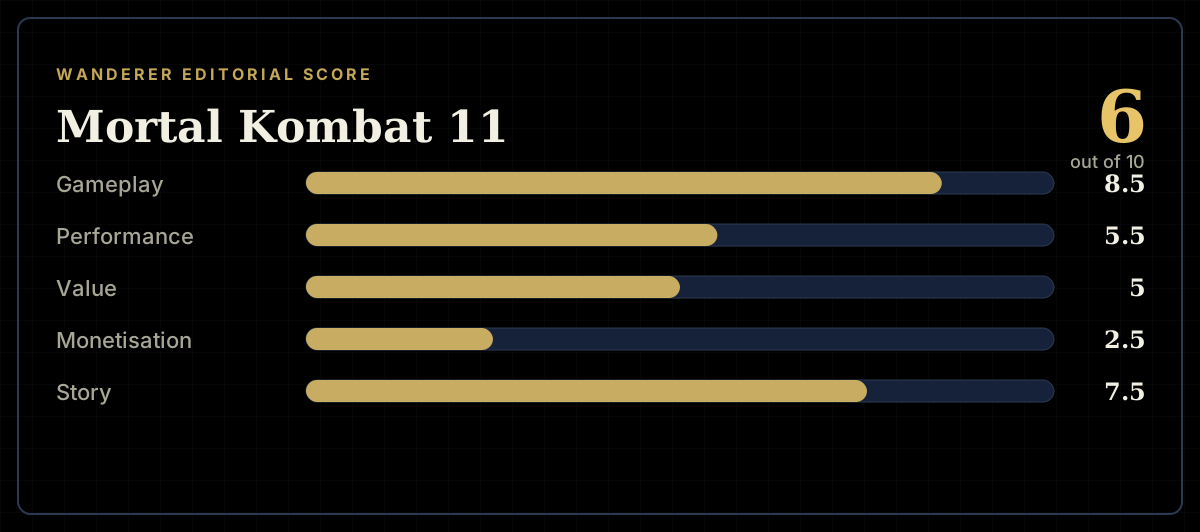
How the review scores each part of the gameWanderer Editorial -
The short versionWanderer Editorial