
Game review
Mirage Online Classic
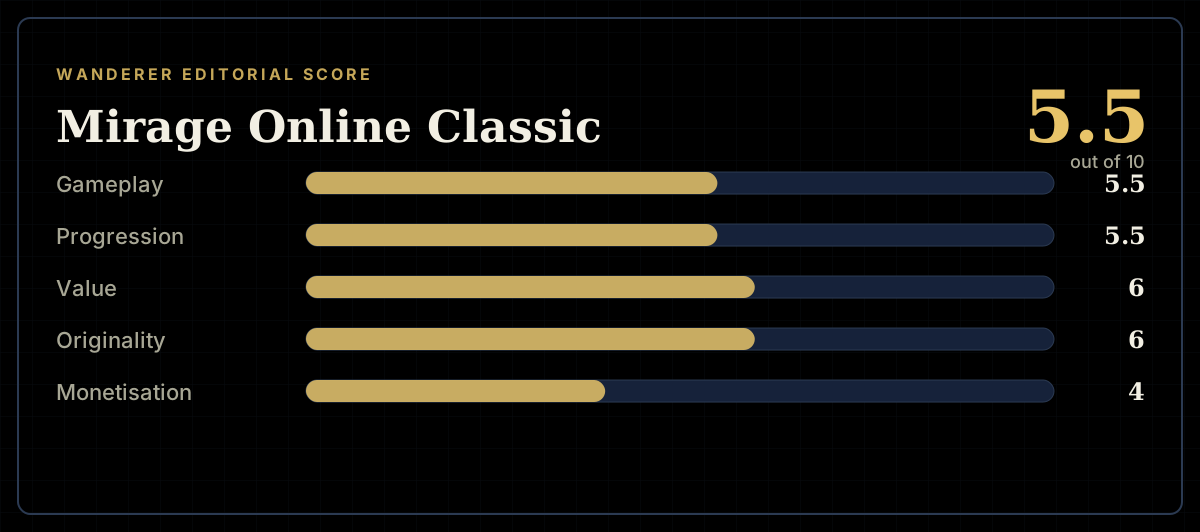
5.5 / 10
- Developer
- Retrelon Games, LLC
- Publisher
- Retrelon Games, LLC
- Released
- 30 December 2019
- Platforms
- Windows, Linux
- Genre
- MMORPG
- Monetisation
- Free-to-play; store lists In-App Purchases despite a marketing claim of none
- Players
- true
The short version
Mirage Online Classic's Steam page is nearly silent — no written reviews, no achievement schema, a barely-there concurrent player count — but its actual development record tells a different story: dozens of substantive, numbered patches running continuously from mid-2021 through at least August 2025, adding a scripting engine, player housing, guild warfare, a battle royale mode and a steady stream of new dungeons. That's a genuinely rare thing for a small, free, six-year-old browser MMO to sustain, even if there's no independent player account here to confirm it's actually fun to play.
Biggest strengths
- An unusually long and substantive documented development history: dozens of numbered patches running from mid-2021 through August 2025, each adding real features rather than just bug fixes
- A genuinely deep toolset behind the game itself: a level editor, an NPC scripting engine, support for player housing, and community-driven content additions
- Free to play with six playable classes and stated idle-reward customisation as part of its character system
Biggest weaknesses
- Zero written Steam reviews exist, so nothing here can be independently corroborated by another player's account of how it actually plays
- No Steam achievement schema at all, removing one of this lane's usual fallback signals for measuring engagement
- The store's own short description claims the game has "no microtransactions," but the Steam category listing includes In-App Purchases — a direct contradiction worth resolving before assuming which is accurate
Who it's for: Nostalgic browser-MMO players and fans of early-2000s-style 2D action RPGs who want to try something still being actively built rather than abandoned.
Our recommendation: Worth trying for free purely on the strength of its development record — go in with the expectation that this review can't independently confirm the moment-to-moment experience, since no one has reviewed it.
5.5 / 10
What it is
Mirage Online Classic bills itself as a callback to "the early days of the internet," a browser-based 2D action MMORPG in the mold of late-1990s and early-2000s community-driven online worlds, deliberately compared in its own marketing to the feel of IRC chatrooms rather than a modern polished MMO. Six classes, each with two abilities, sit alongside customisable stats and what the store page specifically calls "idle rewards" as part of character progression — a detail that puts at least one foot in this lane's usual territory even though the game as a whole is better classified as an MMORPG. The Steam listing functions mainly as a launcher into a game that runs in-browser, with cross-platform support for Windows and Linux.
It arrived on Steam on 30 December 2019, and six years on presents an unusual profile for a review to work with: not a single written Steam review, no achievement schema at all, and a live concurrent-player count on Steam itself reading close to zero. Ordinarily that combination would point toward an abandoned or dead project. Here, it points toward something else entirely once the game's actual development record is checked.
An unusually long, unusually real patch history
Steam's own news feed for this app tells a story its review count doesn't: a long, dense run of substantive, numbered version patches. The feed shows entries running continuously from patch v1996 in July 2021 through at least August 2025 — nearly four straight years of documented, dated updates, covering everything from bug fixes to genuinely significant systems work. One 2025 update alone adds five new dungeons (each with distinct level-60 gear rewards), three new "pacifism" mission types letting players trade resources for experience without combat, and rebalances several existing reward tables. A separate patch-note post rounding up engine changes since September 2023 lists dozens of individual additions: support for player housing, a battle royale team mode, NPC drop-table scripting access, door-and-switch interaction logic, and a 30-day grace period added to account deletion requests — the kind of granular, considered systems work that speaks to a real, ongoing codebase rather than a project on life support.
That's a genuinely uncommon thing to find attached to a completely unreviewed, near-zero-visible- player Steam listing. Whatever this game's actual population looks like, the people building it have kept building it, seriously, for years past the point most small free MMOs go quiet.
A contradiction worth flagging plainly
The store page's own short description states the game provides "unparalleled player-developer interaction" as "the best browser game with no microtransactions." The same Steam listing's category tags directly contradict that specific claim, including "In-App Purchases" among the game's listed features. This review can't resolve which framing is accurate without independently verifying what, if anything, is actually for sale inside the game — but the contradiction itself is worth surfacing rather than picking a side, since it's the kind of discrepancy a prospective player should know to check for themselves before assuming either description is the full picture.
What can't be verified here
It would be dishonest to write around the central limitation of this review: there is no independent player account anywhere in the usual sources — no written Steam review, no forum thread quoted in a review, no achievement-completion curve — describing what it actually feels like to play Mirage Online Classic day to day. The development record argues strongly that there's a real, functioning game with real depth behind the marketing copy; it says nothing about whether combat feels responsive, whether the current playerbase is large enough to make PvP and guild content actually work, or whether new players are onboarded well into a game built up in this many incremental layers over six years. The near-zero Steam concurrent count is the one hard number available, and while it likely understates real activity given the game's browser-first design, it's also the only externally verifiable population signal this review has, and it should temper any expectation of a bustling, populated world.
Why the tooling matters more than it might seem
It's worth dwelling on why a level editor and an NPC scripting engine are significant details rather than incidental ones. Most small, free MMOs that survive years past launch do so because their developers keep hand-authoring new content themselves, a model that scales poorly and is the usual point where a small studio's momentum runs out — new zones and quests get more expensive to produce as the years go on, while the audience that would justify the effort often shrinks. A scripting engine that exposes NPC drop tables, map events and custom kill logic to whoever is building content changes that equation, because it means new dungeons and missions (like the five added in a single 2025 update) can be assembled faster and by more people than a hand-coded content pipeline allows. Combined with the "includes level editor" category tag on the store page itself, this reads like a deliberate long-term strategy for keeping a small MMO's content treadmill running without requiring proportionally larger investment every year — which would explain, better than luck or stubbornness alone, how a completely unreviewed game with a near-invisible Steam footprint has still produced a denser patch history than many far more visible 2019 releases in this same lane.
The idle-rewards detail and where this game actually sits
The store page's specific mention of customisable "idle rewards" as part of the character system is worth flagging for readers of this specific outlet, even though the game as a whole is best filed under MMORPG rather than idle/incremental. It suggests at least some accommodation for players who can't commit to active, synchronous play sessions — a real practical consideration for a persistent multiplayer world with (per the visible Steam data) a very small population, where finding other players online at the same time may not always be reliable. Whether that idle-reward system is substantial enough to make solo, asynchronous play genuinely viable, or just a minor convenience layered on top of what's still fundamentally a multiplayer-first design, is exactly the kind of detail this review can't confirm without a player account to draw on.
Verdict
Mirage Online Classic is a genuine anomaly: a small, free, completely unreviewed browser MMO with one of the more substantive, continuously active development records this lane has found in the 2019 release year. That record earns it a real, if cautious, recommendation to try — but this is a review built entirely from the outside looking in, and anyone going in should treat the total silence from actual players as a real gap in what's knowable here, not as evidence either way about whether the game delivers on what its development team has clearly kept building.
Pros and cons
Pros
- An unusually long and substantive documented development history: dozens of numbered patches running from mid-2021 through August 2025, each adding real features rather than just bug fixes
- A genuinely deep toolset behind the game itself: a level editor, an NPC scripting engine, support for player housing, and community-driven content additions
- Free to play with six playable classes and stated idle-reward customisation as part of its character system
- Frequent new-content patches (multiple new dungeons and mission types added in a single 2025 update) suggest the developer is still actively growing the game, not just maintaining it
Cons
- Zero written Steam reviews exist, so nothing here can be independently corroborated by another player's account of how it actually plays
- No Steam achievement schema at all, removing one of this lane's usual fallback signals for measuring engagement
- The store's own short description claims the game has "no microtransactions," but the Steam category listing includes In-App Purchases — a direct contradiction worth resolving before assuming which is accurate
- Steam's live concurrent-player counter reads close to zero, though this likely reflects the game being played directly in-browser outside the Steam client rather than genuine inactivity
Screenshots
-

Mirage Online ClassicImage: Retrelon Games, LLC via Steam -

Mirage Online ClassicImage: Retrelon Games, LLC via Steam -

Mirage Online ClassicImage: Retrelon Games, LLC via Steam -
How the review scores each part of the gameWanderer Editorial -
The short versionWanderer Editorial