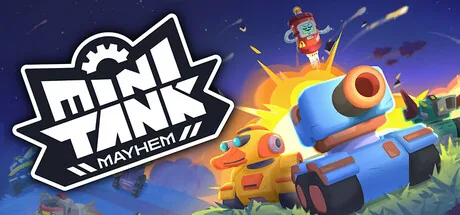
Game review
Mini Tank Mayhem
6.9 / 10
- Developer
- Algorocks
- Publisher
- Algorocks
- Released
- 29 April 2026
- Platforms
- [Windows]
- Genre
- Strategy
- Monetisation
- Premium
- Players
- false
The short version
Mini Tank Mayhem fuses deckbuilding and tower defense about as well as anyone has, with genuine card synergy and a satisfying loop, but grindy pacing, a punishing shared difficulty system, and a thin card-and-map pool keep it from reaching the genre's best.
Biggest strengths
- A genuinely well-integrated fusion of deckbuilding and tower defense, not just one genre skinned over the other
- Deep card, artifact, and tower synergy that rewards experimentation, with several distinct commanders and factions to build around
- Charming, stylized art and satisfying combat feedback, with juicy visual and sound effects that reviewers repeatedly praise
Biggest weaknesses
- Grindy, repetitive runs, few maps that repeat constantly once players are familiar with them
- Inconsistent difficulty tuning: some players find broken infinite-loop combos trivialize runs, others find early RNG and card costs punishing
- The global 'Threat' scaling system ties meta-progression to a single leader, discouraging players from trying new characters
Who it's for: Slay the Spire and deckbuilder fans curious about a tower defense spin, and TD players willing to learn a genuinely card-driven strategy layer.
Our recommendation: Recommended
6.9 / 10
A long road to launch day
Mini Tank Mayhem, developed and self-published by Algorocks, released fully on April 29, 2026, after nearly two years of public development, a demo cycle stretching back to mid-2025, and multiple Next Fest appearances. Its pitch is a genre mashup that's become increasingly common in the wake of Slay the Spire's dominance: take that game's branching-map, deck-and-relic structure, and replace its turn-based combat with tower defense waves, commanding a mini-tank and a roster of deployable towers instead of a single hand of attack cards. It launched to a Very Positive reception, 105 reviews and roughly 89% positive, with the review sample split between players who think the fusion is genuinely novel and those who feel each half of the hybrid is a little underbaked.
The hybrid actually works
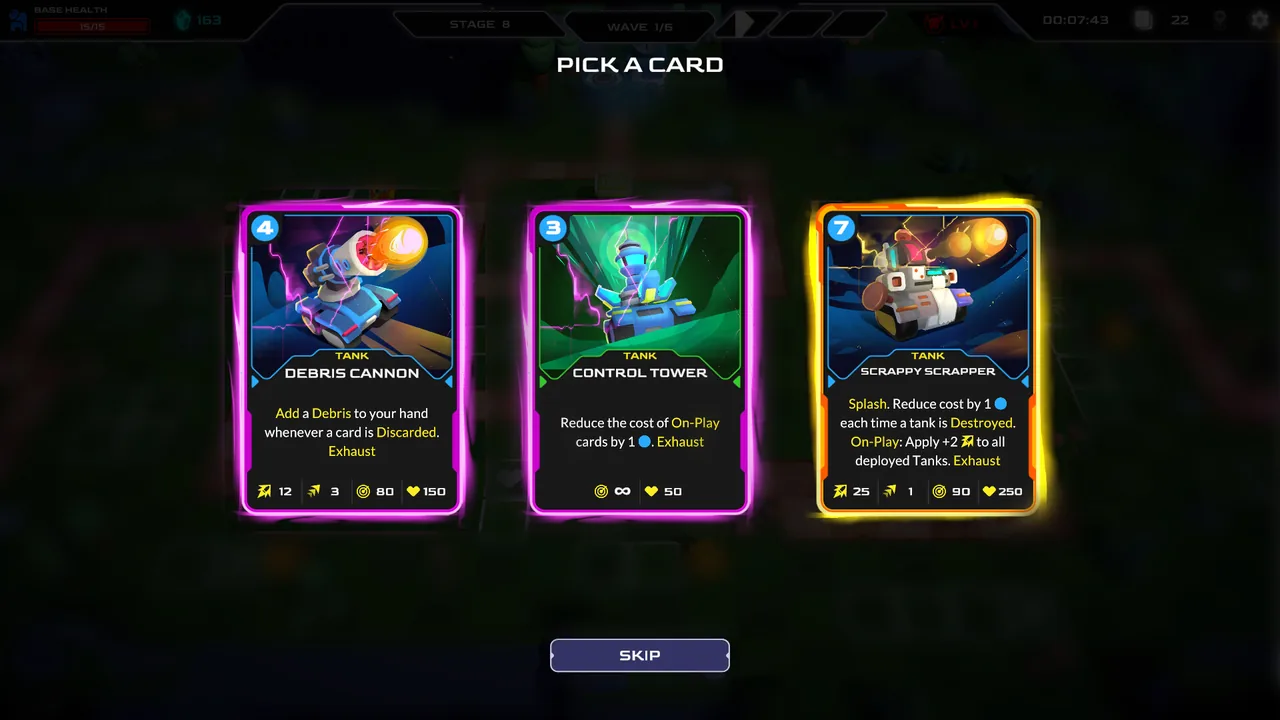
The most consistent praise across the sample is that the core idea isn't just a gimmick. Reviewers across English, German, and Japanese repeatedly describe the card-and-tower interplay as "properly a card game," not a thin deckbuilding skin over a standard TD loop, with genuine synergies between card draw, energy costs, and tower placement that reward planning rather than pure reflexes. One German reviewer calls it "a masterpiece" that captures what fans of Slay the Spire and Monster Train love about deckbuilding while giving Plants vs. Zombies and Bloons TD fans something familiar too. Multiple commanders and factions, plus a large pool of cards and artifacts to unlock, give the promise of real build diversity across runs.
Presentation lands well
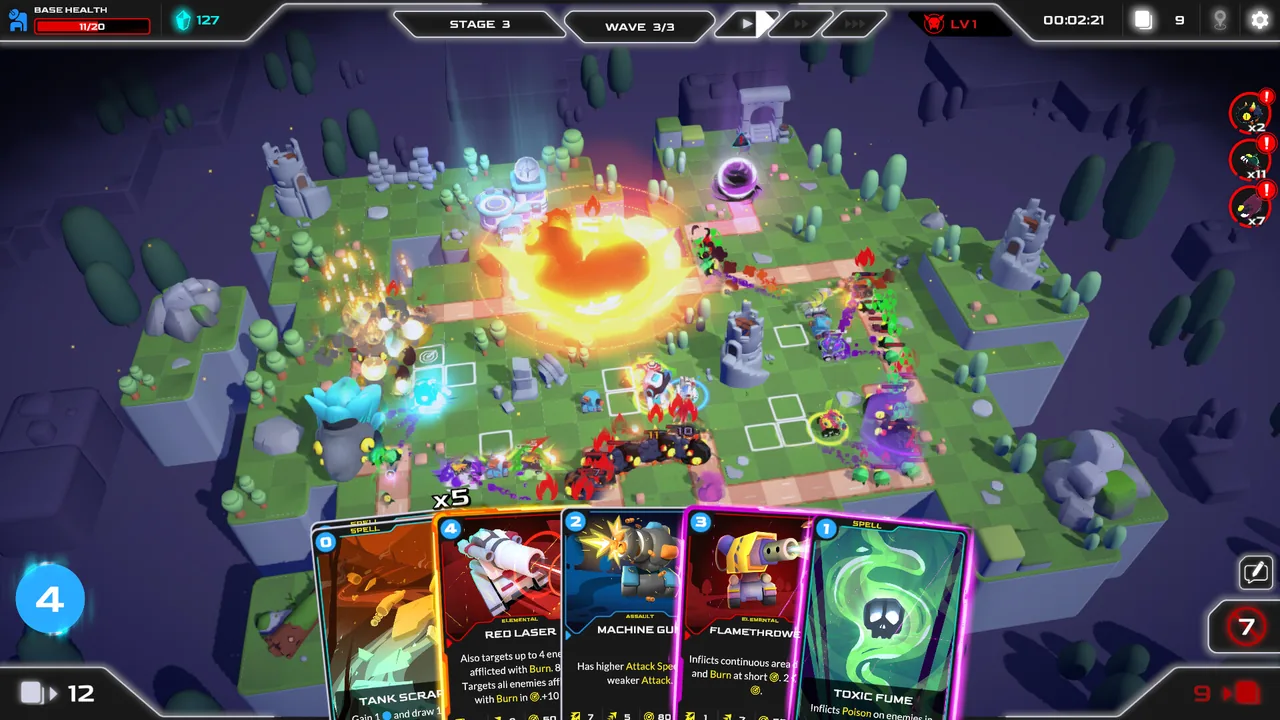
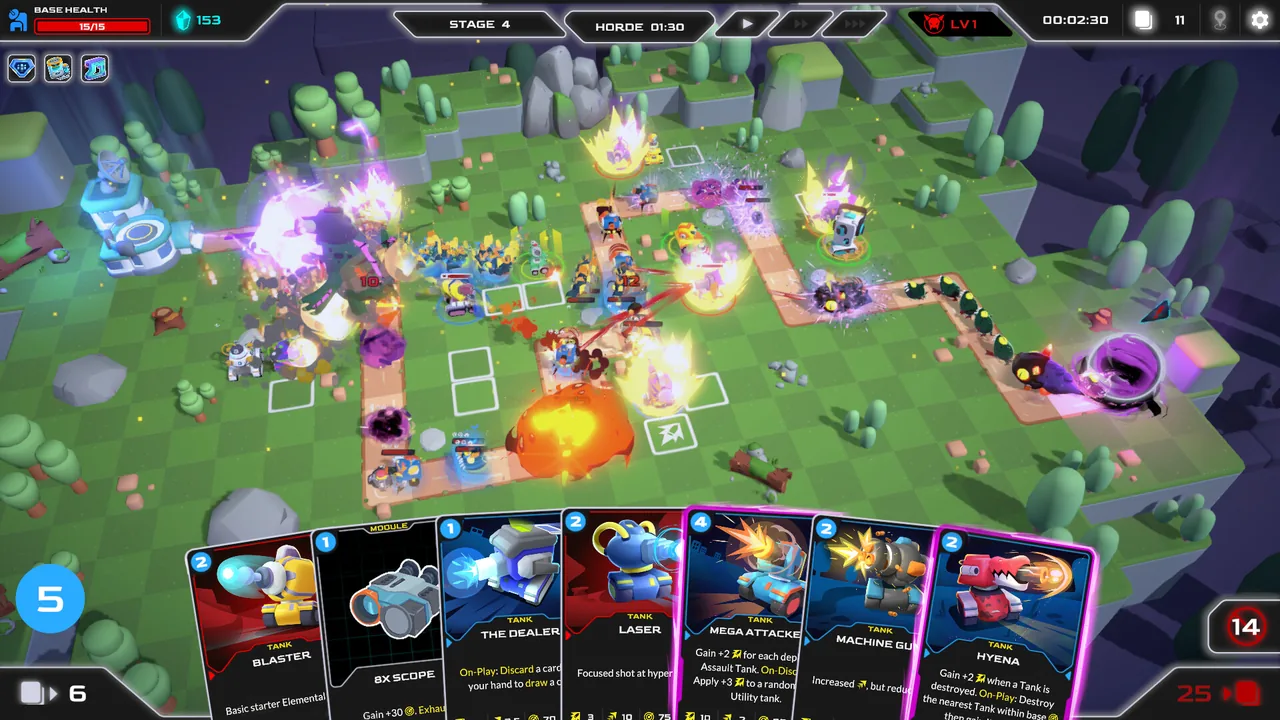
The stylized, slightly sinister tank designs and overall visual presentation earn consistent praise, several reviewers specifically call out the "juicy" visual and sound feedback, satisfying hit effects, and a soundtrack that suits the game's tongue-in-cheek alien-invasion premise. The interface itself is generally well-received too, with reviewers noting a clean UI and reasonable pacing despite the genre's inherent complexity, though a few flag loading screens between actions as an unnecessary friction point.
Grind and repetition wear thin
The most common substantive complaint is that runs start to blur together. With a relatively small pool of maps and battlefields that repeat constantly, several reviewers note that once you're familiar with a given layout you know exactly what to expect, undercutting the roguelite promise of fresh challenges each run. One reviewer, generally positive, still flags this directly as the game's biggest weakness: solid foundations, light on actual variety. Run length is a related sticking point, several reviewers say individual runs feel too long for the amount of moment-to-moment decision-making on offer, with padded early waves that amount to busywork before the interesting choices show up.
A punishing, uneven difficulty curve
Difficulty tuning draws genuinely split reactions, and it's worth reporting both sides honestly. Some reviewers report finding broken, near-infinite combo loops with specific starting decks that trivialize entire runs, one Japanese reviewer documents a looping "Capacitor" starter-card combo that renders certain character-and-tank combinations nearly unloseable. Others report the opposite experience: early-game RNG that can strand a run with expensive, unusable card costs and no viable path forward, with one reviewer calling it "the most grindy and punishing" roguelite deckbuilder they've played, unfavorably compared to Slay the Spire's more forgiving fresh-file difficulty curve. That kind of inconsistency, some players sailing through on exploits while others get walled by bad luck, points to balance work that clearly still needs attention post-launch.
The Threat system's real cost
A specific structural complaint recurs often enough to flag on its own: the game's global "Threat" difficulty scaling is tied to whichever leader a player has been using, meaning hours of progress on one character doesn't transfer if a player wants to try a different hero with their unlocked card compendium. One reviewer describes investing four hours and multiple Area 3 clears on one leader, only to be dropped back to base difficulty when trying someone new, a design choice that actively discourages exactly the kind of build experimentation the card system is built to reward.
Bugs and rough edges
Beyond balance, there's a real spread of reported bugs: card effects like "draw one, discard one" failing to trigger consistently, multiple cost-reduction effects conflicting with each other, and at least one specific localization error where a range stat displayed as 100 instead of the intended 10. A Simplified Chinese reviewer reports a specific progression-blocking issue in a mid-game stage where "discard" card effects stopped working entirely. None of these appear to be universal or unrecoverable, but they add up to a launch that still needed more testing time in specific interaction edge cases.
Where it sits against the deckbuilder wave
Mini Tank Mayhem arrives in an increasingly crowded space of Slay the Spire-influenced hybrids, and its specific angle, genuine tower defense rather than turn-based combat, is a meaningfully different enough hook to stand out. It doesn't match Slay the Spire's decade of iterative balance work, and it shouldn't be expected to at launch, but the foundation here, distinct commanders, real card synergy, tower-placement strategy layered on top of deck construction, is sound enough that continued post-launch patching, which the developer has already begun with several May and June updates, could close much of the gap.
The verdict
Mini Tank Mayhem proves the tower-defense-meets-deckbuilder idea can work as more than a novelty, with genuine card synergy and a satisfying, stylish combat loop backing up its pitch. It's currently held back by repetitive maps, an uneven difficulty curve that swings between broken-easy and punishingly grindy depending on luck, and a Threat-scaling system that discourages experimenting with new characters, issues a determined post-launch patch cycle could meaningfully address.
Pros and cons
Pros
- A genuinely well-integrated fusion of deckbuilding and tower defense, not just one genre skinned over the other
- Deep card, artifact, and tower synergy that rewards experimentation, with several distinct commanders and factions to build around
- Charming, stylized art and satisfying combat feedback, with juicy visual and sound effects that reviewers repeatedly praise
- Steam Deck verified with a well-optimized handheld experience
Cons
- Grindy, repetitive runs, few maps that repeat constantly once players are familiar with them
- Inconsistent difficulty tuning: some players find broken infinite-loop combos trivialize runs, others find early RNG and card costs punishing
- The global 'Threat' scaling system ties meta-progression to a single leader, discouraging players from trying new characters
- A spread of bugs around card and modifier interactions, plus some sloppy localization errors
Screenshots
-
Mini Tank MayhemImage: Algorocks via Steam -
Mini Tank MayhemImage: Algorocks via Steam -
Mini Tank MayhemImage: Algorocks via Steam -
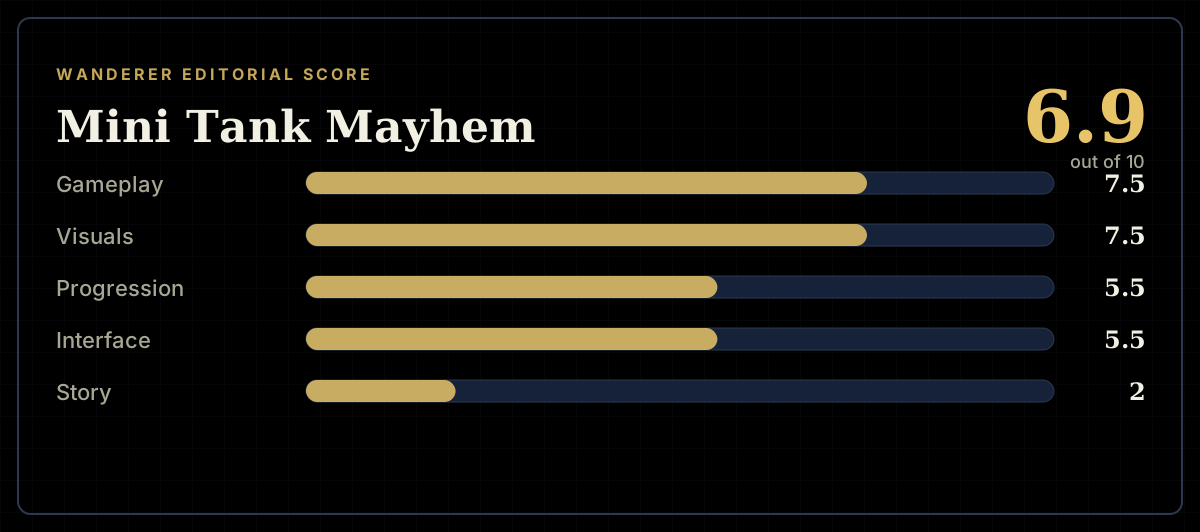
How the review scores each part of the gameWanderer Editorial -
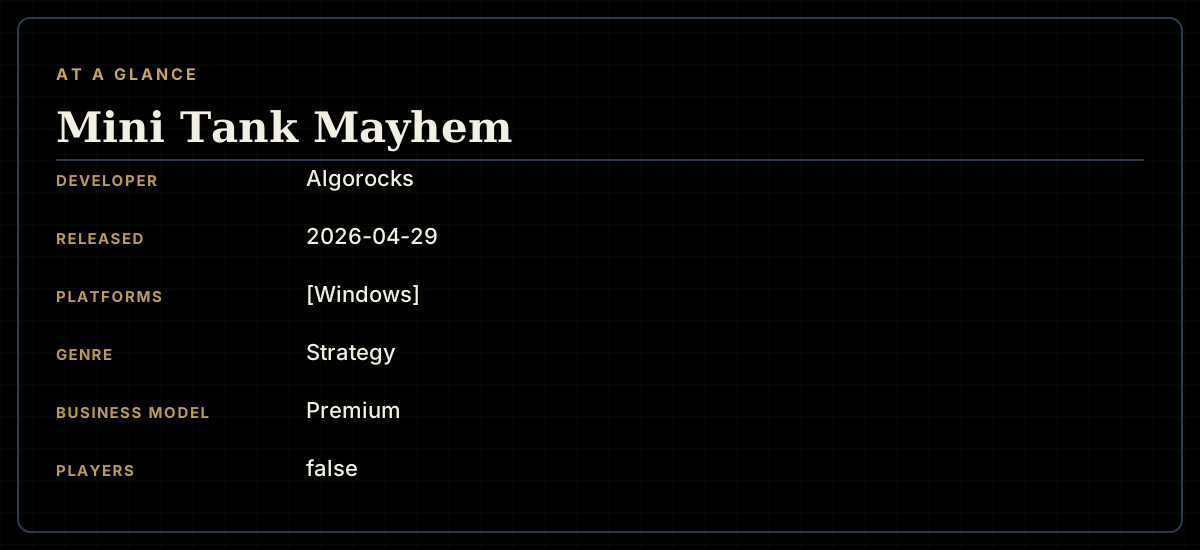
Key facts at a glanceWanderer Editorial -
The short versionWanderer Editorial