
Game review
Mini Cozy Room: Lo-Fi
6.5 / 10
- Developer
- Tesseract Studio, Nugem Studio
- Publisher
- Tesseract Studio, Nugem Studio
- Released
- 30 March 2025
- Platforms
- Windows
- Genre
- Casual, Indie
- Players
- Co-op
The short version
Biggest strengths
- Genuinely effective as a real productivity tool for a meaningful share of users, with specific, sincere accounts of the game helping with focus, motivation, and even anxiety management
- Charming pixel art and room customization that reviewers consistently enjoy decorating and expanding as they progress
- A well-integrated toolset — Pomodoro timer, to-do list, and memo notes — that several reviewers specifically credit as genuinely useful rather than gimmicky
Biggest weaknesses
- A significant DLC controversy, with multiple reviewers arguing meaningful decoration and customization content that should have shipped free or in the base game was instead sold separately, describing the paid version as still feeling like "a demo" for full content access
- Restrictive window behavior: the app can't be freely dragged and repositioned, forcing it to remain pinned near a screen edge
- No character rotation preview in the shop before purchasing cosmetic items, leaving buyers unable to see how a purchase actually looks from behind
6.5 / 10
A focus companion that reviewers say genuinely works
Mini Cozy Room: Lo-Fi belongs to a fast-growing category of gamified productivity apps: decorate a cozy pixel-art room, keep a companion avatar company while you work, and use built-in focus tools — a Pomodoro timer, to-do checklist, and quick memos — all set against relaxing lo-fi music. Based on the available English-language review sample of 678 reviews — 653 positive, 25 negative, landing at an Overwhelmingly Positive rating — what stands out most is how many reviewers describe the app producing genuine, measurable changes in their actual work habits rather than just being a pleasant novelty. "This is my first review on Steam ever. Ever since I got this game my productivity has skyrocketed all because of the guilt I get from seeing my lil dude working on his tablet and me not working. If I get good grades it's cos of this game," one reviewer writes, describing exactly the kind of accountability effect these tools are designed to produce.
A separate reviewer connects the app's companionship element to a specific, personal mental-health benefit: "It has everything I need for a mini-checklist, memo, and timer. Plus the worko buddy gives some sense of relief and companionship as someone who suffers from an anxiety disorder. I hope for more room decors in the future!" That kind of specific, sincere testimony recurs often enough across the sample to be treated as a genuine, reliable strength rather than an isolated reaction — this app appears to work as intended for a meaningful share of its actual users.
A DLC strategy that a real share of buyers resent
Set against that genuine utility, the most substantive and most consistently repeated criticism concerns how content is packaged and sold after the initial purchase. "Started off good then developers added DLC content that should have been in the game or a free update," one reviewer writes concisely, and a separate reviewer frames the same frustration more pointedly: "Lol even after 'paying' for it, most of the intriguing stuff is still 'paid' under 'dlcs' you are basically buying a Demo 2." That specific framing — that the base purchase functions more like a demo for a fuller paid experience than a complete product — recurs enough to represent a genuine, structural complaint about the game's monetization strategy rather than ordinary DLC grumbling.
Real interface limitations behind the charm
Beyond the monetization debate, several reviewers raise specific, concrete usability complaints. "You can't even drag the window around, it forces you to keep it pinned to the side of your screen. The shop doesn't even let you rotate your character before buying something, so you have no clue if you actually like how the back of your hair/item looks until your money is already gone," one detailed reviewer writes, describing two distinct, specific interface gaps rather than vague dissatisfaction. A separate reviewer identifies a technical performance issue worth flagging directly for anyone planning long work sessions: "I will say for something so small, it's odd it consumes as much RAM as it does over a while. Restarting the game every so often helps (smells like a memory leak somewhere)." That same reviewer, notably, still recommends the app enthusiastically overall, reporting an extraordinary 1,179 hours of use with every achievement and DLC unlocked — a genuinely striking data point about long-term engagement that coexists with a real, specific technical complaint.
A specific but inconclusive question about the soundtrack
One reviewer raises a pointed concern about the default music worth reporting carefully, precisely because the reasoning behind it is circumstantial rather than confirmed. "Found out today (after having used it for months and even having paid for some DLCs) that the devs bought the default songs as a bundle from Envato, a website that heavily focuses on AI-tools and provides tools for 'creating' songs through AI prompts. The chances that they somehow happened to buy non-AI songs from a website that focuses on AI tools are... pretty slim," the reviewer writes. It's worth being precise about what this claim actually establishes: Envato is a broad stock-asset marketplace that sells a great deal of conventionally human-composed music alongside newer AI-generation tools, so purchasing a music bundle there doesn't, on its own, confirm AI origin the way this reviewer's framing implies. This is included here as a specific, reasoned but ultimately unconfirmed suspicion from one reviewer, not an established fact about the soundtrack's origin.
How it stacks up against a direct competitor
Several reviewers explicitly frame their assessment through comparison with a well-known rival in this specific productivity-app niche. "This is yet another Lo-fi Room themed Productivity Booster game that rushed into Steam on 2025. And this one here is actually among one of the top, just slightly inferior to Spirit City by functionalities but with its overlay desktop companion design, this one might actually fit the tastes for more users in comparison," one detailed reviewer writes, offering a genuinely useful, specific point of reference for anyone choosing between the genre's leading options. A separate reviewer frames the broader genre-saturation observation directly: "We've reached the point where these gamified productivity tools are starting to feel a bit like first-person shooters, where so many titles look and play alike" — a fair, candid acknowledgment that this specific app operates in an increasingly crowded space rather than being a wholly unique offering.
The achievement data confirms real, substantial engagement depth is available for motivated users: across 14 total achievements, early milestones sit above 80%, while full decoration unlocks and the hardest to-do-list completion goals fall to 17.1% and 6.6% respectively, a wide spread consistent with the extraordinary usage figures some reviewers report.
Where this leaves it
Mini Cozy Room: Lo-Fi delivers genuine, well-documented value as a focus and productivity tool for a real share of its users, backed by charming presentation and a well-integrated toolset that goes beyond pure aesthetic novelty. Its most significant drawback is a DLC strategy that a meaningful portion of reviewers feel withholds content that should have been part of the core purchase, compounded by real interface limitations around window positioning and cosmetic previews, and a reported memory leak worth knowing about before committing to long sessions. Recommended for anyone specifically drawn to gamified productivity tools and comfortable with an à la carte content model; worth comparing directly against genre rivals like Spirit City before deciding which fits your specific workflow needs best.
Pros and cons
Pros
- Genuinely effective as a real productivity tool for a meaningful share of users, with specific, sincere accounts of the game helping with focus, motivation, and even anxiety management
- Charming pixel art and room customization that reviewers consistently enjoy decorating and expanding as they progress
- A well-integrated toolset — Pomodoro timer, to-do list, and memo notes — that several reviewers specifically credit as genuinely useful rather than gimmicky
- Substantial long-term engagement depth for dedicated users, confirmed by a wide achievement spread and at least one reviewer reporting over a thousand hours with full completion
Cons
- A significant DLC controversy, with multiple reviewers arguing meaningful decoration and customization content that should have shipped free or in the base game was instead sold separately, describing the paid version as still feeling like "a demo" for full content access
- Restrictive window behavior: the app can't be freely dragged and repositioned, forcing it to remain pinned near a screen edge
- No character rotation preview in the shop before purchasing cosmetic items, leaving buyers unable to see how a purchase actually looks from behind
- A reported memory leak causing RAM usage to climb noticeably over long, continuous sessions
- One reviewer raises a specific but ultimately circumstantial and unconfirmed concern that the default soundtrack may be AI-generated, based on its purchase as a stock-music bundle from a marketplace that also offers AI tools
Screenshots
-

Mini Cozy Room: Lo-FiImage: Tesseract Studio via Steam -

Mini Cozy Room: Lo-FiImage: Tesseract Studio via Steam -

Mini Cozy Room: Lo-FiImage: Tesseract Studio via Steam -
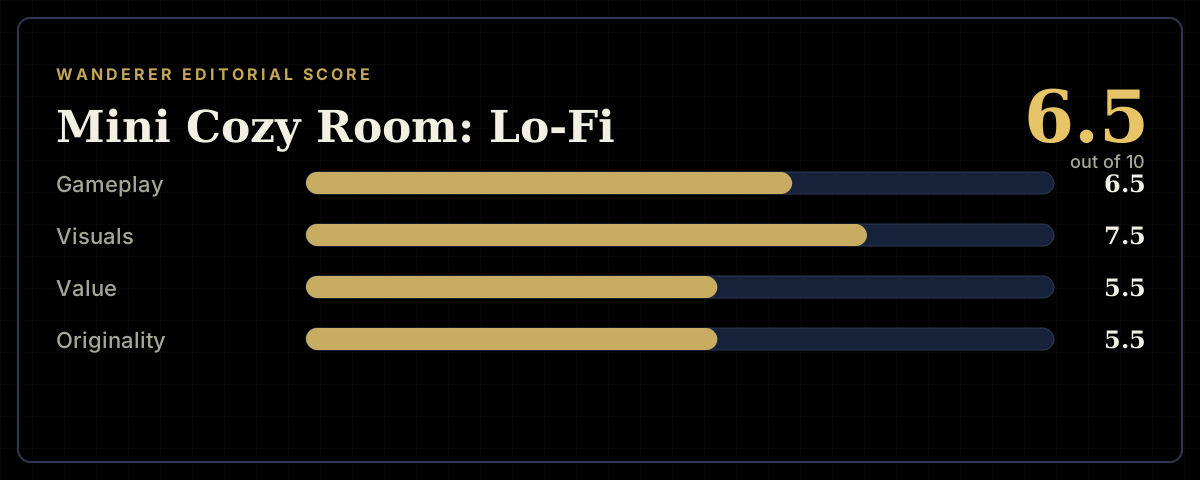
How the review scores each part of the gameWanderer Editorial -
The short versionWanderer Editorial