Game review
Megastore Simulator
5.7 / 10
- Developer
- Yolo Games Studio
- Publisher
- Yolo Games Studio
- Released
- 2 February 2026
- Platforms
- [Windows]
- Genre
- Simulation
- Monetisation
- Paid
- Players
- Single-player
The short version
Megastore Simulator, developed and published solo by Yolo Games Studio, expands the now-crowded grocery-sim genre into a full first-person retail tycoon: unload delivery trucks, manage a real backroom warehouse with forklifts and pallet jacks, stock shelves across departments like Bakery, Electronics, and Clothing, and grow a small storefront into a sprawling two-floor megastore. Reception sits at Very Positive across 1,068 reviews, and a large English-language sample pulled for this piece (100 reviews: 89 positive, 11 negative) is dominated by direct comparisons to Supermarket Simulator, comparisons that overwhelmingly favour this game, praised for deeper logistics, no DLC paywalls, and a solo developer reviewers describe as unusually active and responsive. Against that backdrop, a smaller but pointed thread of recent negative reviews centres on a food-spoilage update that reviewers say disrupted established warehouse layouts and made an already grindy economy noticeably more tedious.
Biggest strengths
- Warehouse logistics, forklifts, pallet jacks, multi-box dollies, and a real backroom, go noticeably deeper than most competitors in the genre
- No DLC paywalls: departments like Bakery, Electronics, and Clothing are all included in the base purchase, repeatedly contrasted against Supermarket Simulator's DLC model
- The solo developer is widely praised for frequent, sometimes weekly updates and active engagement with community feedback on Discord
Biggest weaknesses
- A recent update adding food spoilage and immovable freezer units frustrated many previously enthusiastic reviewers, who describe having to rebuild established warehouse layouts around it
- The economy is widely criticised as unbalanced: tight margins after wages and restocking costs, combined with prices that reviewers say don't meaningfully respond to undercutting or overcharging
- Unloading delivery trucks becomes a dominant, repetitive task at scale, with restocker AI reportedly unreliable at handling it automatically
Who it's for: Fans of Supermarket Simulator and similar retail-management sims who want deeper warehouse logistics and are comfortable riding out Early Access balance changes.
Our recommendation: A strong, content-rich alternative to its genre's biggest name, best bought by players prepared for real grind and the occasional disruptive update rather than a purely relaxing time-waster.
5.7 / 10
From Small Storefront to Two-Floor Megastore
Megastore Simulator, developed and published solo by Yolo Games Studio, takes the now-familiar grocery-sim formula popularised by Supermarket Simulator and scales it up considerably. Players start with a modest storefront and a tight budget, then expand into a genuine warehouse-driven operation, ordering pallets, unloading trucks at a loading dock, organising backroom racks, and eventually unlocking forklifts and reach trucks to move inventory efficiently. Departments span Bakery, Clothing, Electronics, Sports, Music, Toys, Grocery, Seafood, and Vending Machines, all playable from a first-person perspective. It entered Early Access on 2 February 2026, and the store page's own Early Access Release Date confirms this as the original start, not a backdated relaunch. Reception currently sits at Very Positive across 1,068 total reviews. The English-language sample pulled for this piece (100 reviews: 89 positive, 11 negative) is unusually dominated by a single comparison point: reviewer after reviewer arrives having played Supermarket Simulator or one of its many clones, and comes away describing this as the stronger game.
A Genre Favourite Outclassed, According to Its Own Fans
The comparison to Supermarket Simulator isn't incidental, it's the framing nearly every positive review uses, and it's consistently favourable to Megastore Simulator. Reviewers repeatedly praise the depth of its logistics systems: multi-box dollies for carrying inventory, a proper backroom warehouse with racking, forklifts and pallet jacks unlocked through progression, and a loading dock that makes unloading feel like a real supply chain rather than a single conveyor belt. Just as frequently praised is the absence of DLC paywalls, several reviewers explicitly contrast this with Supermarket Simulator's model of selling individual departments and product categories as separate purchases, noting that everything from bakery goods to electronics comes included in the base game. The solo developer draws consistent, often effusive praise for the pace and quality of updates, reviewers describe multiple updates per week, active presence on Discord, and a willingness to respond to community feedback that they say larger studios rarely match. Smaller touches, two distinct work shifts, NPC customers with actual dialogue, and reported smooth performance including on Steam Deck, reinforce the sense of a well-supported, actively improving title. It's a genuinely strong foundation, and it's worth noting that even most of the negative reviews in this sample open by acknowledging real potential before getting into their specific complaints.
A Food-Spoilage Update Collides With an Already Grindy Economy
The most pointed recent criticism in this sample centres on a single update: the introduction of food spoilage and dedicated freezer units for perishable stock. Several long-time players, some with well over a hundred hours invested, describe the update as having actively ruined layouts they'd carefully built over many hours, freezers reportedly can't be relocated once placed, forcing a full warehouse redesign, and the added space requirements make early-game stocking noticeably more cramped and frustrating. This lands on top of a pre-existing complaint about the game's economy, which multiple reviewers describe as unbalanced: profit margins after paying wages and restocking costs are tight enough that growth feels less like expansion and more like a constant struggle to stay afloat, and at least one reviewer notes that prices don't meaningfully respond to under- or over-charging customers, undermining a core simulation mechanic. Unloading delivery trucks is a further recurring complaint, restocker AI is described as inconsistent at automatically clearing deliveries, leaving much of that work to the player manually even well into the game, and employee limits on cashiers and restockers feel restrictive for a store of this scale, particularly since staff only cover partial shifts rather than full days. None of this reads as fatal in the sample, several critical reviewers frame their negative rating as a temporary protest aimed at prompting a rebalance rather than a verdict on the game's long-term potential, but it's a clear and specific rough patch layered on top of an otherwise well-regarded game.
Strong Value at NZ$20.49, With Caveats
At NZ$20.49, value judgments in this sample lean heavily positive, largely because of what the price does and doesn't include. Reviewers repeatedly point out that every department, Bakery, Clothing, Electronics, Sports, Music, Toys, Grocery, Seafood, and Vending Machines, is unlocked through in-game progression rather than sold separately, a direct rebuttal to competitors that gate similar content behind paid add-ons. Several reviewers with 50, 100, even 500-plus hours logged describe the purchase as having long since paid for itself purely in entertainment value, and multiple reviewers specifically credit the pace of free content updates as adding further value without additional cost. The caveat, echoed by several reviewers even among the positive sample, is that the game's Early Access status means that value calculus can shift with a single patch, the food-spoilage update being the clearest recent example, and that players who dislike having established setups disrupted by balance changes should factor that volatility into their expectations rather than treating the current state as final.
Verdict
Megastore Simulator earns its Very Positive score primarily by doing what genre fans most wanted from a Supermarket Simulator successor: deeper warehouse logistics, no DLC paywalls, and a solo developer whose update pace and community responsiveness draw consistent, specific praise. That foundation is real, and it's why so much of this review sample reads as enthusiastic converts rather than casual buyers. But a recent food-spoilage update has visibly strained goodwill among some of the game's most invested players, compounding pre-existing frustration with a tight, sometimes punishing economy and manual-heavy restocking at scale. For players who enjoy grocery and retail sims and want a game with genuine logistical depth, and who are willing to ride out Early Access balance swings, Megastore Simulator is a strong pick, just go in expecting real grind alongside the polish.
Pros and cons
Pros
- Warehouse logistics, forklifts, pallet jacks, multi-box dollies, and a real backroom, go noticeably deeper than most competitors in the genre
- No DLC paywalls: departments like Bakery, Electronics, and Clothing are all included in the base purchase, repeatedly contrasted against Supermarket Simulator's DLC model
- The solo developer is widely praised for frequent, sometimes weekly updates and active engagement with community feedback on Discord
- Multiple work shifts, department variety, and NPC customers who talk add texture reviewers say most competitors lack
- Runs smoothly for most players, including reported success on Steam Deck
Cons
- A recent update adding food spoilage and immovable freezer units frustrated many previously enthusiastic reviewers, who describe having to rebuild established warehouse layouts around it
- The economy is widely criticised as unbalanced: tight margins after wages and restocking costs, combined with prices that reviewers say don't meaningfully respond to undercutting or overcharging
- Unloading delivery trucks becomes a dominant, repetitive task at scale, with restocker AI reportedly unreliable at handling it automatically
- Employee limits (cashiers, restockers) feel restrictive for a store this size, and staff only work partial shifts, forcing manual coverage
- A handful of reviewers find the generic character models and current visual presentation a step behind other genre entries
Screenshots
-

The megastore's exterior, the sprawling endpoint of the game's expansion loopYolo Games Studio -
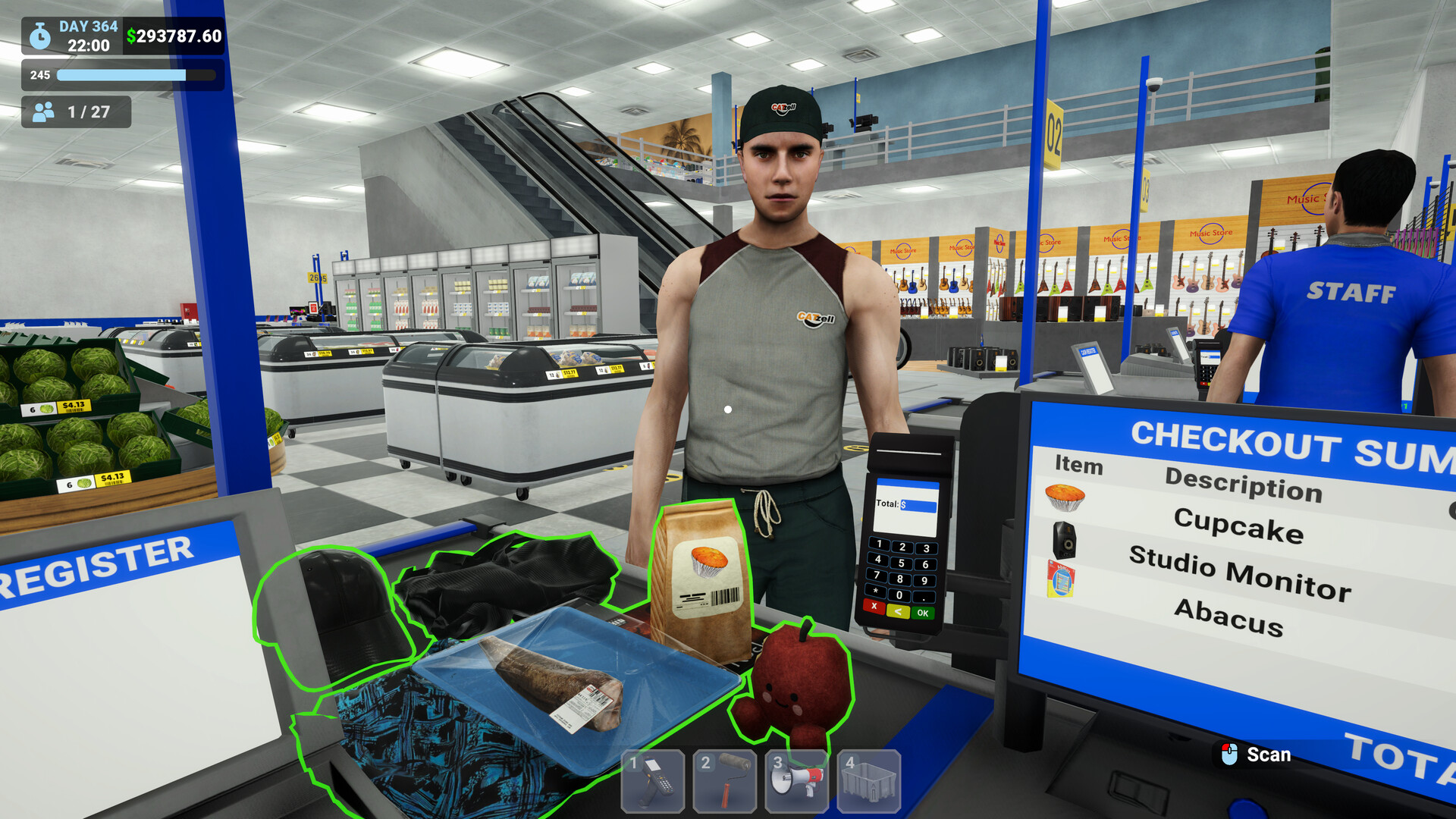
Checkout scanning across mixed departments, part of the no-DLC content variety reviewers praiseYolo Games Studio -
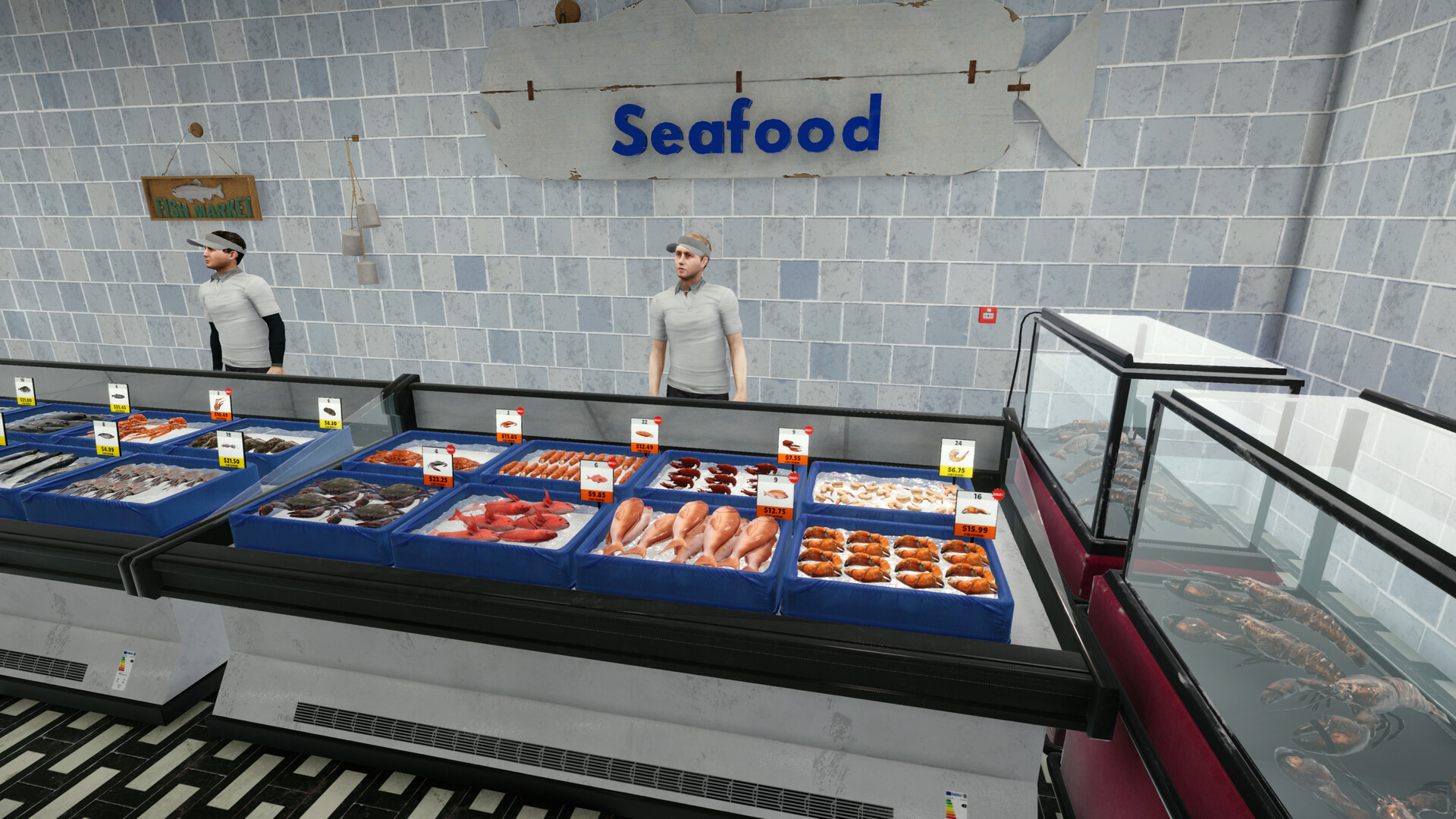
The seafood department's chilled display cases, tied to the food-spoilage update reviewers found disruptiveYolo Games Studio -
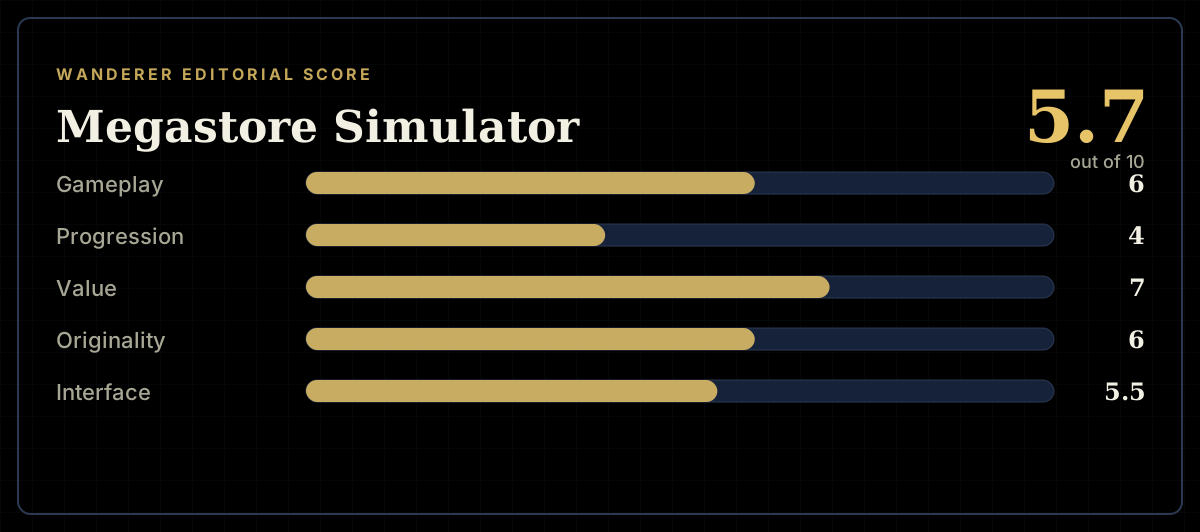
How the review scores each part of the gameWanderer Editorial -
The short versionWanderer Editorial