
Game review
Lord of the click
3 / 10
- Developer
- HugePixel
- Publisher
- HugePixel
- Released
- 26 March 2019
- Platforms
- Windows
- Genre
- Strategy
- Monetisation
- Paid, no in-app purchases found
- Players
- false
The short version
Lord of the Click borrows a clicker's name and a fantasy tower-defense skin without borrowing the mechanics that make the genre work: no meaningful auto-clicking, no DPS scaling that keeps pace with the raw click count required, and only a handful of interchangeable short levels behind it. A confirmed near-full-completion achievement curve backs up what the review corpus already says plainly — there just isn't much game here, and what there is asks a lot of manual clicking for it.
Biggest strengths
- Distinct pixel art style with a genuinely nice touch — the map itself visibly changes hands between the player and the enemy as the tide of battle shifts
- The developer patched multiple reported bugs within hours during the review period, including a resolution bug and a broken achievement-adjacent settings interaction
- Achievements and content are all reachable in a short sitting, which suits players who specifically want a brief, low-commitment clicker
Biggest weaknesses
- No auto-clicking of any kind — every soldier, every coin, every upgrade requires a fresh manual click, with one reviewer counting roughly 11,000 manual clicks just to reach an early gold-rate upgrade
- No DPS-style upgrade path that meaningfully outpaces the escalating enemy strength between stages, so early soldier upgrades become worthless a few stages later
- Only three distinct level layouts, reused with stronger enemies as the only variation
Who it's for: Only players specifically curious about a short, undemanding clicker who don't mind an autoclicker being close to mandatory.
Our recommendation: Skip it, or wait for a very steep discount if the pixel art and setting are the draw.
3 / 10
What it is
Lord of the Click casts the player as a crown prince defending a medieval kingdom, framed as a top-down clicker with tower-defense trappings: click a central building to produce soldiers, click the coins those soldiers drop before they vanish, and spend the proceeds on upgrades while an opposing side does the same on the other half of the map. The pitch leans on "bright and stylish pixel graphics" and a fantasy setting — seven levels, seven enemy types, "more than 10 subspecies" of foe — and on paper reads like any number of small premium clickers on Steam. It released on 26 March 2019 at NZD 11.79, a price point squarely aimed at a short premium experience rather than a free-to-play time-sink.
The Steam review corpus sits at Mostly Negative for its 25 English-language reviews (8 positive, 17 negative), and unusually for a small, low-review-count game, the negative case here is made in detail rather than in one-line dismissals — one review in particular functions almost as a mechanical audit of the genre and where this entry departs from it.
The genre-literacy problem
The most-upvoted review in the corpus opens by defining what a clicker game usually is: clicking as one mechanic among several, layered with auto-clicking, DPS upgrades, prestige systems and steady progression that lets the player feel themselves getting stronger over time. Its verdict on Lord of the Click is blunt — the game has "no progression" and "none of those mechanics," and is "solely centered around clicking on a building." That's not hyperbole borne out by nothing: the same review documents needing roughly 11,000 manual clicks to unlock the game's very first meaningful upgrade to gold generation, with soldier-tanking upgrades along the way becoming "completely worthless" against the following round's stronger enemies almost as soon as they're bought. A second reviewer corroborates the raw click math independently, reporting it took 20 clicks per soldier rather than the 10 the in-game tooltip promised, a discrepancy other reviews also note before a patch addressed it.
This matters more than a nitpick about numbers, because it identifies exactly what's missing from the design rather than just how repetitive it feels. A clicker's escalating numbers are supposed to feel earned because the player's own upgrades are outpacing the difficulty curve; here, reviewers describe the opposite relationship, where upgrades are rendered moot by the next stage's enemies almost immediately, which turns "click faster" into the only real strategy available. One reviewer who played to completion put it plainly: there's "no way you could play this game without" an auto-clicker, despite the game shipping without one — an odd omission for something built around this much repetitive input.
Thin on content, confirmed by the numbers
Multiple reviewers converge independently on the same complaint about scope: "every single level is exactly the same," differing only in enemy strength; one reports completing "all stages and achievements" in under an hour with "no content after beating the game"; another logged just 47 minutes to finish using an auto-clicker and calls the manual-click requirement "insane." This isn't just a vocal minority venting — the game's own global achievement data backs it up precisely. Across all 20 tracked achievements, completion rates range only from 35.6% up to 89.9%, with no achievement sitting in the single digits or low teens the way a genuinely lengthy or difficult game would show. That range is the signature of a short, low-friction completion loop: essentially everyone who buys the game and plays it for any real stretch ends up finishing most or all of what it has to offer, which is a very different shape from either of the other two 2019 idle-adjacent titles checked this cycle, both of which showed steep, gradual completion curves reaching down into the single digits.
A locked 640x360 windowed resolution — screenshotted and shared by the top review to show how small it renders on a 1080p monitor — adds a basic technical complaint on top of the content and mechanics issues, and one that a $12 premium release should not ship with in 2019.
A small mitigating point
It would be unfair to the developer to leave out the one thing several reviewers credit them for: responsiveness. The top-voted review documents at least two separate bugs — an inability to upgrade gold-per-kill, and audio settings that broke unrelated building interactions — both patched within hours of being reported. That's a genuinely good sign for a small studio's support responsiveness, even if it doesn't address the more fundamental design gaps the same reviewers describe.
Value against the asking price
NZD 11.79 is not an outrageous number in isolation, but it only makes sense relative to what a buyer gets for it, and the reviews that tried to quantify that are consistent with each other: sub-hour to two-hour full completions, three repeated level layouts, and content that "quickly ran dry" according to one reviewer who specifically credits the animations, artwork and music as well executed before landing on that conclusion. That's an important distinction to draw out — this isn't a corpus of people who hated the aesthetic or the premise. Several positive reviews explicitly praise the pixel art, the soundtrack from Hatebit, and the basic idea of playing a prince defending a kingdom. The complaint is almost entirely about there not being enough substance behind that presentation to justify a two-figure price tag, and about the mechanical choices — no auto-click, no scaling upgrades — actively working against the presentation's own appeal by turning "quick, charming sessions" into "thousands of repetitive clicks to see more of it."
That gap between well-received presentation and poorly-received substance is also why this isn't quite the same story as an abandoned or scam-adjacent release. HugePixel shipped a real, if shallow, game and responded to bug reports quickly during the period reviewers describe. The problem Lord of the Click has is a design problem, not a support or good-faith problem — it chose to leave out the systems that would have made its own core loop rewarding to repeat, and no patch mentioned in the review corpus touches that gap.
Verdict
The pixel art and the visibly shifting frontline are a nice hook, and HugePixel clearly can ship a quick fix when a bug is reported. But a clicker that omits auto-clicking, prestige and any real DPS progression, then charges NZD 11.79 for three recycled level layouts that the achievement data shows almost everyone finishes in a sitting or two, isn't offering enough to justify the asking price against the enormous field of better-designed clickers, many of them free.
Pros and cons
Pros
- Distinct pixel art style with a genuinely nice touch — the map itself visibly changes hands between the player and the enemy as the tide of battle shifts
- The developer patched multiple reported bugs within hours during the review period, including a resolution bug and a broken achievement-adjacent settings interaction
- Achievements and content are all reachable in a short sitting, which suits players who specifically want a brief, low-commitment clicker
Cons
- No auto-clicking of any kind — every soldier, every coin, every upgrade requires a fresh manual click, with one reviewer counting roughly 11,000 manual clicks just to reach an early gold-rate upgrade
- No DPS-style upgrade path that meaningfully outpaces the escalating enemy strength between stages, so early soldier upgrades become worthless a few stages later
- Only three distinct level layouts, reused with stronger enemies as the only variation
- Windowed mode is locked to 640x360 with no way to resize or use another resolution
- Global achievement data confirms the whole game is finished quickly: every one of 20 achievements sits between 35.6% and 89.9% completion, with none of the steep drop-offs a longer or harder game would show
Screenshots
-

Lord of the clickImage: HugePixel via Steam -

Lord of the clickImage: HugePixel via Steam -

Lord of the clickImage: HugePixel via Steam -
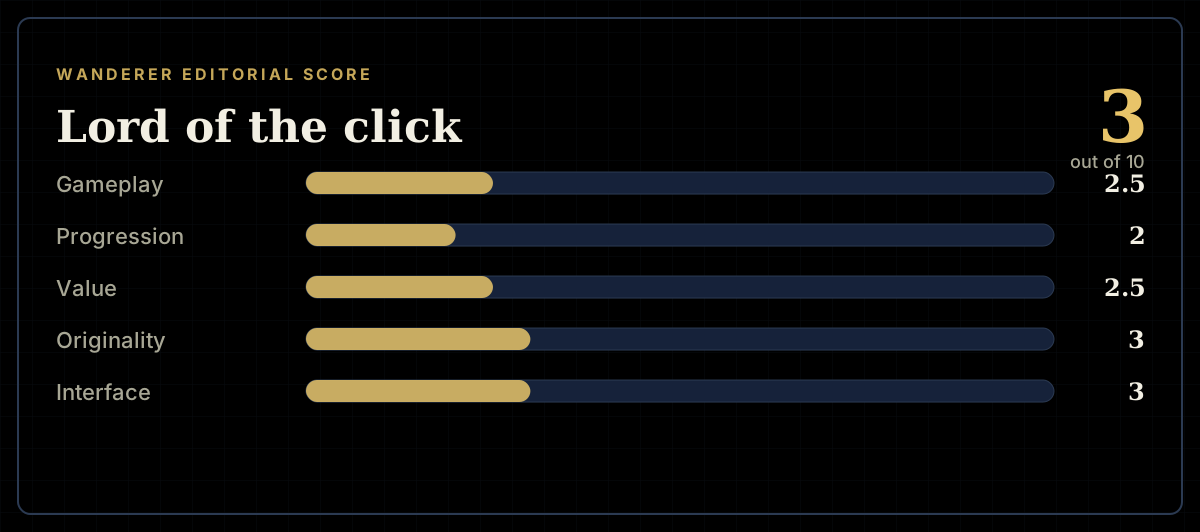
How the review scores each part of the gameWanderer Editorial -
The short versionWanderer Editorial