
Game review
STAR WARS Knights of the Old Republic II - The Sith Lords
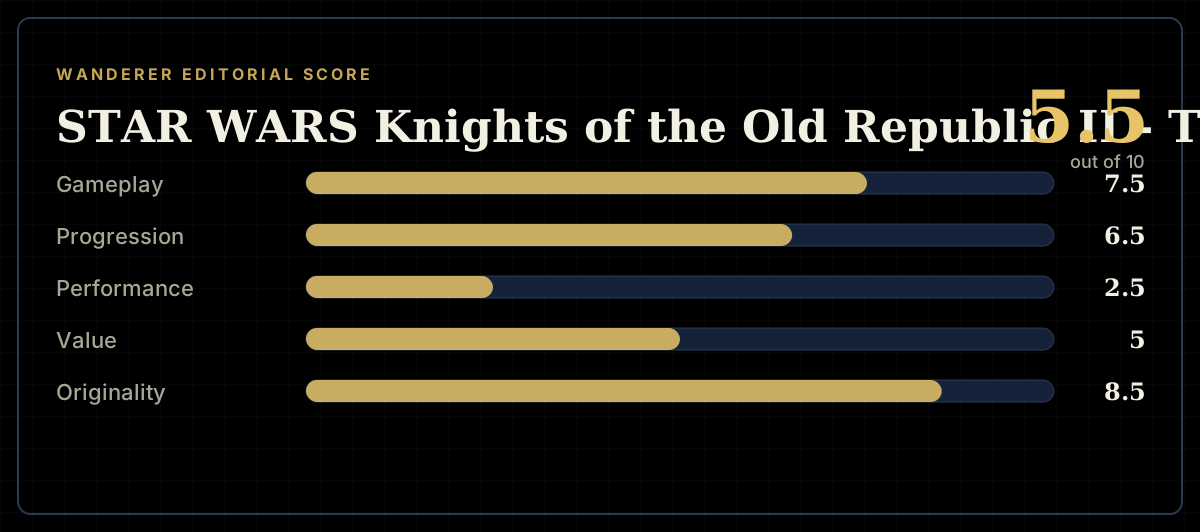
5.5 / 10
- Developer
- Obsidian Entertainment
- Publisher
- LucasArts, Lucasfilm
- Released
- 6 December 2004
- Platforms
- Windows, macOS, Linux
- Genre
- Sci-Fi RPG
- Monetisation
- Paid, one-time purchase. No in-app purchases or DLC.
- Players
- Single-player only.
The short version
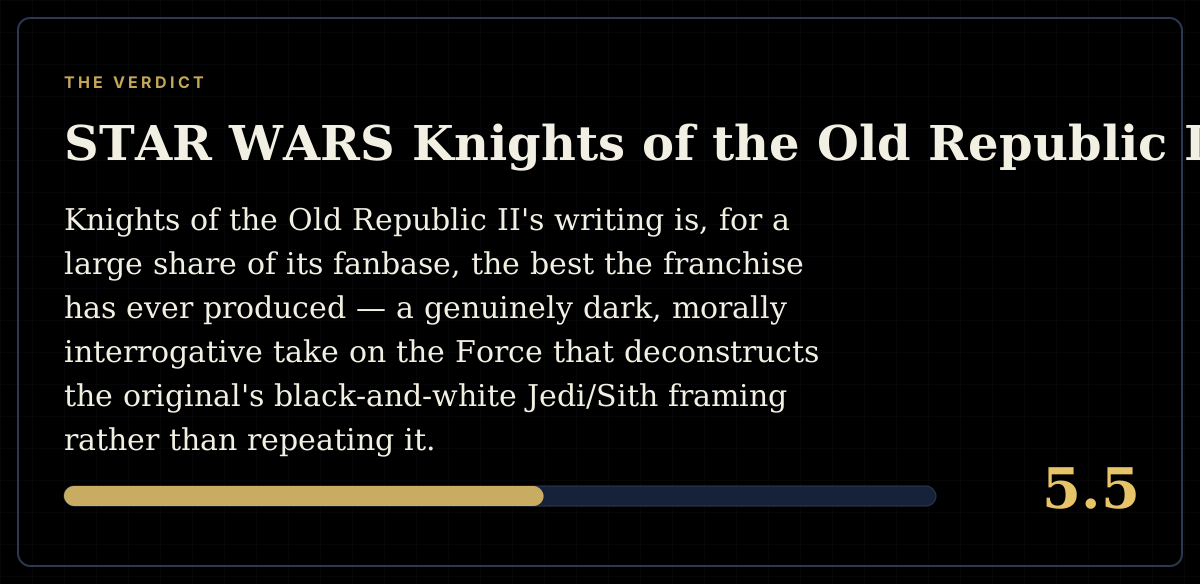
Knights of the Old Republic II's writing is, for a large share of its fanbase, the best the franchise has ever produced — a genuinely dark, morally interrogative take on the Force that deconstructs the original's black-and-white Jedi/Sith framing rather than repeating it. Very Positive across more than 22,000 reviews reflects that reputation fairly. What this review can't set aside is an extraordinarily specific and consistently reported bug: a large share of recent reviews, spanning 2018 through the middle of 2026, independently describe the player character becoming unable to move after combat ends, forcing a reload, with multiple reviewers reporting they tried every known community fix without success.
Biggest strengths
- Widely regarded, including by many longtime KOTOR fans, as having the best and most philosophically ambitious writing in the franchise, interrogating the Jedi/Sith moral framework rather than simply restating it.
- A genuinely dark, morally grey central story and companion cast that pushed the format further than the more straightforward original.
- Retains the class and build variety of the first game while expanding the influence/party-loyalty systems around companions.
Biggest weaknesses
- An extraordinarily specific, reproducible bug is reported by a large share of recent reviews (spanning 2018 through 2026): the player character becomes unable to move after combat, requiring a reload, with numerous reviewers reporting known community fixes failing to resolve it.
- The game's rushed original development is well known and is described by some current reviewers as still evident even with the Restored Content Mod installed.
- Combat and controls draw comparatively little praise relative to the writing, with a small number of reviewers calling this entry a mechanical downgrade from the first game.
Who it's for: Star Wars and BioWare/Obsidian RPG fans who want the franchise's most philosophically ambitious entry, and who are prepared to research and apply community fixes — with the understanding that even those fixes are reported to fail for some players.
Our recommendation: The writing justifies playing this game more than almost any other Star Wars RPG, but budget real time for troubleshooting a specific, well-documented movement-lock bug that a meaningful share of current reviewers say has no reliable fix.
5.5 / 10
The sequel that darkened the Force
Where the original Knights of the Old Republic told a fairly clean story of Jedi versus Sith, its sequel deliberately complicates that framing, and it's this shift that a large share of its own fans credit as the reason the writing here has aged into the franchise's most respected entry. The store page's framing hints at the tonal shift without spoiling it: "5 years after the events of the award winning original, the Sith are on the verge of crushing the Old Republic. As a lone Jedi, will you follow the light side or succumb to the dark?" What that pitch doesn't fully convey is how far Obsidian pushed the philosophical interrogation of that choice — companions who challenge the player's assumptions about the Force itself, a central mystery built on genuine moral ambiguity rather than a clear-cut villain, and dialogue widely regarded as sharper and more consistently well-written than the original's. The official screenshot captures a quieter, more contemplative moment than the first game's promotional material typically shows — two Jedi with lightsabers drawn against a battle droid in tall grass beside a grounded starship — the kind of understated, atmosphere-first composition that matches the sequel's more reflective tone.
The bug reviewers keep describing in near-identical terms
What makes this review necessary rather than a simple recommendation on the writing's strength is how specific and how consistent one particular technical complaint is across the review sample. A 2021 review, from an account with over 11,000 minutes logged, describes it precisely: "there's a game breaking bug that I cannot find a fix for. I tried around 6 different fixes to no avail. After combat, around 80% of the time, the game will not allow the player to move." A 2022 review, from an account with nearly 17,000 minutes played, reports the identical symptom: "your character locks up after [combat]," concluding "the Steam version is unplayable" despite years of positive history with the disc version. A January 2025 review states it in four words: "combat ends, you can't move unless you reload." A June 2026 review — among the most recent in the entire sample — reports the same core issue compounded by additional platform problems: "either the screen is cut off, or the direction controls stop working after every engagement and the only way to make them work again is to save and reload." Checking a broad sample of recent negative reviews, twelve of thirty raise this exact same movement-lock symptom independently, spanning more than eight years of reports with no indication the underlying cause has been resolved. This is a different, more specific kind of technical failure than a general "it crashes sometimes" complaint — it's the same precise, reproducible bug, described in nearly identical terms by strangers years apart.
A production history that shaped the game before the bug did
It's worth being fair to a separate, older piece of context: this game's rushed development is extensively documented history, not a modern criticism invented after the fact. Obsidian built the game under a tight holiday-season deadline, and the finished product shipped with cut content, underdeveloped late-game areas and a noticeably compressed ending relative to what the game's own narrative setup implies. The community-made Restored Content Mod exists specifically to address this, reintroducing content that was cut but left mostly intact in the game's files. A 2015 review notes that even with restoration mods applied, the game remains "full of bugs and incomplete story threads," suggesting the mod closes some but not all of the gap between what was intended and what shipped. This is a distinct issue from the movement-lock bug covered above — one is a story and content completeness question rooted in 2004 development pressures, the other is a Steam-specific technical failure that appears to have emerged or persisted independently of that history — and this review treats them as two separate, both-real problems rather than conflating them into one vague complaint about the game being "buggy."
Why this specific bug is worse than an ordinary crash
It's worth explaining precisely why a movement lock after combat is a more damaging bug than a random crash would be, since the two can sound similar in severity from a brief description. A crash that happens unpredictably is frustrating but survivable — a player saves often and loses a few minutes at worst. A bug that reliably triggers after most combat encounters, in a game built around frequent combat as a core pillar of its design, effectively turns every fight into a checkpoint a player must reload through rather than simply finish and move past. Several reviewers describe exactly this shift in how they had to play: treating each battle as a save-scum ritual rather than a normal part of progressing through the story, which fundamentally changes the pacing and feel of a game that was never designed to be played that way. That's a meaningfully worse experience than an occasional crash, even though both would generically be described as "buggy" by a reviewer summarising quickly, and it's the reason this review treats the frequency and predictability of the symptom as more important than a simple bug count.
Final verdict
Knights of the Old Republic II's writing represents some of the most ambitious storytelling the Star Wars RPG genre has produced, and readers drawn to the philosophical, morally complicated take on the Force this game offers will find that reputation well earned. What keeps this recommendation qualified is a specific, extraordinarily consistent technical failure that a large share of this game's current reviewers report experiencing on Steam, one that multiple documented troubleshooting attempts have failed to resolve for many players. This review recommends the writing without reservation. It recommends buying and installing it today with real caution, and suggests researching the current state of community fixes for the post-combat movement lock specifically before assuming a smooth playthrough.
Pros and cons
Pros
- Widely regarded, including by many longtime KOTOR fans, as having the best and most philosophically ambitious writing in the franchise, interrogating the Jedi/Sith moral framework rather than simply restating it.
- A genuinely dark, morally grey central story and companion cast that pushed the format further than the more straightforward original.
- Retains the class and build variety of the first game while expanding the influence/party-loyalty systems around companions.
- A large, dedicated modding community, including the well-known Restored Content Mod, actively works to address the game's well-documented rushed development.
Cons
- An extraordinarily specific, reproducible bug is reported by a large share of recent reviews (spanning 2018 through 2026): the player character becomes unable to move after combat, requiring a reload, with numerous reviewers reporting known community fixes failing to resolve it.
- The game's rushed original development is well known and is described by some current reviewers as still evident even with the Restored Content Mod installed.
- Combat and controls draw comparatively little praise relative to the writing, with a small number of reviewers calling this entry a mechanical downgrade from the first game.
- Additional platform-specific complaints (cut-off screens, direction controls failing after combat on Steam Deck) compound the base movement-lock issue for some players.
Screenshots
-

STAR WARS™ Knights of the Old Republic™ II - The Sith Lords™Image: LucasArts via Steam -

STAR WARS™ Knights of the Old Republic™ II - The Sith Lords™Image: LucasArts via Steam -

STAR WARS™ Knights of the Old Republic™ II - The Sith Lords™Image: LucasArts via Steam -
How the review scores each part of the gameWanderer Editorial -
The short versionWanderer Editorial