Game review
Knightfall Idle Review
6.4 / 10
- Developer
- Gibber
- Publisher
- Knightfall Games
- Released
- 1 September 2026
- Platforms
- ["Windows"]
- Genre
- Strategy
A Free Idle Kingdom That Asks for Real Patience
Knightfall Idle is a free-to-play idle/incremental RPG that layers ten interconnected skills — woodcutting, mining, fishing, farming, combat, processing, trade, kingdom management, toughness, and overall account level — into a single persistent economy that keeps ticking whether or not you're at the keyboard. Gathered resources get refined into goods, goods get loaded onto caravans and traded for a premium currency called Azurite, and everything feeds back into gear, kingdom buildings, and a sprawling 450-plus-node passive skill tree split across Travel, Mastery, and Axiom branches. It launched into Early Access on September 1, 2026 with a genuinely fresh appid and no earlier version history, and reception so far is a real "Mostly Positive" — 17 of 22 English-language reviews positive, 18 of 25 across all languages (72%), not the runaway five-star reception some of this lane's other recent idle picks have earned.
That gap is worth taking seriously rather than smoothing over, because the negative reviews in the pool aren't noise — they're a coherent, repeated complaint about pacing. "Just as any other similar game released in 2026 it has no gameplay at all. You wait 8 seconds to get 0,1 experience and 0,05 wood," one frustrated reviewer wrote, arguing the idle genre has tipped too far toward literal inactivity. It's a fair criticism of the opening hours specifically, and prospective players should know the early game is genuinely, deliberately slow before deciding whether to commit.
Ten Skills, a Kingdom Economy, and Guild-Level Cooperation
Where Knightfall Idle earns its praise is in how much structure sits underneath that slow start. Ten kingdom buildings — Castle, Lumber Mill, Mine, Dock, Barracks, Farm, Market, Library, Tavern, Watchtower — can be staffed with workers who produce resources every ten-minute server tick, and those workers need feeding or production halts, turning kingdom management into a small self-sustaining logistics puzzle rather than a passive number generator. "It gives me a lot more to think about than simply watching numbers increase," one reviewer wrote, praising specifically how gathering, processing, and trading skills reinforce each other rather than sitting in isolated silos.
The social layer extends further than most idle games attempt: Fiefs are player-run clans with four ranked roles (King, Vassal, Knight, Man-at-Arms), shared item reserves, and guild-wide production and combat bonuses, while an Ironman mode exists for players who'd rather stay fully solo. Competitive pressure comes from resets — recurring leagues alongside a permanent server — and PvP, for now, stays confined to economic and leaderboard competition rather than direct player harm, a design choice one reviewer specifically praised: "No one can harm your progress." Worth flagging for anyone planning a long-term investment: the developer has already announced a full progress wipe across all servers, including the supposedly permanent ones, scheduled for February — a detail buried in a review rather than headline marketing, and one that matters a great deal for players weighing hundreds of hours of commitment.
A Passive Tree Deep Enough to Reward Real Specialization
The 450-plus-node passive tree is the game's most distinctive system, and reviewers who stuck around past the slow opening consistently cite it as the reason they kept playing. Axiom nodes in particular go beyond flat stat boosts into genuinely mechanics-altering perks — doubling kingdom output, auto-processing gathered materials, locking item rarities to target-farm specific drops, or making skills boost each other through a "Cross-Training" perk. Respeccing costs a dedicated rare currency rather than being free, which keeps build choices meaningful without making early experimentation punishing. "The vastness of leveling up and how everything is spread out means you can branch if you desire to be good at a little or hyper focus on something," one reviewer wrote, and the ability to become a specialist other players actually need — rather than a generalist who can solo everything — is a genuinely uncommon design choice for the genre.
An Interface That Needs Work, and a Developer Who's Listening
The most consistent, unambiguous complaint in the review pool is the interface, and it's a fair one: multiple reviewers flagged nearly illegible default text sizing with no UI scaling option, only a separate chat font-size toggle that doesn't touch the rest of the game. "I'll come back when the text isn't the tiniest scribbles," one reviewer wrote, though notably followed up after a patch: "Update: UI scaling is clunky but makes things legible... thanks for the quick update dev." That kind of fast, visible response to launch-week feedback shows up repeatedly in the review pool, and reviewers who stuck around long enough to see it credit the developer specifically: "Dev is fully open to feedback and updates the game regularly."
Verdict
Knightfall Idle is a deep, patient economy-builder wearing an idle game's clothes, and whether it clicks for you depends almost entirely on how much you're willing to tolerate a genuinely slow, sparse opening stretch before the interlocking skill, kingdom, and passive-tree systems start paying off. Reviewers with real hours invested are consistently enthusiastic about the depth, the fief-based social layer, and a monetization model with no real pay-to-win pressure; reviewers who bounced off in the first hour are just as consistently frustrated, and their complaints about near-zero early gameplay aren't unreasonable. The interface needs real work despite a quick post-launch patch, and the announced February full-server wipe is a significant asterisk for anyone considering a serious long-term investment. As a free Early Access idle RPG for genre fans specifically, it's a solid, still-rough recommendation — as a first idle game for someone unsure if the genre is for them, it's a much harder sell.
Screenshots
-
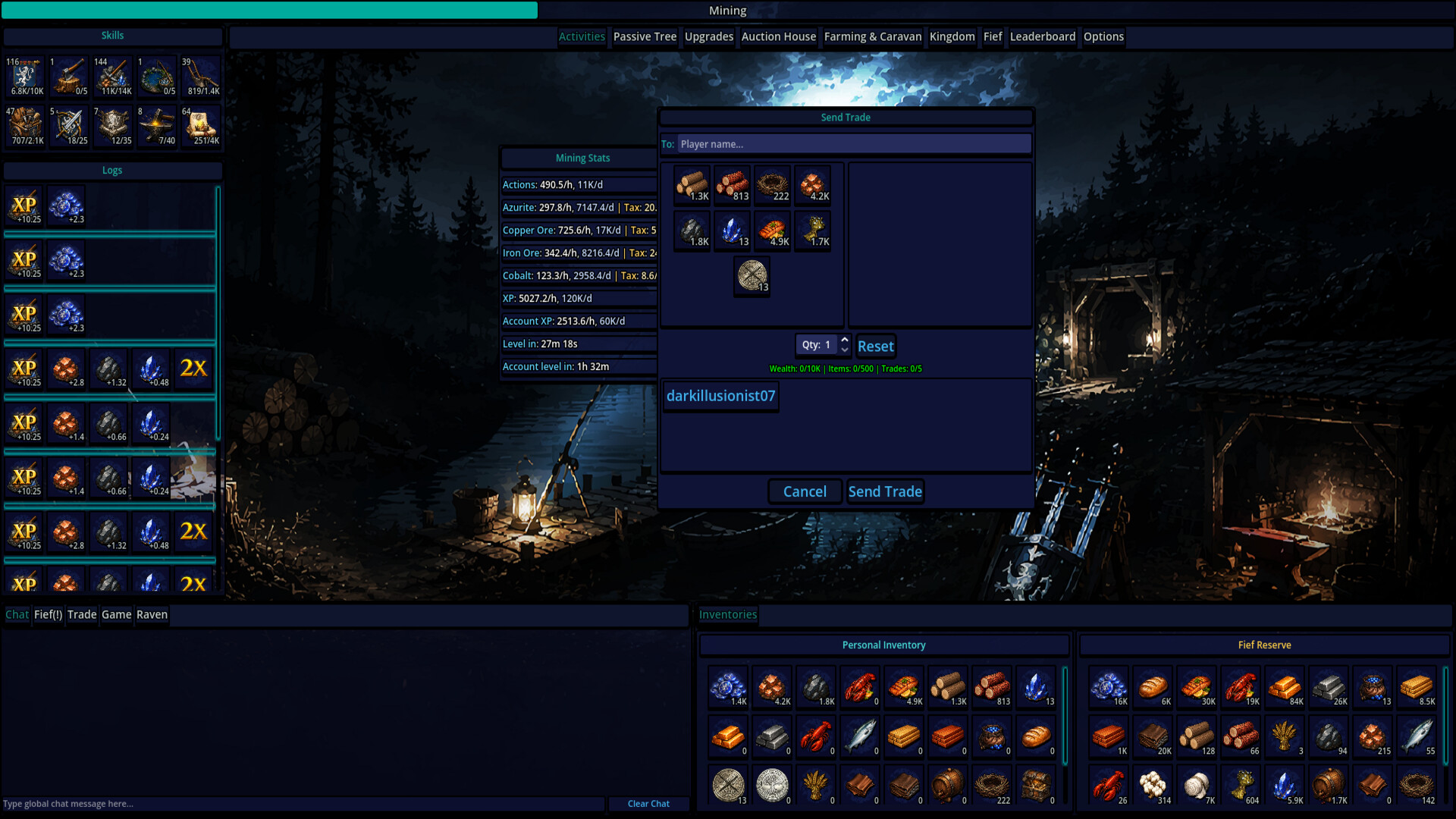
The interface crams a lot of small icons and numbers onto one screen, echoing reviewer complaints about default text size.Image: Knightfall Games via Steam -
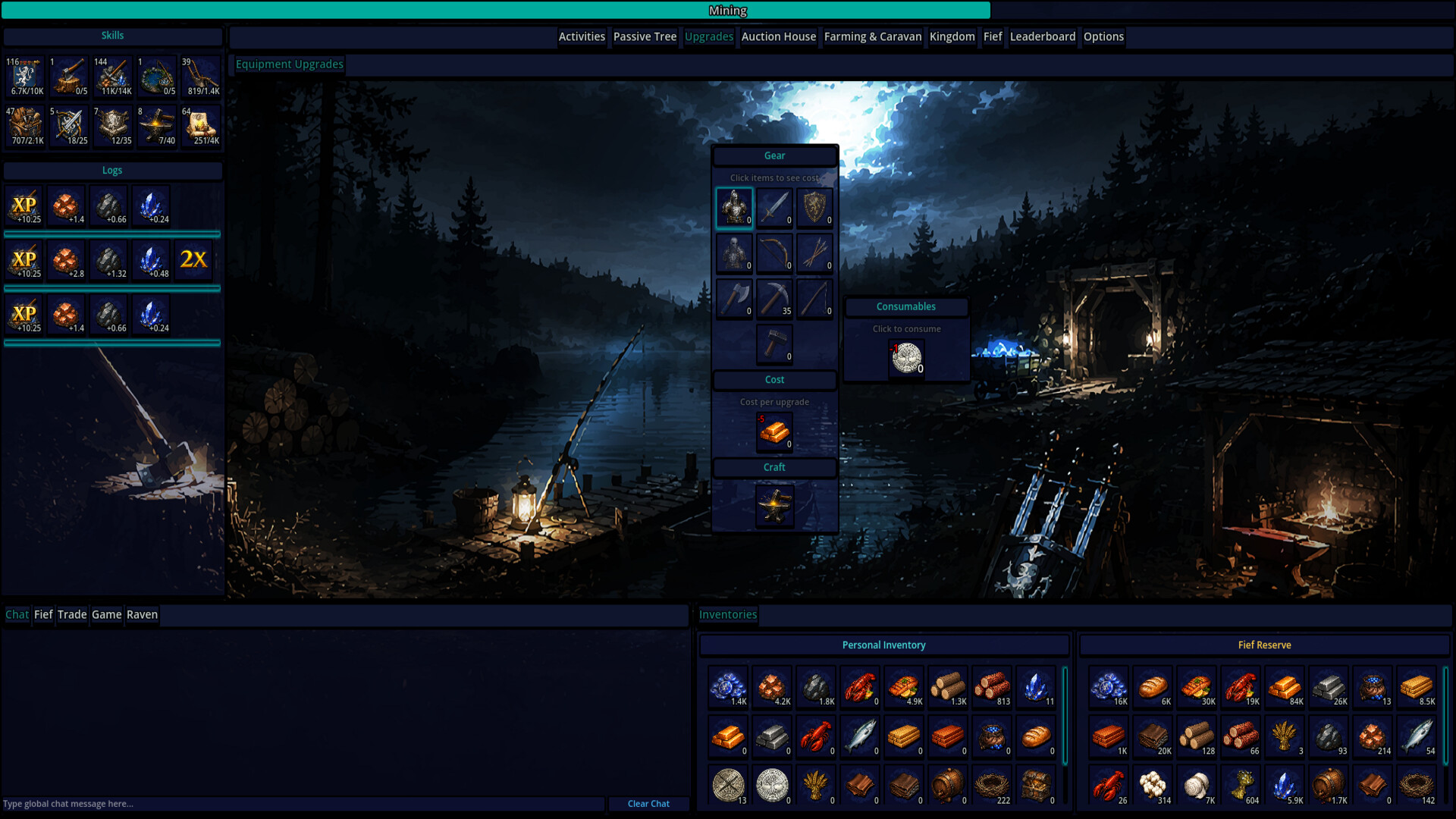
Gear upgrades and crafting run through menus like this one, layered atop atmospheric medieval backdrops.Image: Knightfall Games via Steam -
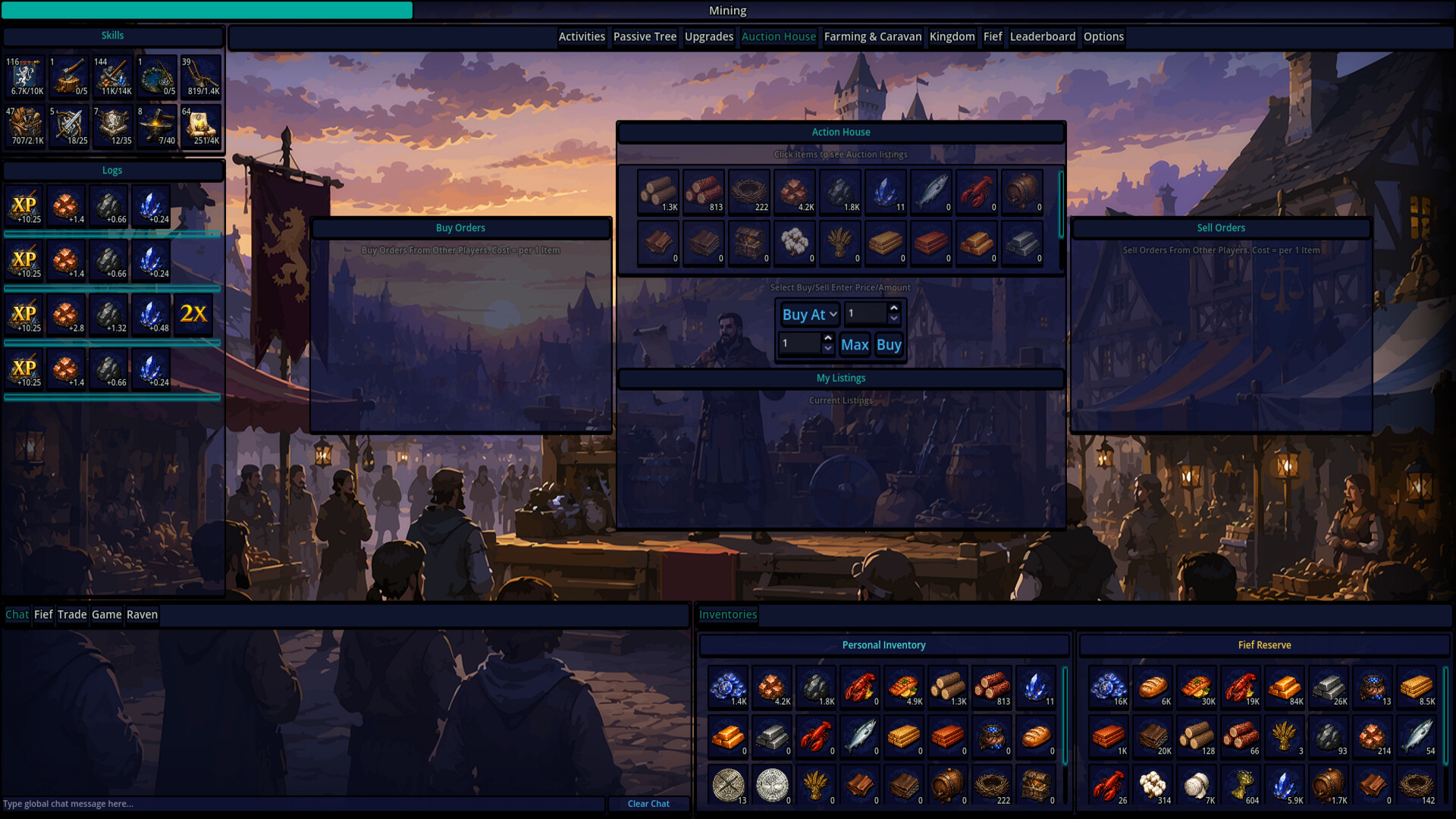
The player-run Auction House lets Fiefs and individuals trade resources, set against a lively market square.Image: Knightfall Games via Steam