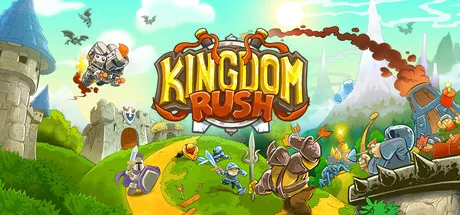
Game review
Kingdom Rush - Tower Defense
8.5 / 10
- Developer
- Ironhide Game Studio
- Publisher
- Ironhide Game Studio
- Released
- 6 January 2014
- Platforms
- Windows, macOS, Linux
- Genre
- Tower Defense
- Monetisation
- One-off premium purchase, no in-game store, no DLC listed on the Steam page
- Players
- None. Single-player only, no leaderboard or shared-progress feature
The short version
Kingdom Rush is the game that made "towers plus heroes plus a boss at the end of every stage" into a template the entire genre still leans on, and its own four sequels haven't replaced it so much as iterated around it. Placing archers and barbarians along a fixed lane, timing a mage's polymorph spell, and dropping a hero into a losing lane at the last second is exactly as satisfying now as it was on Armor Games in 2011. What hasn't aged well is everything around that loop: no speed-up button on levels that can run twenty minutes, a handful of late bosses that demand dozens of repeated clicks rather than a decision, and level design some long-time players read as one correct build rather than open-ended strategy. None of that has dented the reception — 95.8% positive across 5,825 reviews, 98 of the last 100 English reviews positive — because the fundamentals were right from the start.
Biggest strengths
- Tower placement, upgrade paths and hero abilities combine into readable, satisfying tactical decisions almost every stage, the exact loop the rest of the genre has spent a decade copying
- Thirteen heroes are all included with the base purchase and meaningfully change how a stage plays, not just reskin the same unit
- Hand-illustrated cartoon art and boss design still read clearly at a glance, even next to tower defense games made a decade later
Biggest weaknesses
- No speed-up or fast-forward control, so a stage that goes wrong still has to be watched or replayed at full, real-time pace
- A few late bosses are decided by repeated clicking to strip a shield or debuff rather than by any tactical decision, which reads as padding rather than difficulty
- Long-time players describe most stages as having one dominant tower-and-upgrade combination rather than several viable builds, which narrows the strategy the marketing promises
Who it's for: Tower defense players who haven't played the original, strategy fans who want something they can finish a stage of in fifteen minutes, and anyone curious where the genre's modern hero-and-tower template actually came from.
Our recommendation: Ten dollars for a game this influential and still this well liked is an easy yes; just go in expecting 2011-era interface conveniences, and know a couple of the later boss fights will test your patience rather than your tactics.
8.5 / 10
Most tower defense games from the early 2010s are hard to go back to. The genre spent that decade attached to browser portals as a cheap, disposable time-waster, and almost none of it survived the move to mobile and Steam with its reputation intact. Kingdom Rush did more than survive — it's the reason the survivors look the way they do. Ironhide Game Studio, six months old and Uruguayan, put it up for free on Armor Games in July 2011 with a specific idea: towers aren't just damage dealers, they're a roster with upgrade paths and personalities, heroes are units you can drop into a failing lane at the last second, and every stage ends with a boss fight that breaks the rules you'd just learned. That idea is now the template. Four numbered sequels later (Ironhide's own Kingdom Rush 5: Alliance TD shipped in 2024, and Wanderer has reviewed it separately), the original still sits at 95.8% positive across 5,825 reviews on the Steam port alone, and 98 of its last 100 English reviews are positive too. This isn't a nostalgia score. It's still working.
The loop that started it
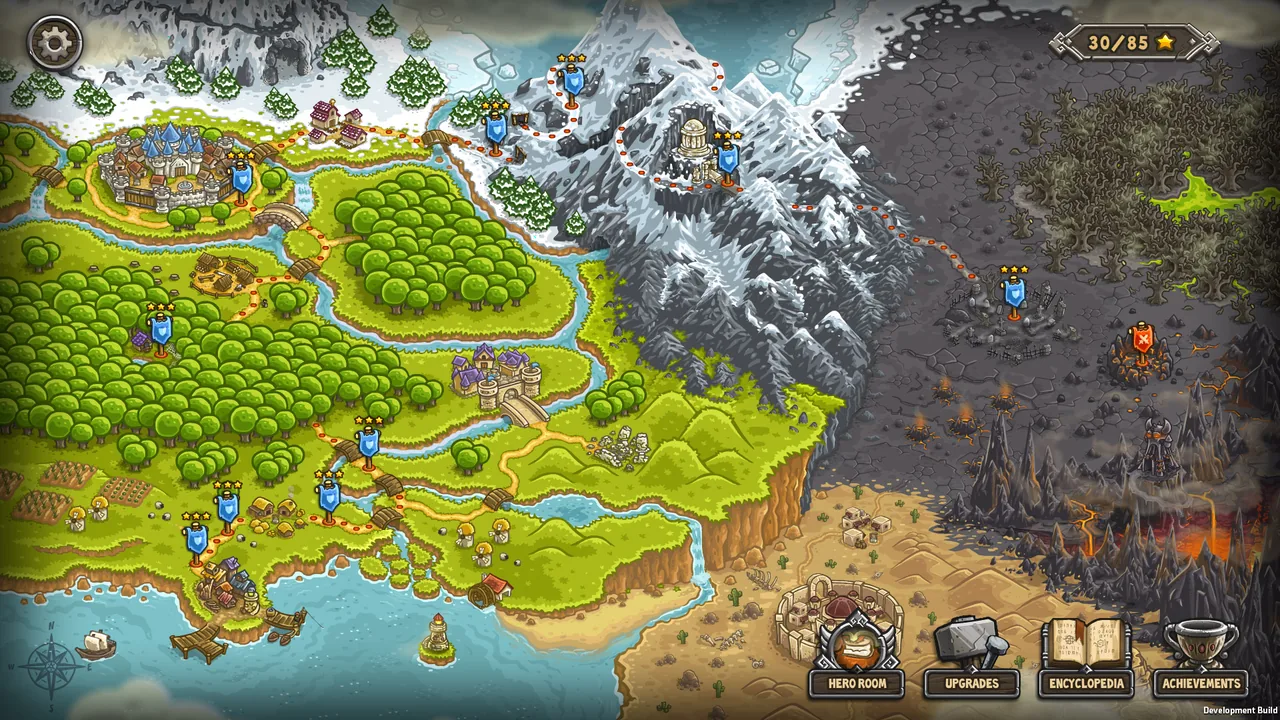
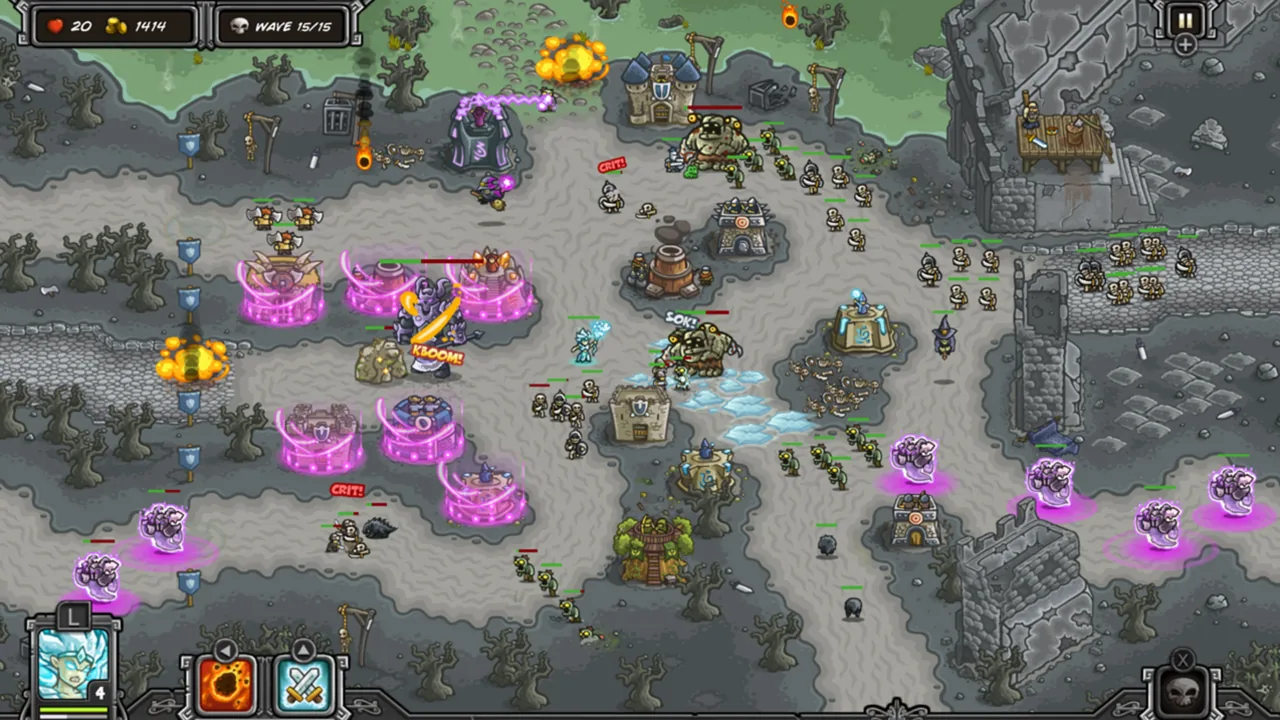
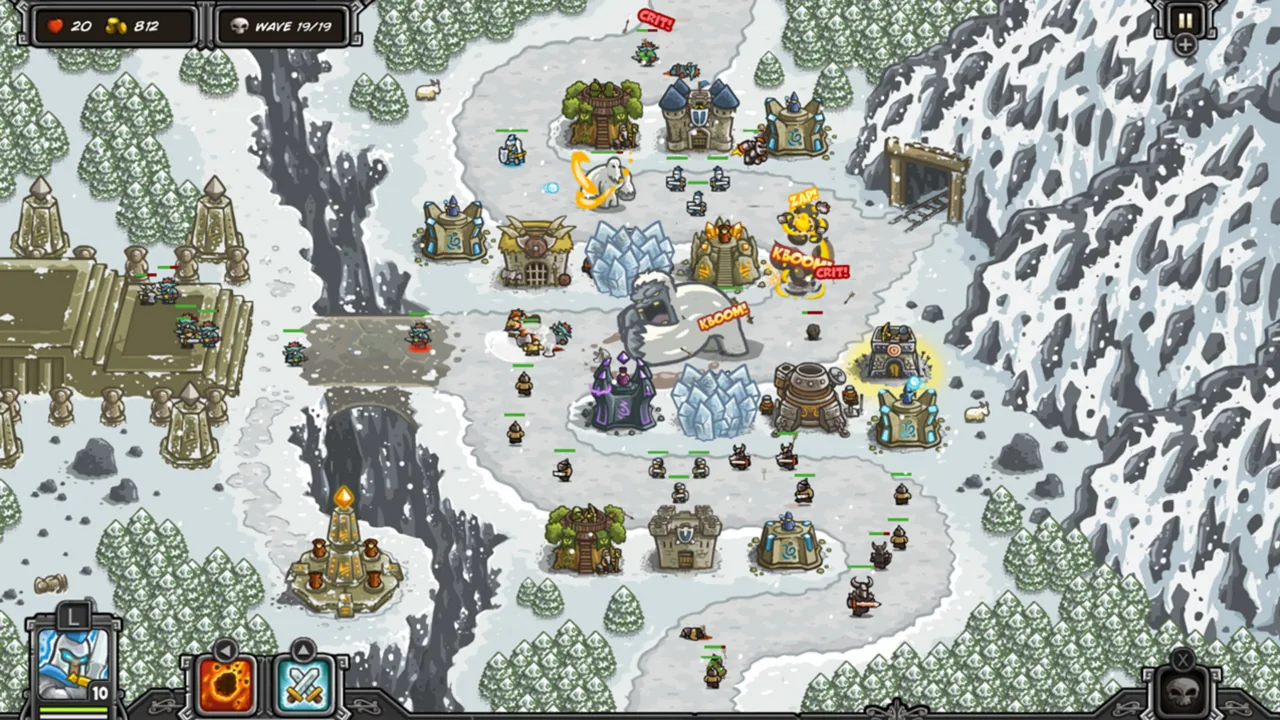
Twelve core campaign stages, each a fixed lane or set of lanes winding through forests, mountains and wastelands, with a limited number of tower plots along the way. You've got soldiers to hold a choke point, archers and mages for ranged damage, and specialist towers — Barracks, Rangers, Artillery, Sorcerers among them — that branch into two upgrade specializations apiece once levelled up. Thirteen heroes, all included at no extra cost, can be dropped directly into the lane to tank hits, deal burst damage or use a unique ability on a cooldown. None of that sounds unusual now, because it's been copied so many times, but the execution is still sharper than most of what followed it: tower ranges and enemy paths are legible at a glance, upgrade icons tell you what a specialization actually does before you commit gold to it, and a stage rarely feels lost to bad luck rather than a bad decision you can trace back and fix next attempt.
The 61-plus enemy types and boss encounters are where the design earns its reputation. A troll that regenerates health forces you to focus fire rather than spread damage across the lane; a polymorph spell on a dangerous unit briefly turns a real threat into a sheep. Boss fights change the rules mid-stage rather than just scaling up numbers — reasonable by 2011 standards, still reasonable now, and the reason IGN handed the original an Editor's Choice 9/10 and Pocket Gamer a Gold Award the same year. Those weren't outlier scores; Kingdom Rush won multiple Game of the Year awards from browser-game outlets in 2011, and the Steam audience's near-identical rating fourteen years on suggests the design held up better than the format it launched on.
Where 2014 shows through
The most common specific complaint in the negative review sample isn't about balance or content — it's the absence of a speed-up control. Stages here can run fifteen to twenty real-time minutes, and if a run is clearly failing by minute twelve, there's no way to fast-forward to the loss and try again faster. One reviewer with over 1,700 hours logged put it plainly: burning half an hour per failed attempt, with no way to accelerate it, turns experimentation into a chore rather than part of the fun. It's a minor missing feature in isolation, but tower defense as a genre has spent the years since normalising 2x and 4x speed toggles specifically because games like this one proved how much friction real-time pacing adds to iterative play. Kingdom Rush arrived before that lesson was learned, and the Steam port never retrofitted it.
A second, more structural complaint shows up almost as often: several long-time players describe most stages as having one dominant tower-and-upgrade combination rather than a genuine range of viable builds, closer to a puzzle with a correct answer than open tactical strategy. One reviewer with over 700 hours called it "trial and error" with "one correct choice per level," and a separate, heavily-upvoted review from launch year describes needing to ace nearly every stage just to unlock the upgrades the later campaign requires — a soft difficulty gate dressed up as optional completion. The most specific version of this complaint targets a single tower directly: the Tesla tower's chained lightning damage was reported, repeatedly and across years of reviews, as strong enough to trivialise most stages it's available on, with Ironhide publicly defending the balance and pointing skeptical players at the game's separate Veteran and Iron challenge modes rather than patching it down. Whether that's a flaw or just a soft-difficulty escape hatch depends on what you want from the genre — but it's a real and recurring observation, not an isolated grumble.
A smaller, sharper complaint concerns a handful of late bosses that strip a shield or debuff only through repeated manual clicking — one reviewer counted needing over 500 clicks to remove a single boss's protection, describing it as adding nothing tactically once you understand the pattern. That's the kind of design choice that reads as a stage extending itself rather than testing you, and it's the closest thing in the whole review corpus to an actual technical complaint rather than a balance or pacing one.
Difficulty and who it's for
The endgame difficulty curve draws its own consistent thread of complaints, and it's worth taking seriously precisely because it comes from players who otherwise like the game. Several reviews, including ones posted well over a decade after release, describe the last two campaign stages as a sharp spike relative to everything before them, with one recent review reporting the campaign feeling "impossible" even on Casual difficulty and a persistent sense of being underpowered rather than under-skilled. The global achievement data backs this up cleanly: the entry-level achievements sit at 80–94% completion, while the Iron and Heroic mode achievements — the game's optional hard difficulty settings — sit down around 14–15%. That's a wide and honest gap between "finished the game" and "mastered the game," and it reads less as a flaw than as an accurate signal of where the difficulty wall actually sits: most players clear the core campaign comfortably, and the small minority chasing full completion are the ones running into the spike.
What it costs and what you get
NZ$9.99 buys the full 12-stage core campaign plus three additional mini-campaigns — Winter Storm, Rise of the Bandits and the four-stage Curse of Castle Blackburn — and four further bonus stages, all included rather than sold as separate DLC. There's no in-game store, no premium currency and nothing gated behind a second purchase, which stands out sharply next to how the genre monetises today, including some of Ironhide's own later entries. A handful of reviews from the game's early Steam years argued the PC price compared unfavourably to a cheaper mobile release at the time, but that's a 2014-era complaint about a since-settled price point rather than a live concern — at today's NZ$9.99 with no ongoing IAP pressure, the value case is straightforward.
Final verdict
Kingdom Rush earns its reputation honestly. The tower-and-hero loop it introduced in 2011 is still tight, still readable and still fun to execute a full campaign through, and the fact that four sequels and an entire genre's worth of imitators haven't displaced it says more than any single score can. The real deductions here are specific and consistent across a decade of reviews rather than scattered: no way to speed past a losing attempt, a design philosophy that some experienced players read as one correct build per stage rather than genuine tactical variety, a couple of click-heavy boss fights that substitute repetition for challenge, and a difficulty spike late in the campaign that catches players who've been coasting on Casual. None of those are severe enough to argue with the 95.8% positive score, but they're real enough to keep this from the very top of the scale. If you've never played the game that set the template for the genre's last fifteen years, ten dollars is a small price for finding out why it still holds.
Pros and cons
Pros
- Tower placement, upgrade paths and hero abilities combine into readable, satisfying tactical decisions almost every stage, the exact loop the rest of the genre has spent a decade copying
- Thirteen heroes are all included with the base purchase and meaningfully change how a stage plays, not just reskin the same unit
- Hand-illustrated cartoon art and boss design still read clearly at a glance, even next to tower defense games made a decade later
- NZ$9.99 for a full campaign plus three extra mini-campaigns and four bonus stages is exceptional value next to what tower defense costs today
Cons
- No speed-up or fast-forward control, so a stage that goes wrong still has to be watched or replayed at full, real-time pace
- A few late bosses are decided by repeated clicking to strip a shield or debuff rather than by any tactical decision, which reads as padding rather than difficulty
- Long-time players describe most stages as having one dominant tower-and-upgrade combination rather than several viable builds, which narrows the strategy the marketing promises
- The endgame difficulty curve spikes sharply enough that some players report finishing the campaign on Casual and still bouncing off the last two stages
Screenshots
-
Kingdom Rush - Tower DefenseImage: Ironhide Game Studio via Steam -
Kingdom Rush - Tower DefenseImage: Ironhide Game Studio via Steam -
Kingdom Rush - Tower DefenseImage: Ironhide Game Studio via Steam -
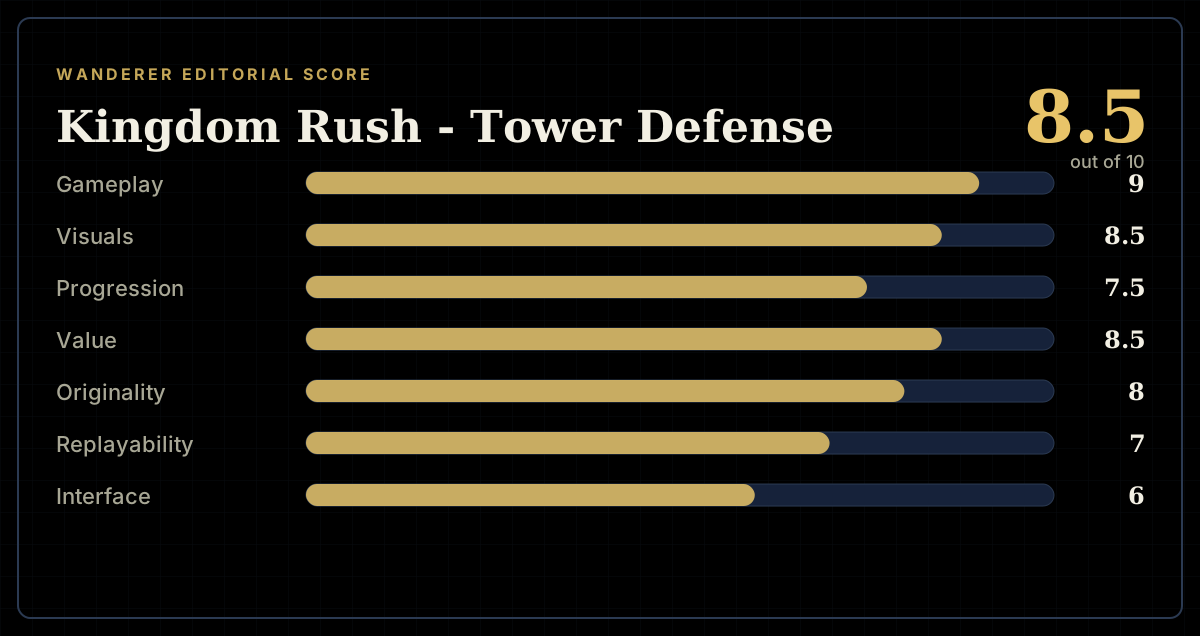
How the review scores each part of the gameWanderer Editorial -
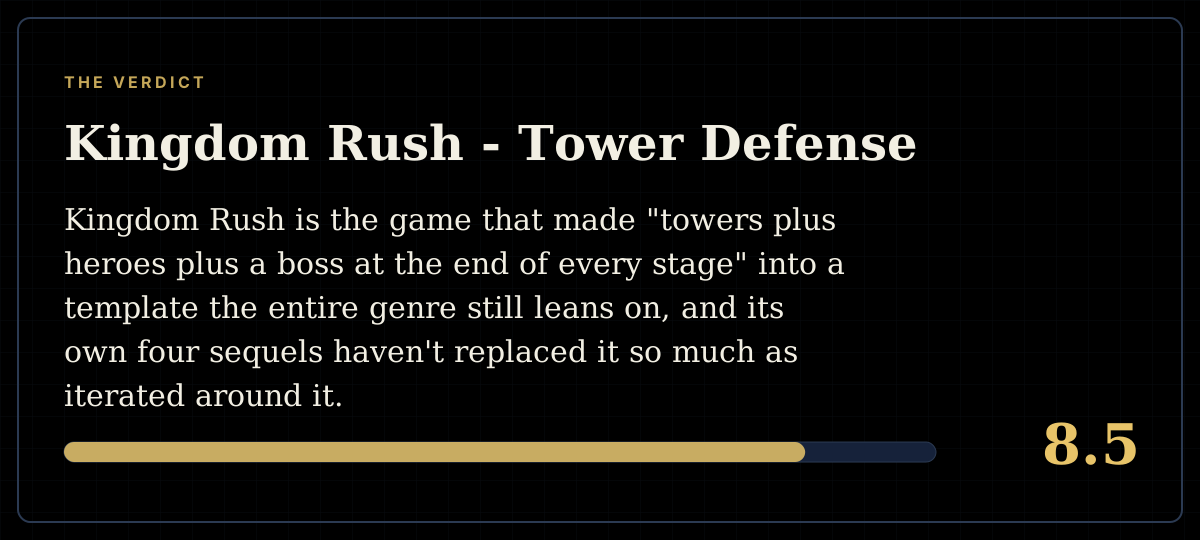
The short versionWanderer Editorial