
Game review
Kind Words (lo fi chill beats to write to)
7 / 10
- Developer
- Popcannibal
- Publisher
- Popcannibal
- Released
- 12 September 2019
- Platforms
- Windows
- Genre
- Simulation
- Monetisation
- Paid, no in-app purchases found
- Players
- true
The short version
Kind Words asks players to write short, anonymous requests describing something troubling them, and lets other players respond with letters of comfort, sympathy or gentle advice, all set against a warm, cozy lofi soundtrack. Its 98.1% positive rating is not exaggerated by this outlet's standards — an unusually large share of its review corpus describes real, sometimes profound emotional benefit. But a smaller, carefully argued minority, including at least one reviewer citing direct clinical mental-health experience, raises a serious and specific concern: the game routinely receives requests describing genuine crisis-level distress, and has no apparent screening or professional backup for connecting those requests to untrained anonymous strangers instead.
Biggest strengths
- A genuinely novel concept executed with real sincerity: anonymous, one-off letter exchanges built specifically around kindness rather than the toxicity anonymity usually enables online
- An unusually large number of detailed, first-person testimonials describing real emotional benefit, with several reviewers explicitly using language like "saved my life"
- A warm, well-regarded lofi soundtrack and cozy visual presentation that reviewers consistently credit with setting the right tone for vulnerable, honest writing
Biggest weaknesses
- A serious, specific concern raised independently by multiple reviewers, including one citing clinical mental-health experience: requests routinely describe genuine crisis-level distress (up to and including references to suicidal ideation), which untrained anonymous strangers are answering with no screening, moderation transparency, or professional backup visible to reviewers
- No mechanism exists for ongoing contact between two people who connect meaningfully through a letter exchange, a specific, repeated feature request from reviewers who found real connection but had no way to continue it
- Multiple reviewers describe the emotional toll of reading sustained, concentrated distress from strangers as real and cumulative, with at least one saying they find it hard to mentally "switch off" afterward
Who it's for: Players looking for a gentle, low-pressure way to give and receive small emotional support online, ideally in a stable enough headspace to encounter other people's genuine distress without it affecting their own wellbeing.
Our recommendation: A genuinely lovely idea, executed sincerely — but go in aware that you may encounter requests describing serious crises rather than everyday stress, and that the platform has no professional safety net if you or someone you're responding to needs one.
7 / 10
What it is
Kind Words strips the multiplayer letter-writing concept down to its simplest possible form: sitting in a small, cozy virtual room to lofi music, players write short, anonymous "request" letters describing something bothering them, and other players anywhere in the world can read those requests and respond with letters of comfort, sympathy, or gentle advice. A lightweight sticker and room-decoration system rewards participation without ever becoming the actual point — the developer's own pitch, "use your words to lift others and be lifted in return," is close to a literal description of the entire experience. It released on 12 September 2019 at NZD 7.39 from developer Popcannibal, which has since built a sequel, Kind Words 2, that shares save data and lets players of both versions write to each other — a sign of sustained investment in the concept rather than a one-off experiment.
Its review corpus, at 6,011 English-language reviews sitting at 98.1% positive, is among the most lopsidedly positive this lane has encountered. What sets it apart from other Overwhelmingly Positive titles reviewed in this lane, though, is the emotional weight and specificity of that corpus — this isn't enthusiasm about mechanics or value, it's an unusually large volume of first-person accounts describing genuine personal impact, sitting alongside a smaller but carefully reasoned set of concerns that deserve equally serious treatment.
What players say it gave them
The praise here consistently goes beyond typical game enjoyment into something more personal. "I felt sad so I wrote a letter and threw it into the void. The void wrote back and was very kind, it made me feel better," writes one reviewer, capturing the core loop's appeal simply. Others describe more sustained impact: one reviewer, gifted the game "during a dark time," calls it "the best gift [a friend] could have given me," praising both the soundtrack and "a community of lovely people all ready to answer my questions and give me encouragement." Another states directly that someone in the community "saved my life," crediting the game with helping them recognise their own path toward supporting others professionally. A recurring theme across many reviews is quiet surprise that anonymity — a feature so often associated with online toxicity — produces the opposite result here consistently: "it's nice to see it being used for the comfort and encouragement of others," as one reviewer puts it, a sentiment echoed independently across dozens of others.
A concern worth taking as seriously as the praise
Set against that overwhelming warmth is a smaller number of reviews making a specific, carefully reasoned argument rather than a generic complaint, and this review treats them with the weight they deserve rather than as a footnote. One reviewer, explicitly citing clinical experience in mental health work, argues that the game's actual use case has drifted from its stated design: "people responding to strangers with potentially declining mental health is unethical and dangerous," they write, noting that many requests aren't casual venting but "cries of help that are eye opening and indicate severe depression," submitted with no context about the person's situation and answered by strangers with no training and, in the reviewer's account, no visible request-screening process from the developer. That reviewer specifically raises a second-order concern too: players who are themselves struggling may be the ones responding to others' requests, "not in the right state of mind" to be doing so safely.
A separate reviewer reaches a similar conclusion from direct personal experience rather than professional background, describing the game as feeling like "crisis hotline simulator 2019" despite that clearly not being its intent, and reporting that sustained exposure to concentrated distress — including, by their account, content bordering on suicide notes — took a real emotional toll they found difficult to switch off from afterward. Tellingly, both of these detailed critical accounts ultimately mark their reviews as positive rather than negative, each explicitly torn between genuine appreciation for the concept and real concern about how it plays out in practice for vulnerable users on both ends of an exchange.
The missing feature both camps agree on
Interestingly, one specific, concrete request cuts across both the enthusiastic and the concerned sides of the corpus: a way to maintain ongoing, still-anonymous contact with someone after a meaningful exchange. "Pen Pals option please," writes one reviewer, arguing that without a way to stay in touch, "relationships can never form" beyond a single letter — a limitation felt by players who found a genuinely helpful connection and had no way to check back in. That same limitation cuts both ways on the safety question, too: a one-off, anonymous exchange means neither party can follow up to see whether their words actually helped, or notice if someone's situation has become more urgent since their last letter. A structured, opt-in way to continue a specific conversation — still anonymous, but persistent — could plausibly address both the relationship-building request from happy users and, to some extent, the continuity-of-care concern raised by the game's more cautious critics, though this review has no evidence either version of the game has implemented anything of the sort.
What the developer's own framing does and doesn't address
It's worth weighing the concern above against what Popcannibal's own store description actually promises. The pitch is explicitly modest: "letters of comfort, sympathy or gentle advice" for things that have "got you down" or "stressed you out" — everyday emotional weather, not crisis intervention. Read strictly, the game was never positioned as a mental-health service, and the sincerity of that original, smaller-scale intention is easy to take at face value. The concern raised by critical reviewers isn't that the developer built something malicious or dishonest — it's that a genuinely well-intentioned, lightweight concept has, in practice, become something people also use as a crisis outlet, a use case the platform's design (anonymous, one-off, peer-response, no visible screening) doesn't appear built to handle safely. That gap between stated intent and observed use is exactly the kind of thing a thoughtful developer would want to know about, and nothing in the available patch history or store copy checked for this review indicates it's been addressed directly.
Verdict
Kind Words is a sincere, well-crafted execution of a genuinely rare idea — an anonymous online space built around kindness rather than despite the absence of it — and the sheer volume and specificity of testimonials describing real personal benefit make its near-perfect review score feel earned rather than inflated. But the safety concern raised by its most thoughtful critics is substantive, not overblown: a peer-support platform handling genuine crisis disclosures without professional screening or backup carries real risk for people on both sides of that exchange, and prospective players, especially anyone currently in a vulnerable place themselves, should weigh that honestly before diving in.
Pros and cons
Pros
- A genuinely novel concept executed with real sincerity: anonymous, one-off letter exchanges built specifically around kindness rather than the toxicity anonymity usually enables online
- An unusually large number of detailed, first-person testimonials describing real emotional benefit, with several reviewers explicitly using language like "saved my life"
- A warm, well-regarded lofi soundtrack and cozy visual presentation that reviewers consistently credit with setting the right tone for vulnerable, honest writing
- A lightweight sticker and room-decoration collection layer that gives the letter-writing loop a small sense of ongoing progression without ever feeling like the point of the experience
Cons
- A serious, specific concern raised independently by multiple reviewers, including one citing clinical mental-health experience: requests routinely describe genuine crisis-level distress (up to and including references to suicidal ideation), which untrained anonymous strangers are answering with no screening, moderation transparency, or professional backup visible to reviewers
- No mechanism exists for ongoing contact between two people who connect meaningfully through a letter exchange, a specific, repeated feature request from reviewers who found real connection but had no way to continue it
- Multiple reviewers describe the emotional toll of reading sustained, concentrated distress from strangers as real and cumulative, with at least one saying they find it hard to mentally "switch off" afterward
- The core interaction loop is intentionally minimal, and reviewers are honest that this "isn't much of a game" in any conventional sense if approached with normal gameplay expectations
Screenshots
-

Kind Words (lo fi chill beats to write to)Image: Popcannibal via Steam -

Kind Words (lo fi chill beats to write to)Image: Popcannibal via Steam -

Kind Words (lo fi chill beats to write to)Image: Popcannibal via Steam -
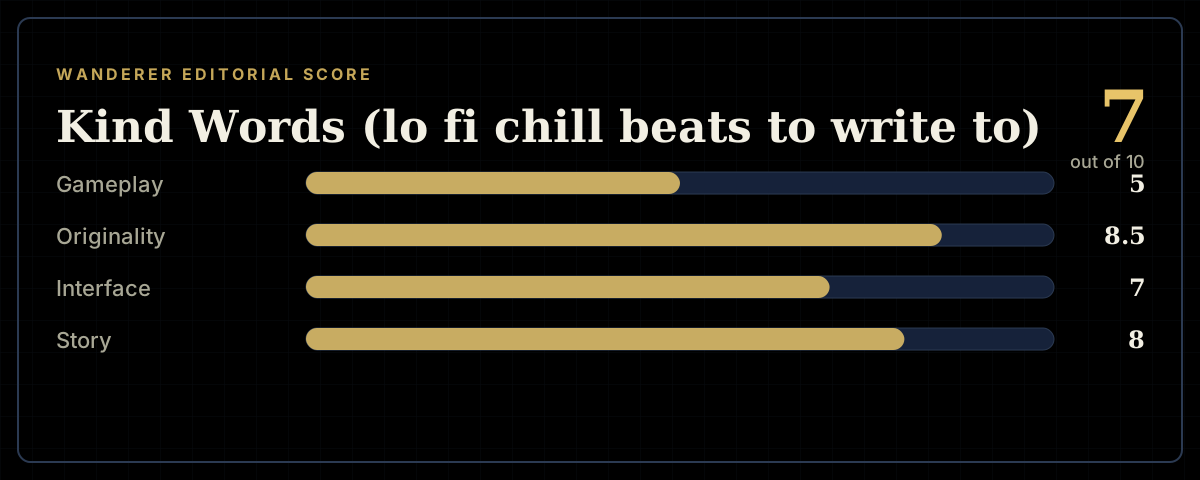
How the review scores each part of the gameWanderer Editorial -
The short versionWanderer Editorial