Game review
Kerbal Space Program
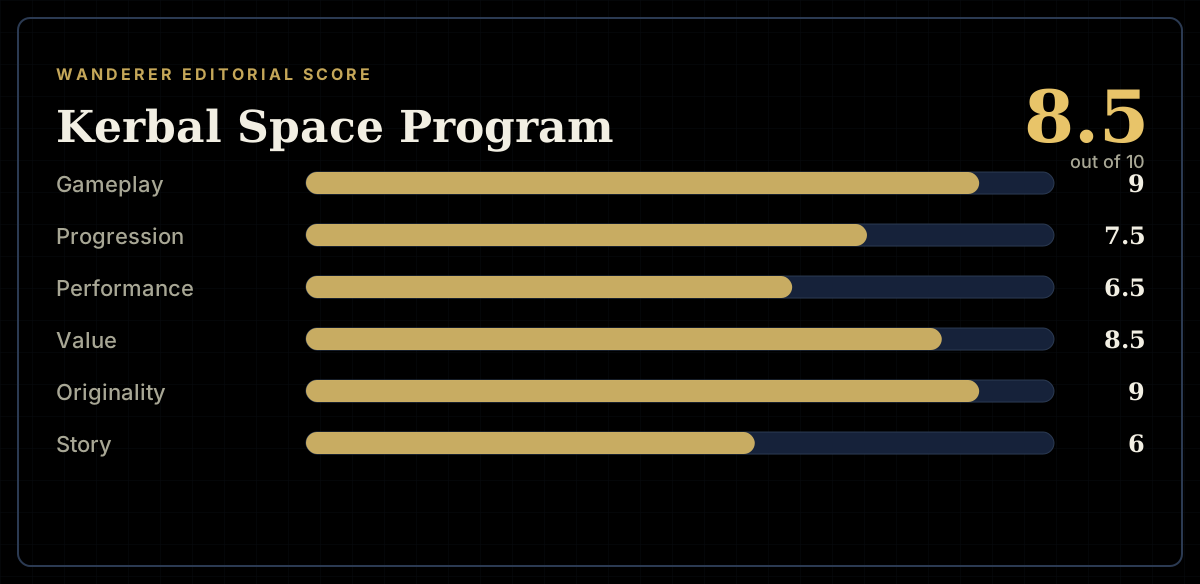
8.5 / 10
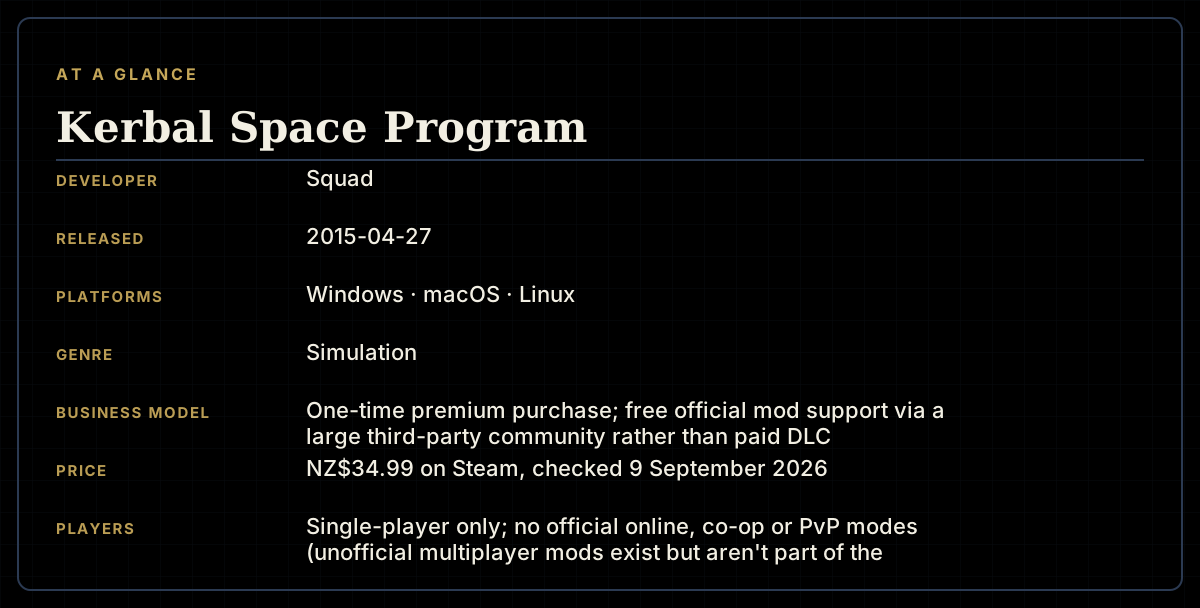
- Developer
- Squad
- Publisher
- Private Division
- Released
- 27 April 2015
- Platforms
- Windows, macOS, Linux
- Genre
- Simulation
- Monetisation
- One-time premium purchase; free official mod support via a large third-party community rather than paid DLC
- Players
- Single-player only; no official online, co-op or PvP modes (unofficial multiplayer mods exist but aren't part of the base game)
The short version
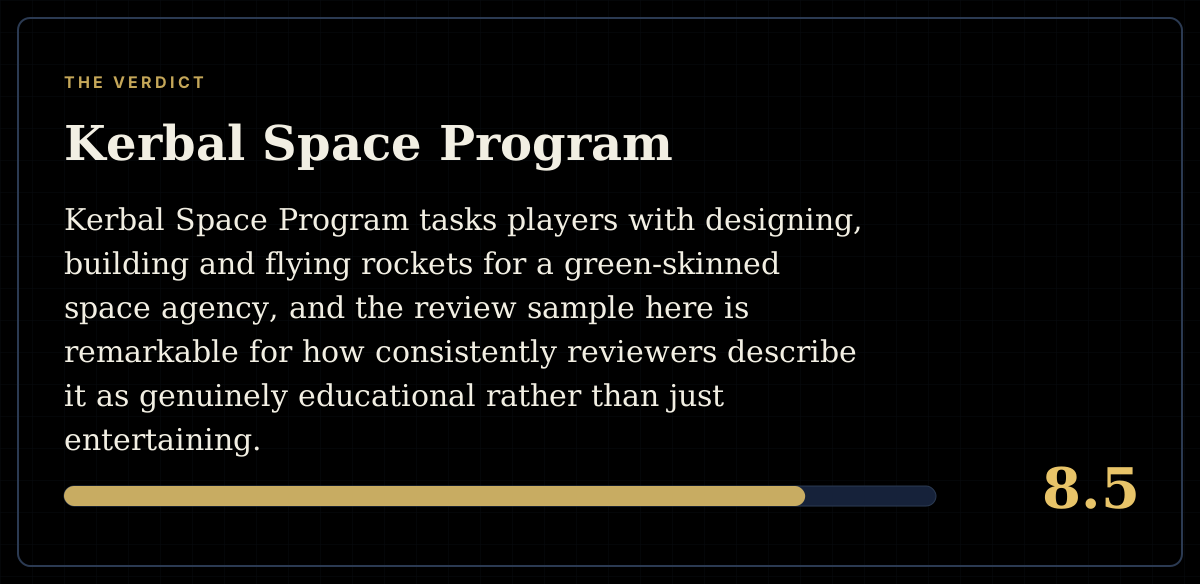
Kerbal Space Program tasks players with designing, building and flying rockets for a green-skinned space agency, and the review sample here is remarkable for how consistently reviewers describe it as genuinely educational rather than just entertaining. Multiple reviewers, independently and without prompting, credit the game with teaching them real orbital mechanics, and several specifically say watching real spaceflight news now means more to them because of hours spent in this sandbox. "This game should be standard issue in school physic classes," one widely upvoted review states plainly.
Set against that praise is a real, well-documented controversy from 2018: a EULA change, introduced not long after Take-Two's parent company acquired publisher Private Division, drew sustained, detailed reviewer objections over expanded data-collection language, compounded by the game briefly shipping with the Redshell marketing/tracking program bundled in. This review takes those specific, corroborated complaints seriously while noting that recent 2026 reviews no longer raise them, suggesting the acute controversy has passed even if this review can't independently confirm the underlying terms have since changed.
Biggest strengths
- Reviewers consistently and specifically describe learning real orbital mechanics from the game, crediting it with making actual spaceflight news and science more meaningful to them
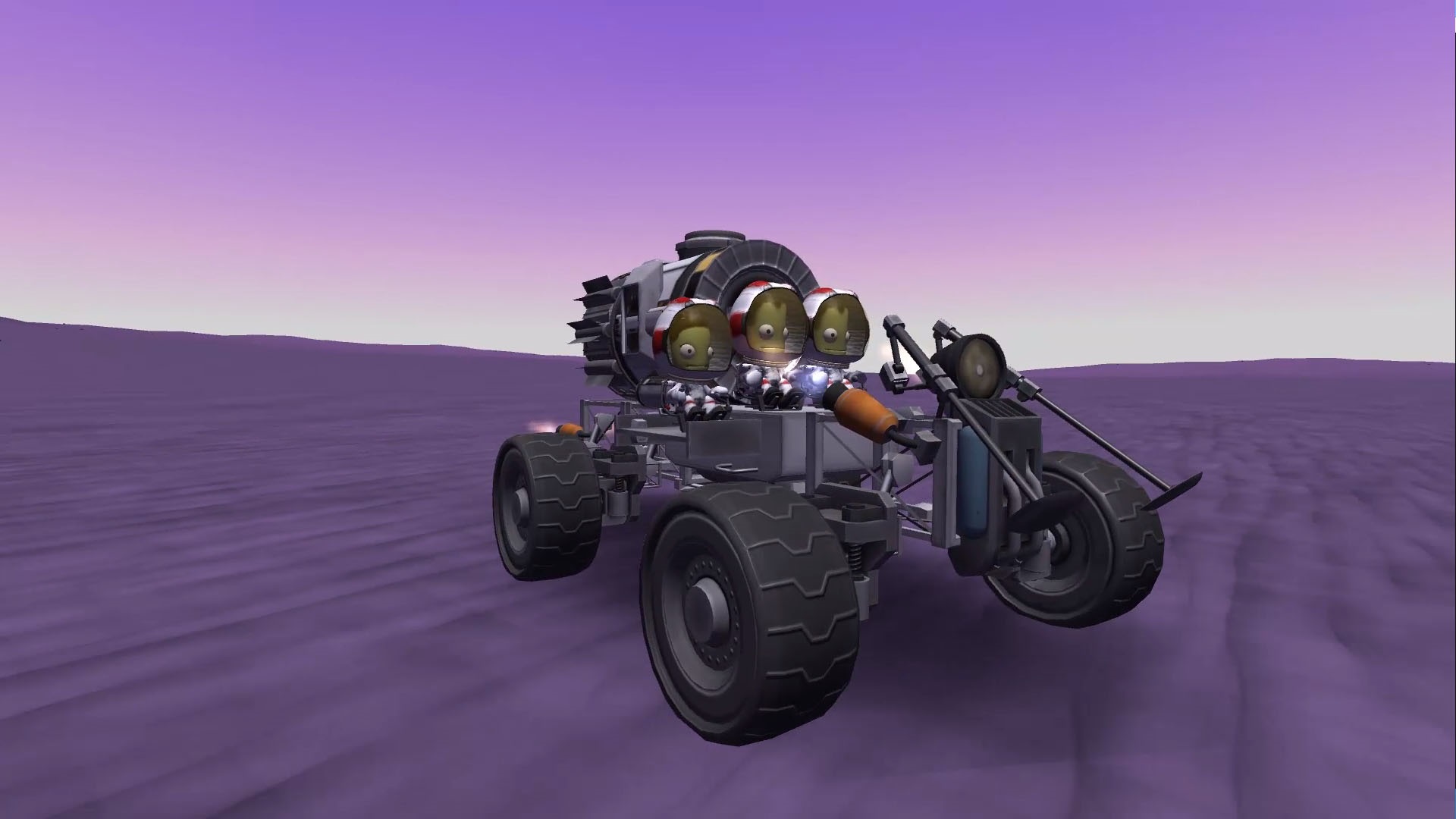
- A vast, structurally free-form sandbox supporting rockets, planes, rovers, and space stations, with reviewers praising the sheer range of things that can actually be built and flown
- An exceptionally large, active modding community, repeatedly credited by reviewers with adding graphical fidelity, new parts, and features well beyond the stock game
Biggest weaknesses
- A real, well-documented 2018 controversy: a EULA change introducing expanded data-collection language, compounded by the game briefly shipping with the Redshell tracking program bundled in, drew sustained and detailed reviewer objections; recent 2026 reviews no longer mention it, but this review could not independently confirm the underlying terms have since changed
- A steep, often frustrating initial learning curve, with multiple reviewers describing their first hours as mostly repeated explosions before anything resembling understanding sets in
- The base game's tutorial and interface are widely described as rough, with several reviewers specifically recommending community mods to smooth over onboarding friction
Who it's for: Anyone curious about real orbital mechanics and space exploration, and fans of open-ended building and physics sandboxes. Less suited to players wanting guided objectives or fast, low-friction progression, since the stock game's tutorial and interface are widely described as rough without community mods.
Our recommendation: An essential purchase for anyone even mildly curious about spaceflight or open-ended engineering sandboxes — go in expecting a genuinely steep initial learning curve, and consider community mods once you're past the basics.
8.5 / 10
Few games earn the specific kind of praise Kerbal Space Program collects from its reviewers: not just "fun," but "educational," "humbling," and, more than once, a genuine credit for making players understand real spaceflight for the first time. Developer Squad spent years building the game through a long public alpha and beta before its 1.0 release in April 2015, and that foundation shows in just how deep and open-ended the final simulation became — design a rocket part by part, launch it, and live with the consequences of your own orbital mechanics, good or catastrophically bad.
A game reviewers say actually taught them something
The single most consistent theme across this large review sample isn't the game's humor, though there's plenty of that in players' many "Jeb got stuck in orbit" stories. It's a genuine, repeated claim of real learning. "This game taught me more physics than real life did, and I loved every second," one reviewer writes, adding that "once you understand orbital dynamics, a lot of movies and TV shows seem really stupid." Another, watching a real-world rocket launch, writes that they "now have a much larger understanding of space travel because of KSP." A separate, heavily upvoted review states it even more directly: "This game should be standard issue in school physic classes." That's an unusually strong, consistent claim for a piece of entertainment software to earn from its own players, and it recurs across enough independent reviews to treat as a genuine, defining strength rather than one enthusiast's overstatement.
A real, well-documented controversy from 2018
Set against that praise, a specific and serious controversy runs through a large cluster of detailed negative reviews from 2018 and 2019. Following Take-Two's acquisition of publisher Private Division, a EULA update introduced considerably broader data-collection language, and reviewers quote it directly and at length: "your first and/or last name, e-mail address, phone number, photo, mailing address, geolocation, or payment information," alongside age, gender, hardware configuration and purchase history. Compounding that, the game was found to have briefly shipped with Redshell, a marketing-tracking program often described as spyware, bundled into an update in early 2018 before its removal. One detailed reviewer later added a correction to their own review noting a misreading of exactly what the policy covered — a useful reminder that even well-intentioned, heavily upvoted reviews can get specifics wrong, and that this is a dense, legalistic area worth reading the current terms on directly rather than taking any single review's word for it. Checking the most recent reviews available, from September 2026, turns up no fresh mentions of the EULA or Redshell at all, suggesting the acute wave of concern has passed, though this review can't independently confirm whether the underlying terms have themselves changed.
A steep climb before it clicks
Beyond that controversy, the most common practical complaint is a real, steep initial learning curve. Reviewers describe their first hours in almost identical terms across the sample: repeated, comedic failure ("built a rocket, put Jeb in rocket, send Jeb to space, forgot parachute, Jeb died") followed, eventually, by real competence. One reviewer's own before-and-after captures it well, going from "WHAT DO I DO WHY IS IT BLOWING UP" in their first hour to precise talk of transfer-window burns and aerobraking manoeuvres four hundred hours later. Several reviewers specifically recommend community mods to smooth over the stock game's rough tutorial and interface, describing the modding scene as one of the most active and long-running of any simulation game on Steam.
A troubled would-be successor, kept separate from this game's own score
Worth noting honestly: several reviewers here reference a sequel, Kerbal Space Program 2, with open disappointment. That separate game was left in an unfinished, effectively abandoned state after its Take-Two-owned developer closed down in 2024, having received only a fraction of its promised content. That's a genuine story worth knowing if considering that other release specifically, but it reflects on a different product with its own separate track record, not on this original game's own design or quality, and hasn't been allowed to affect this review's score.
Three modes, and no achievement data to lean on
The base game offers three distinct ways to play: an unstructured Sandbox mode with every part unlocked from the start, a Science mode built around unlocking new technology through experiments, and a full Career mode layering in budget management, contracts and reputation on top of that research loop. Reviewers who've tried multiple modes generally recommend starting in Sandbox to learn the fundamentals before moving into Science or Career for a more structured, goal-driven experience. One structural limitation worth noting directly: this listing carries no Steam achievement schema at all, so unlike many other games in this catalogue, there's no independent completion-rate data available here to corroborate how far the average player typically progresses through any of these three modes.
Where it lands
Kerbal Space Program earns its Overwhelmingly Positive reputation through a rare, specific quality: reviewers overwhelmingly describe genuinely learning something real from an entertainment product, on top of a deep, open-ended building and physics sandbox that still draws new players in a decade after its 1.0 release. The 2018 EULA and Redshell controversy is real and well-corroborated enough to flag clearly, even as recent reviews suggest it's no longer a live concern, and the steep learning curve is worth going in prepared for rather than discouraged by. For anyone even mildly curious about how spaceflight actually works, this remains close to essential.
Pros and cons
Pros
- Reviewers consistently and specifically describe learning real orbital mechanics from the game, crediting it with making actual spaceflight news and science more meaningful to them
- A vast, structurally free-form sandbox supporting rockets, planes, rovers, and space stations, with reviewers praising the sheer range of things that can actually be built and flown
- An exceptionally large, active modding community, repeatedly credited by reviewers with adding graphical fidelity, new parts, and features well beyond the stock game
- Genuinely emotional, memorable moments reviewers describe in personal terms, from a first successful orbit to a first landing on another world
- Runs on comparatively modest hardware without mods, widely described by reviewers as accessible even on older or lower-spec machines
Cons
- A real, well-documented 2018 controversy: a EULA change introducing expanded data-collection language, compounded by the game briefly shipping with the Redshell tracking program bundled in, drew sustained and detailed reviewer objections; recent 2026 reviews no longer mention it, but this review could not independently confirm the underlying terms have since changed
- A steep, often frustrating initial learning curve, with multiple reviewers describing their first hours as mostly repeated explosions before anything resembling understanding sets in
- The base game's tutorial and interface are widely described as rough, with several reviewers specifically recommending community mods to smooth over onboarding friction
- At least one reviewer reports a specific input-related crash while attempting a difficult landing sequence, though this reads as an isolated technical account rather than a widely-corroborated pattern
- A separate but related product, Kerbal Space Program 2, was left unfinished and effectively abandoned after its Take-Two-owned developer closed in 2024 — a real disappointment several reviewers reference, though it reflects on that separate release rather than this original game's own quality
Screenshots
-
Kerbal Space ProgramImage: Private Division via Steam -
Kerbal Space ProgramImage: Private Division via Steam -
Kerbal Space ProgramImage: Private Division via Steam -
How the review scores each part of the gameWanderer Editorial -
The specsWanderer Editorial -
The short versionWanderer Editorial