Game review
JESTER TRUMP Review
6.5 / 10
- Developer
- Playing Middle Ages
- Publisher
- Playing Middle Ages
- Released
- 31 August 2026
- Platforms
- ["Windows"]
- Genre
- Casual
A Very Focused Take On A 36-Card Classic
JESTER TRUMP is a $9.99 single-player adaptation of Throw-in Durak, the Eastern European trick-taking card game, wrapped in a deliberately grotesque medieval court presentation and developed and published by Playing Middle Ages. It released on Steam on August 31, 2026, and three weeks later carries only nine English reviews, every one of them positive. That's a genuinely small sample for a store listing, but the reviews themselves are unusually substantive for a pool this size, and they converge tightly on the same strengths and the same single glaring omission, which makes this thin pool more useful than its size would suggest.
Durak, Explained For Newcomers
The core game uses a 36-card deck, and the objective is simply to empty your hand before anyone else does. Attacking and defending form the heart of every round: a defender needs to counter an attacking card with a higher card of the same suit, or fall back on the trump suit when nothing else works, while additional cards of matching rank can join an attack mid-round and turn a comfortable defense into a scramble. One reviewer summarized the appeal plainly: "It's a classic Durak-style card game with a medieval theme... There are no bonuses—just the satisfaction of victory and some in-game achievements." Durak is a well-known card game across Eastern Europe but far less familiar to Western PC players, and JESTER TRUMP's built-in rules reference is specifically designed to close that gap, walking new players through why certain cards can attack, defend, or be added to an ongoing exchange before expecting them to compete against the AI.
Three Personalities, Three Difficulties
The game supports matches against one, two, or three computer opponents, each built around a distinct behavioral style, cautious, aggressive, or greedy, layered on top of easy, normal, and hard difficulty settings. Reviewers consistently single this out as the game's best design decision. "The intelligent AI is a plus: opponents behave differently depending on their personality—some are greedy, while others attack aggressively," wrote one reviewer, while another summed up the same idea more tersely: "The game trades flashy multiplayer elements for solid, predictable AI strategy and nostalgic card-table vibes." Adding more opponents to a match doesn't just add more cards to track, it changes the entire rhythm of a round, since a greedy opponent hoards cards differently than a cautious one folds under pressure, and that variation is doing real work to keep a fundamentally simple ruleset from feeling repetitive across sessions.
A Deliberately Strange Visual Identity
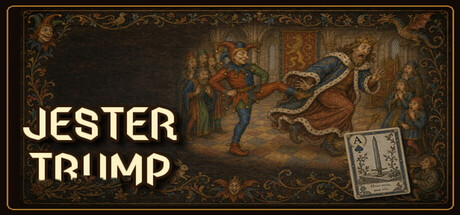
Rather than settling for a generic digital card table, JESTER TRUMP leans into jesters, nobles, and pointedly grotesque medieval court imagery to give an otherwise traditional card-game adaptation a distinct personality. Reviewers respond well to that choice specifically because it stands out from the crowd of interchangeable card-simulator templates on Steam: one reviewer called the atmosphere "an eccentric medieval atmosphere" that "immediately sets the game apart from typical card simulators," while another framed the whole package as "Classic card gaming in a sleek, modern design... beautifully crafted cards, smooth animations, and a soothing atmosphere." Whatever the specific art pipeline behind it, the visual identity is clearly the thing carrying JESTER TRUMP's presentation past what its underlying rules alone would suggest.
No Betting, No Grinding, No Multiplayer
JESTER TRUMP is explicit about what it isn't: there are no real-money microtransactions, no online betting, and no gambling mechanics of any kind, just a straight card game played for its own sake. That's a genuine point in its favor for anyone wary of modern monetization creeping into even the smallest indie releases, and reviewers notice and appreciate it: one called it a "pure, single-player experience with zero real-money microtransactions or online betting," praising the design for "striping away the stress of modern gaming." But the same single-player focus is also the pool's one consistent complaint. Every match is played against AI, not other people, so the game can't reproduce the social unpredictability that makes Durak especially fun with a group of friends around a real table. The distinct AI personalities help compensate, and the upside of skipping multiplayer entirely is that sessions start instantly with no matchmaking, no waiting on another player, and no online population to maintain, but human opponents would clearly have expanded this game's longevity well beyond what's on offer here.
Ten Achievements And Not Much Else To Chase
Beyond winning matches against different opponent counts and difficulties, JESTER TRUMP offers ten achievements tied to victories and unusual in-match situations, giving completionist-minded players a small secondary goal beyond simply playing more Durak. One reviewer flagged an odd wrinkle worth noting for achievement hunters specifically: "There are in-game achievements, but for some reason they're not on Steam," suggesting at least one player encountered achievements that track in-game but don't register on the Steam achievement list, a minor but potentially frustrating gap for anyone chasing full completion through Steam's own interface rather than in-game tracking. Beyond that, there's no campaign, no character progression system, and no deck-building layer, the entire package stays centered on the base Durak ruleset without trying to bolt on modern card-battler trappings, which several reviewers treat as a feature rather than a flaw for a game clearly aimed at a quick, focused session rather than a long-term time sink.
Verdict
JESTER TRUMP is exactly what it says on the tin: a compact, well-presented single-player adaptation of Throw-in Durak that leans on distinct AI personalities, adjustable difficulty, and a genuinely striking grotesque medieval art style to stand apart from the pile of generic card-simulator clones on Steam. Its review pool is tiny, only nine reviews three weeks after launch, but unusually detailed and unanimously positive, and the strengths and weaknesses those reviewers describe are consistent enough to trust: a strong rules explainer for newcomers, a genuinely varied AI opponent roster, and zero predatory monetization, set against the hard ceiling of having no multiplayer and no deeper progression systems beyond ten achievements. At $9.99, it's a fair, low-risk pickup for anyone curious about Durak or looking for a card game they can boot up for a short, self-contained session, but anyone hoping for a持続的 card-battler with real depth or the chaos of human opponents should look elsewhere.
Screenshots
-
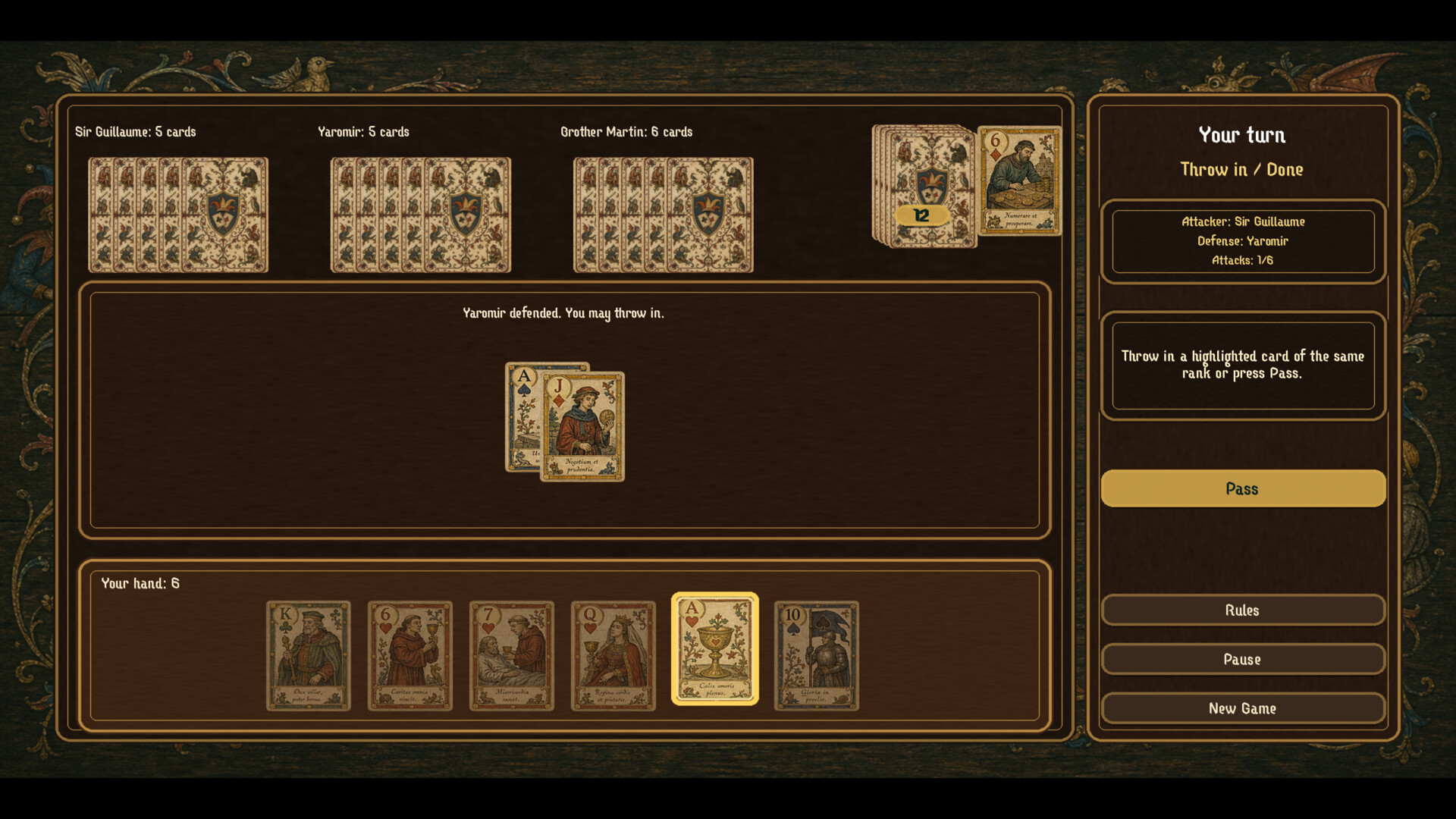
A round in progress against three named opponents. The ornate, tarot-styled card art and scrollwork border give an otherwise plain card table its medieval-manuscript personality.Image: Playing Middle Ages via Steam -
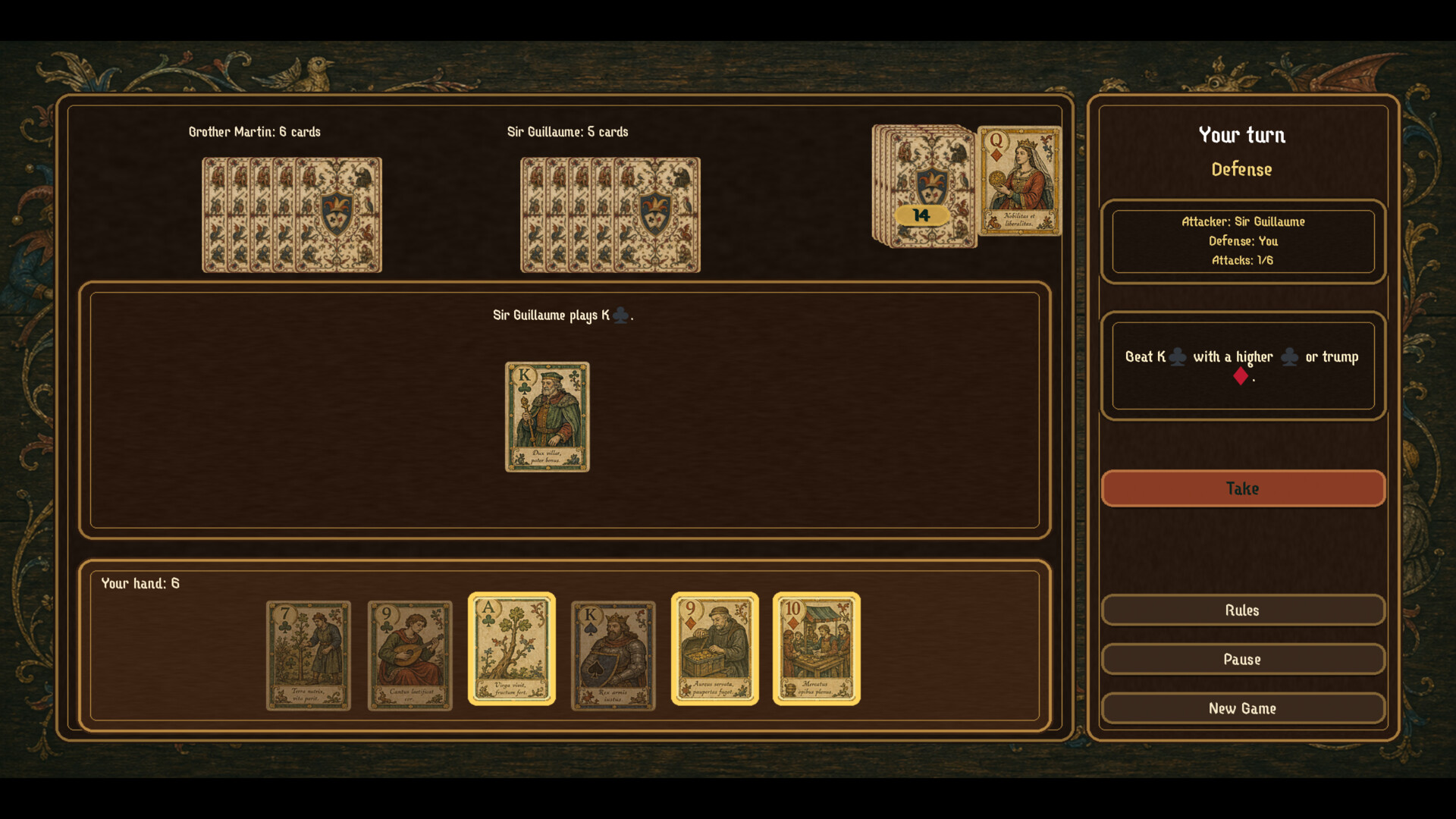
A defensive turn: beat the attacking card with a higher card of the same suit or a trump, or take the whole pile.Image: Playing Middle Ages via Steam -
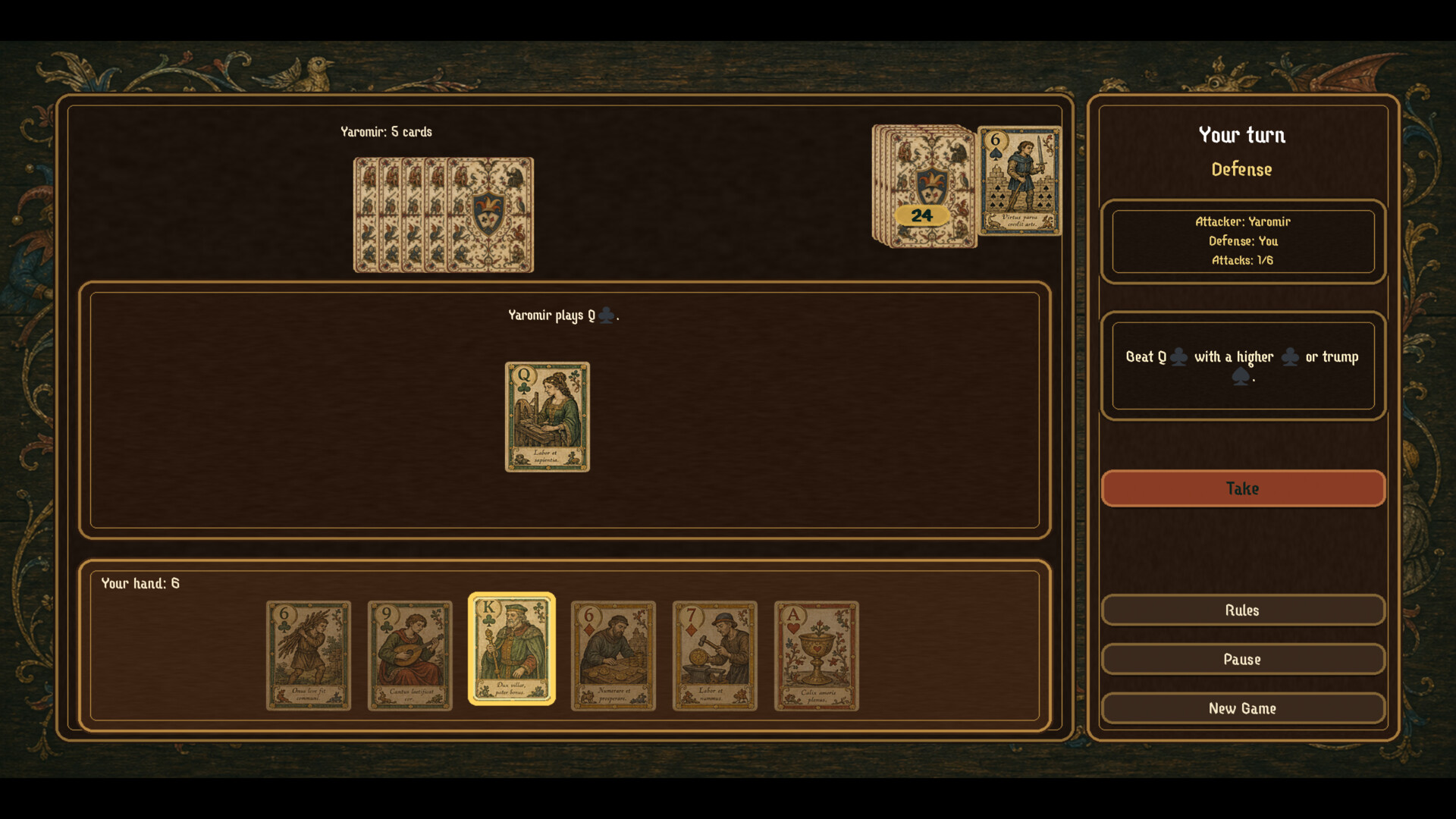
The same attack-and-defend loop against a different opponent. Runs of it like this form the entire game.Image: Playing Middle Ages via Steam