Game review
Cook with Card Review
7 / 10
- Developer
- Genco Interactive
- Publisher
- Genco Interactive
- Released
- 18 August 2026
- Platforms
- ["Windows"]
- Genre
- Simulation
A Kitchen Made of Cards
Cook with Card takes the increasingly popular "everything is a physical card" genre, the one that Stacklands helped popularize, and points it squarely at restaurant management: every ingredient, dish, and tool in the kitchen exists as a draggable card that can be chopped, cooked, combined, or plated by physically interacting with other cards. It's a clean, tactile idea, chop a card onto a cutting-board card, drop the result onto a pan card, combine two prepared cards into a finished dish, that turns the usual restaurant-sim clicking-and-menuing into something closer to a physical workspace the player builds and rebuilds as orders pile up.
Direct Lineage, Openly Acknowledged by Players
Reviewers aren't shy about naming the influences at work here. One wrote plainly: "It's sort of a cooking version of Stacklands. I've seen a few similar games but I don't recall any of them evolving into a restaurant simulation quite like this one." A second reviewer, comparing it to two specific prior titles, added: "If you liked Sizzle & Stack and Stacklands you'll vibe with this too." That's a genre lineage worn openly rather than hidden, and both reviewers frame Cook with Card not as a copy but as a specific, novel extension, the card-combination mechanic applied to the ongoing operational chaos of a working restaurant rather than a single static puzzle-box economy.
From Quiet Setup to Real Chaos
The same reviewer who drew the Stacklands comparison described a pacing arc worth noting: "I was wondering why it was so slow at the start but then pure chaos kicked in as I moved forward." That's a meaningful data point about how the difficulty curve actually plays out in practice, a deliberately gentle on-ramp that gives way to genuine multitasking pressure once orders start overlapping and the kitchen's card-based workflow has to handle several dishes moving through prep, cooking, and plating simultaneously. For a game built around physically managing a card-based kitchen, that shift into real chaos is presumably the intended payoff, and having a player independently confirm it actually arrives is a good sign the core loop is tuned with real ambition rather than just being a passive, low-stakes card-sorting toy.
Early Access, and an Honest Content Gap
Cook with Card is currently in Early Access, and the same detailed review is candid about where the current build runs thin: "Taking a break for now because I think it needs more content after day 20, gonna jump back in for the full release." That's a specific, useful signal for anyone considering buying in now rather than waiting, the early days of the restaurant's growth are apparently well-paced and engaging, but the content curve doesn't yet sustain itself much past that point, a common and forgivable growing pain for an Early Access management game still building out its recipe list and escalation systems.
Recipes, Tools, and the Promise of More to Come
The stated recipe progression, starting from steak and salad before expanding into french fries, eggs, fish, burgers, pizza, mantı, spaghetti, and pancakes, gives a sense of the intended scope: a genuinely international, growing menu rather than a handful of dishes stretched thin across the whole runtime. Each new recipe unlock is tied to new ingredients and kitchen tools, which is the right structural shape for an Early Access roadmap, there's a clear, legible axis (more recipes, more tools, tougher orders) along which the game can keep expanding without needing to reinvent its core card-interaction mechanic.
Kitchen Upkeep as Its Own Management Layer
Beyond the recipe-card loop, the game layers in restaurant upkeep concerns, dirty floors, mice, flies, and fires are all named hazards that compete for attention alongside the actual cooking, alongside cosmetic customization of walls, floors, and furniture funded by earned money. That's a sensible way to give the management side of "restaurant management game" some teeth beyond just cooking faster, a kitchen that's falling apart around the player creates pressure independent of order volume, and it gives the earned currency somewhere purposeful to go beyond just efficiency upgrades.
A Small but Unanimous Early Signal
Four reviews, all positive, is a genuinely small sample for a $7.99 Early Access release, and it would be premature to call this a proven hit off that alone. But the reviews that exist are detailed, specific, and consistent in exactly the ways that matter: they name the genre lineage accurately, they describe the difficulty curve honestly including its current shortcomings, and they express clear intent to return once more content lands, which is a notably strong vote of confidence for a game its own players see as unfinished. Steam Achievements and cloud saves are both already in place, standard infrastructure that at least suggests the developer is building toward a complete, supported release rather than treating Early Access as an indefinite holding pattern.
Verdict
Cook with Card takes the card-based automation formula popularized by Stacklands and successfully redirects it into restaurant-management chaos, with reviewers confirming both a well-tuned early pacing curve and real substance once the orders start overlapping. Its Early Access content runs out around day 20 by at least one detailed account, a fair and expected limitation rather than a fundamental flaw, and the stated recipe and upkeep systems point toward a reasonable roadmap for filling that gap. At $7.99, with a small but unanimously positive and specific review base, it's a reasonable Early Access buy-in for card-automation fans willing to accept the current content ceiling while the full release takes shape.
Screenshots
-

Day 2: a customer places an order at the counter, tracked alongside a day counter, satisfaction rating, and cash on hand.Image: Genco Interactive via Steam -
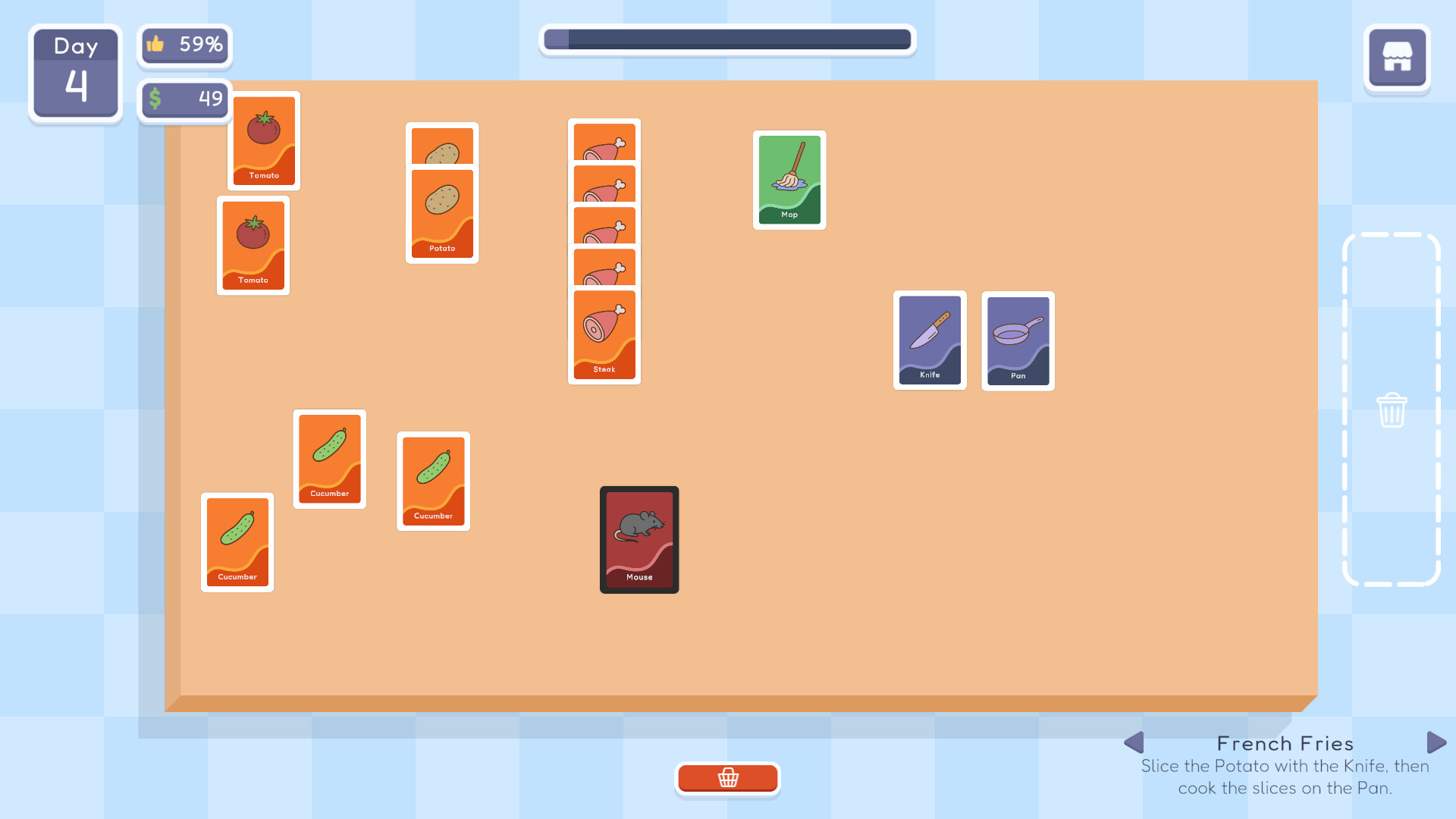
The kitchen workspace, ingredient and tool cards spread out alongside a Mouse hazard card that has appeared among the produce.Image: Genco Interactive via Steam -

By day 13, multiple customers wait at once, the kind of overlapping-order pressure reviewers describe as the game's real chaos.Image: Genco Interactive via Steam