
Game review
Dungeon Tells Review
6.4 / 10
- Developer
- Ace Benoff
- Publisher
- Ace Benoff
- Released
- 21 August 2026
- Platforms
- ["Windows"]
- Genre
- Strategy
A Solo Deduction Game Where Math Matters More Than Bluffing
Dungeon Tells casts you as a dungeon boss trying to figure out which heroes in a captured lineup are lying about their strength, using their cryptic, unreliable statements about their own and each other's levels to decide who to execute and who to spare. It's built and published solo by developer Ace Benoff, pitched explicitly as a "short, replayable deduction roguelite where hidden identities meet game-show risk," and it borrows the shape of social deduction party games like Werewolf or Town of Salt while stripping out the multiplayer entirely — every round is a solitary logic puzzle you work through by comparing statements, narrowing possibilities, and occasionally accepting a calculated gamble rather than a certain answer. At $7.99, it's a tightly scoped, low-friction pickup rather than a sprawling roguelite, closer in spirit to a daily puzzle app than a long-session strategy game.
A Mostly Positive Launch, Shadowed by a Better-Known Rival
Dungeon Tells launched to 32 reviews and a 75% positive score, landing in Steam's "Mostly Positive" bracket — a smaller, more contested pool than most releases covered here, though English still makes up 20 of the 32 reviews sampled, a solid majority to draw on. The single most recurring theme across the entire review pool, positive and negative alike, is a direct comparison to Demon Bluff, a better-known deduction game that reviewers describe this title as either preceding or trailing depending on who's writing. One reviewer frames it warmly: "if you were looking for Demon Bluff pre-release, your princess is in another castle, but this has the same charm." A more critical reviewer takes the opposite view, suggesting Dungeon Tells "was rushed out so it could be released before Demon Bluff," arguing the underlying idea deserved more development time than it apparently got. This review can't independently verify which game's release timing was influenced by the other, but the comparison shapes a meaningful share of both the praise and the criticism in the pool. Notably, several reviewers who bring up Demon Bluff still land on a positive verdict for Dungeon Tells specifically, treating the two as complementary rather than as a straight one-or-the-other choice — reasoning that a solo, math-driven puzzle and a multiplayer bluffing party game can both be worth owning without one making the other redundant.
Deduction That's Really a Math Puzzle, According to Its Fans
Reviewers who enjoyed Dungeon Tells are consistent about what it actually is: less a pure "who's lying" deduction game and more a logic-and-arithmetic puzzle wearing a social-deduction skin. One reviewer puts it plainly: "identifying the heroes' levels is more important than figuring out who is lying," while another calls it "a math heavy logic puzzle" rather than deduction in the traditional sense. Several reviewers praise how that structure escalates in difficulty across the game's different modes, with one describing going from repeated early failures to clearing every difficulty and topping the leaderboards over roughly seven hours without external help, calling the puzzle design "amazingly well balanced" with rare true coin-flip guesses. The developer's post-launch support also draws specific praise: multiple reviewers note that patches adding a drawing tool for tracking deductions, a more readable font, mid-run saving, and a full in-game reference for hero abilities all arrived within the first two weeks, addressing exactly the friction points earlier reviewers had flagged. Shorter, calmer game modes are also singled out as a good fit for a quick daily session rather than a long sitting, and one reviewer specifically calls out the pixel-art character portraits and clean, uncluttered interface as strengths that make even the game's denser late-run boards easy to read at a glance.
Thin Content and Execute-Everyone Strategies Undercut the Deduction Fantasy
The negative and mixed reviews cluster around two related complaints: the game is short, and its core deduction mechanic can be short-circuited by simply executing suspects rather than reasoning about their statements. One reviewer lays out the issue directly, explaining that instead of piecing together clues, "I could just use all my executes randomly before reading anything, which reveals the status of the executed, and thus usually gives me all the info I need" — meaning the intended puzzle-solving loop is optional rather than required for many boards. Multiple reviewers also mention that each game mode currently ships with only five levels, which several found disappointingly thin for a game built around replayability, and at least one reviewer specifically called out unclear explanations of what certain hero abilities actually do. A separate, sharply worded complaint notes there's no way to save and resume mid-run, meaning an interrupted session forces a restart from scratch — a rough edge for a game otherwise marketed as a quick, pick-up-and-play puzzle experience.
Verdict
Dungeon Tells is a compact, single-player spin on social deduction that swaps bluff-reading for probability and arithmetic, and its fans clearly appreciate both the puzzle design and a developer who shipped meaningful quality-of-life patches within weeks of launch. It arrived into a smaller, more contested reception than most titles here, partly shaped by direct comparisons to the higher-profile Demon Bluff, and partly by legitimate complaints about thin per-mode level counts, an execute-first strategy that can bypass the intended deduction puzzle, and no mid-run saving. At $7.99 for a handful of hours of daily-puzzle-style logic play, it's a reasonable pickup for players who want a solo, numbers-driven alternative to party-game deduction rather than the genre's usual multiplayer bluffing — just go in expecting a tight, still-maturing puzzle box rather than a fully realized roguelite.
Screenshots
-
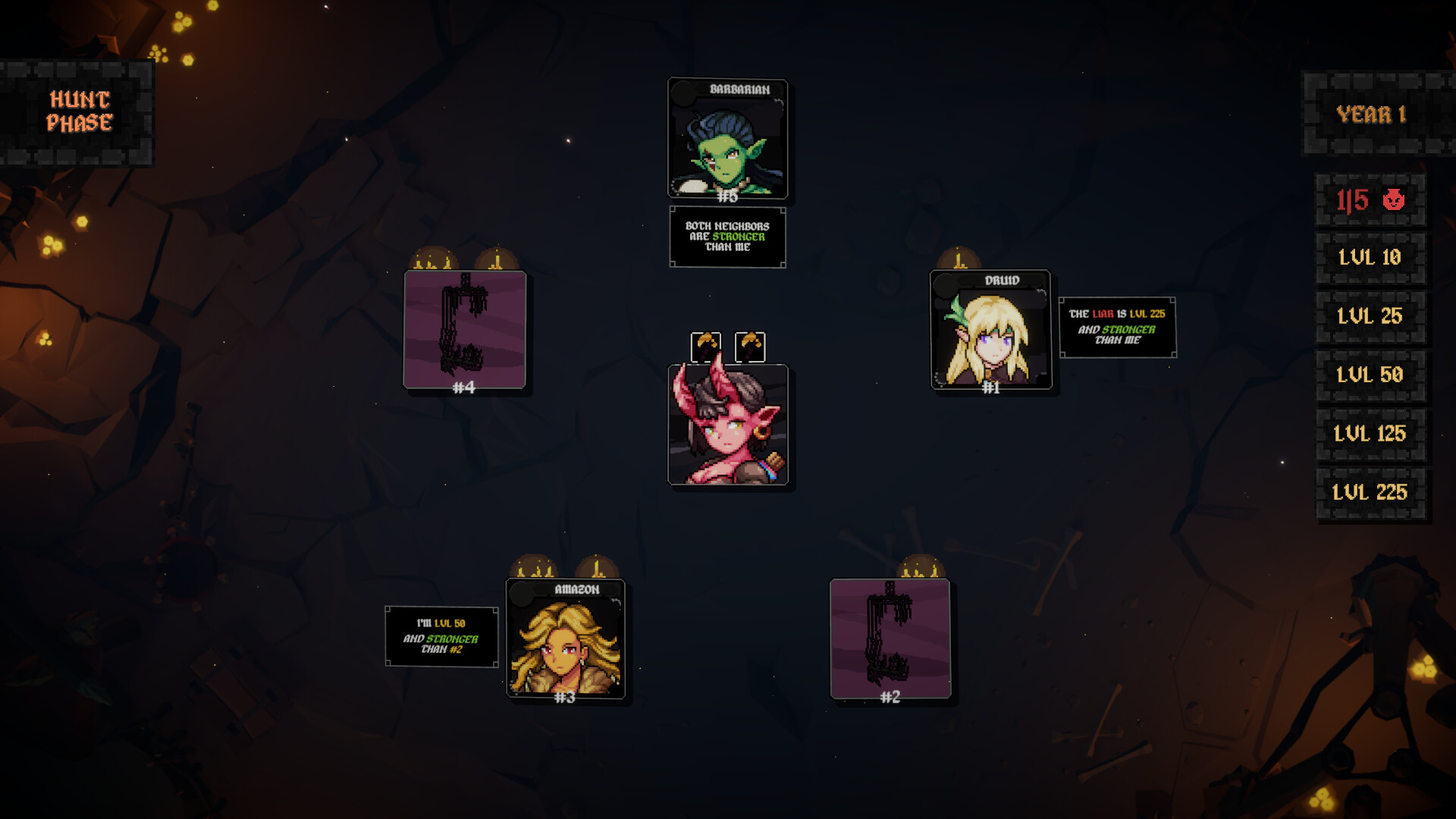
The Hunt Phase: five captured heroes make claims about their levels, some honest and some not, for the player to weighImage: Ace Benoff via Steam -
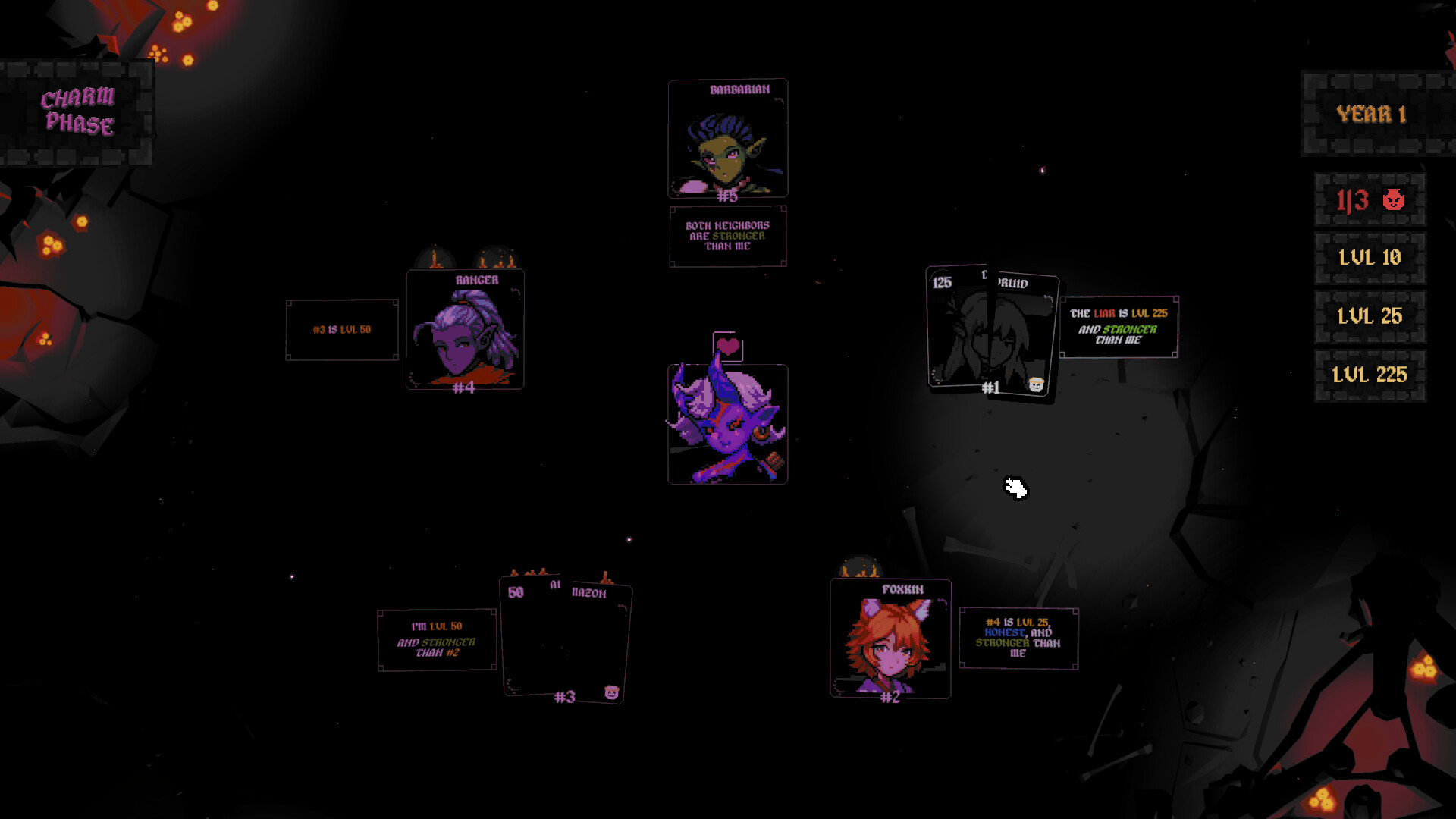
The Charm Phase, after an execution has revealed a hero's true level, narrowing down who else can be trustedImage: Ace Benoff via Steam -

Between runs, choosing an Evolution upgrade that will be attached to a random hero in the next dungeonImage: Ace Benoff via Steam