Game review
Jargon
6.5 / 10
- Developer
- Damon D'Amico
- Publisher
- Damon D'Amico
- Released
- 31 March 2026
- Platforms
- Windows
- Genre
- Strategy
- Monetisation
- Premium
- Players
- Single-player
The short version
Jargon is an $11.99 solo-developer roguelite from Damon D'Amico, released 31 March 2026, that builds words on a persistent board while collecting rule-bending "books" that escalate each run toward chaos. Its 5-review sample runs unanimously positive, and this review's read of that sample found a genuinely satisfying, strategically deep word game that several reviewers explicitly compare to Balatro-style deckbuilders, with real innovations in the genre even if it doesn't pretend to be the first of its kind.
Biggest strengths
- This review's sample is unanimous and enthusiastic, with scores volunteered directly in the review text running as high as 9/10 and 8.5/10, and one reviewer logging over 2,057 minutes, more than 34 hours, a strong indicator of genuine long-term engagement rather than a single-session curiosity
- This review's sample repeatedly praises the persistent gameboard as a real point of differentiation, with one detailed reviewer explicitly comparing it against other word-based deckbuilders they'd played and concluding Jargon is the first to make players balance tiles already on the board against tiles still in their bag, calling it 'neat' and citing it as the most compelling part of the design
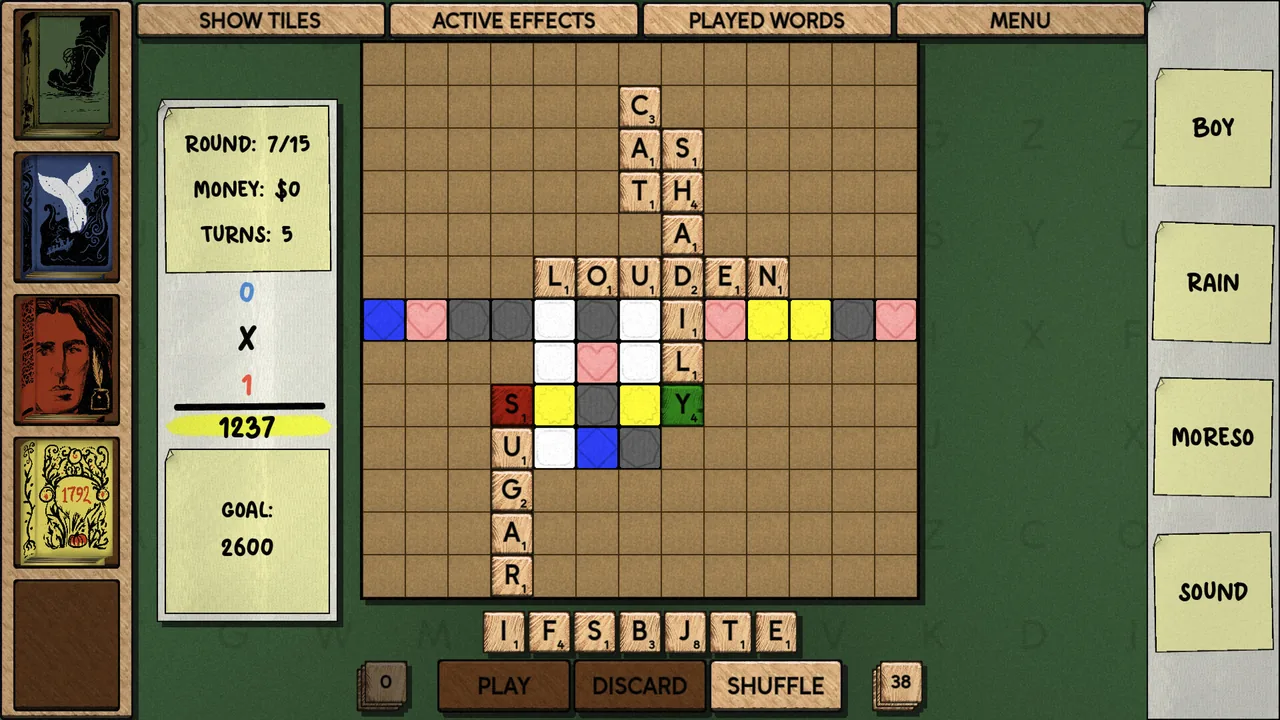
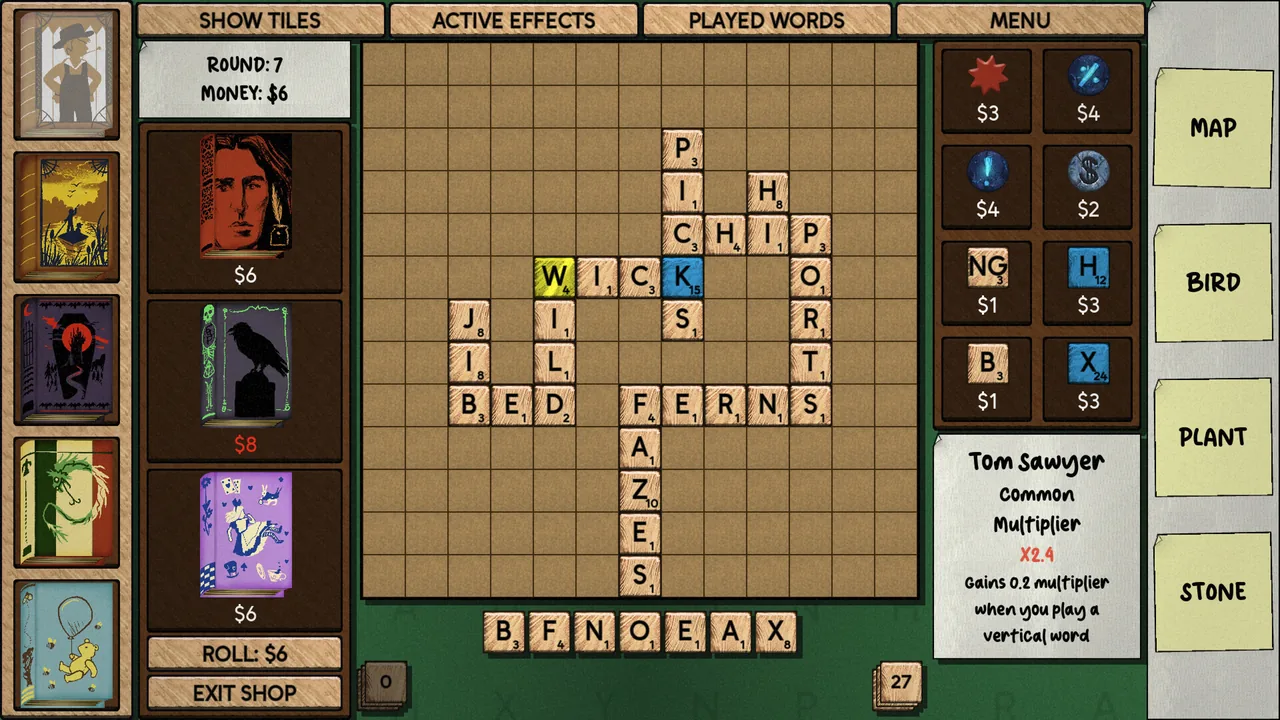
- This review checked the game's own feature list and confirmed a genuinely substantial roguelite structure underneath the word-game hook: over 60 unlockable 'books' that radically change how words score, four separate game modes each with five escalating difficulty levels, and a shop between rounds stocked with enchanted runes and items that reshape the board
Biggest weaknesses
- This review's sample includes a detailed reviewer who is explicit that Jargon is 'another balatro scrabble game,' immediately placing it within an already crowded wave of run-based deckbuilders borrowing the same escalating-combo structure, a framing this review's other four reviews don't contest even as they praise the execution
- This review's sample includes a UK-based reviewer's specific complaint that the game only accepts words from US dictionaries rather than the broader word list used in UK Scrabble, costing what they say would otherwise have been a perfect score, and this review checked the developer's public patch history and found no fix or acknowledgment of the complaint
- This review's sample includes a reviewer who otherwise rates the game very highly but flags the soundtrack as repetitive over long sessions, writing it 'does get a bit old' and suggesting more variety, a specific critique worth weighing against the same store page's own description of the music as calm and consistent by design
Who it's for: Word-game and deckbuilder fans looking for a genuinely strategic, replayable roguelite to sink dozens of hours into; a weaker fit for UK players wanting a Scrabble-standard dictionary, or anyone wanting something wholly unlike the Balatro-inspired wave it's openly part of.
Our recommendation: A well-built, strategically rich word roguelite that this review's small sample found genuinely addictive rather than merely competent, worth its price for genre fans despite offering little that's entirely new to anyone already deep into the Balatro-likes.
6.5 / 10
Jargon builds words on a persistent board while collecting rule-bending "books" that escalate each run toward glorious chaos, a Scrabble-meets-roguelite hybrid from solo developer Damon D'Amico. It's an $11.99 release, released 31 March 2026. This review draws on all 5 reviews the game has accumulated, alongside its achievement data and developer patch history.
A word game its own players call strategic, not just cozy
This sample repeatedly pushes back against the assumption that a word game must be a purely relaxed, low-stakes affair. One reviewer specifically credits the "layer of strategy" that comes from having to clear tiles to avoid running out of them, and calls it "honestly one of the better word games out there." Another separately describes it as "more than just a word game," explicitly citing the strategic layer as the reason it stands out. Even the reviewer who frames it as ideal for a pre-bed wind-down still notes it "takes a bit to click," suggesting the game asks more of players than its cozy surface first implies. This review checked the Steam achievement data directly and found a wide spread across the game's 12 tracked achievements, from a top completion rate of 46.2% down to several sitting at 0.0%, a distribution consistent with a game whose harder difficulty tiers and deeper systems are genuinely gating most players rather than everything being cleared on a first pass.
A persistent board this sample calls a genuine innovation
The most detailed review in this sample singles out one specific mechanical choice as the game's strongest idea: unlike other word-based deckbuilders, where each round reportedly starts with a fresh board, Jargon carries the board state forward, forcing players to balance the tiles already placed against the tiles still in their bag, along with wherever their collected "books" might scale from. That reviewer calls the result "neat" and names it the most compelling part of the design, alongside a separate mention of "bounty words" that reward spending resources to chase specific targets, both cited as genuine departures from the genre's usual template rather than incremental polish.
Real structure underneath the word-game hook
This review checked the game's own feature list and confirmed a substantial roguelite skeleton: more than 60 unlockable "books" that radically change how words score and behave, a wide variety of items that enchant letters and reshape the board, four distinct game modes each with five escalating difficulty levels, and a between-round shop selling enchanted runes and the occasional bomb. That's a real, sizeable structure for players to work through, one this sample's high logged playtimes, including a single reviewer at over 2,057 minutes, roughly 34 hours, suggest genuinely holds up over repeated runs.
"Another balatro scrabble game," and that's not entirely a compliment
Not every reviewer in this sample treats the game as a wholly fresh idea. One writes plainly that Jargon is "another balatro scrabble game," recommending newcomers try the free demo first since the full release is, in their words, largely the same formula "but longer with more complicated jokers (books) and additional game modes." That reviewer still recommends it and goes on to praise the persistent-board innovation discussed above, but the framing is a useful corrective against overselling the game's originality: it's a well-executed, meaningfully improved entry in an increasingly crowded wave of Balatro-style deckbuilders, not something inventing its own genre from scratch.
A dictionary gap that cost one reviewer a perfect score
This sample's one specific, named complaint comes from a reviewer used to UK Scrabble rules, who reports the game only accepts words from US dictionaries rather than the broader word list they're used to. That reviewer still scores the game a "solid 9/10," explicitly stating it would have been a 10 with full UK dictionary support, and closes by hoping for an update to address it. This review checked the developer's public patch history for any response and found none.
A soundtrack one reviewer says wears thin
The store page describes the game's music as "a cozy jazz soundtrack that stays calm while everything else falls apart," and most of this sample doesn't comment on the audio at all. One detailed reviewer breaks from that silence to flag the soundtrack specifically as a weak point over long sessions, writing that while it's "very good," it "does get a bit old" and could use more variety, a fair critique to weigh against the store's own framing of consistency as a deliberate design choice rather than an oversight.
No public patch history to check
This review checked the developer's partner-events feed directly and found zero posts of any kind. For a solo-developer premium release now five months past its 31 March 2026 launch, that's a notable silence: there's no public record via that channel of bug fixes, balance changes, or responses to specific player requests like the UK-dictionary complaint above. It doesn't necessarily mean nothing has changed under the hood, patches can ship without an accompanying public announcement, but it does mean this review found no citable evidence of active, communicated post-launch support.
Verdict
Jargon earns its unanimous, small-sample praise honestly: this review's sample and its own feature list both point to a genuinely strategic, replayable word roguelite with at least one real mechanical innovation, its persistent gameboard, layered on top of a formula several of its own fans openly acknowledge borrows heavily from Balatro-style deckbuilders. It ships with a clean bill of health on bugs, a real dictionary gap for UK players, and no visible public record of the developer addressing feedback since launch. At $11.99, it's a legitimately deep, well-made entry in a crowded genre rather than a category-defining one.
Pros and cons
Pros
- This review's sample is unanimous and enthusiastic, with scores volunteered directly in the review text running as high as 9/10 and 8.5/10, and one reviewer logging over 2,057 minutes, more than 34 hours, a strong indicator of genuine long-term engagement rather than a single-session curiosity
- This review's sample repeatedly praises the persistent gameboard as a real point of differentiation, with one detailed reviewer explicitly comparing it against other word-based deckbuilders they'd played and concluding Jargon is the first to make players balance tiles already on the board against tiles still in their bag, calling it 'neat' and citing it as the most compelling part of the design
- This review checked the game's own feature list and confirmed a genuinely substantial roguelite structure underneath the word-game hook: over 60 unlockable 'books' that radically change how words score, four separate game modes each with five escalating difficulty levels, and a shop between rounds stocked with enchanted runes and items that reshape the board
- This review's sample contains not a single reported bug, crash, or technical complaint across all five reviews, a genuinely clean showing compared to every other title this lane has covered this window, several of which had reviewers flagging progression-blocking bugs even in otherwise well-received releases
Cons
- This review's sample includes a detailed reviewer who is explicit that Jargon is 'another balatro scrabble game,' immediately placing it within an already crowded wave of run-based deckbuilders borrowing the same escalating-combo structure, a framing this review's other four reviews don't contest even as they praise the execution
- This review's sample includes a UK-based reviewer's specific complaint that the game only accepts words from US dictionaries rather than the broader word list used in UK Scrabble, costing what they say would otherwise have been a perfect score, and this review checked the developer's public patch history and found no fix or acknowledgment of the complaint
- This review's sample includes a reviewer who otherwise rates the game very highly but flags the soundtrack as repetitive over long sessions, writing it 'does get a bit old' and suggesting more variety, a specific critique worth weighing against the same store page's own description of the music as calm and consistent by design
- This review checked the developer's public partner-events feed directly and found zero posts, meaning there is no visible public record of post-launch patches, fixes, or developer communication since release, a notable silence for a solo-developer premium release five months after launch
Screenshots
-
JargonImage: Damon D'Amico via Steam -
JargonImage: Damon D'Amico via Steam -
JargonImage: Damon D'Amico via Steam