Game review
IRON NEST: Heavy Turret Simulator
6 / 10
- Developer
- Nick Nieuwoudt, Dominik Latos
- Publisher
- Nick Nieuwoudt, Dominik Latos
- Released
- 6 August 2026
- Platforms
- Windows
- Genre
- Simulation
- Monetisation
- One-time purchase
- Players
- Single-player
The short version
IRON NEST: Heavy Turret Simulator, released 6 August 2026 by a two-person team, casts the player as the sole operator of a colossal dieselpunk artillery platform in an alternate 1920s Spain, triangulating targets by hand and firing on High Command's orders. Its huge, largely English review sample praises the game's tactile machinery, phenomenal sound design, and a much-loved customisable cat companion, but a substantial and detailed body of criticism, echoed even by many positive reviewers, describes a lack of mid-mission saves, a triangulation mechanic that stops evolving after the first couple of missions, and a range of progress-affecting bugs including a memory leak and mission-ending softlocks.
Biggest strengths
- The sound design and tactile machinery draw exceptionally consistent, specific praise across the sample, with reviewers repeatedly describing the clanking levers, creaking metal, and booming cannon fire as some of the best in the genre
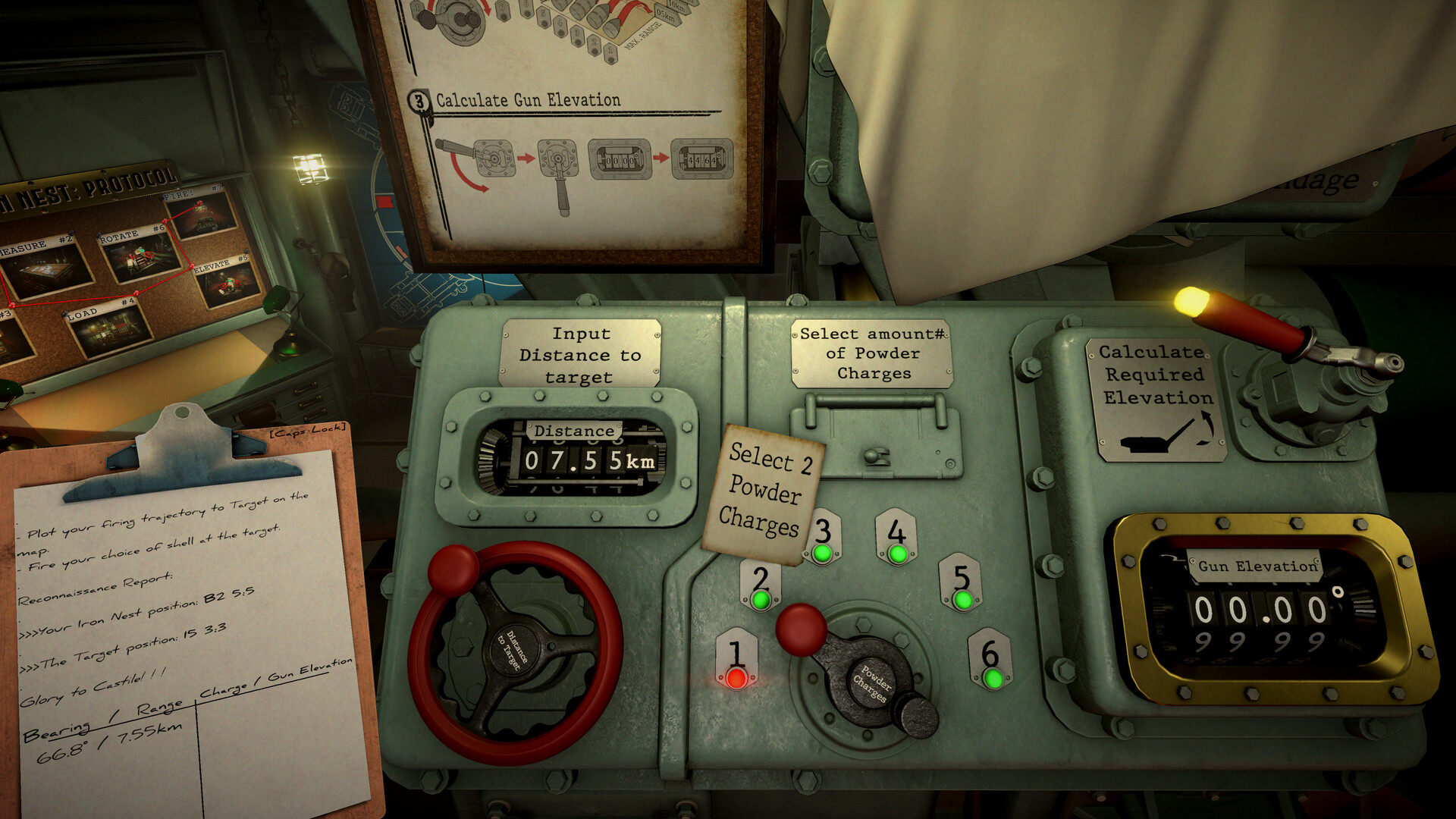
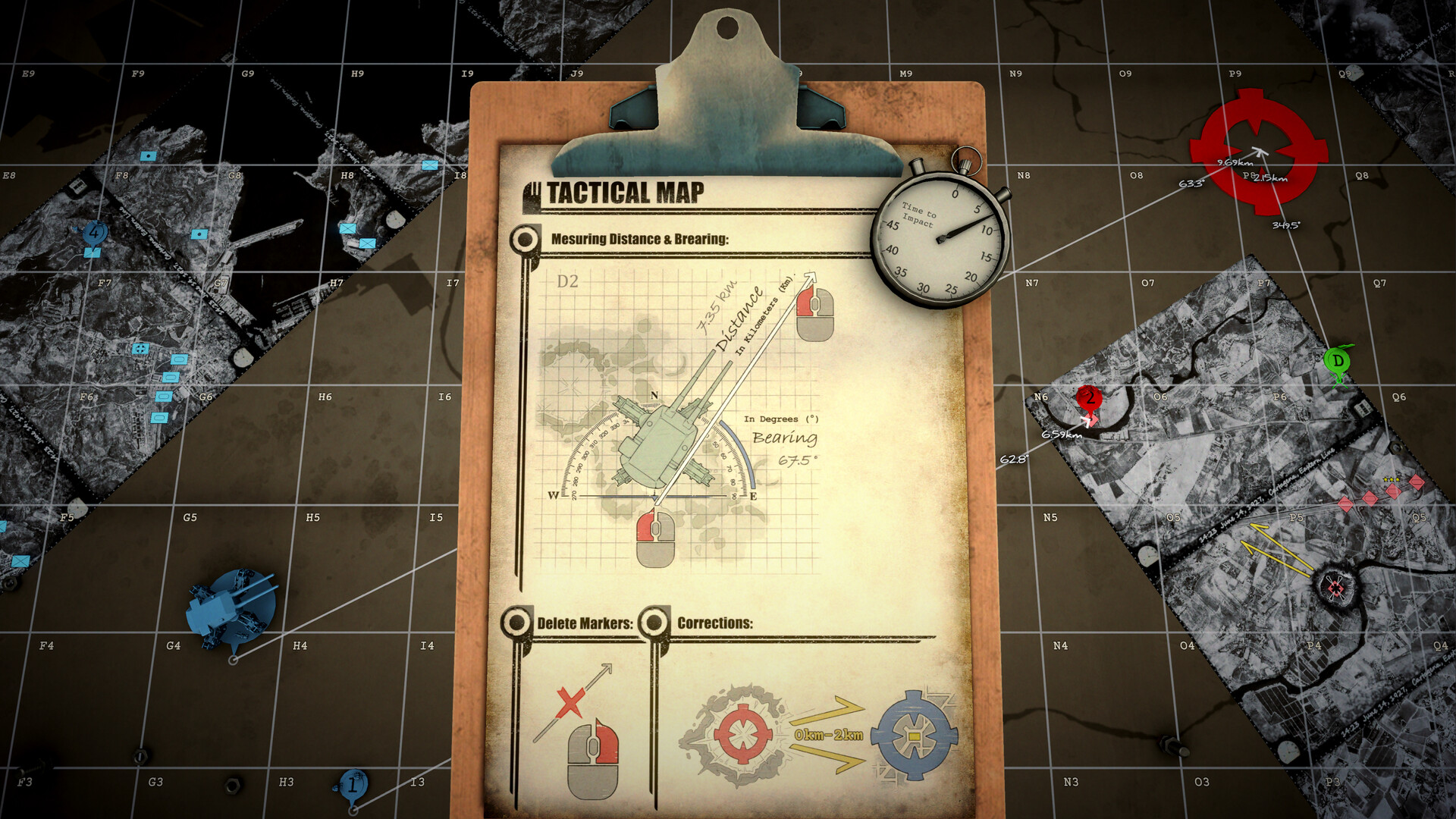
- The core triangulation mechanic, plotting targets on a map and calculating a firing solution by hand, is widely described as immediately satisfying and unusually approachable, requiring only basic arithmetic while still feeling like genuine problem-solving
- A customisable pet cat that follows the player around the turret is repeatedly and specifically singled out as a beloved, memorable touch, referenced across a very large share of the positive reviews in the sample
Biggest weaknesses
- By far the most repeated complaint in the sample, including the two highest-voted negative reviews, is the absence of a mid-mission save, with missions running 30 to 60 minutes and no way to pause progress if the player is interrupted or the game crashes
- Several long, detailed reviews argue the triangulation mechanic, however satisfying at first, stops evolving after the first two or three missions, with perfect information, no ballistic variance, and a large arsenal of shell types the campaign rarely requires players to actually use
- Multiple independent reports describe progress-affecting bugs, including mission-ending softlocks, objectives that fail to register as complete, unobtainable "gold medal" challenges, and a memory leak that degrades performance significantly over longer sessions
Who it's for: Players who enjoy tactile, procedure-driven simulation games, methodical puzzle-solvers who like calculating a correct answer step by step, and anyone drawn to a distinctive dieselpunk military aesthetic with a dark satirical edge.
Our recommendation: A genuinely original, well-crafted couple of evenings for the right audience, but players expecting deep, evolving simulation mechanics, or who can't tolerate losing 30-60 minutes of progress to a crash or interruption, should wait for a patch addressing saves and stability.
6 / 10
IRON NEST: Heavy Turret Simulator puts the player alone inside a walking artillery colossus in the service of the fictional crown of Castile, an alternate-history 1920s Spain, tasked with triangulating enemy positions from a war-room map, calculating a firing solution by hand, and pulling the lever on a gun that can level a hospital as easily as a bunker. Built by just two developers, it has landed with an enormous, Overwhelmingly Positive review sample of over 7,000 reviews. Reading through that sample in depth reveals a game that has earned its reputation for an unusually tactile, satisfying core idea, while facing a specific and substantial body of criticism, much of it from reviewers who still recommend the game, about how far that idea actually goes.
A phenomenal machine to sit inside
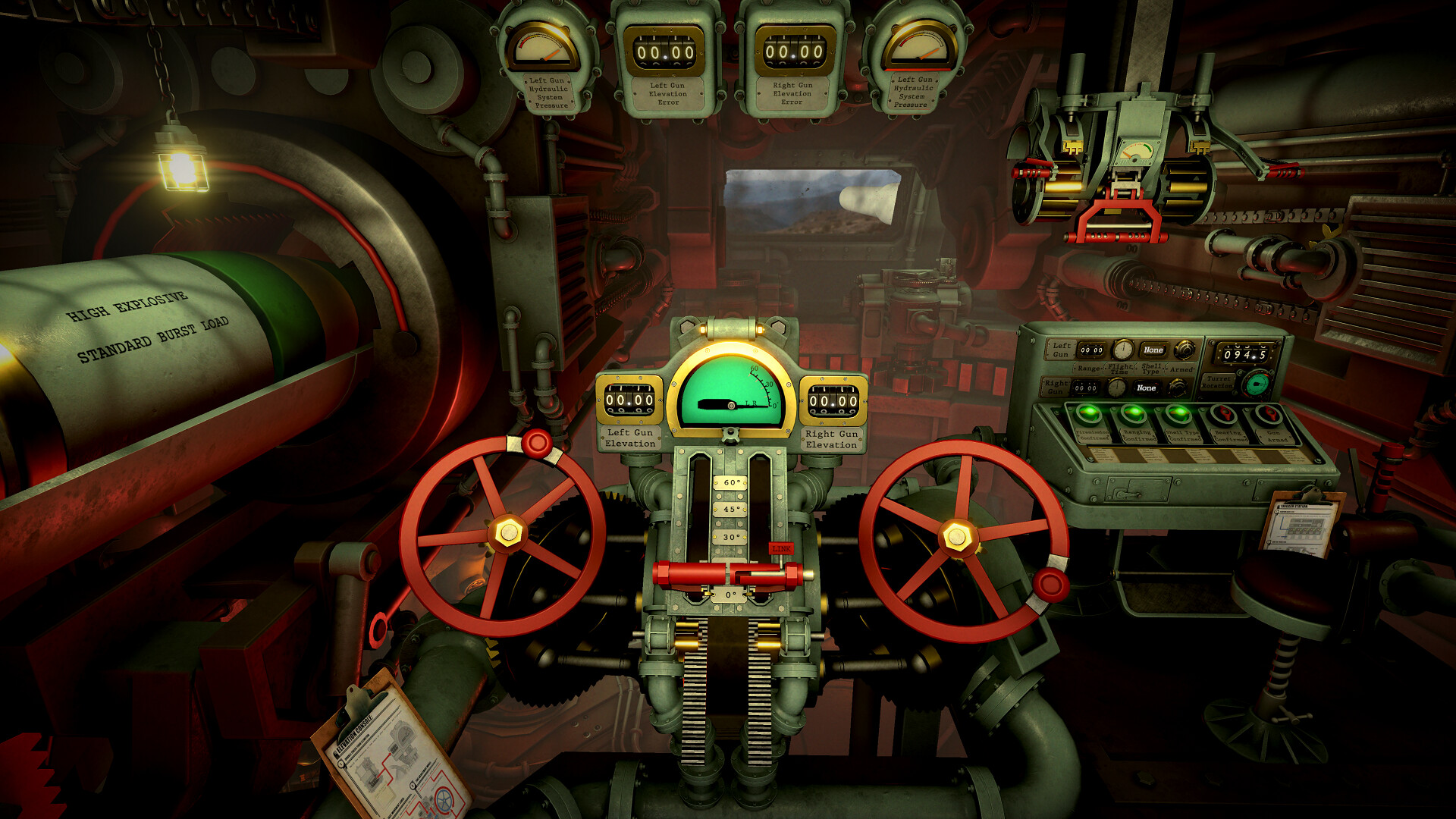
The single most consistent praise in this sample has nothing to do with strategy or difficulty: it's about how the Iron Nest itself feels to operate. Reviewers repeatedly and specifically single out the sound design, the creak of handwheels, the clank of shells being loaded, the deafening boom of the gun firing, as some of the best in the genre, with several describing an almost meditative "flow state" that develops once the firing procedure becomes second nature. A detailed review from a self-identified former US Marine artillery fire-direction-control specialist praises the calculations as surprisingly close to real-world procedure, right down to a small coffee-maker detail in the menu. The triangulation mechanic at the centre of it all, plotting bearings and distances on a map to work out where to aim, draws similarly consistent praise for being immediately approachable with only basic arithmetic while still delivering a genuine sense of solving a puzzle. And a large number of reviewers, entirely independently of the core mechanics, single out a customisable pet cat that wanders the turret as a beloved, specific highlight, one of the more unusual but consistent threads running through the positive side of this sample.
Depth that thins out after the first few missions
Set against that praise is a detailed and substantial critique, echoed across a wide range of reviewers including many who still recommend the game, that the simulation underneath the tactile presentation is thinner than it first appears. One especially detailed negative review lays out the case precisely: targets are almost always static with perfect information available, the ballistic model is simple and deterministic enough to calculate directly, and once a player has learned the triangulation procedure in the first two or three missions, the remaining campaign largely repeats the same loop with cosmetic variation. Several reviewers make the same point more briefly: the game hands you a large arsenal of shell types and battlefield tools that the missions rarely actually require you to use, with most players reporting they relied on the same three or four shells for the entire fifteen-mission campaign. It's worth being fair to what this criticism is and isn't: very few reviewers call the underlying idea bad, several explicitly praise the two-person team's ambition and craft, but there's a clear, recurring sense that the game introduces its best ideas early and doesn't build meaningfully on them.
No mid-mission save, and a handful of real bugs
The single most repeated specific complaint in this entire sample, appearing in the two highest-voted negative reviews and dozens more throughout, is the lack of any way to save progress partway through a mission. With missions commonly running 30 to 60 minutes, an interruption, crash, or simply needing to stop for the day means losing that entire session's work, and multiple reviewers describe this as the deciding factor in an otherwise positive experience. That's compounded by a range of independently reported bugs serious enough to flag: several players describe missions that fail to register as complete despite finishing every objective, requiring a restart from scratch, unobtainable "gold medal" challenges that block full completion, and a memory leak that one detailed review says gradually drags a capable PC down to single-digit frame rates over a long session. A smaller but specific set of reviewers also flag poor controller and Steam Deck support, pointing out that background menu elements continue receiving input while a different menu is open, a notable complaint given the game's official Steam Deck Verified status.
A dark satirical edge, worn lightly
Beyond the mechanics, several reviewers specifically comment on the game's tone, an over-the-top, propagandistic "Glory to Castile" newspaper and command structure that frames the player's actions, including strikes that can hit hospitals or friendly units, with cheerful, unquestioning loyalty. Multiple reviewers read this as a pointed, if lightly worn, satire of military bureaucracy and casual complicity in collateral damage, one detailed review specifically notes the game's narrative framing shows "an ordinary artilleryman who simply follows orders... and doesn't even realize what he is doing constitutes war crimes." It's a tone that clearly lands with much of the audience without overwhelming the moment-to-moment mechanical satisfaction that's driving most of the praise.
Final Verdict
IRON NEST is a genuinely original, confidently crafted simulator built around an idea, hand-calculated artillery triangulation, that very few other games have attempted, and its sound design and tactile machinery back that idea up about as well as a two-person team could hope to. But a detailed, wide-ranging body of criticism, not from outliers but echoed across much of the sample including many positive reviews, makes clear that the simulation doesn't deepen the way its opening hours promise, and the lack of a mid-mission save alongside a handful of real, progress-affecting bugs are practical problems serious enough to weigh against the recommendation. Worth it for players who want a distinctive few evenings with a genuinely new idea, but calibrate expectations around a short, front-loaded experience rather than a long-form simulation.
Pros and cons
Pros
- The sound design and tactile machinery draw exceptionally consistent, specific praise across the sample, with reviewers repeatedly describing the clanking levers, creaking metal, and booming cannon fire as some of the best in the genre
- The core triangulation mechanic, plotting targets on a map and calculating a firing solution by hand, is widely described as immediately satisfying and unusually approachable, requiring only basic arithmetic while still feeling like genuine problem-solving
- A customisable pet cat that follows the player around the turret is repeatedly and specifically singled out as a beloved, memorable touch, referenced across a very large share of the positive reviews in the sample
Cons
- By far the most repeated complaint in the sample, including the two highest-voted negative reviews, is the absence of a mid-mission save, with missions running 30 to 60 minutes and no way to pause progress if the player is interrupted or the game crashes
- Several long, detailed reviews argue the triangulation mechanic, however satisfying at first, stops evolving after the first two or three missions, with perfect information, no ballistic variance, and a large arsenal of shell types the campaign rarely requires players to actually use
- Multiple independent reports describe progress-affecting bugs, including mission-ending softlocks, objectives that fail to register as complete, unobtainable "gold medal" challenges, and a memory leak that degrades performance significantly over longer sessions
- Poor controller and Steam Deck support draws pointed criticism given the game's official Steam deck verification, with menus reported to receive unintended input from background elements
Screenshots
-
IRON NEST: Heavy Turret SimulatorImage: Nick Nieuwoudt via Steam -
IRON NEST: Heavy Turret SimulatorImage: Nick Nieuwoudt via Steam -
IRON NEST: Heavy Turret SimulatorImage: Nick Nieuwoudt via Steam