Game review
Grand Cru: The Wine Maker
6.5 / 10
- Developer
- hAi Corp
- Publisher
- hAi Corp
- Released
- 8 August 2026
- Platforms
- Windows, Mac
- Genre
- Simulation, Strategy
- Monetisation
- One-time purchase
- Players
- Single-player, with an online global leaderboard for revenue and top sale price
The short version
Grand Cru: The Wine Maker, released 8 August 2026 by small studio hAi Corp, puts players in charge of a struggling family winery in Bordeaux, working through the full cycle of viticulture from planting and harvest through fermentation, blending, and negotiating sales to a roster of distinct buyers. Its small but Positive review sample is unusually warm for such a specific niche, praising both the accuracy and depth of its wine-making systems and a surprisingly affecting story about inheriting a father's debt and his unfinished final blend. Set against that is a near-universal acknowledgment, even from reviewers who love the game, that it still looks and plays like an early access title: rough interface elements, a jarring mismatch between AI-generated art and hand-painted portraits, and a single region's worth of content that several reviewers say runs dry after the first several hours.
Biggest strengths
- Reviewers, including some who describe themselves as serious wine enthusiasts, consistently praise the depth and accuracy of its viticulture systems, covering terroir scoring, soil and grape suitability by region, fermentation choices, oak barrel aging, and blending
- A story built around inheriting a father's winery debt and piecing together his final, unfinished blend is repeatedly singled out as more emotionally engaging than reviewers expected from a business simulation
- A satisfying, "one more turn" gameplay loop that several reviewers describe losing hours to, built around weather variance genuinely affecting each vintage the way it would in real life
Biggest weaknesses
- Content is currently limited to Bordeaux alone, and several reviewers list specific wine styles they'd like to see added, including sparkling wine, sherry, port, Madeira, rosé, and late-harvest wines, describing the current scope as a strong foundation rather than a finished picture
- Multiple reviewers describe the game as still feeling like early access despite its formal full release, citing a jarring visual mismatch between simple AI-generated backdrops and detailed painted character art, occasional stray Korean text in the English localization, and general rough edges throughout
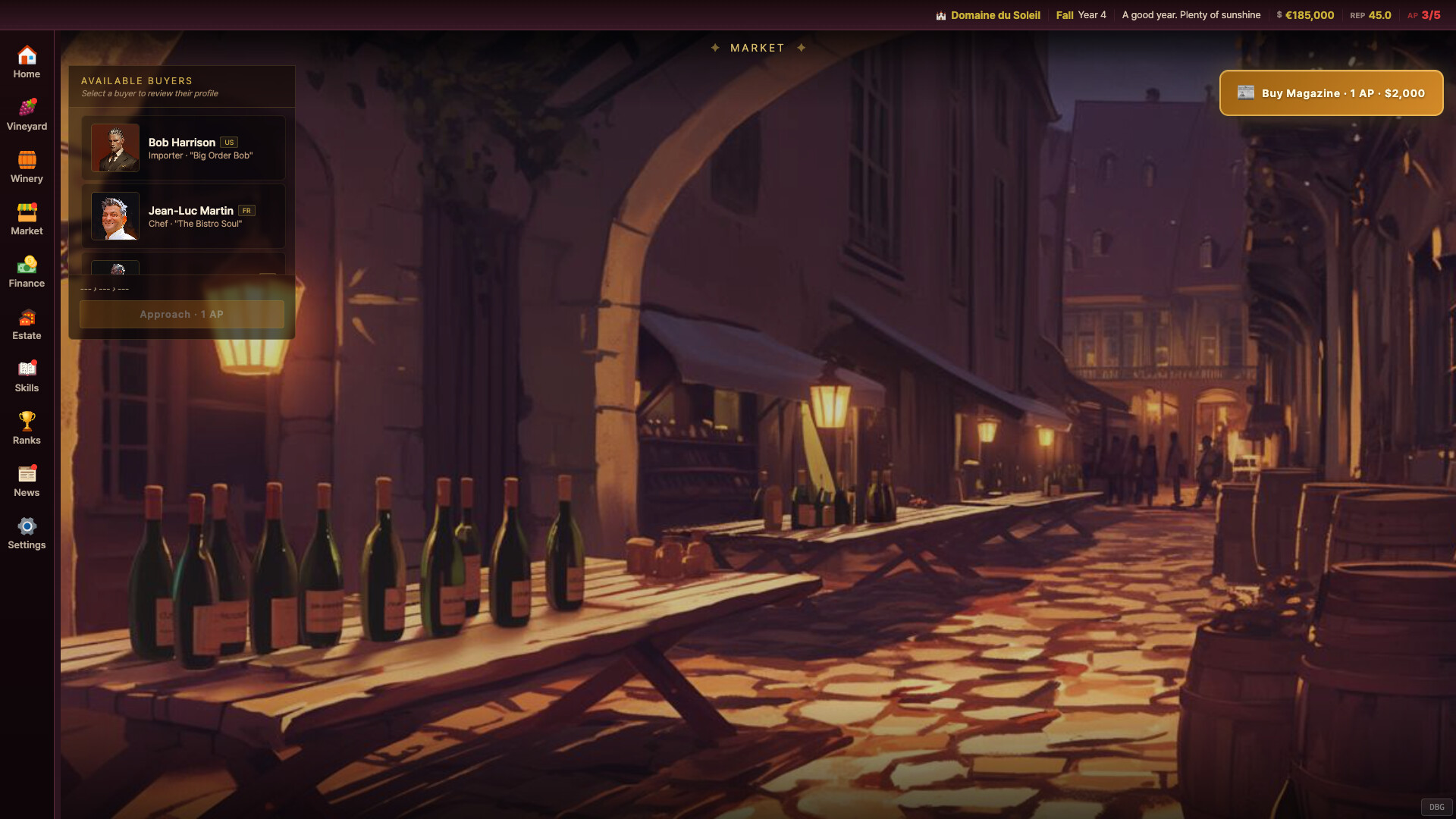
- Interface complaints recur often: a sell button that can get pushed off-screen once a cellar holds several wine types, a blending screen that doesn't show which specific lots are being combined, and an end-of-season results screen that some reviewers report gets cut off
Who it's for: Fans of deep, slow-paced business simulations and anyone genuinely curious about the mechanics of winemaking, rather than players looking for a broad, varied management game or a polished, bug-free experience out of the gate.
Our recommendation: A genuinely distinctive simulation with real substance underneath its rough surface, worth a look for management-sim fans willing to tolerate interface friction and currently thin content in exchange for a genre few other games attempt this seriously.
6.5 / 10
Grand Cru: The Wine Maker asks a question few management sims bother with: what would it actually take to rebuild a failing Bordeaux winery from scratch? Released 8 August 2026 by small studio hAi Corp, it hands players their late father's debt-ridden estate and walks them through the entire cycle of winemaking, planting, harvesting, fermenting, aging in oak, blending, and negotiating sales to a cast of distinct buyers, each with their own tastes and pricing quirks. Its small review sample, currently sitting at 39 reviews with a Positive rating, responds to that ambition with real warmth, and just as consistently notes that the execution still has some distance to travel.
A wine simulation that takes its subject seriously
The quality reviewers return to most often is depth. Several describe themselves as genuine wine enthusiasts and praise the accuracy of the terroir system, where different plots within Bordeaux have distinct soils suited to different grapes, and where a wine's final quality depends on a genuinely wide chain of decisions stretching from which vines get planted where through to how long a blend spends in oak. One reviewer compares the feel to a blend of 100 Days and Viticulture, and multiple others say the in-game encyclopedia explaining real winemaking concepts adds genuine educational value on top of the simulation itself. Weather adds a layer several reviewers specifically call out as realistic: a strong plan and careful management can still be undercut by a bad harvest season, the same way it would for a real vintner, and that unpredictability is treated as a feature rather than an annoyance.
An unexpectedly personal story
Reviewers consistently mention being surprised by how much the narrative pulled them in. The setup, inheriting a father's winery along with his debts and an unfinished final blend players slowly piece together clues toward over the course of play, is singled out repeatedly as more emotionally resonant than a business simulation typically attempts. One reviewer described not expecting "to feel things playing a wine sim," and several others cite the storyline specifically as the reason they kept playing past their first few hours, even when other parts of the game frustrated them.
Rough edges the sample won't let slide
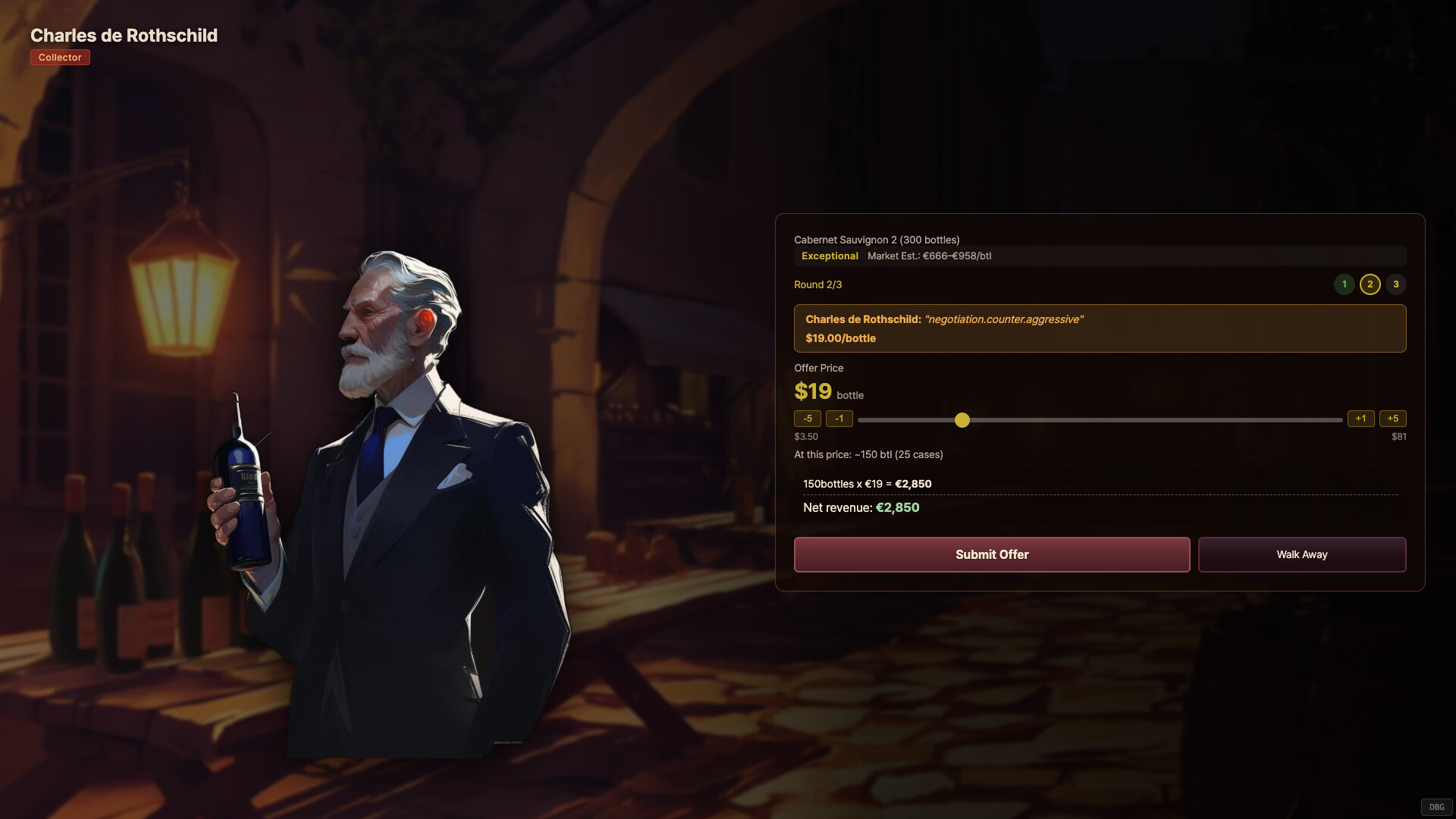
Set against that praise is a recurring, specific set of complaints, and notably, they come from reviewers who otherwise like the game rather than from its detractors alone. Several describe a jarring visual inconsistency between simple, abstract AI-generated backdrops and much more detailed, hand-painted portraits of wine buyers, calling the shift between the two styles distracting. More than one reviewer reports stray Korean text appearing in what's otherwise a solid English localization, and interface complaints show up often enough to be treated as a pattern rather than a one-off: a sell button that can get pushed off-screen once a cellar holds several types of wine, a blending screen that doesn't clearly show which specific lots are being combined, and an end-of-season results screen some reviewers report getting cut off entirely. Multiple reviewers use the exact phrase "early access" to describe the game's current state, despite its formal full release, which is worth factoring in even though Steam does not list it as an Early Access title.
A single region, and an action-point system under strain
Content breadth is the other consistent thread in the sample's more measured reviews. The game currently covers Bordeaux exclusively, and several reviewers list specific wine styles they'd like to see added in future updates, sparkling wine, sherry, port, Madeira, rosé, and late-harvest styles among them, treating the current scope as a strong foundation rather than a complete picture. The action point system that governs how many tasks a player can complete each turn draws specific frustration once a save expands past one or two properties, with multiple reviewers describing themselves running out of points before they can both manage the vineyard and complete winemaking tasks in the same turn. At least one reviewer reports the game running dry of meaningful things to do after roughly five hours, and a few describe AI buyer behaviour and wine scoring as inconsistent or hard to predict once initial expectations don't line up with in-game results.
An active developer players are willing to be patient for
What keeps the sample largely positive despite all of this is a consistent thread of trust in the developer. Multiple reviewers specifically credit hAi Corp with responding quickly to bug reports and pushing regular updates, with at least one reviewer noting they'd removed earlier criticisms from their review as specific issues got patched. A global leaderboard tracking total revenue and top bottle sale price gives the otherwise single-player experience a light competitive edge that several reviewers say adds meaningful replay value once the main story concludes, encouraging repeated playthroughs aimed at climbing the rankings against players with dramatically more in-game years under their belt.
Final Verdict
Grand Cru: The Wine Maker is a genuinely distinctive simulation that earns its warm reception through sheer specificity, few games take the actual mechanics of winemaking this seriously, and its small review sample responds to that seriousness with real enthusiasm, particularly around its surprisingly personal storyline. But the same sample is honest that the game currently feels less finished than its full-release status suggests, with interface friction, a single region's worth of content, and an action-point system that several reviewers say needs rebalancing before the experience feels complete. At just under NZ$24, this is a reasonable bet for business-sim fans and wine enthusiasts willing to tolerate some rough edges in exchange for a genre few developers attempt at all, but players expecting the breadth or polish of a mature management sim should wait for a few more content updates first.
Pros and cons
Pros
- Reviewers, including some who describe themselves as serious wine enthusiasts, consistently praise the depth and accuracy of its viticulture systems, covering terroir scoring, soil and grape suitability by region, fermentation choices, oak barrel aging, and blending
- A story built around inheriting a father's winery debt and piecing together his final, unfinished blend is repeatedly singled out as more emotionally engaging than reviewers expected from a business simulation
- A satisfying, "one more turn" gameplay loop that several reviewers describe losing hours to, built around weather variance genuinely affecting each vintage the way it would in real life
- An active developer who reviewers describe as responsive to bug reports and feedback, with several noting fixes and improvements arriving quickly after launch
- A global leaderboard tracking total revenue and top bottle sale price gives the otherwise single-player game a light competitive, replayable hook
Cons
- Content is currently limited to Bordeaux alone, and several reviewers list specific wine styles they'd like to see added, including sparkling wine, sherry, port, Madeira, rosé, and late-harvest wines, describing the current scope as a strong foundation rather than a finished picture
- Multiple reviewers describe the game as still feeling like early access despite its formal full release, citing a jarring visual mismatch between simple AI-generated backdrops and detailed painted character art, occasional stray Korean text in the English localization, and general rough edges throughout
- Interface complaints recur often: a sell button that can get pushed off-screen once a cellar holds several wine types, a blending screen that doesn't show which specific lots are being combined, and an end-of-season results screen that some reviewers report gets cut off
- Several reviewers flag the action point system as a frequent source of frustration once a player owns more than one or two properties, leaving too little room to both manage the vineyard and complete winemaking tasks in a single turn
- A recurring complaint is thin late-game content, with at least one reviewer describing the game as running out of things to do after roughly five hours, and others noting that AI buyer behaviour can feel arbitrary or unbalanced once negotiation stops mattering
Screenshots
-
Grand Cru: The Wine MakerImage: hAi Corp via Steam -
Grand Cru: The Wine MakerImage: hAi Corp via Steam -

Grand Cru: The Wine MakerImage: hAi Corp via Steam