
Game review
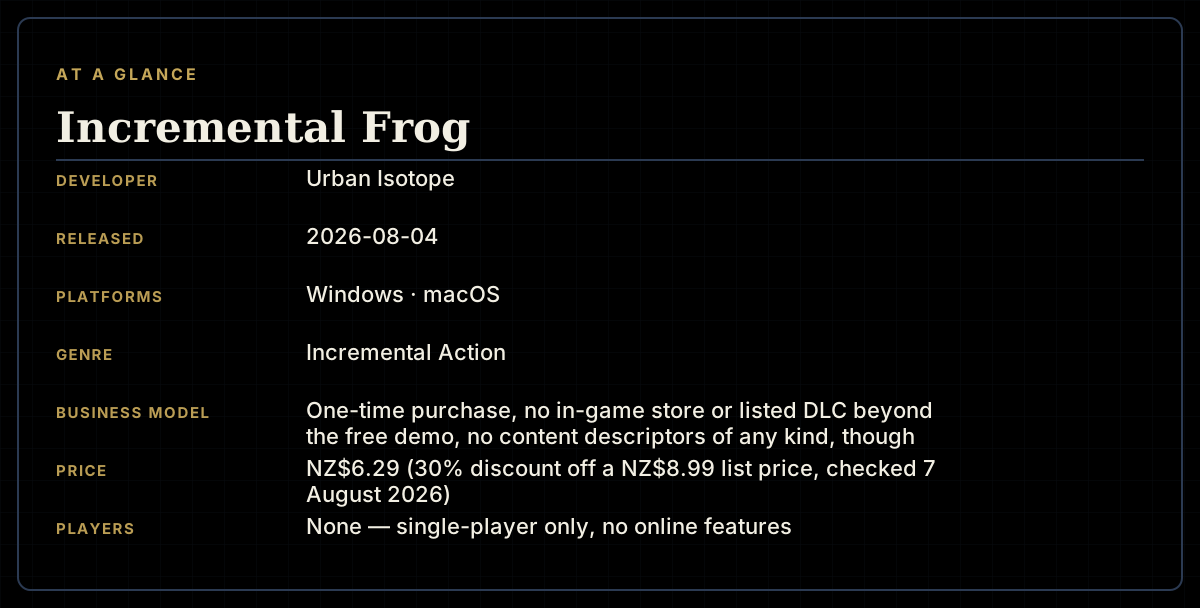
Incremental Frog
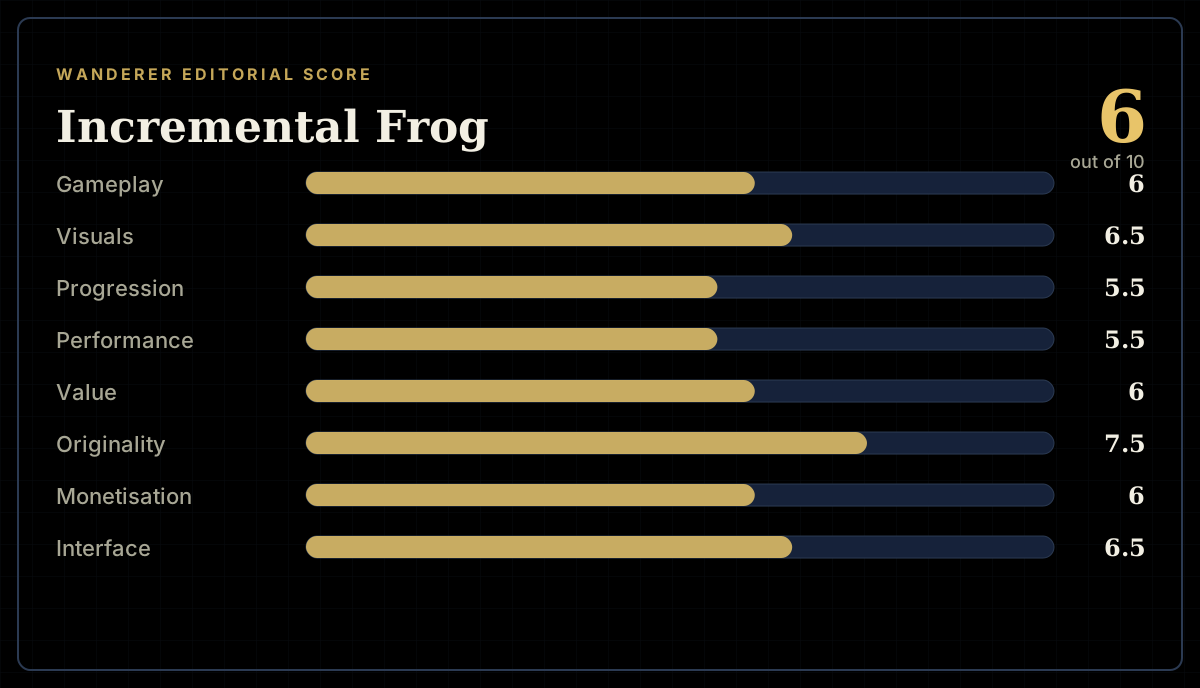
6 / 10
- Developer
- Urban Isotope
- Publisher
- Urban Isotope
- Released
- 4 August 2026
- Platforms
- Windows, macOS
- Genre
- Incremental Action
- Monetisation
- One-time purchase, no in-game store or listed DLC beyond the free demo, no content descriptors of any kind, though the in-game run-summary screen offers a rewarded-video prompt to double a run's gold
- Players
- None — single-player only, no online features
The short version
Incremental Frog's pitch is disarmingly simple: catch flies and dragonflies with a frog's tongue, aimed and swept with the mouse, and pour the gold into a branching tech tree with its own prestige layer sitting above it. The catching itself has a real trick to it — rotating the mouse mid-swing drags the tongue through several targets at once — and the upgrade grid behind it looks genuinely deep in its own screenshots, right down to a full reset button for respeccing into a different build. What undermines it, on the thin evidence available three days after launch, is that this isn't the passive idle experience its own community tags promise: attacks fire the instant a wave starts, there's no way to pause mid-round, and the only detailed account of a full session describes prestige costs outpacing prestige rewards by the third reset. Add a rewarded-video gold doubler bolted onto a one-time purchase and the picture is a clever, occasionally rough small release rather than a finished one.
Biggest strengths
- Rotating the mouse mid-catch sweeps the frog's tongue through several insects in one motion, turning what could have been a flat clicking loop into something with a real, learnable aiming skill
- The tech tree shown in the official screenshots is a large branching grid of mostly-hidden nodes, with a dedicated reset button in its toolbar for respeccing into a different upgrade path rather than being locked into your first build
- A one-time NZ$6.29 purchase is backed by a free standalone demo that's been live since mid-July, so buyers can test the actual catch-and-upgrade loop before paying anything
Biggest weaknesses
- The only detailed player account on record describes attacks firing the instant a wave begins with no way to pause mid-round, which works against a genre that usually lets the player set the pace
- That same account reports prestige requirements ballooning far faster than prestige rewards by the third reset — the specific "wall" complaint that a tech-tree incremental is supposed to be designed around avoiding
- Nothing on the store page, in the trailer clips or in the feature list states whether gold accrues while the game is closed, which is the first thing genre-adjacent shoppers look for and it simply isn't addressed either way
Who it's for: Players who like the aim-and-catch skill of an arcade shooter married to spreadsheet-style upgrade math, and who don't mind being the one testing where an unpolished-but-promising tech tree actually breaks down.
Our recommendation: At NZ$6.29, with a free demo covering the exact same catch-and-upgrade loop, there's very little financial risk in finding out for yourself whether the aiming trick and the tech tree hold your attention. The bigger question is whether you're shopping for something you can leave running in the background — this isn't that, and nothing on the store page claims otherwise once you look for the claim and don't find it.
6 / 10
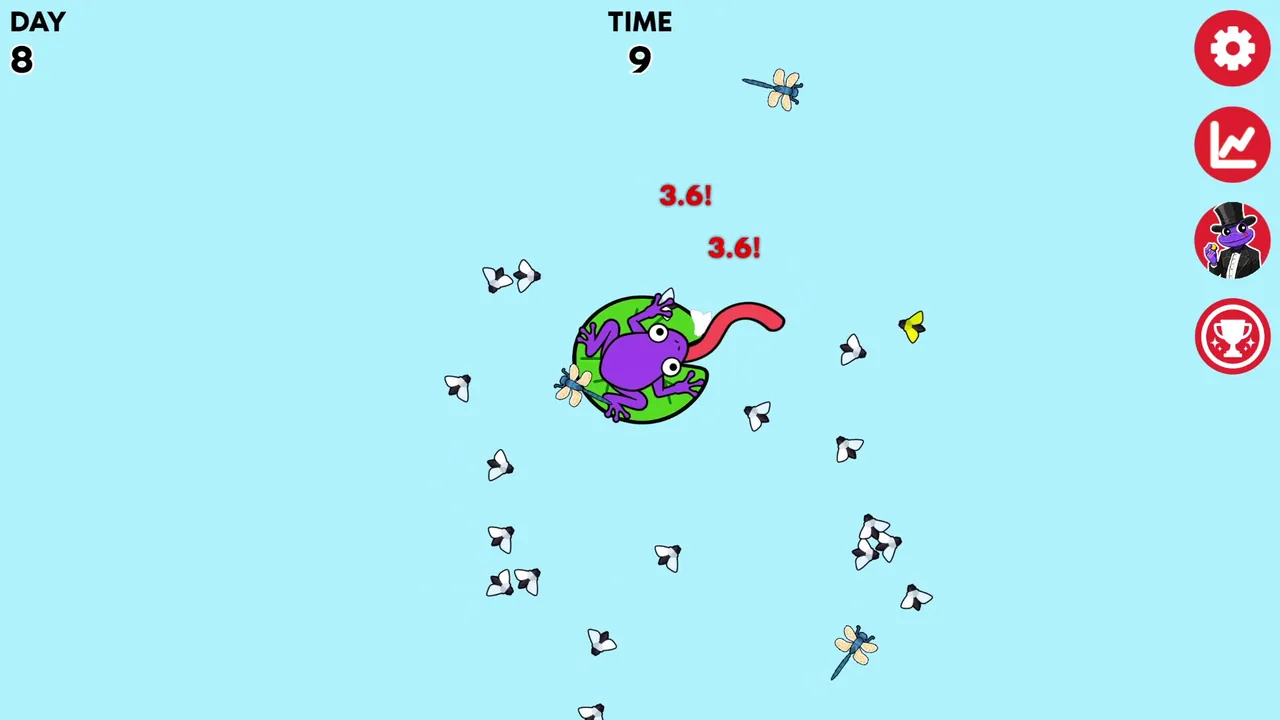
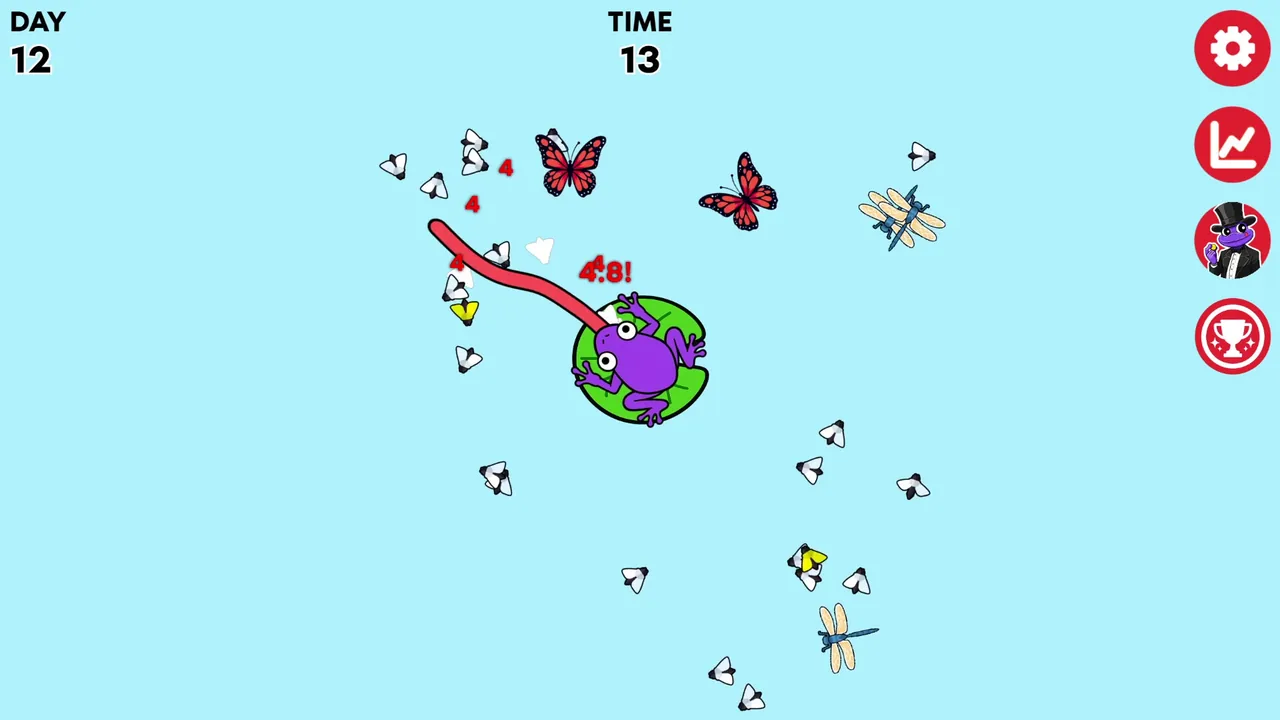
Catch things, spend the currency, catch more things — that loop has been done to death, so the way a new entry earns attention is in the catching. Incremental Frog's answer is a frog sitting on a lily pad, tongue aimed by the mouse, snapping up flies, dragonflies, bees and butterflies as they drift past in timed waves. Rotate the mouse while the tongue is extended and it sweeps through several targets in one arc rather than snapping back after each one — a small trick the store page calls a "secret move," and it's the single best idea in the package. Behind that sits a large branching tech tree and a prestige layer, both visible in the game's own screenshots, both looking like the deep half of an "easy to learn, hard to master" pitch. Three days after launch, though, there is exactly one detailed account of what happens once a player pushes past the opening hour, and it isn't a particularly happy one.
A shooter wearing an incremental's clothes
Officially, Steam classifies this as Action and Casual — no Simulation, no Strategy, nothing that screams "spreadsheet game" in the genre field. The community tagging tells a more honest story: Incremental and Idler both sit prominently among the player-applied tags, right alongside Action, Shooter, Top-Down Shooter and Point & Click. That split matches what the screenshots show. This isn't a passive number-watcher; it's a real-time wave shooter with an aiming mechanic, a day counter and a countdown timer per wave, where insects have to be caught before time runs out and gold is the reward for doing it well. The incremental half — the currency, the tech tree, the prestige system the store page confirms is "available" — is real, but it's built on top of active, moment-to-moment play rather than replacing it. Buyers coming from genuinely idle games expecting to leave this running in the background are shopping for the wrong game; buyers who want an arcade shooter with persistent meta-progression are closer to the mark.
That distinction matters more than usual here because nothing on the store page, in any of the three promotional clips, or anywhere in the feature list says whether gold keeps accumulating once the game is closed. It isn't described as continuing, and it isn't described as pausing — the topic simply doesn't come up, which for a game wearing "Idler" as one of its own community tags is a conspicuous gap rather than a neutral one.
A tech tree that wants to be the deep half
The upgrade screen, shown directly in one of the official screenshots, is a large grid of nodes connected by branching paths, most of them still hidden behind question marks waiting to be revealed. The one node visible in full — Critical Multiplier, a flat +10% to the frog's tongue critical damage for 399 gold — suggests a fairly conventional incremental spread of damage, speed and economy nodes sitting behind that fog. The toolbar above the tree carries a reset icon alongside search, a currency shortcut and a target-lock toggle, meaning the whole tree can be wiped and rebuilt along a different branch without starting the run itself over — a respec option a lot of tech-tree games make far more punishing to use.
Layered above the tree is a separate prestige system, confirmed by the store description but not detailed anywhere on the page. The one player account with enough playtime to speak to it — 55 minutes, reaching a third prestige reset before quitting mid-session — describes the early resets coming quickly and then the requirement for each subsequent one growing far faster than the gold it pays out, alongside a complaint about a shortage of additional skills or abilities beyond the tree itself. One account from one very short session isn't proof of a systemic balance problem, but it's also the only data point currently available, and it describes exactly the failure mode tech-tree incrementals exist to avoid: the point where spending stops feeling like progress.
The interface, the presentation, and a doubler nobody asked for
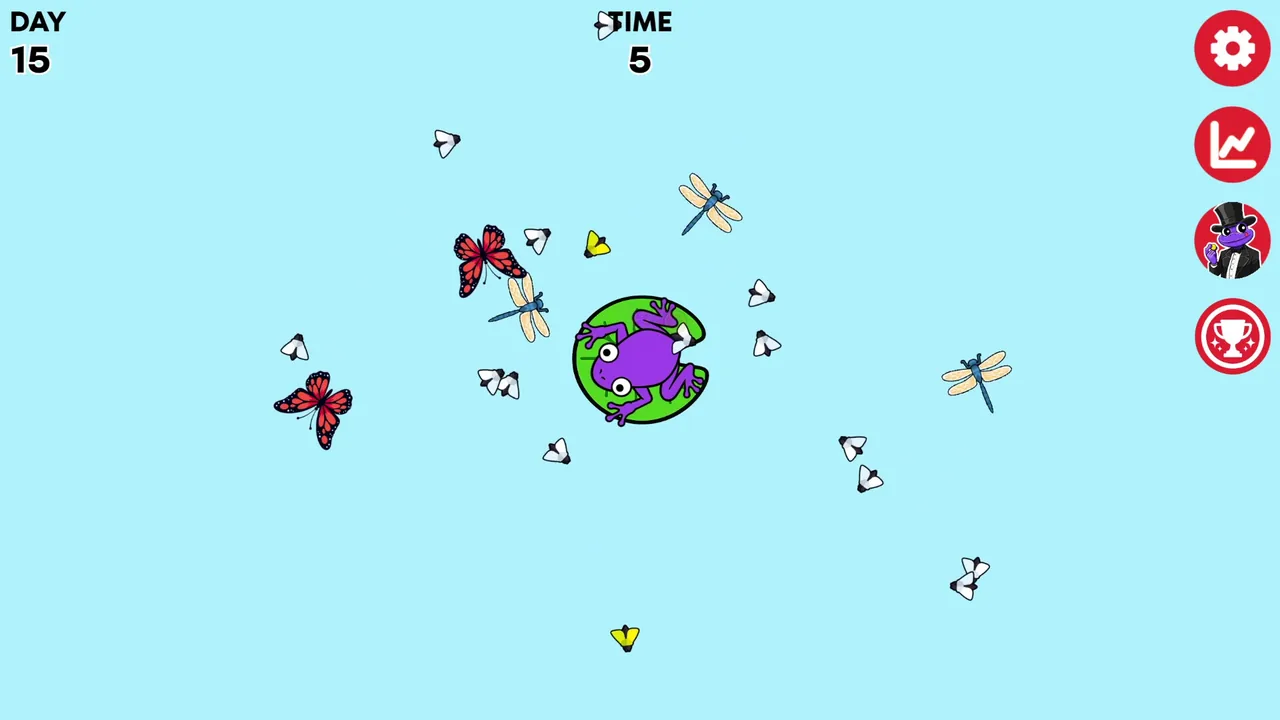
The core wave view is clean and legible — a flat, colourful cartoon style with a light blue background, a green lily pad, and enough visual separation between the frog, the tongue and a screen full of insects that the action stays readable even when it's crowded. Damage numbers pop in red above each catch, and a day counter alongside a per-wave timer give the run a clear sense of pacing from the outside, even without knowing exactly how long each wave lasts on average.
The run-end summary screen is where the presentation gets more interesting for the wrong reasons. It tallies what was caught, breaks down new gold earned against the running total, and sits a bright "2x" button next to the gold figure with a video-play icon on it — a rewarded-video prompt to double that run's earnings. Steam's own content descriptors for this listing are empty, and nothing about advertising appears anywhere on the store page. For a free-to-play game that would be an ordinary, unremarkable choice. For a one-time NZ$6.29 purchase with no other stated monetisation, it's a genuine surprise, and one worth knowing about before buying rather than after the first run ends. It doesn't look predatory — it's opt-in, not gated behind a timer or an energy system, and skipping it costs nothing but the doubled gold — but it's still an ad mechanic in a game whose price already paid for the content.
What the numbers actually show
There isn't much to lean on yet. The Steam review count sits at exactly one, negative, from a player who logged 55 minutes. The live player-count check returned zero at the moment of looking, which for a three-day-old release says more about a quiet launch than about quality. There's no achievement list either — the trophy icon visible in the game's own sidebar screenshots appears to be an internal, in-game system rather than anything wired into Steam's own achievement API, which returned nothing at all when queried. The developer has been responsive in the way that matters most this early: a patch landed two days after launch specifically addressing bugs, performance and rebalancing, which is a better sign than silence would have been, even without knowing exactly what it changed.
Final verdict
Incremental Frog earns a 6 for the one idea that's genuinely its own — a mouse-swept tongue-catching mechanic with real aiming skill behind it, wrapped around a tech tree and prestige system that look substantial in their own screenshots. It doesn't score higher because the only detailed account of playing it describes the prestige math turning against the player by the third reset, because the genre's foundational promise of progress continuing while the game is closed goes unaddressed on the one page that would need to make that claim, and because a rewarded-video gold doubler is an odd inclusion in a game that already asked for money up front. None of that is disqualifying at this price, especially with a free demo covering the exact same loop sitting right next to the buy button — but this is a game still being figured out in public, by very few people so far, and anyone buying it today is closer to an early tester than a customer walking into a finished product. Wanderer players used to progress ticking over while they're logged off should go in knowing this frog stops working the moment the window closes.
Pros and cons
Pros
- Rotating the mouse mid-catch sweeps the frog's tongue through several insects in one motion, turning what could have been a flat clicking loop into something with a real, learnable aiming skill
- The tech tree shown in the official screenshots is a large branching grid of mostly-hidden nodes, with a dedicated reset button in its toolbar for respeccing into a different upgrade path rather than being locked into your first build
- A one-time NZ$6.29 purchase is backed by a free standalone demo that's been live since mid-July, so buyers can test the actual catch-and-upgrade loop before paying anything
- Two Steam patches landed within 48 hours of launch, one explicitly a bug-fix, performance and rebalancing pass — more post-launch attention than a lot of small releases manage in their first week
- The flat cartoon presentation stays legible even with a screen full of insects, damage numbers and a sweeping tongue animation happening at once
Cons
- The only detailed player account on record describes attacks firing the instant a wave begins with no way to pause mid-round, which works against a genre that usually lets the player set the pace
- That same account reports prestige requirements ballooning far faster than prestige rewards by the third reset — the specific "wall" complaint that a tech-tree incremental is supposed to be designed around avoiding
- Nothing on the store page, in the trailer clips or in the feature list states whether gold accrues while the game is closed, which is the first thing genre-adjacent shoppers look for and it simply isn't addressed either way
- The run-end summary screen offers to double that run's gold through a rewarded video, an ad mechanic that sits oddly in a one-time-purchase game whose store page discloses no advertising at all
- Steam records zero achievements, a single review, and zero concurrent players at the moment of checking, so there is essentially no outside data yet on whether the tech tree's apparent depth holds up past the opening runs
Screenshots
-
Incremental FrogImage: Urban Isotope via Steam -
Incremental FrogImage: Urban Isotope via Steam -
Incremental FrogImage: Urban Isotope via Steam -
How the review scores each part of the gameWanderer Editorial -
The game at a glanceWanderer Editorial -

The short versionWanderer Editorial