
Game review
Idle Life - An Idle Game
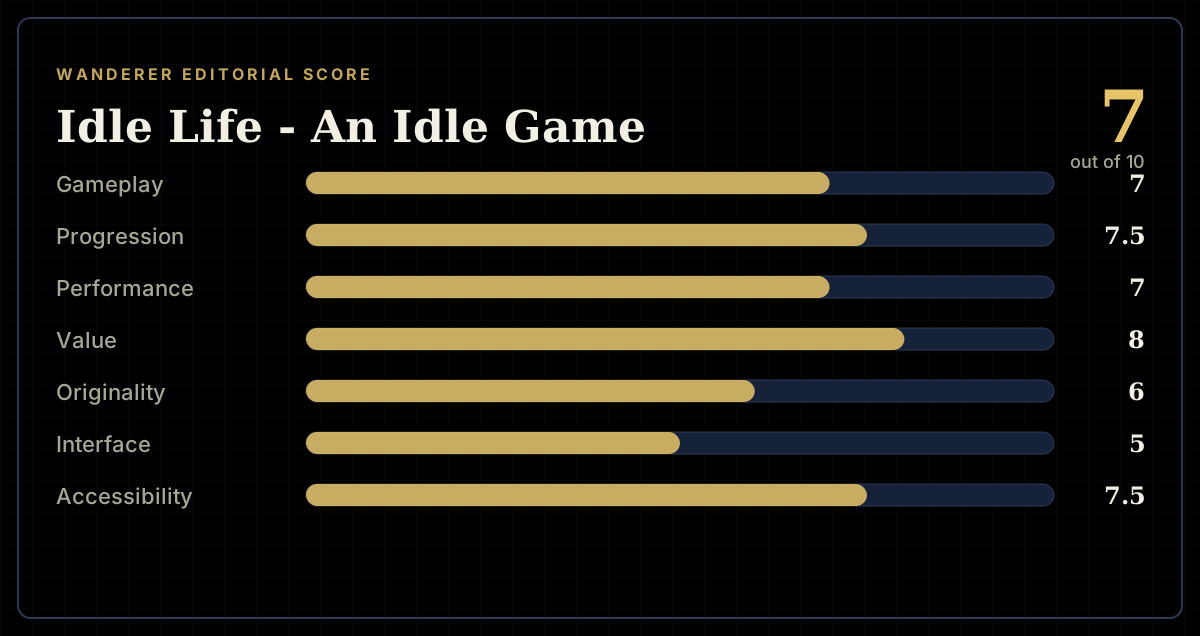
7 / 10
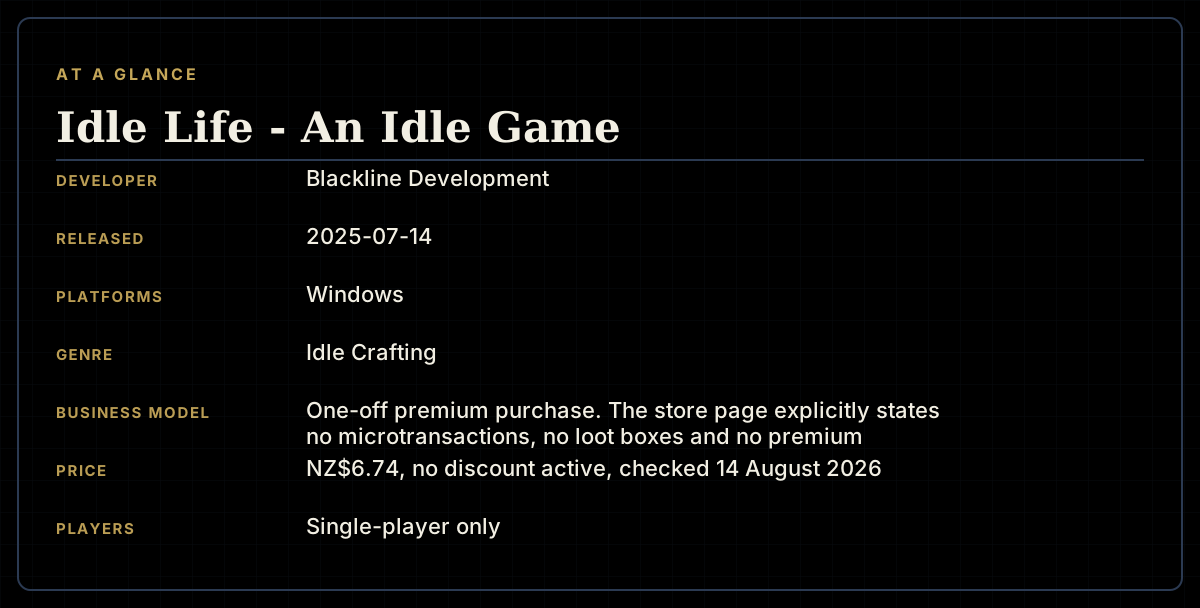
- Developer
- Blackline Development
- Publisher
- Blackline Development
- Released
- 14 July 2025
- Platforms
- Windows
- Genre
- Idle Crafting
- Monetisation
- One-off premium purchase. The store page explicitly states no microtransactions, no loot boxes and no premium currency.
- Players
- Single-player only
The short version
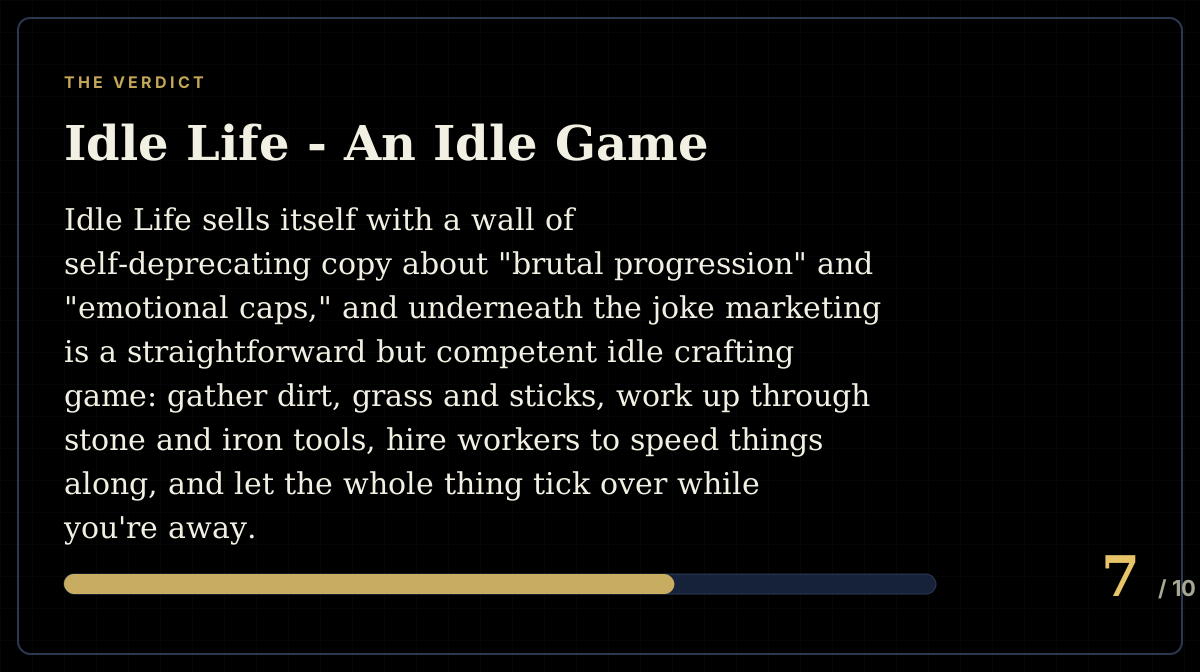
Idle Life sells itself with a wall of self-deprecating copy about "brutal progression" and "emotional caps," and underneath the joke marketing is a straightforward but competent idle crafting game: gather dirt, grass and sticks, work up through stone and iron tools, hire workers to speed things along, and let the whole thing tick over while you're away. It works, the offline progress is real, and the solo developer behind it posts something almost every week. What it doesn't have yet is an interface that looks like more than a spreadsheet of item cards, and anyone buying in now should know that the coming 1.0 release will wipe every Early Access save.
Biggest strengths
- A genuinely deep crafting web -- dirt and sticks lead to stone tools, furnaces, iron ingots and beyond -- gives the loop real long-term structure rather than one flat resource bar.
- Offline progress works as advertised, with a review specifically praising not having to "sit constant and wait for more stuff to open."
- The solo developer ships something close to weekly, responds to bug reports directly, and posted an unusually candid explanation of why 1.0 will require a fresh save.
Biggest weaknesses
- The interface is a grid of near-identical item cards with sparse styling, and a negative review calling the UI "rough" matches what the screenshots show.
- One reviewer disputes the "idle" framing outright, arguing the early game demands active clicking on mine/craft actions rather than running itself.
- Anyone buying during Early Access should expect their save to be wiped when 1.0 ships -- confirmed directly by the developer, with only a promised "thank you bonus" as compensation.
Who it's for: Idle-genre regulars who don't mind an unpolished interface in exchange for a deep, frequently-updated crafting tree, and players who specifically want a solo developer who communicates openly rather than a studio product. Less suited to anyone who wants their idle game to also look and feel finished today.
Our recommendation: A fair buy at under seven dollars if you go in understanding two things: your current progress will not survive the jump to 1.0, and the interface is functional rather than attractive. The update cadence and the developer's own conduct are the strongest arguments for buying now rather than waiting -- this is Early Access working close to as intended.
7 / 10
Dirt, sticks, and a joke that's mostly true
Idle Life's own store page opens with "Welcome to the grind, loser. We hope you brought snacks," and keeps going in that voice through a list of features that reads more like a parody of the genre than a pitch for it -- "prestige mechanics: reset, profit, repeat, classic, but evil" and "no fake 'idle' systems." It's a bet that the audience for one more crafting idler wants to be talked to like this rather than sold to, and on the evidence of the review corpus, it mostly lands. Multiple reviewers describe getting pulled in further than expected, with one admitting they "honestly didn't expect to get this hooked."
Underneath the joke copy is a real crafting-idle loop. You start punching dirt and grass, work up through wood tools, then stone, then iron -- furnaces, ingots, ropes and a slowly expanding tech tree that the game's own achievement data backs up as genuinely long: the "chop your first tree" milestone sits at 40% of the player base, dropping through wood and stone tool crafting into the low double digits, and further systems like the iron furnace and reinforced furnace sit under 2%. That's not a game that runs dry after twenty minutes -- it's one with a curve steep enough that most players haven't reached its later systems yet, which for a genre built on long-term number-watching is closer to a feature than a flaw.
Idle in the way that matters, argued in the way that doesn't
The most useful review in the whole English corpus is a two-line thumbs-up: the game "works in offline mode which makes it even better, so no need to sit constant and wait for more stuff to open the next thing." That's the single claim that actually decides whether an idle game is worth recommending to this audience, and it checks out against the rest of the corpus -- nobody disputes it, and several long-session reviewers describe the game running unattended for extended stretches.
Worth flagging honestly: a handful of the playtime figures behind those long-session reviews are enormous for an eight-month-old Early Access title -- one reviewer logs figures equivalent to well over a thousand hours. Steam's playtime counter tracks how long the game has been running, not active attention, and an idle game left open in the background for months will rack up numbers like that regardless of how much time anyone actually spent looking at the screen. Read those figures as evidence the game runs reliably unattended over long periods, not as a measure of how absorbing any single session is.
The one dissenting voice argues the opposite of the store page's promise: "You gotta focus on the game -- clicking on the things to mine/make. It isn't an idle type game." Both things are true at once, and neither reviewer is wrong. Early game resource gathering leans on manual clicking before workers and automation come online later in the tree, so the "idle" framing is more accurate as an endgame description than an opening-hour one. Anyone buying specifically to avoid active input in the first sitting should know that patience is required before the game starts running itself.
An interface that hasn't caught up to the systems
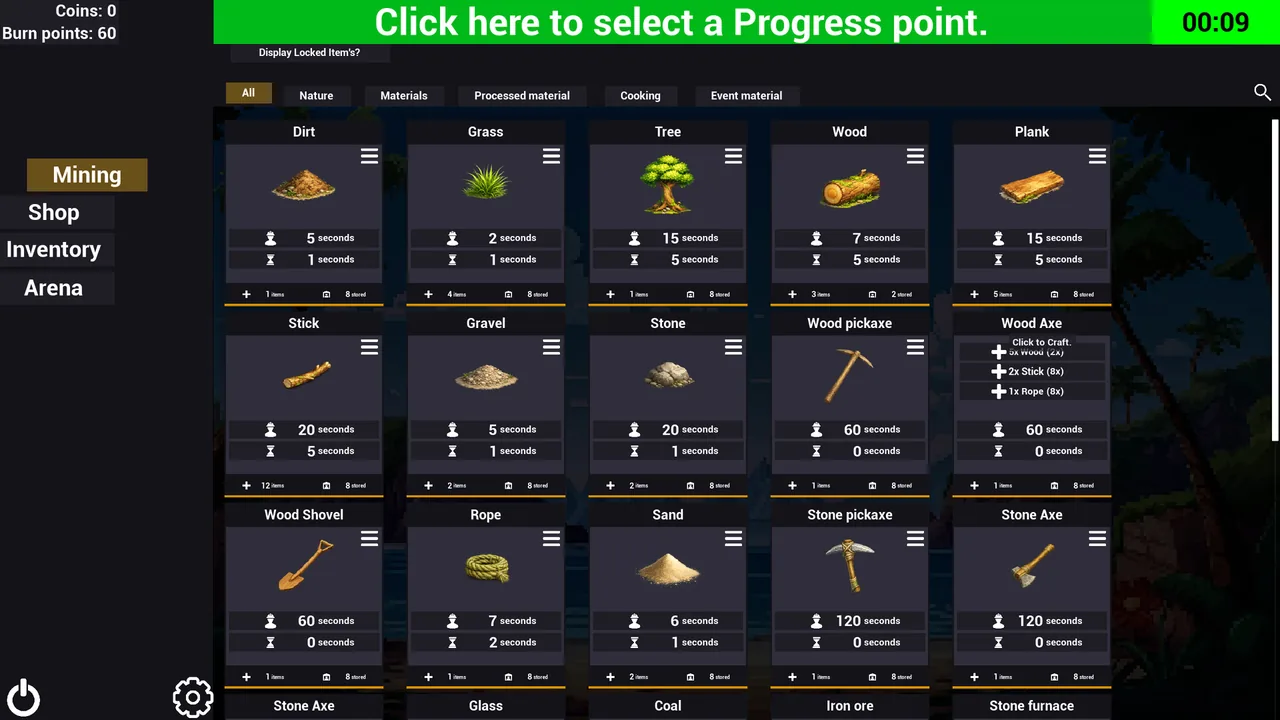
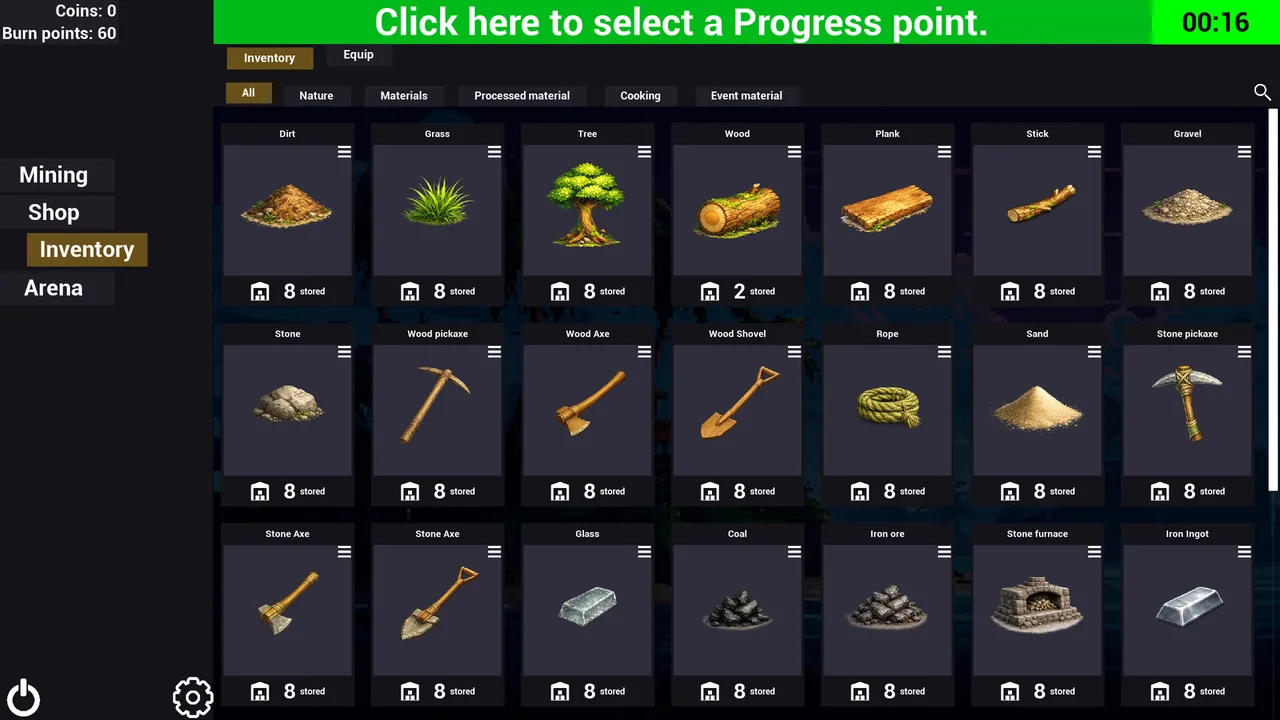
The screenshots tell the same story as the corpus's other negative review. Idle Life's crafting menu is a grid of near-identical dark cards -- an icon, an item name, a gather timer and a craft timer, repeated across dozens of resources with almost no visual hierarchy to separate a raw material from a finished tool. It's legible once you've learned it, but a launch-day reviewer specifically called out "the UI is rough, the game progression is confusing" alongside a lost save file, in a review posted the day after Early Access began. The developer has since shipped a dedicated "Performance, Multi Save Support & Main Menu Update," which suggests the rough edges from that first week are a known target rather than an ignored one -- but as of this review, the interface is still function over form.
On the encouraging side, the store page lists Camera Comfort, Color Alternatives, a Mouse Only option and a Touch Only option among its accessibility features -- a genuinely useful spread for a game in this genre, where a lot of competitors offer none of it. A plain, unstyled interface is at least an easy one to navigate with those options switched on.
A developer who tells you the bad news early
The clearest asset this game has isn't a system, it's the person building it. The Steam news feed shows something close to a weekly cadence -- event updates, performance passes, a beta branch for 1.0 that's been public since June 2026 -- and one post stands out for how it's written. In April 2026, the developer posted a direct message to players titled "A Difficult but Important Step Towards 1.0," explaining plainly that the 1.0 release will not be compatible with any current Early Access save, why that rebuild is necessary, and what's planned to soften the landing for existing players (a faster restart, a small thank-you bonus, and reworked early game pacing). A reviewer independently credits the same developer for being "consistent in communication" and responsive to bug reports.
That transparency doesn't erase the practical consequence: anyone buying Idle Life today during Early Access should expect to lose their progress when 1.0 lands, full stop. It's the right way to handle a necessary rebuild, and it's still a real cost to weigh against the asking price.
Value
At NZ$6.74 with no premium currency, no loot boxes and no battle pass anywhere on the store page, Idle Life is cheap even by idle-genre standards, and the store page's promise on that front holds up under review. The trade you're making for that price is patience with an unfinished interface and acceptance that your save file has an expiry date built into the roadmap. For a genre whose audience already expects to restart and prestige repeatedly, that's a smaller ask than it would be almost anywhere else -- and a solo developer who tells you about the wipe five months in advance, in a personal message rather than a footnote, has earned a reasonable amount of trust for the version that follows it.
Pros and cons
Pros
- A genuinely deep crafting web -- dirt and sticks lead to stone tools, furnaces, iron ingots and beyond -- gives the loop real long-term structure rather than one flat resource bar.
- Offline progress works as advertised, with a review specifically praising not having to "sit constant and wait for more stuff to open."
- The solo developer ships something close to weekly, responds to bug reports directly, and posted an unusually candid explanation of why 1.0 will require a fresh save.
- The store page's promise of no microtransactions, loot boxes or premium currency holds up -- it's a flat one-off purchase.
Cons
- The interface is a grid of near-identical item cards with sparse styling, and a negative review calling the UI "rough" matches what the screenshots show.
- One reviewer disputes the "idle" framing outright, arguing the early game demands active clicking on mine/craft actions rather than running itself.
- Anyone buying during Early Access should expect their save to be wiped when 1.0 ships -- confirmed directly by the developer, with only a promised "thank you bonus" as compensation.
- The English-language review sample is small (17 reviews), so this verdict rests on a thinner base of opinion than a typical release.
Screenshots
-

Idle Life - An Idle GameImage: Blackline Development via Steam -
Idle Life - An Idle GameImage: Blackline Development via Steam -
Idle Life - An Idle GameImage: Blackline Development via Steam -
How the review scores each part of the gameWanderer Editorial -
The game at a glanceWanderer Editorial -
The short versionWanderer Editorial