Game review
Dwarves Mining Idle
6.5 / 10
- Developer
- Litty Games
- Publisher
- Litty Publishing
- Released
- 26 September 2023
- Platforms
- Windows
- Genre
- Idle mining and management sim
- Monetisation
- One-time purchase, no DLC, no in-game purchases
- Players
- Single-player only, no multiplayer, co-op or leaderboard features
The short version
Dwarves Mining Idle asks you to dig down before you climb up: buy dwarves, put them to work on mineable, combat, liquid and loot floors, smelt and craft your way through an escalating materials list, then spend hundreds of hours pushing toward a literal surface you can see from the very first tile you break. The floor and dwarf-cloning systems give it more real strategy than most idle miners bother with, and Litty Games has kept patching it steadily for more than two years, including a same-week fix for the Unity engine vulnerability that hit half of Steam in October 2025. What holds it back is a genuinely cramped, hard-to-parse interface — a complaint that shows up from happy and unhappy players alike — and a design that several reviewers, in three different languages, all independently call too slow even by idle-game standards.
Biggest strengths
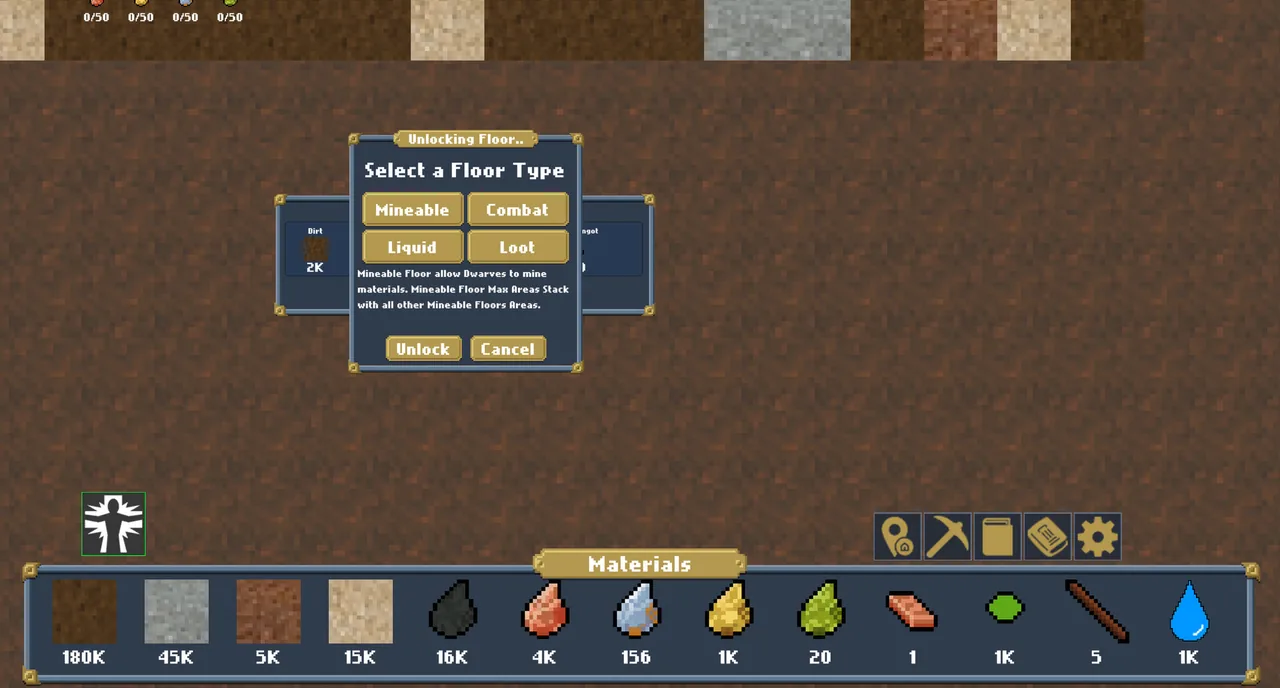
- Floors split into Mineable, Combat, Liquid and Loot types that each feed a different part of the crafting chain, giving you a real choice of strategy rather than one upgrade path
- Dwarf Cloning lets you merge two dwarves' stats and skills into one at the cost of a premium currency, an irreversible decision the game states plainly before you commit
- Offline gains run for up to 24 hours and specifically exclude active multipliers, a design choice that keeps idling useful without making it strictly better than playing
Biggest weaknesses
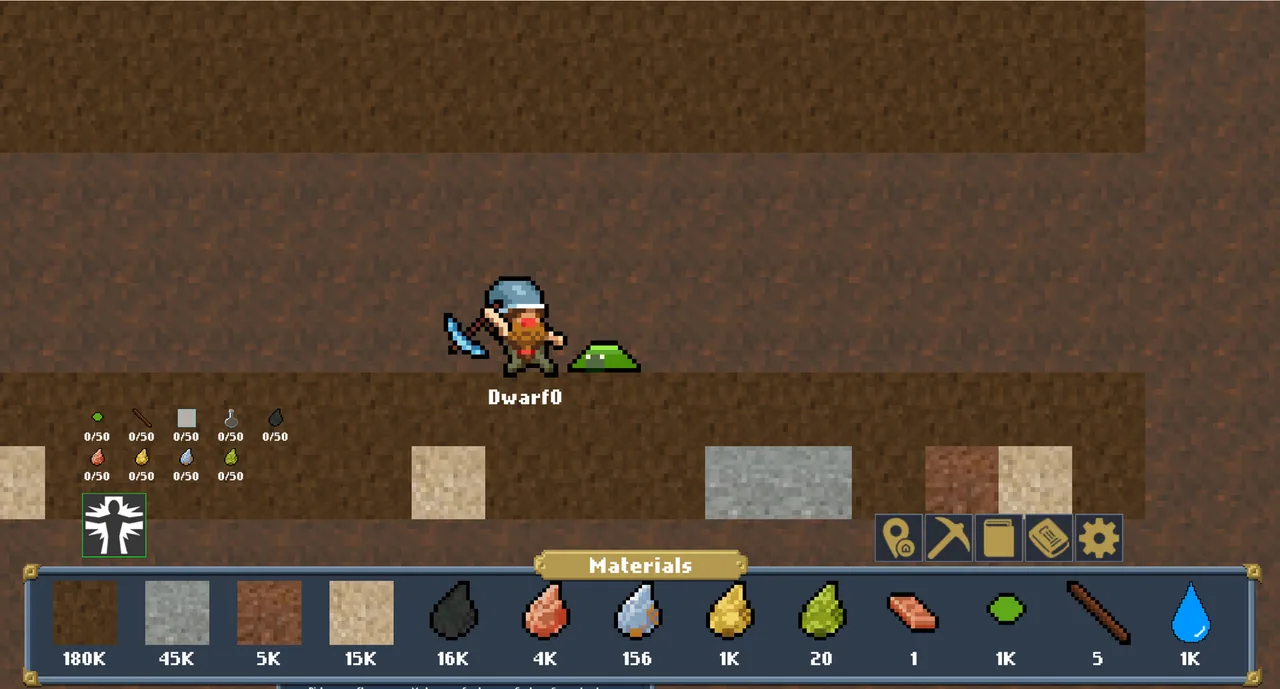
- The resource bar packs a dozen near-identical coloured teardrop icons into a single row with no text labels beyond a quantity, and reviewers call the wider UI "kinda big" and hard to parse at a glance
- A Japanese-language review logged shortly after the 1.0 launch describes early mining speed as glacial and says progress stalled unexpectedly once "The Surface" update landed
- A French-language review from mid-2025 calls the pacing too slow even by idle-game standards, naming Revolution Idle and Galaxy Idle Clicker as faster alternatives
Who it's for: Idle and incremental fans who want something with real systems to plan around rather than a single number going up, and who don't mind a rough-edged UI in exchange for a cheap, actively supported game with a genuine long-term climb.
Our recommendation: At NZ$2.99 there's very little financial risk, and the achievement data shows a real subset of players getting hundreds of hours out of it. Go in prepared for a slow, UI-heavy opening few hours, and treat the early pace as the on-ramp to a much bigger back half rather than a representative sample of the whole game.
6.5 / 10
Dwarves Mining Idle spends its first ten seconds telling you exactly what kind of game it's going to be: a single dwarf, a pickaxe, and dirt in every direction. What it doesn't tell you up front is how much sits underneath that opening frame — a floor-management system with four distinct floor types, a currency-gated dwarf-cloning mechanic that permanently merges two characters into one, an archaeology sub-game built around completing item sets, and a stated end-of-game goal, The Surface, that the store page describes as requiring "a good amount of time and resources to climb to." This is a small, cheap, Early-Access-turned-1.0 idler from a two-person-scale studio, and it has more actual systems than that description usually implies. It's also, by the account of multiple players in three different languages, slower than it needs to be, and its interface hasn't caught up to the amount of information it's trying to display.
A floor-and-dwarf economy with real choices in it
The core loop starts simply — buy a dwarf, put it to work, watch materials accumulate — but the floor system is where the game distinguishes itself from a straight number-go-up clicker. Floors come in four types: Mineable, Combat, Liquid and Loot, each feeding a different resource stream, and a store-page detail worth noting is that Mineable Floor areas explicitly stack with each other while the other types don't, which pushes you toward a genuine allocation decision rather than a single obvious "best" floor to spam. Floors also level up independently through the experience your dwarves generate while working them, earning points you spend on floor-specific upgrades, and you can convert a floor's type later if your strategy needs to change — a rare admission from an idle game that your early build order might not be your best one.
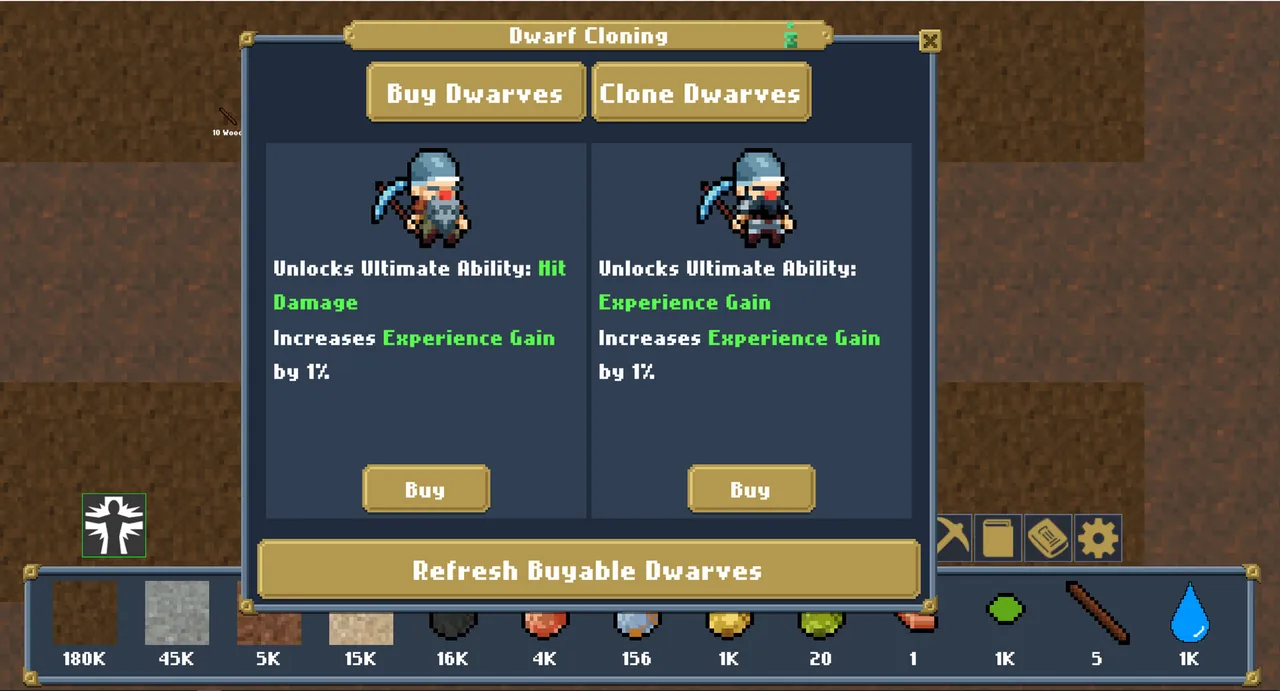
Dwarves themselves aren't interchangeable either. The starting choice lets you pick any dwarf with any special stat and ultimate ability, and from there you can bench dwarves you're not using or send them out to work automatically. The system that stood out most in the screenshots is Dwarf Cloning: merge two dwarves together, and their stats combine while each learns whichever ability the other had that it lacked. It costs a premium currency — Diamonds, four of them in the confirmation dialog captured from the store page — and the game states directly, in red text, that cloning "resets all stats, skills" for the dwarves involved and "cannot be undone." That's an unusually blunt way to present an irreversible decision in a genre that often hides its true costs behind vague confirmation prompts, and it's a genuine point in the game's favour.
Crafting, sets, and a literal light at the end of the tunnel
Beyond floors and dwarves there's a full materials chain: furnaces smelt ore into ingots and sand into glass, crushers and bottlers process other resource lines, and each placeable unlocks at a specific area threshold with its own material cost shown before you build it. Layered on top of that is an Archaeology Book that tracks two separate collection sets — a Gnome Set built from fragments like skulls, teeth and mechanisms, and an Artifact Set built from rarer finds — each of which grants a buff once completed. None of this is forced on you early; it reads as content for players who stick around long enough to need something to do with a surplus of high-tier materials.
The stated end goal, The Surface, is presented as a literal destination rather than an abstract prestige button: the game tells you outright that reaching it requires 10 floors and 15 dwarves, that the climb starts from a specific tile at Floor 1, and that once you've bought a ladder there's no going back to convert that starting floor into something else. Framing the endgame as a place you walk to, with a visible cost and a locked-in commitment, gives Dwarves Mining Idle a more concrete sense of destination than most idlers manage, where "prestige" is usually just a bigger multiplier with a new coat of paint.
Offline progression is handled with a similar amount of care. The store page states you'll earn materials and dwarf levels for up to 24 hours away, but specifically excludes active multipliers from that calculation — a small detail, but it means idling productively doesn't quietly become the objectively correct way to play the whole game, which is a trap a lot of idle titles fall into without meaning to.
The interface hasn't kept pace with the systems
Set against all of that is an interface that multiple players, on both sides of the recommendation line, flag as a real problem. One of the more recent English-language reviews — someone who logged over 860 hours — still opens with "the UI is kinda big" before getting to what they liked about the game. A Japanese-language review posted not long after the July 2024 1.0 launch is more pointed, comparing the early mining speed to "endlessly using a copper pickaxe in Terraria" and describing blocks as oversized enough to be genuinely off-putting; that same review also reports progress stalling unexpectedly right after the 1.0 update landed, a launch-week complaint worth reading as exactly that rather than a description of the game as it stands today, two years and roughly twenty patches later.
Looking at the promotional screenshots bears the complaint out in places. The bottom resource bar packs a dozen material icons — several of them near-identical coloured teardrops distinguished mainly by hue — into a single row with nothing but a rounded quantity beneath each one, and menus like the Dwarven Book upgrade screen show large stretches of empty scrollable space above a handful of upgrade options. None of it looks broken, but it does look like a UI built by someone thinking in systems first and legibility second, and that tracks with what the reviews describe.
Pace is the other recurring complaint, and it isn't confined to one language. A French-language review from mid-2025 says flatly that progress is "way too slow" even accounting for the genre, and names two other idle games — Revolution Idle and Galaxy Idle Clicker — as faster alternatives it preferred. Between that, the Japanese review's early-game frustration, and the English reviewer's "kinda big" aside, the pattern across independent reviewers in three different languages is consistent enough to trust: whatever the later hours look like, the opening stretch asks for more patience than a lot of idle-game fans are used to giving.
What the achievement curve actually shows
Steam's global achievement data gives an unusually clear picture of where that patience runs out. Destroying your first tile (93.9%) and reaching a new area (90.3%) are near-universal — almost everyone who launches the game gets that far. Mining a first metal drops to 75.8%, and learning a first recipe to 59.9%. From there the numbers fall fast: only 39.3% ever get multiple dwarves working, 31.7% place their first machine, and by the time you reach a dwarf upgrade the figure is 18.9%. Defeating an enemy sits at 15.1%. Past that point almost everything drops under 4% — the dwarf skill tree, the archaeology sets, artifact buffs — and the true endgame markers are vanishingly rare: reaching the Surface and hitting a first dwarf prestige are both logged by just 0.3% of players, and the various "Challenger" achievements, which read as harder optional tasks layered on top of the core climb, sit at 0.1%.
That's not an unusual shape for an idle game specifically — the format rewards leaving the game running more than it rewards active decision-making, so a low completion rate for the deepest content doesn't automatically mean the deepest content is bad. But it does line up with the pacing complaints: a huge portion of the audience never gets past the point where the reviews say the game feels slowest, and the achievement curve shows exactly where that drop-off happens rather than just implying it.
A small audience, and a developer who's stuck around for it
Across every language, Dwarves Mining Idle has accumulated just 13 Steam reviews in nearly three years on the store — 10 positive, 3 negative. That's a tiny sample by any standard, and it means the "Positive" badge Steam shows for the English-only subset (10 of 11) is measuring a handful of voices rather than a real consensus. What that small sample does show, though, is genuine long-term engagement from the people who stuck around: individual playtimes on file run past 590 hours, 860 hours, and in one case over 3,700 hours, which isn't the profile of players bouncing off a bad idle game. The single technical negative review, filed in September 2024, describes a refund request over the game simply not working for them at 30 minutes played — worth noting as a possible install or hardware issue rather than a design complaint, since nothing else in the review corpus reports the same problem.
Litty Games' support record backs up the idea that this is a maintained, not abandoned, project. The dedicated news feed for this app — not a shared multi-game feed — runs from a June 2024 pre-1.0 hotfix through a January 2026 "Small Update 1.2.3," with roughly twenty posts in between covering balance hotfixes, a February 2025 "Progression Update," and, notably, an October 2025 post titled "Unity Vulnerability | Update Required" responding to the real engine-level security issue that forced a wave of Unity-built games to patch around the same time. A two-year-old, NZ$5.99 idle game from a small studio staying current with an engine-level security response is a stronger signal of ongoing support than most games at this price point offer.
Final verdict
Dwarves Mining Idle is a better-built idle miner than its price and its tiny review count suggest, with a floor-and-dwarf economy that gives you real choices to make rather than one obvious upgrade path, an irreversible cloning mechanic the game is honest about, and a literal destination to climb toward that most idlers in this price bracket don't bother designing. It's held back by an interface that's cramped enough to earn complaints from its own fans, and by a pace that reviewers in three separate languages all describe as slow even by idle-game standards — a combination the achievement data confirms by showing most players stall out long before the systems described above ever come into play. At NZ$2.99, with a developer that's kept patching for two years running, it's a fair bet for idle and incremental fans specifically willing to push through a rough first few hours. Anyone hoping for a slicker, faster-paced clicker experience should look elsewhere.
Pros and cons
Pros
- Floors split into Mineable, Combat, Liquid and Loot types that each feed a different part of the crafting chain, giving you a real choice of strategy rather than one upgrade path
- Dwarf Cloning lets you merge two dwarves' stats and skills into one at the cost of a premium currency, an irreversible decision the game states plainly before you commit
- Offline gains run for up to 24 hours and specifically exclude active multipliers, a design choice that keeps idling useful without making it strictly better than playing
- Litty Games has shipped patches on a near-monthly cadence since the July 2024 1.0 launch, including a same-week response to the October 2025 Unity engine vulnerability that affected a wide swathe of Steam
- Keyboard-only and mouse-only control schemes are both offered as dedicated options, unusually deliberate accessibility support for a solo-scale idle title
Cons
- The resource bar packs a dozen near-identical coloured teardrop icons into a single row with no text labels beyond a quantity, and reviewers call the wider UI "kinda big" and hard to parse at a glance
- A Japanese-language review logged shortly after the 1.0 launch describes early mining speed as glacial and says progress stalled unexpectedly once "The Surface" update landed
- A French-language review from mid-2025 calls the pacing too slow even by idle-game standards, naming Revolution Idle and Galaxy Idle Clicker as faster alternatives
- Steam's global achievement data shows a steep cliff after the opening hour: 93.9% of players destroy their first tile, but only 18.9% ever reach a dwarf upgrade and just 0.3% ever reach the Surface itself
- Windows-only with English as the sole supported language, and no controller support beyond the keyboard/mouse toggle options
Screenshots
-
Dwarves Mining IdleImage: Litty Publishing via Steam -
Dwarves Mining IdleImage: Litty Publishing via Steam -
Dwarves Mining IdleImage: Litty Publishing via Steam -
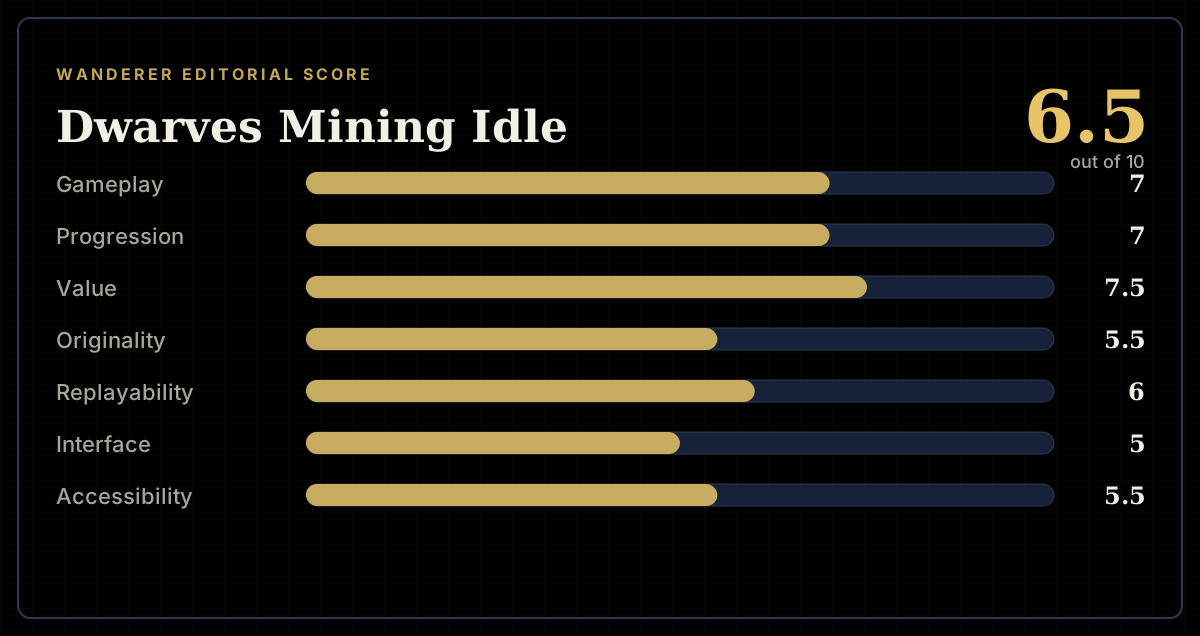
How the review scores each part of the gameWanderer Editorial -
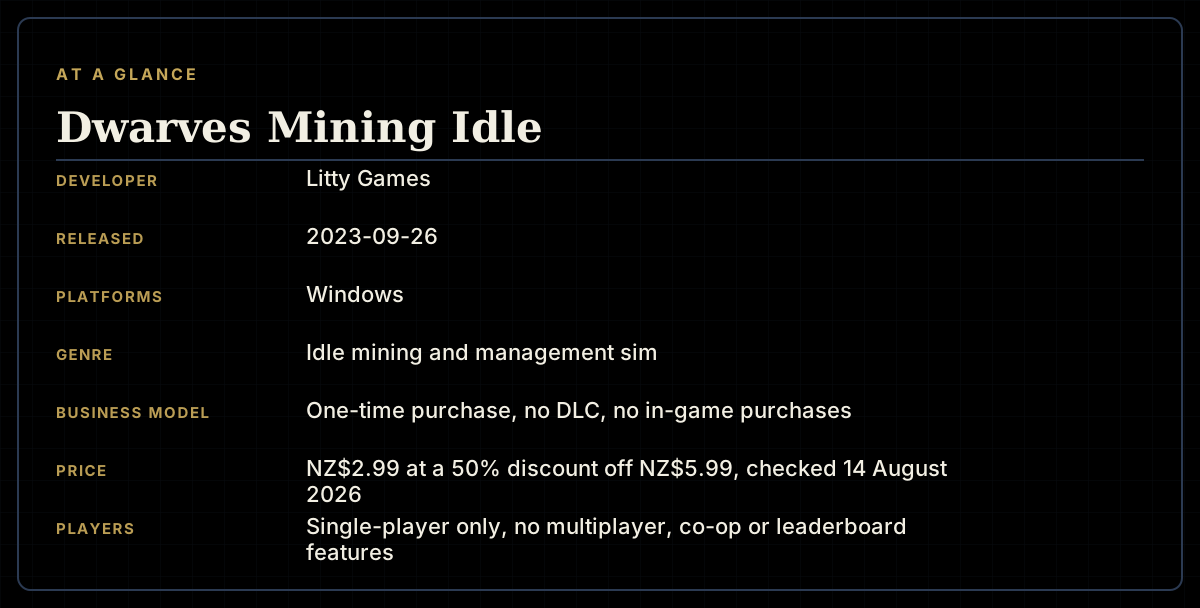
The game at a glanceWanderer Editorial -
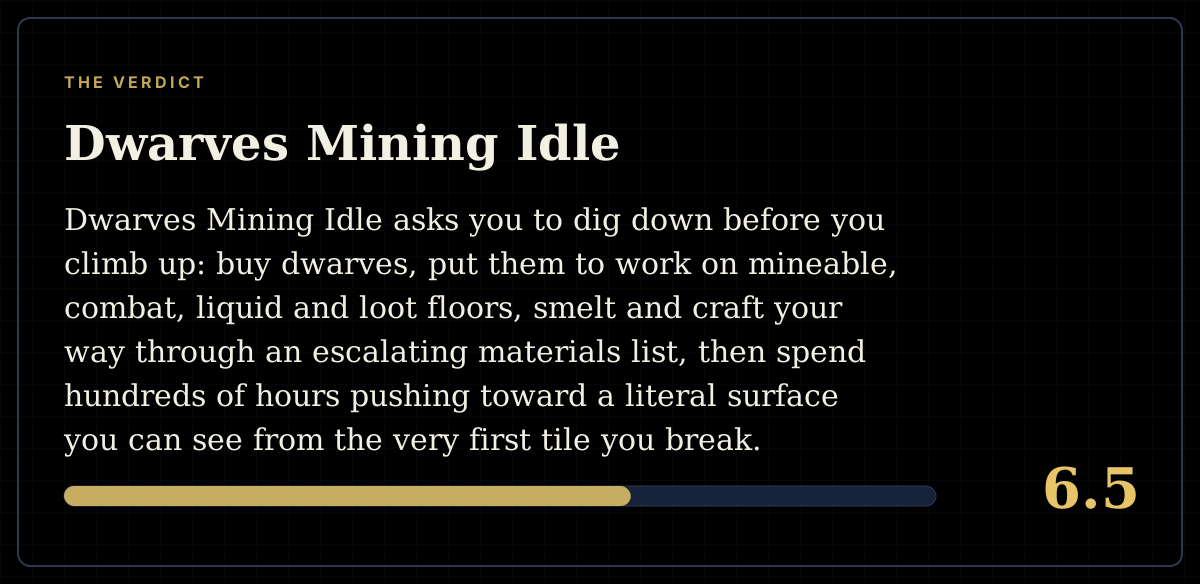
The short versionWanderer Editorial