
Game review
Idle Commonwealth
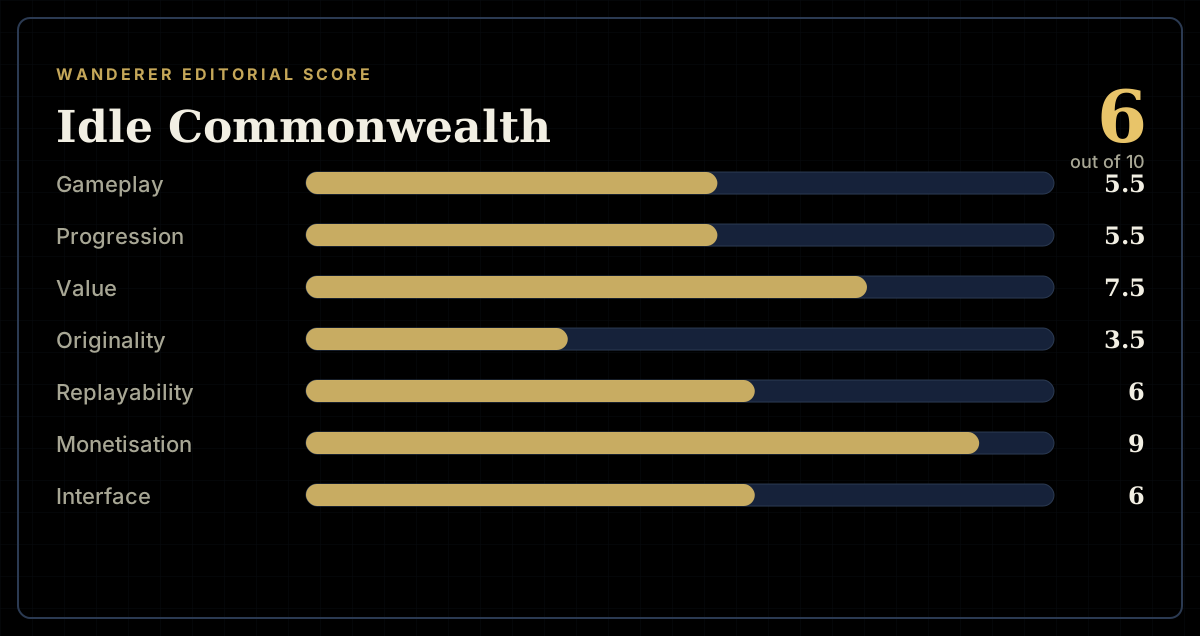
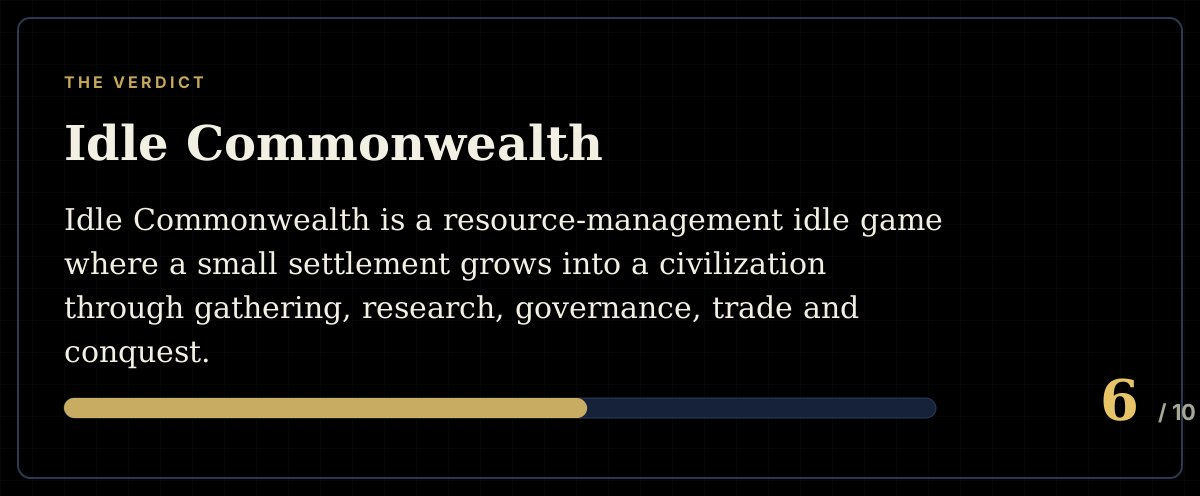
6 / 10
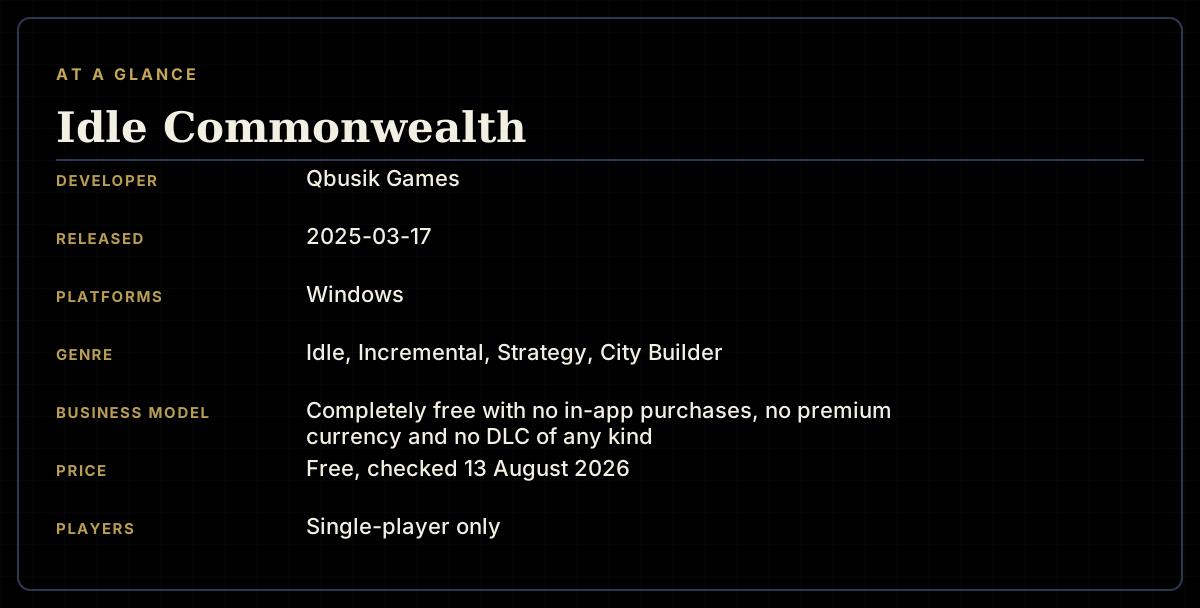
- Developer
- Qbusik Games
- Publisher
- Qbusik Games
- Released
- 17 March 2025
- Platforms
- Windows
- Genre
- Idle, Incremental, Strategy, City Builder
- Monetisation
- Completely free with no in-app purchases, no premium currency and no DLC of any kind
- Players
- Single-player only
The short version
Idle Commonwealth is a resource-management idle game where a small settlement grows into a civilization through gathering, research, governance, trade and conquest. Developed and self-published by the two-person studio Qbusik Games, it entered Early Access 17 March 2025 and exited to a 1.0 release 5 June 2025. What should be a straightforward review is complicated by two things this review can independently confirm: the game's Steam news feed shows no update since that 1.0 release — well over a year of silence as of this writing — and it has since become entirely free to play. Multiple reviewers and outside reporting describe this as the result of the developer closing the studio; this review could not independently verify a primary announcement, but the fourteen-month update silence and the switch to free are both directly confirmed facts. Judged as what it is today — a finished, abandoned, completely free idle strategy game — there's a genuinely substantial civilization-builder here, aimed uncomfortably close at several well-known browser incrementals, with real design choices that work against the "idle" label it wears.
Biggest strengths
- Real, substantial systems — gathering, building, research, governance, trade and military conquest — that a dedicated minority of players have engaged with for hundreds and, in at least one case, over 2,500 hours
- Completely free with no purchases of any kind to evaluate or worry about
- A clean, minimalist interface that draws specific praise for being simple and well executed
Biggest weaknesses
- Confirmed no update to the game since its 5 June 2025 release, over fourteen months as of this review, and reviewers report — consistent with outside reporting this review could not fully verify from a primary source — that the developer closed the studio shortly afterward
- Despite being marketed as an idle game, it withholds offline progress, blocks auto-clickers, and requires frequent manual worker reassignment; several reviewers specifically argue it fails at being "idle" in the way the genre promises
- A recurring, specific complaint from multiple reviewers compares its research tree and mechanics closely to Evolve Idle, Kittens Game and Trimps, naming matching research paths and even a matching prestige mechanic
Who it's for: Fans of deep, slow-burn resource-management incrementals in the mould of Kittens Game, Evolve Idle or Trimps who don't mind a game that demands regular manual attention and won't receive further updates; a poor fit for anyone who wants their idle game to actually progress while the window is closed.
Our recommendation: A genuinely deep, completely free civilization-building incremental for players who don't mind babysitting it, dragged down by strong resemblance to bigger genre names, design choices that punish progress, and confirmed abandonment by its developer.
6 / 10
Introduction
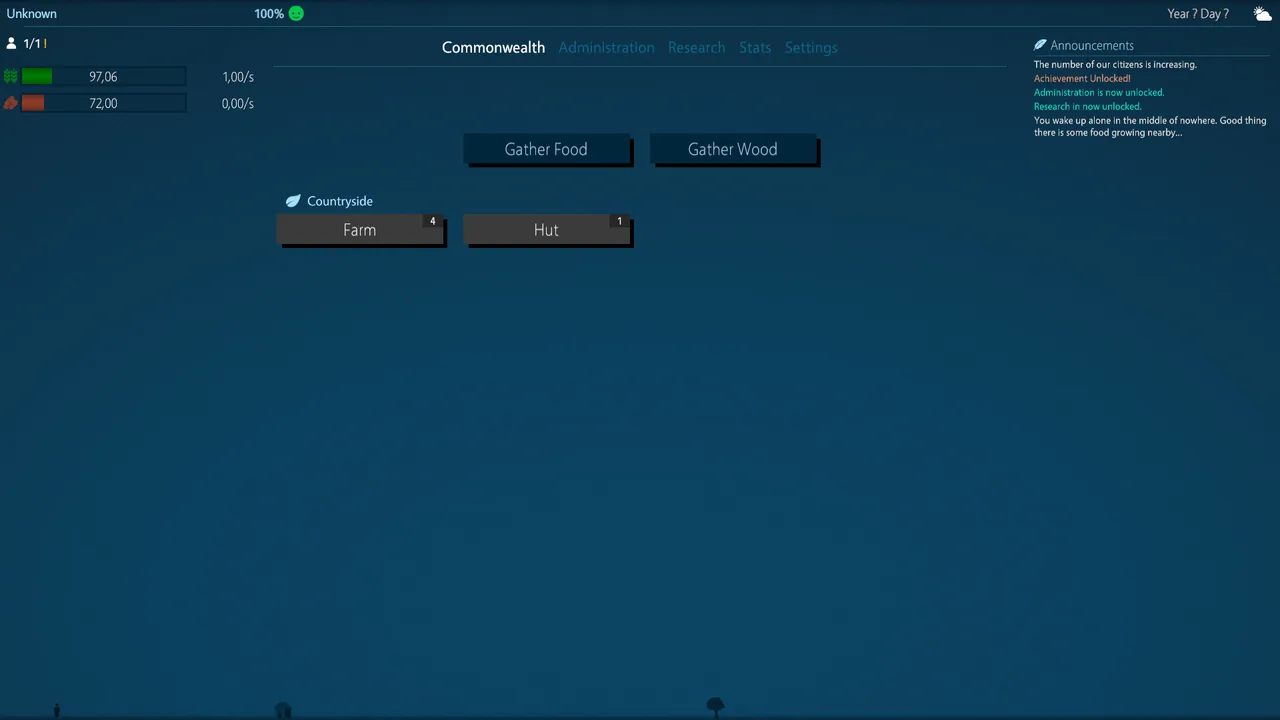
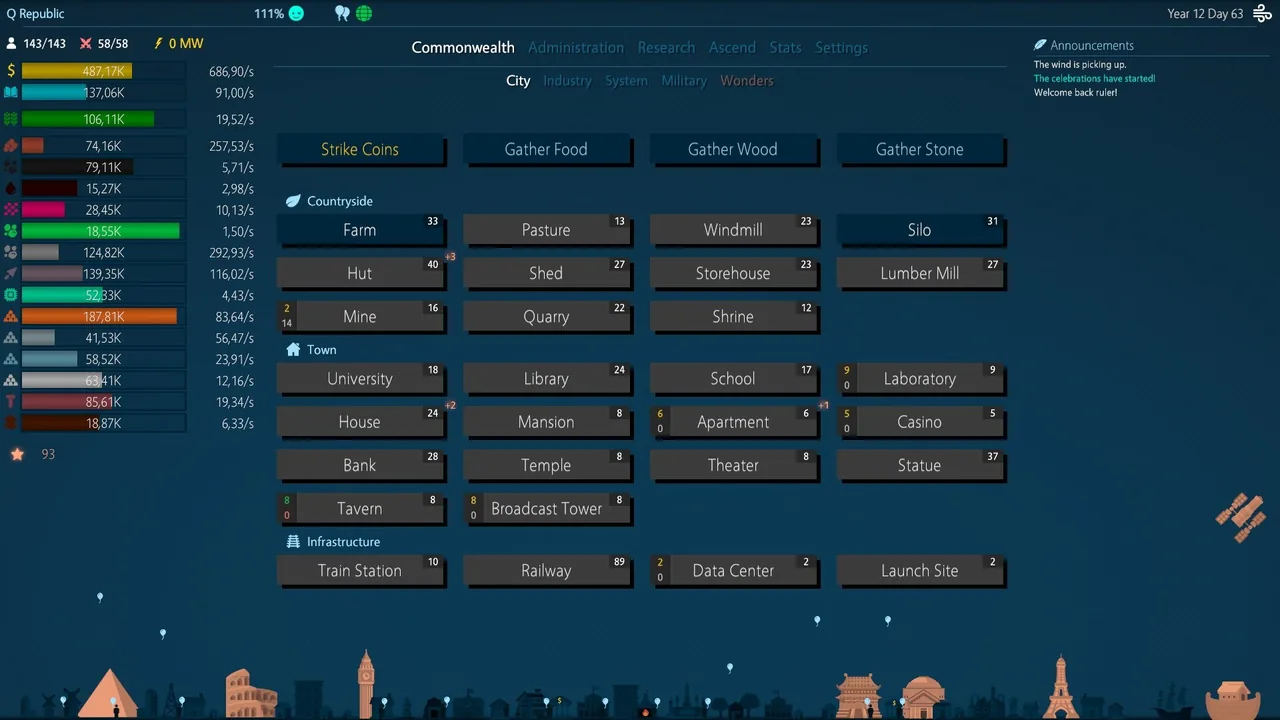
Idle Commonwealth asks the player to grow a single settlement into a full civilization: gathering raw resources, constructing buildings, researching technology, managing morale and governance, trading with neighbours and eventually going to war with them. It's a genre this library knows well — the resource-tree, prestige-loop incremental — and Idle Commonwealth wears its influences openly. Developed and self-published by the two-person studio Qbusik Games, it entered Early Access on 17 March 2025 and exited to a full 1.0 release on 5 June 2025. That would ordinarily be where a review's factual section ends and the analysis begins. It isn't here, because the most important fact about Idle Commonwealth in August 2026 is one the game's own Steam page confirms without needing a single review to back it up: there has been no update since that 1.0 release, fourteen months ago, and the game has since become entirely free to download and play.
What can and can't be verified
Several reviewers state plainly that the studio behind the game closed. One, posted 23 August 2025, reads simply: "Game is dead as of 15 Aug 2025! Don't blame me, the company shut down, check out their announcement." Later reviews describe the game as "abandoned by the developer since June" and, by early 2026, "no longer supported." Outside reporting on the game's history broadly agrees, describing a developer decision to move the game to free-to-play and close the studio because of the ongoing cost of maintaining it. This review was not able to independently pull a primary Steam announcement making that statement — the game's official news feed contains no post after its 5 June 2025 patch notes, and the closure announcement, if it exists on Steam, does not appear through the standard channels this review checked. What this review can state as directly confirmed fact: the update history genuinely stops in June 2025, and the game genuinely charges nothing today, having launched at roughly NZ$13 during Early Access. Both are consistent with the studio-closure account. Readers should treat the closure specifically as reported rather than independently verified, and the update silence and free price as facts this review checked itself.
A real, if unoriginal, civilization-builder
Set that context aside and there's a genuinely substantial game underneath. A dedicated core of players has put real time into it — one review logs 2,507.8 hours and simply calls the interface "beautiful... simplistic and well executed," and others describe multiple full playthroughs, serious achievement hunting, and a prestige system that meaningfully changes how later runs open up. The systems are broad for a two-person team: over a hundred achievements track everything from early gathering milestones to deep genome and evolution mechanics, and the completion curve declines gradually rather than falling off a cliff, which suggests the mid-game content genuinely holds attention rather than losing players immediately after the tutorial.
The recurring problem in this game's own review sample is how closely it resembles specific existing incrementals. The single most-upvoted English review calls it "just a bad rip-off of the free browser game Evolve Idle." Others are more specific still: "every research path and names are the same," one writes, while another calls it "a blatant clone of Kittens Game" and a third simply notes it "copied other games that did it better." A fourth compares it to Trimps. These aren't vague genre comparisons — reviewers are pointing at matching research tree names and matching prestige mechanics between named, well-established browser incrementals and this one. That's a serious knock against a game's claim to be worth playing over its inspirations, and it's raised often enough across independent reviewers that it reads as a considered, shared observation rather than one person's grudge.
An idle game that resists being played idly
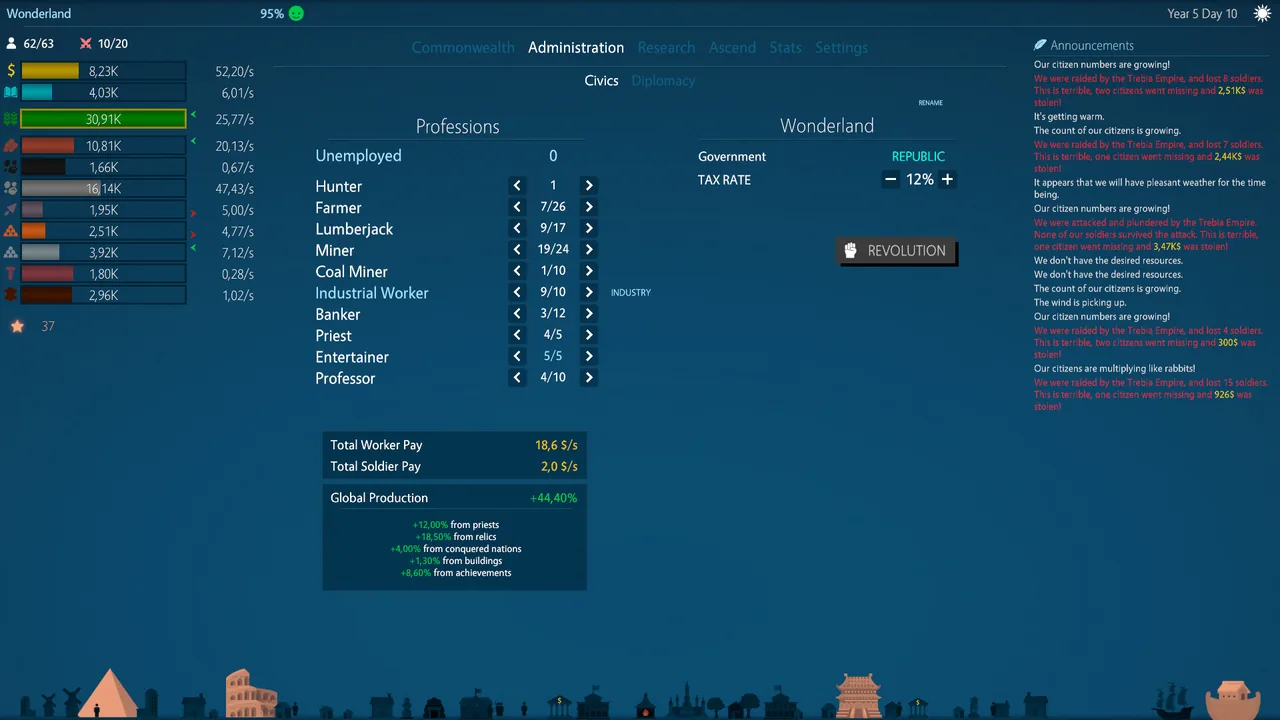
The sharper design complaint, and the one most specific to this genre, is that Idle Commonwealth frequently doesn't behave like an idle game at all. Multiple reviewers report no offline progression whatsoever — closing the game stops production entirely rather than banking it for your return — and the game actively blocks auto-clickers, which several players call out as actively hostile to the genre it's marketed in. "Pretty much nothing idle about it," one review reads. "Enjoy toggling workers around nonstop to make tiny bits of progress." A 1,683-hour review goes further, arguing the game "HAVE[s] to be played manually because the dev thought it'd be clever to take your people away from their tasks by having them killed by other civilizations, or by work accidents" — meaning inattention has an active cost, not just an opportunity cost. Layered on top of that is a specific complaint about the tech tree itself: several reviewers describe unlocking new technologies as introducing active drawbacks rather than pure upgrades, to the point that one January 2026 review calls it feeling "like the player is punished for progressing." None of this makes the game unplayable — the positive sample includes players who accept the pace and even defend it, one arguing bluntly that anyone complaining about the slowness "has never played an IDLE game before" — but the pattern across dozens of independent reviews is specific enough, and consistent enough, to treat as a real design choice rather than a difficulty spike a patch would fix.
Value and monetisation
There's no meaningful criticism to make here. Idle Commonwealth costs nothing, carries no DLC and has no in-app purchases, premium currency or advertising of any kind — it launched as a roughly NZ$13 Early Access purchase and now asks for nothing at all. Whatever the reason behind that change, it removes monetisation entirely from the conversation and leaves the game to be judged purely on the systems it offers for free.
Final Verdict
Idle Commonwealth is a real, reasonably deep civilization-building incremental that a small, genuine fanbase has spent hundreds and occasionally thousands of hours with, and it costs nothing to try. That's worth taking seriously. It's held back by three separate things that would each be a fair complaint on its own: a research tree and prestige structure that a meaningful number of independent reviewers say closely mirrors specific, better-known incrementals; game design that actively works against the offline, hands-off promise its own genre tag makes; and, as of this review, over a year of silence from a developer several players and outside reports describe as having closed its doors. None of that erases the genuine hours some players have gotten out of it, and at a price of zero there's little financial risk in finding out whether its slow, punishing rhythm appeals. Just go in knowing this is very likely a finished product in the fullest sense — what's here now is probably all there will ever be.
Pros and cons
Pros
- Real, substantial systems — gathering, building, research, governance, trade and military conquest — that a dedicated minority of players have engaged with for hundreds and, in at least one case, over 2,500 hours
- Completely free with no purchases of any kind to evaluate or worry about
- A clean, minimalist interface that draws specific praise for being simple and well executed
- A gentle, gradual 100-achievement completion curve rather than a cliff, suggesting the civilization-building content genuinely holds attention past the opening hours
Cons
- Confirmed no update to the game since its 5 June 2025 release, over fourteen months as of this review, and reviewers report — consistent with outside reporting this review could not fully verify from a primary source — that the developer closed the studio shortly afterward
- Despite being marketed as an idle game, it withholds offline progress, blocks auto-clickers, and requires frequent manual worker reassignment; several reviewers specifically argue it fails at being "idle" in the way the genre promises
- A recurring, specific complaint from multiple reviewers compares its research tree and mechanics closely to Evolve Idle, Kittens Game and Trimps, naming matching research paths and even a matching prestige mechanic
- A tech-tree design where new unlocks introduce active drawbacks (worker deaths, new threats, steep cost curves) reads to several reviewers as actively punishing progression rather than rewarding it
Screenshots
-
Idle CommonwealthImage: Qbusik Games via Steam -
Idle CommonwealthImage: Qbusik Games via Steam -
Idle CommonwealthImage: Qbusik Games via Steam -
How the review scores each part of the gameWanderer Editorial -
The essentials at a glanceWanderer Editorial -
The short versionWanderer Editorial