
Game review
Heroes' Vow: Three Kingdoms
7 / 10
- Developer
- Free Wing
- Publisher
- Free Wing, NPC Entertainment
- Released
- 25 March 2025
- Platforms
- Windows
- Genre
- Indie, RPG, Simulation, Strategy
- Players
- Single-player
The short version
Biggest strengths
- Praised repeatedly and specifically by veteran Romance of the Three Kingdoms players as deeper and more mechanically rich than KOEI's own recent official entries in the series
- An unusually deep character-development and officer system, with genre veterans specifically crediting main stats, skills, weapon-specific properties, and long-term growth curves
- Genuinely substantial scope, with at least one completionist reviewer reporting 200 hours of play alongside full achievement completion, and 37 achievements spread across a wide difficulty curve
Biggest weaknesses
- No official English localization exists, and the developer has stated none is currently planned, which is by far the single most common complaint across the entire review sample
- The game's built-in translation options are reported by some reviewers as buggy or effectively unplayable, in contrast to the well-regarded third-party fan patch
- A heavily story-gated pacing structure means long stretches of simply waiting for the correct date and conditions to trigger the next major narrative event
7 / 10
The Three Kingdoms RPG that KOEI stopped making
Heroes' Vow: Three Kingdoms lets players live through the Three Kingdoms era of Chinese history as a ruler, advisor, mercenary, or wandering hero — marrying, raising a family, training in martial arts, and choosing between diplomacy and open conquest. It's explicitly built in the mold of KOEI's long-running Romance of the Three Kingdoms series, and based on the available English-language review sample of 130 reviews — 117 positive, 13 negative, landing at an overall Very Positive rating — a striking number of those reviews come from self-identified veterans of that exact franchise, who consistently argue this indie entry now does the job better than KOEI's own recent output. "This is like RTK13, but better in almost every way, deeper mechanics and much cheaper," one reviewer states directly, a comparison echoed even more forcefully by another: "This is THE ultimate Three Kingdoms game, specially for officer-based gameplay. It's so much better than any Koei game its not even funny."
One especially thorough reviewer, reporting back after 200 hours and full achievement completion, frames the game's relationship to its inspirations precisely: "It's an excellent Three Kingdoms game and RPG to boot. First, it's a refreshing feel of a familiar gameplay from Koei games, no doubt the devs themselves play those games. This game is closest to ROTK X and XIII where they have drawn most of their inspirations from them." A separate long-time fan of the genre puts it even more plainly after comparing it against the entire modern RTK lineup: "I've played every ROTK and NA' that's come out on top of Dynasty Warriors. KOEI opting out to keep releasing newer versions and going down the Remastered route, this game is the next best thing. My god is it a blessing. This game is an upgrade from the previous ROTK's with more features and depth."
The single dominant complaint: there is no official English
Set against that enthusiasm, one issue overwhelmingly dominates the negative side of this review sample and appears, in some form, in a large share of even the most positive reviews: Heroes' Vow currently has no official English localization, and the developer has stated none is planned. "No plans for a English translation now nor in the future, So for this reason I'm giving it a thumbs down. Current translations makes the game bugged and unplayable," the most heavily upvoted negative review states, directly connecting the localization gap to a specific technical complaint about the game's own built-in translation tools rather than treating it as a purely cosmetic language barrier. A separate reviewer, this one recommending the game, still flags the same core issue as a real cost: "Great game. Variety in the game play loop is fun. It's not perfect but cannot complain for the price and all the excellent parts of the game. English language option would be helpful."
What complicates a simple "avoid if you don't read Chinese" verdict is how consistently reviewers describe a specific, well-regarded community fan-translation patch as bridging that gap effectively. "This is like RTK13, but better in almost every way... The only downside is lack of English by default (although there is a perfectly well working fan translation)," one reviewer notes, and a separate reviewer offers a specific completion estimate for the patch's coverage: "Using the English patcher makes it 100% playable. Roughly 95% of everything is translated." A third reviewer describes the setup process directly: "Setting up the english patch is not difficult... I'm glad their settings take account of certain gameplay can be slow and settings are offered." That degree of specific, independent agreement across many reviewers about a third-party fix genuinely working is worth taking seriously as a practical mitigation — but it's also worth being direct that this remains an unofficial, community-maintained solution rather than something the game ships with, and prospective buyers should weigh that distinction for themselves.
A slow-burn structure built around waiting for the right moment
Beyond the localization question, one structural complaint recurs among reviewers who are otherwise positive: the game's heavy reliance on date- and condition-gated story events creates real stretches of downtime. "The game is decent, I don't regret buying it or playing it, but this game is very story oriented and for most part you are waiting for correct date and conditions to participate in the next major event. If you fulfill conditions to participate in an event by being in the correct faction and the characters are alive, you will have story with dialogue where you can change how the events play out," one reviewer explains, describing a pacing model that rewards patience and long-term planning over constant, moment-to-moment engagement. That's a genuine structural choice worth flagging clearly for players who prefer more continuously active gameplay loops, distinct from the localization debate entirely.
A recent balance change some longtime players resent
One detailed Chinese-language review — worth including specifically because it offers a perspective largely absent from the English-language sample — raises a substantive complaint about a recent update's effect on progression pacing. The reviewer describes the game as genuinely engaging and replayable at launch, requiring real effort to study and develop a character's abilities, but argues a subsequent update strengthened passive growth mechanics and study-related items to the point that meaningful stat growth now happens automatically with minimal player input, regardless of which starting character is chosen. The reviewer frames this specifically as eroding the sense of earned progression and character-building depth that made the game's early period compelling, calling the recent changes a step backward for veteran players even as they may make the game more approachable for newcomers. That's a specific, plausible account of a genre-relevant tension — reducing friction for accessibility at the cost of depth for dedicated players — and it's worth weighing alongside the overwhelmingly positive English-language reception as a reminder that even well-loved Early Access titles can generate real internal disagreement about specific balance decisions.
The achievement data offers a strong, independent signal of the game's genuine scope regardless of the localization and pacing debates. Across 37 total achievements, early milestones sit at 92% and 86.4% completion, while a substantial number of harder, longer-term goals fall into the single digits, down to 2.5% for the most demanding. That's a wide, well-structured spread consistent with the 200-hour completionist account and with reviewer descriptions of a game built for sustained, long-term investment rather than a quick playthrough.
Where this leaves it
Heroes' Vow: Three Kingdoms has earned unusually strong, specific praise from a genre fanbase that knows exactly what it's comparing the game against, with veteran Romance of the Three Kingdoms players repeatedly arguing it surpasses KOEI's own recent entries in depth and ambition. Its single largest obstacle to a broader recommendation is the complete absence of official English, a gap a well-regarded community translation patch appears to close effectively for most players willing to install it, though that remains an unofficial workaround rather than a built-in feature. Recommended strongly for RTK genre veterans and patient strategy-RPG fans willing to set up the fan translation and embrace a slower, event-gated pacing structure; a harder sell for anyone unwilling to rely on a third-party patch for basic comprehension.
Pros and cons
Pros
- Praised repeatedly and specifically by veteran Romance of the Three Kingdoms players as deeper and more mechanically rich than KOEI's own recent official entries in the series
- An unusually deep character-development and officer system, with genre veterans specifically crediting main stats, skills, weapon-specific properties, and long-term growth curves
- Genuinely substantial scope, with at least one completionist reviewer reporting 200 hours of play alongside full achievement completion, and 37 achievements spread across a wide difficulty curve
- A well-regarded, actively maintained community fan-translation patch that a large share of reviewers say makes the game fully playable and enjoyable despite the localization gap
Cons
- No official English localization exists, and the developer has stated none is currently planned, which is by far the single most common complaint across the entire review sample
- The game's built-in translation options are reported by some reviewers as buggy or effectively unplayable, in contrast to the well-regarded third-party fan patch
- A heavily story-gated pacing structure means long stretches of simply waiting for the correct date and conditions to trigger the next major narrative event
- At least one detailed, specific complaint (from a Chinese-language reviewer) argues a recent balance update trivialized progression that previously required deliberate player effort, undermining the sense of earned growth
Screenshots
-

Heroes' Vow: Three KingdomsImage: Free Wing via Steam -

Heroes' Vow: Three KingdomsImage: Free Wing via Steam -

Heroes' Vow: Three KingdomsImage: Free Wing via Steam -
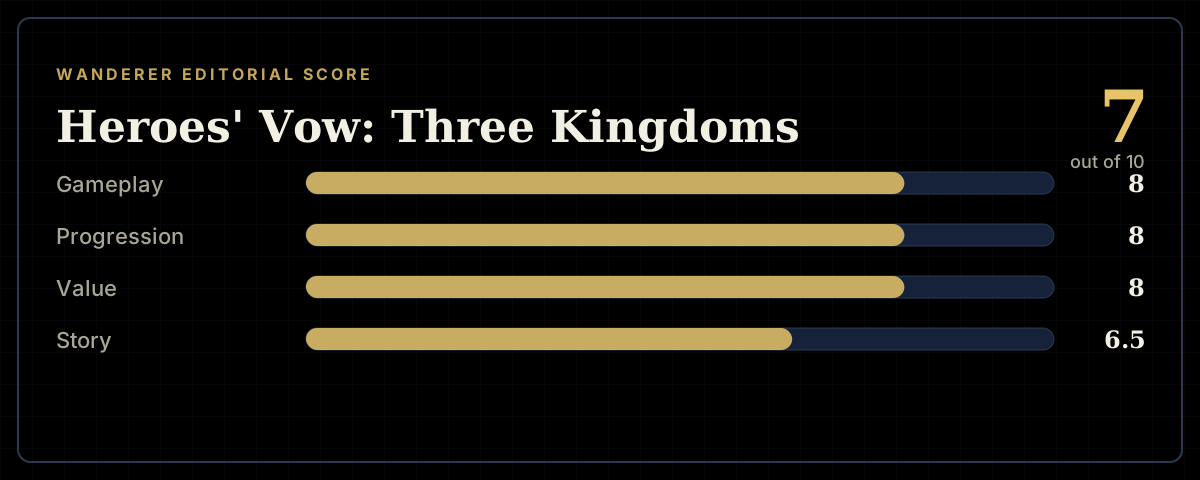
How the review scores each part of the gameWanderer Editorial -
The short versionWanderer Editorial