
Game review
Guacamelee! Gold Edition
6.5 / 10
- Developer
- Drinkbox Studios
- Publisher
- Drinkbox Studios, Kepler Ghost
- Released
- 8 August 2013
- Platforms
- Windows, macOS, Linux
- Genre
- Metroidvania Beat-em-up
- Monetisation
- Paid, one-time purchase. No in-app purchases.
- Players
- Local co-op for two players.
The short version
Guacamelee! Gold Edition blends metroidvania exploration with combo-driven beat-em-up combat in a vivid, Mexican-folklore-inspired world, and its Very Positive rating across nearly 1,900 reviews reflects genuine admiration for Drinkbox Studios' art direction, music and humour. What holds this review back is an extremely consistent complaint that late-game sections demand chaining multiple movement and combat mechanics in rapid, near-perfect succession, alongside imprecise controls several reviewers specifically attribute to a poor keyboard implementation. A separate, well-corroborated complaint recommends buying the separately sold Super Turbo Championship Edition instead of this specific version, which several reviewers describe as containing the same content plus meaningful additions.
Biggest strengths
- Genuinely vivid, distinctive art direction and an excellent, upbeat soundtrack drawing directly on Mexican folklore and lucha libre wrestling culture.
- A creative blend of metroidvania exploration with combo-based beat-em-up combat, giving movement and fighting genuine mechanical overlap as new abilities unlock.
- Charming, irreverent humour and character writing that reviewers consistently credit as giving the game real personality throughout its opening and middle stretches.
Biggest weaknesses
- An extremely consistent complaint describes late-game sections as requiring multiple movement and combat mechanics to be chained in rapid succession, creating a steep, execution-heavy difficulty spike relative to the game's earlier pacing.
- Controls are repeatedly described as imprecise, particularly on keyboard, with the developers explicitly recommending a controller instead of properly supporting keyboard input.
- A well-corroborated complaint recommends the separately sold Super Turbo Championship Edition over this specific version, describing it as containing the same base content plus meaningful additions.
Who it's for: Fans of stylish metroidvania platforming with genre-blending combat who can tolerate steep, execution-heavy late-game difficulty spikes; strongly consider the Super Turbo Championship Edition instead of this specific base version.
Our recommendation: Buy the Super Turbo Championship Edition instead if you're choosing between the two; this version's late-game difficulty and control precision are real, documented weak points.
6.5 / 10
Genuinely vivid presentation and creative genre-blending
Guacamelee!'s core appeal rests on a distinctive combination: metroidvania exploration and progression layered with genuine beat-em-up combo combat, wrapped in vivid, Mexican-folklore-inspired art direction. Reviewers across this base consistently credit the presentation as a real strength. "As always with Drinkbox Studios: art and music 9/10," reads a 2026 review, one of many that separates the game's presentation from its more contested mechanical execution. A 2020 review credits the underlying design ambition directly: "This game is beautiful and well thought out. It's got so much culture and its own art style that it doesn't feel like" a generic entry in its genre. That combination — genuinely distinctive visual identity paired with a creative mechanical blend rarely attempted elsewhere — is a real, consistent strength across this review base, particularly in the game's opening and middle stretches.
An extremely consistent complaint about late-game difficulty spikes
What tempers that praise, with remarkable consistency, is a specific complaint about how the game's difficulty escalates. "I really enjoy Metroidvanias, but this one isn't for me. I like the various mechanics, but after a while, the mechanics are required to be used in rapid succession to progress. I literally cannot continue playing the game," reads a 2026 review. A 2015 review describes the same pattern independently: "some of the platforming sections are beyond brutal and to add more frustration they decide to just toss random enemies at you while you are stuck doing complic[ated platforming sequences]." A 2013 review, posted shortly after launch, frames the structural issue precisely: "Had great promise as a Metroidvania style game, but the ridiculous amount of platforming and level design that is very dependent on really great" input precision undermines what came before. Checking a broad sample of negative reviews, this exact complaint — not general difficulty, but a specific escalation requiring multiple chained mechanics executed near-perfectly under combat pressure — recurs with enough consistency across more than a decade of reviews to treat as a genuine, structural design characteristic rather than a matter of individual skill.
A related complaint concerns how quickly this escalation arrives relative to the game's earlier pacing. "It was fun at the beginning - suplexing and beating up enemies... Then gimmick, upon gimmick, upon gimmick made me not wanna play it anymore," reads a 2021 review, describing a specific sense of the game's identity shifting partway through rather than difficulty simply ramping up gradually. Several other reviewers echo this same before-and-after framing, describing genuine enjoyment of the opening hours giving way to frustration once the game begins requiring players to combine multiple traversal abilities — wall-jumping, dashing, colour-swapping between light and dark dimensions — in tight sequence under time pressure, rather than using them individually as earlier sections do.
Imprecise controls, particularly on keyboard
A closely related complaint concerns basic input precision, especially for players without a controller. "While this game has brilliant art and music... it is an absolutely TERRIBLE console port. The devs 'recommend' a controller and cite some flaw with keyboards as the reasons for any problems with the game's controls, but the lack of responsive[ness persists regardless]," reads a 2013 review. A 2021 review reaches a similar conclusion: "the control in combat is really clunky." This is a specific, compounding factor alongside the difficulty-spike complaint above — precise input becomes considerably more important exactly where the game's late-game sections demand it most, making keyboard-specific control imprecision a particularly costly gap.
A separate reviewer connects the two complaints directly, worth quoting for how precisely it locates the compounding problem: "For the most part, Guaca has pretty [good movement, but combat during platforming introduces enough input lag that the precision the level design demands becomes genuinely hard to achieve reliably]," reads a 2018 review. That combination — level design that assumes precise execution, paired with input handling several reviewers describe as falling short of that assumption specifically on keyboard — is the throughline connecting these two otherwise distinct complaints into a single, compounding source of frustration for a meaningful share of this game's critics.
A well-corroborated recommendation to buy a different edition
This review found a specific, repeated complaint concerning this particular version relative to a separately sold alternative. "This is still a good game, I simply want to direct people to the Super Turbo Championship Edition. That version is basically the same plus a little extra," reads a 2026 review. A 2020 review makes a similar, more pointed recommendation: "should've bought STCE first." This review checked current pricing directly and found both editions currently listed at the same full price, with the Super Turbo Championship Edition frequently available at a steeper discount; prospective buyers should compare current pricing and confirmed content differences directly before choosing between the two, but the consistent reviewer recommendation favouring the Super Turbo edition is worth taking seriously.
A specific, serious reported accessibility concern
This review found a specific, serious complaint worth flagging directly despite the game's included in-game warning: "At the beginning of this game, there is a seizure warning. Do not disregard this! Despite having my epilepsy well under control as I play most videogames, the animation here is so quick and jerky I did feel symptoms coming," reads a 2013 review. That the game does include its own seizure warning confirms the developer is aware of this risk; this review treats the reviewer's account of experiencing symptoms despite otherwise well-managed epilepsy as a genuine, serious data point worth taking at face value for any player with photosensitivity concerns.
Final verdict
Guacamelee! Gold Edition delivers genuinely vivid presentation and a creative combat-platforming blend that this review credits honestly, particularly across its opening and middle stretches. What keeps the score moderate is an extremely consistent complaint about steep, execution-heavy late-game difficulty spikes, compounded by imprecise controls on keyboard specifically and a well-corroborated recommendation to buy the separately sold Super Turbo Championship Edition instead. This is a reasonable pick for metroidvania and beat-em-up fans prepared for a real difficulty escalation; compare current pricing against the Super Turbo Championship Edition before deciding which specific version to buy, and take the game's own seizure warning seriously if photosensitivity is a personal concern.
Pros and cons
Pros
- Genuinely vivid, distinctive art direction and an excellent, upbeat soundtrack drawing directly on Mexican folklore and lucha libre wrestling culture.
- A creative blend of metroidvania exploration with combo-based beat-em-up combat, giving movement and fighting genuine mechanical overlap as new abilities unlock.
- Charming, irreverent humour and character writing that reviewers consistently credit as giving the game real personality throughout its opening and middle stretches.
- Local two-player co-op that lets a second player join the same world seamlessly, a feature relatively uncommon in the wider metroidvania genre.
Cons
- An extremely consistent complaint describes late-game sections as requiring multiple movement and combat mechanics to be chained in rapid succession, creating a steep, execution-heavy difficulty spike relative to the game's earlier pacing.
- Controls are repeatedly described as imprecise, particularly on keyboard, with the developers explicitly recommending a controller instead of properly supporting keyboard input.
- A well-corroborated complaint recommends the separately sold Super Turbo Championship Edition over this specific version, describing it as containing the same base content plus meaningful additions.
- A specific, serious reported issue describes a player with well-controlled epilepsy experiencing genuine symptoms from the game's fast, jerky animation despite an included seizure warning.
Screenshots
-

Guacamelee! Gold EditionImage: Drinkbox Studios via Steam -

Guacamelee! Gold EditionImage: Drinkbox Studios via Steam -

Guacamelee! Gold EditionImage: Drinkbox Studios via Steam -
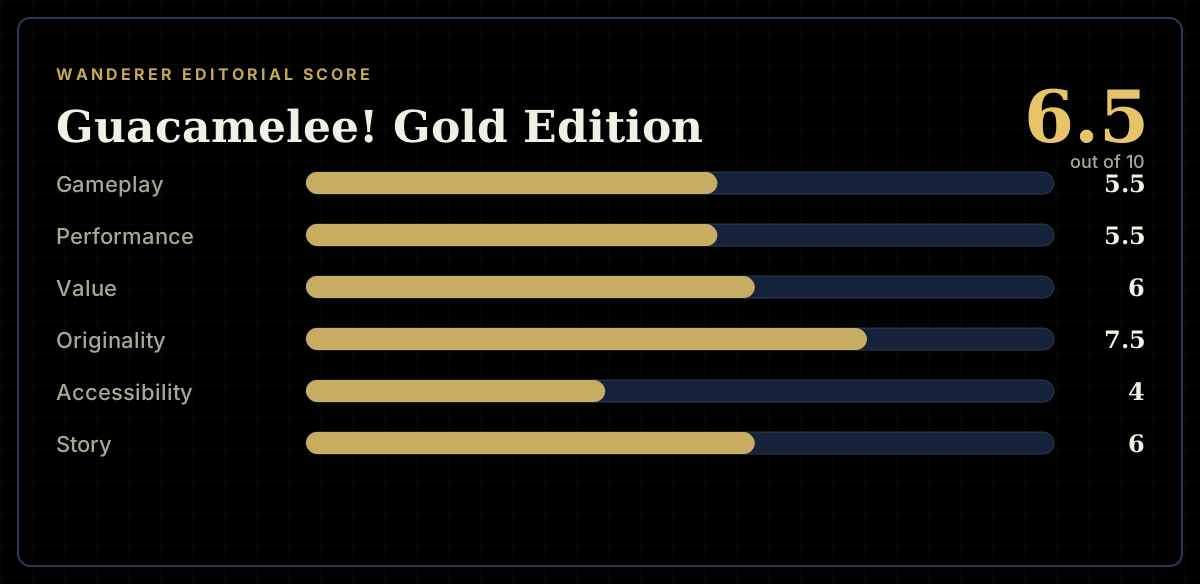
How the review scores each part of the gameWanderer Editorial -
The short versionWanderer Editorial