
Game review
God Awe-full Clicker
4 / 10
- Developer
- Mad Labyrinth Studios LLC
- Publisher
- Mad Labyrinth Studios LLC
- Released
- 19 September 2018
- Platforms
- Windows
- Genre
- Idle RPG
- Monetisation
- Free-to-play. Steam lists the game under its In-App Purchases category, though the visible store description does not itemise what those purchases unlock.
- Players
- Single-player only, with a passive "Companion Mini-game" side-system rather than any online or co-op mode.
The short version
God Awe-full Clicker packs more genuine system design into its Greek-mythology clicker premise than most of the genre bothers with — armor crafting, a class tree, recruitable gods with their own artifacts, a dice-roll reward table and a separate companion mini-game running alongside the main clicking loop. What it doesn't have, as of six years after its last update, is any evidence anyone is home. Steam records zero written reviews for it despite a real and gradually-declining achievement curve that proves people did play it, and its own promotional screenshots show it still carrying a pre-1.0 version number it never moved past.
Biggest strengths
- Layers real mechanical variety onto the clicking loop — armor crafting, a class/skill tree, recruitable gods with their own artifacts, and quest/collection/trophy tracks.
- No forced prestige loop; its own store description advertises permanent power growth "no reincarnation necessary," a genuine point of difference from most of the genre.
- Built-in auto-clicker toggles for both attack and healing are offered openly rather than treated as something to route around.
Biggest weaknesses
- The last substantive update was v2.0a on 18 February 2020, over six years before this review, with nothing since.
- Steam's own review system currently records zero reviews of any kind, so there is no player-sentiment record to check any claim against.
- Its own official screenshots show an in-game build number of v0.9.9.6a, meaning the game itself was still versioned as pre-1.0 at the point development stopped.
Who it's for: Idle-genre players who want more mechanical depth than a bare clicker offers and don't mind that depth arriving without any current support, patch cadence or community to compare notes with. Not for anyone who wants an actively maintained live-service idle game, or who relies on written player reviews to judge whether a system actually works as described.
Our recommendation: Worth a look if the mythology hook and the crafting/class systems appeal, on the clear understanding that support ended years ago and there is no player feedback record to lean on.
4 / 10
A denser build than the genre usually offers
God Awe-full Clicker's pitch is a Greek-mythology skin on the standard clicker/idle template: click and auto-damage an endless line of monsters and gods drawn from the Olympian pantheon, level up a Gladiator, and progress through an escalating dungeon path. What separates it from a thousand other clicker reskins is how much sits on top of that loop. The store page lists armor crafting and upgrading, a full skill and class system, recruitable gods who each carry their own findable artifacts, a dice-based instant-reward table, quest/collection/trophy tracks, and a distinct "Companion Mini-game" that runs as a side-system for extra rewards. The game's own official screenshots back this up in practice rather than just on the feature list: one shows a UI with six tracked companion portraits down the left edge, a full favor meter, God Power and Divine Blessing icons, an armor tab, a store tab and a live quest/trophy tracker all visible simultaneously — a genuinely busy interface for a genre that often gets away with three numbers and a button.
One specific design claim is worth taking at face value because it's unusual for the genre: the store description advertises earning "GodPower" to spend on Divine Blessings for permanent power, explicitly noting "no reincarnation necessary." Most incremental games are built entirely around a prestige reset — you play until progress stalls, then deliberately throw it away for a permanent multiplier and start over. Framing permanent growth as available without that reset loop, if it holds up as advertised, is a real structural difference from the Clicker Heroes/Cookie Clicker template this genre otherwise runs on almost universally.
The numbers only tell half the story, and it's the wrong half
Pull the current player-sentiment data and it looks like a ghost town: Steam's review API returns exactly zero reviews for this game, of any kind, in any language, checked against the full unrestricted sample rather than a truncated one. That would normally be the end of the conversation for evaluating player reception. But Steam's separate global achievement statistics endpoint tells a different story, because it needs no reviewer to have typed anything — it just counts who unlocked what. The curve here is a real one, gradually and smoothly declining from 83% of trackable players on the earliest achievement down to 4.2% on the latest, exactly the shape of an idle game's normal long-tail engagement funnel rather than a flat line suggesting nobody ever launched it. People played this game, in real numbers, for real hours. They simply never wrote a review about it, which is a very different fact from "nobody played it," and worth stating plainly rather than assuming the worst from a review count alone.
What isn't ambiguous is the support timeline. The developer's own news feed shows a steady patch cadence through most of 2019 into early 2020, ending at "Update v2.0" on 12 February 2020 and a follow-up "[Patch] v 2.0a" six days later. Nothing has been posted since — more than six years of silence at the time of this review. The version number visible in the game's own current promotional screenshots, v0.9.9.6a, confirms the build itself never crossed its own 1.0 threshold before work stopped, even though Steam's genre metadata never applied an Early Access label to the listing.
What the interface reveals that the store page doesn't
The store description sells the systems list; the actual promotional screenshots sell how dense the number-crunching gets underneath it. Damage and currency figures in the captured battle screens run into abbreviated scientific notation well beyond the usual K/M/B/T ladder — "EK," "SX" and "AH" suffixes standing in for numbers most players will never see spelled out in full. That's a real signal about pacing: a genre veteran reading those suffixes can tell the escalation curve is steep and long, built for players who intend to sink dozens of hours in, not a five-minute mobile-style session. The same screenshots also show the Companion Mini-game running as a persistently visible side-panel of six portraits with their own favor meters, rather than a menu you have to dig for, which suggests the developer wanted it treated as a parallel system worth checking in on regularly rather than a buried bonus feature. Whether that pacing rewards the investment or just pads it is exactly the kind of judgment call the missing six years of reviews would normally help answer, and here it can't.
Monetisation is present but undocumented
Steam's storefront categorises God Awe-full Clicker under In-App Purchases, confirming it takes money somewhere inside a nominally free game. What that money buys is not stated anywhere in the visible store description, which instead spends its space entirely on mechanical features. For a free idle game that's a mixed signal: the absence of pushy monetisation language in the sales copy is mildly reassuring, but a player has no way to know before installing whether the in-app purchases are cosmetic, currency, or something that meaningfully accelerates the very crafting and class systems the description spends most of its words selling.
Final verdict
Judge the design on its own terms and God Awe-full Clicker earns real credit: it tried to build a denser, more systems-driven idle RPG than the Clicker Heroes formula usually attempts, and its own screenshots and store copy back that ambition up with specifics rather than marketing filler. Judge it as something to install today and the picture is thinner. No update in over six years, no written player reviews to check any of its claims against, an undocumented monetisation model, and a build number that never reached 1.0 before the developer went quiet. The achievement data proves this was a real game that real players engaged with for a while — it just isn't one anybody is currently watching, supporting, or talking about, and a 2026 player going in should expect exactly that: a frozen, moderately ambitious clicker with no one left to answer for it.
Pros and cons
Pros
- Layers real mechanical variety onto the clicking loop — armor crafting, a class/skill tree, recruitable gods with their own artifacts, and quest/collection/trophy tracks.
- No forced prestige loop; its own store description advertises permanent power growth "no reincarnation necessary," a genuine point of difference from most of the genre.
- Built-in auto-clicker toggles for both attack and healing are offered openly rather than treated as something to route around.
Cons
- The last substantive update was v2.0a on 18 February 2020, over six years before this review, with nothing since.
- Steam's own review system currently records zero reviews of any kind, so there is no player-sentiment record to check any claim against.
- Its own official screenshots show an in-game build number of v0.9.9.6a, meaning the game itself was still versioned as pre-1.0 at the point development stopped.
- The store page lists In-App Purchases without ever describing what they buy, leaving the actual monetisation opaque to a prospective player.
Screenshots
-

God Awe-full ClickerImage: Mad Labyrinth Studios LLC via Steam -

God Awe-full ClickerImage: Mad Labyrinth Studios LLC via Steam -

God Awe-full ClickerImage: Mad Labyrinth Studios LLC via Steam -
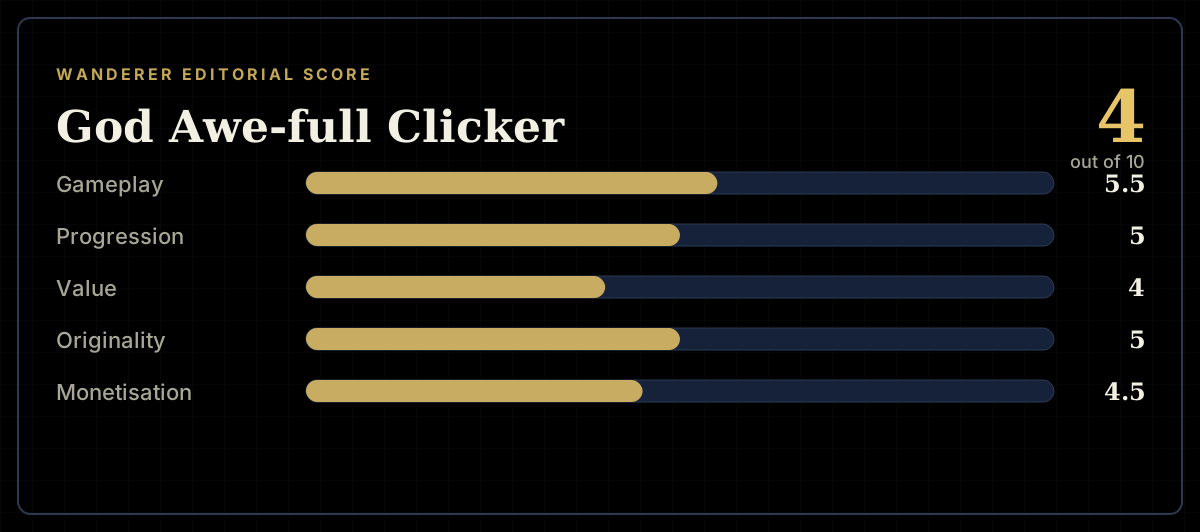
How the review scores each part of the gameWanderer Editorial -
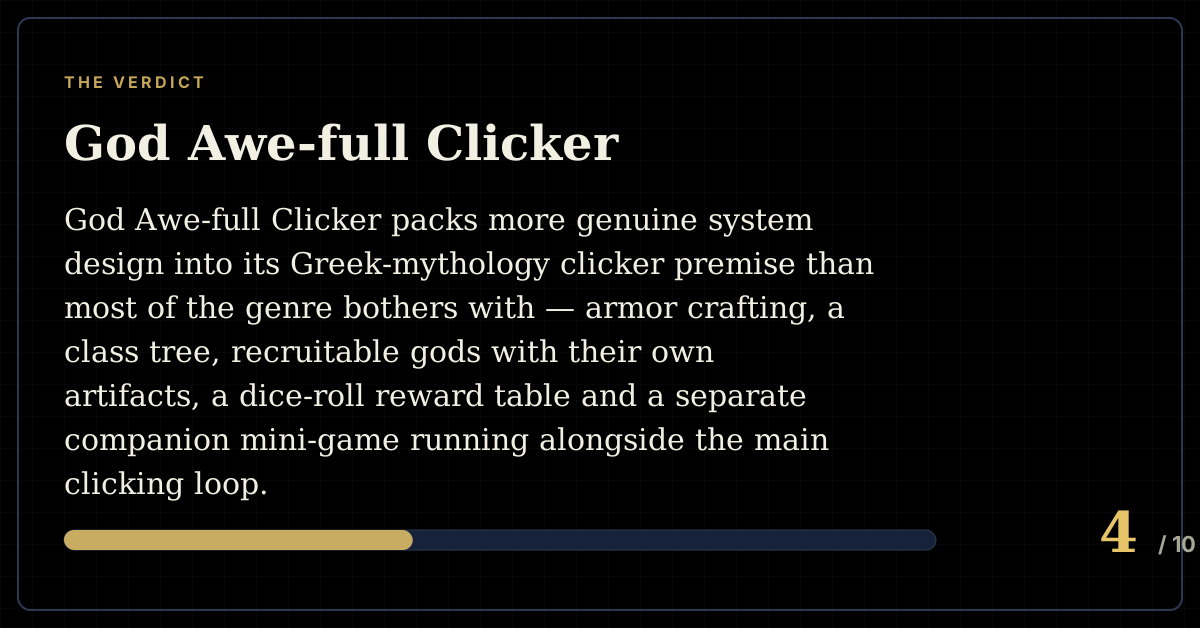
The short versionWanderer Editorial