Game review
Farther West Review
7 / 10
- Developer
- 福州玄一智能科技有限公司
- Publisher
- 福州玄一智能科技有限公司
- Released
- 16 September 2026
- Platforms
- ["Windows"]
- Genre
- Action
A Pilgrimage That Never Quite Arrives
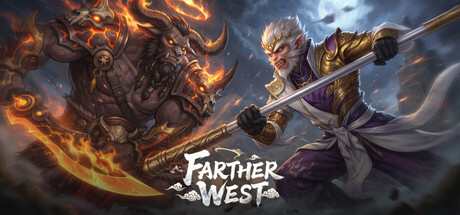
Farther West borrows its setting from Journey to the West, one of the most adapted stories in Chinese fiction, and turns the pilgrim's endless road to enlightenment into a literal, mechanical joke: the sacred mountain of Lingshan is the destination every run chases and never reaches. That's not incidental flavor text, it's baked into the game's own Chinese title, 灵山未至, "Lingshan Not Yet Reached," and it frames the whole roguelite structure honestly. Each run sends a scripture pilgrim hacking through hordes of fallen gods and rampaging demons across stages like the Flaming Mountains and the Spider Silk Cave, with familiar faces from the source material, Sun Wukong, Zhu Bajie, the White Dragon Horse, unlockable as playable heroes along the way.
Vampire Survivors' Horde-Clearing Loop, Given a Chinese-Mythology Skin
Mechanically this sits squarely in the bullet-heaven/horde-survival lineage that Vampire Survivors popularized, and reviewers recognize the lineage immediately. One review categorized it plainly: "3D,国风的类吸血鬼幸存者,还不错,整体更休闲,但打击感,爽感还是ok的" (3D, a Chinese-style Vampire Survivors-like, pretty good, overall more on the casual side, but the hit-feel and satisfaction are still fine). That's an accurate, unpretentious description, waves of demonic and divine enemies swarm the pilgrim, who mows through them with immortal arts and elemental attacks that the store page describes as producing "spectacular knockbacks, shattering impacts, and elemental explosions," with defeated enemies "dismembered, torn apart, or reduced to dust and ashes." It's a familiar formula, but the mythological dressing, temples, demon kings, and immortal weapons drawn from a 16th-century novel rather than generic fantasy, gives it a distinct visual and thematic identity in an increasingly crowded genre. The stage roster leans into that identity rather than treating it as window dressing, runs cycle through named locations straight out of the novel, the Flaming Mountains, the Spider Silk Cave, the Lesser Thunderclap Temple, each guarded by its own demon king who, per the developer's own description, "awaits at the end of every stage" and must be studied rather than brute-forced, exploiting "the environment and mystical treasures" to find the one approach that actually works.
Heroes and Bosses That Actually Play Differently
The strongest, most specific praise in the review set pushes back directly against the genre's most common criticism, that horde-survivor clones are frequently just the same character with a new skin and slightly different numbers. One reviewer called this out explicitly: "让我出奇的是每个英雄每个boss都还自己特殊的技能机制,不是建模换皮堆数值的游戏耶" (what surprised me is that every hero and every boss has its own special skill mechanics, this isn't a game where you just swap models and stack numbers). Another reviewer backed this up from the level-design side: "从游戏内关卡的设置可以感受到制作们的良苦用心" (you can feel the developers' painstaking effort from the in-game level design). For a $3.99 release from a small studio, having genuinely differentiated hero kits and boss patterns rather than reused templates is a meaningfully higher bar than the genre's budget tier typically clears.
Casual Start, Surprisingly Demanding Bosses
Several reviewers independently flagged the same difficulty curve: an approachable, relaxed opening that gives way to real, skill-testing boss encounters. "前期割草还以为很休闲,没想到BOSS挺难的,没点操作还不好过" (early on the mowing-down felt casual, but the bosses turned out to be quite difficult, you need real execution to get past them), one wrote, calling the balance "劳逸结合" (a healthy mix of work and rest) and "有点上头" (a bit addictive). Another reviewer offered a specific build tip that speaks to genuine mechanical depth rather than a pure damage race: "一开始习惯性只拿一个技能,发现打不过BOSS。记得选'我全都要'!一下子就变爽快了" (at first I habitually only picked one skill and found I couldn't beat the boss, remember to pick 'I want them all!' and it suddenly became much more satisfying). That's the kind of specific, actionable advice that only comes from a build system with real decisions to make, not a slot-machine upgrade screen.
Everything Is in Simplified Chinese, and That's Worth Flagging
All twelve reviews on file are in Simplified Chinese, and while Steam's own storefront doesn't list confirmed language support beyond what's visible in the store assets, the review base itself suggests the game's dialogue and marketing have found their audience almost entirely within a Chinese-speaking player base so far. That's not a knock on the game's quality, every review is enthusiastic, but it's a relevant caveat for an English-speaking buyer weighing whether menus, tooltips, and the "arrogant, provocative, or contemptuous" boss dialogue the store page warns about will be legible without machine translation. It's also worth repeating the standard caution for any thin review sample: twelve reviews, however unanimous, is a small enough base that a 100% positive score should be read as "everyone who tried it liked it" rather than a statistically confident verdict on the wider player experience.
A Fair Price for What's Here
At $3.99, discounted further to $2.39 at launch, Farther West sits comfortably in budget territory for its genre, and reviewers consistently frame the price as a non-issue: "十几块不亏" (worth the ten-odd yuan), one wrote, essentially calling it money well spent regardless of scope. For a small-studio horde-survivor with differentiated hero kits, a recognizable mythological hook, and boss fights specific enough that players are trading build tips about them, that price-to-content ratio reads as generous rather than thin.
Verdict
Farther West doesn't reinvent the horde-survivor formula Vampire Survivors popularized, but it wears its Journey to the West setting well, and more importantly, it backs that setting up with hero kits and boss patterns that reviewers specifically credit as meaningfully distinct rather than reskinned. The jump from a relaxed early game to genuinely demanding boss fights gives the loop real stakes once the initial hack-and-slash novelty wears off. The catch is a thin, entirely Chinese-language review base that makes the perfect external score worth taking as encouraging rather than conclusive, and English speakers should go in expecting to lean on machine translation for now. At under four dollars, though, it's an easy, low-risk way to find out whether the pilgrimage is worth taking.
Screenshots
-
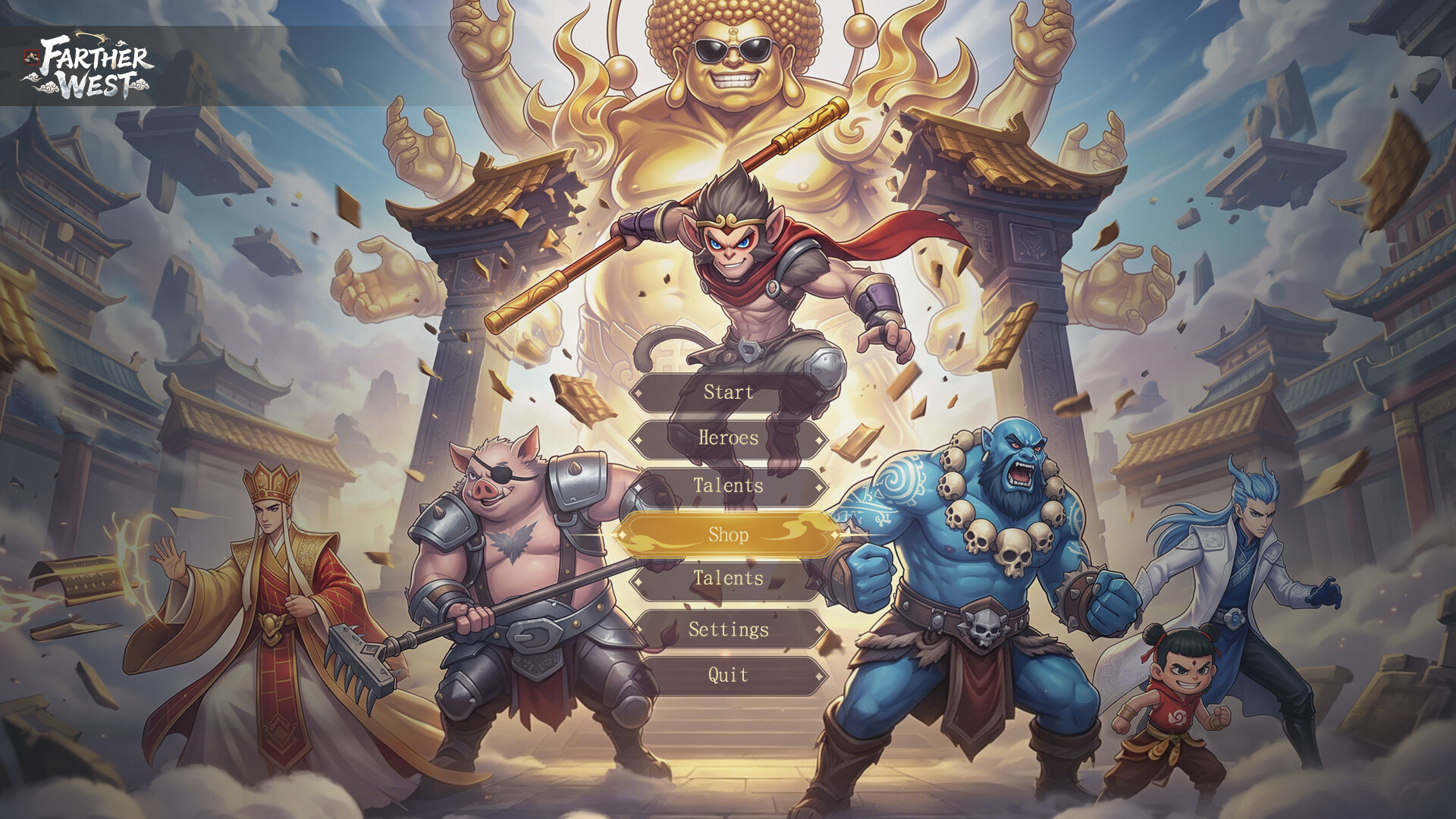
The main menu lineup, Sun Wukong, Zhu Bajie, and other Journey to the West figures unlockable as playable heroes.Image: 福州玄一智能科技有限公司 via Steam -
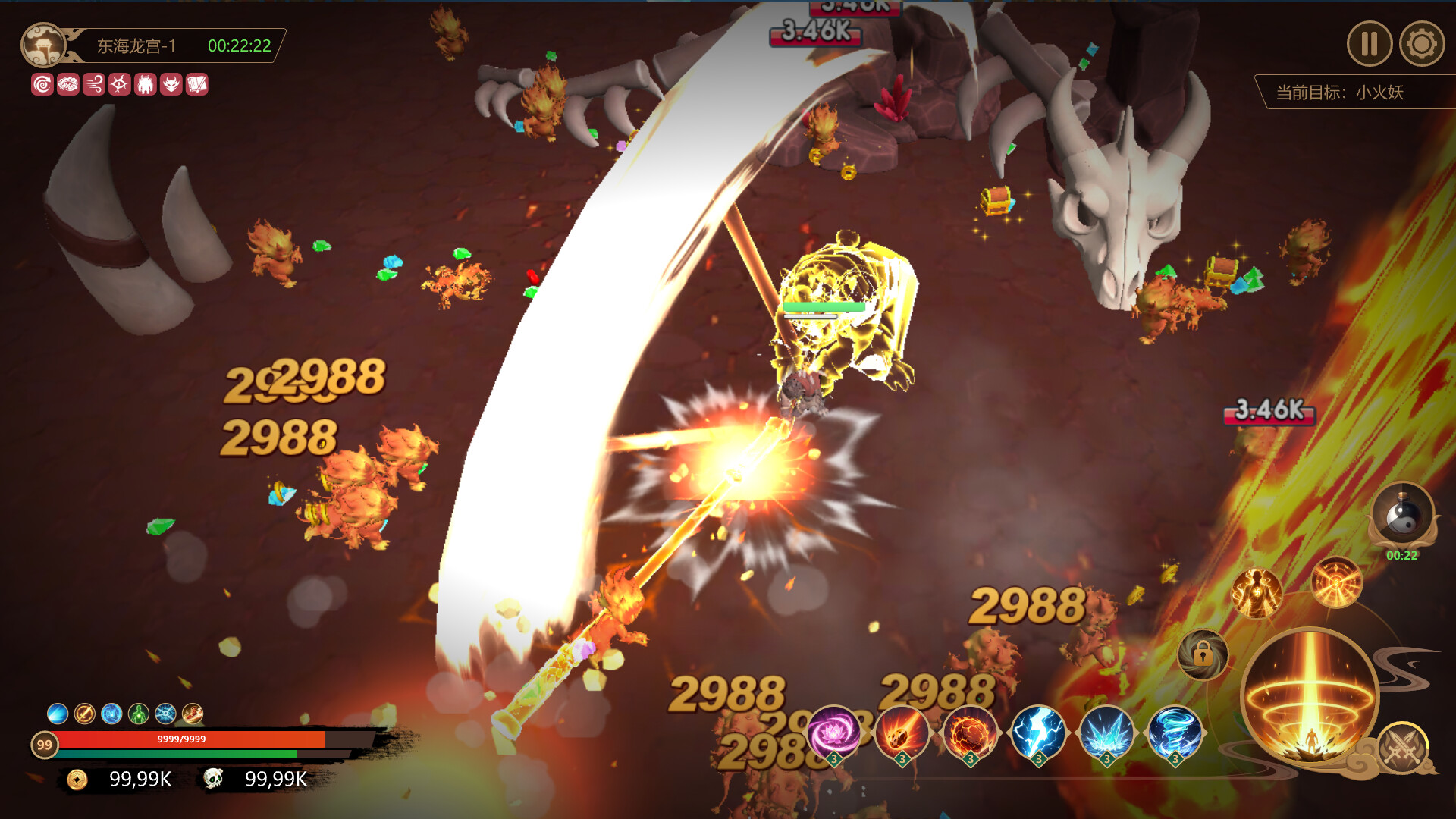
A run through the East Sea Dragon Palace stage, fire imps and a golden tiger enemy swarming as the pilgrim's weapon trail lights up the screen.Image: 福州玄一智能科技有限公司 via Steam -
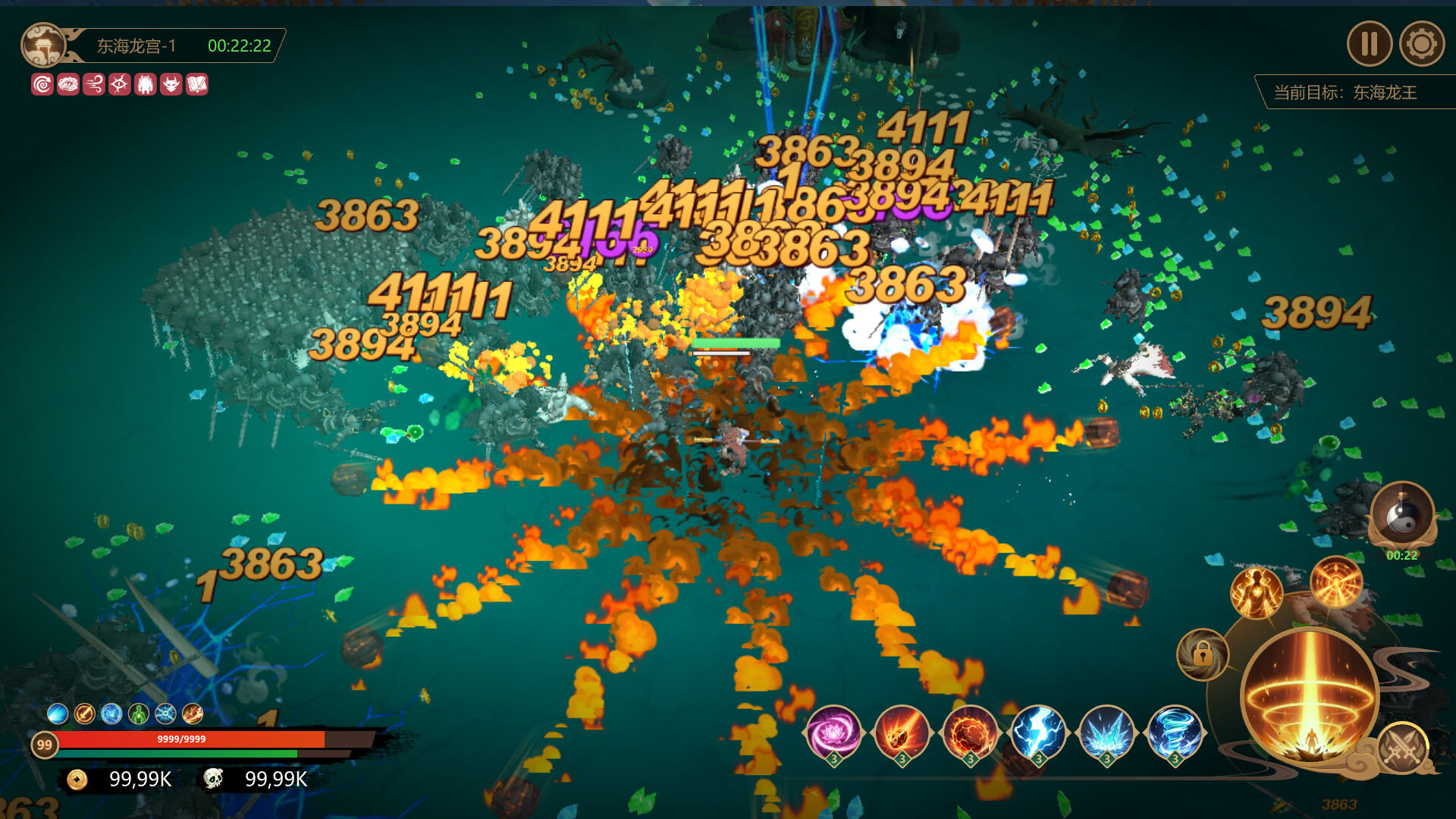
The Dragon King of the East Sea boss fight, one of the demon kings the store page says "awaits at the end of every stage."Image: 福州玄一智能科技有限公司 via Steam