
Game review
Etherborn
5.5 / 10
- Developer
- Altered Matter
- Publisher
- Akupara Games
- Released
- 18 July 2019
- Platforms
- Windows
- Genre
- Puzzle
- Monetisation
- Paid, no in-app purchases found
- Players
- false
The short version
Etherborn asks players to navigate abstract, sculptural landscapes where gravity itself shifts depending on which surface you're standing on, collecting orbs to open the way forward across five stylised levels. The concept draws immediate, apt comparisons to Monument Valley rendered in full 3D, and its puzzle logic and art direction earn real praise — but a camera that automatically repositions itself around each gravity shift is the corpus's dominant complaint, disorienting enough for a large share of reviewers that a smaller but vocal group's defence of it as intentional and 'quirky' hasn't settled the argument.
Biggest strengths
- A genuinely inventive gravity-shifting mechanic that lets players walk across multiple perpendicular surfaces of the same structure, praised by multiple reviewers as intriguing both mechanically and artistically
- Distinctive, stylised low-poly visuals and an atmospheric soundtrack that reviewers consistently single out as highlights
- A short, focused difficulty curve well suited to a single evening's play, with achievable New Game+ content for players who want more of the same puzzles at a higher challenge
Biggest weaknesses
- A dominant, widely repeated complaint that the camera automatically repositions with each gravity shift in ways that swap movement directions unexpectedly, making navigation and planning routes difficult
- Multiple reviewers directly and specifically recommend Youropa instead, describing it as executing the same core gravity-shifting mechanic with more content and better puzzle design
- A short overall runtime (roughly 4 hours including New Game+) that several reviewers feel doesn't fully justify the full asking price, consistently recommending a sale purchase instead
Who it's for: Fans of perspective-based puzzlers (Monument Valley, Youropa, Fez) who can tolerate some camera disorientation in exchange for a genuinely novel spatial puzzle mechanic.
Our recommendation: Worth it on a discount for the puzzle concept and presentation; consider Youropa first if you want the same core mechanic executed at greater length.
5.5 / 10
What it is
Etherborn places players in a series of abstract, sculptural worlds where the normal rules of up-and-down don't apply consistently: walk onto a different face of the same structure and gravity reorients around you, turning what was a wall into a floor and vice versa. Across five main levels plus a tutorial, players collect orbs and deposit them into switches to progress, navigating increasingly complex geometry that requires thinking about a space from multiple simultaneous orientations at once. The comparison nearly every reviewer reaches for is Monument Valley — one describes the game plainly as "what you get when Monument Valley gets to play in Unity's big boy sandbox" — and the resemblance in tone and puzzle philosophy, translated into full freeform 3D movement rather than fixed isometric perspective shifts, is genuine and deliberate.
It released on 18 July 2019 at NZD 24.99, developed by Altered Matter and published by Akupara Games. Its review corpus is thin at 59 English-language reviews but sits at a genuine Mostly Positive (45 to 14), and reading through it in full reveals a corpus largely in agreement about both what's good and what's frustrating about the experience.
A genuinely clever mechanic, well executed
Reviewers engaging seriously with the puzzle design describe real satisfaction once its spatial logic clicks. "Plenty of puzzle games aim to test your spatial reasoning in some unusual way, yet how Etherborn goes about using three-dimensional space is particularly intriguing," writes one detailed review, describing the experience of exploring the game's "atypical spaces" as captivating from both a mechanical and artistic standpoint. Another, playing early, reports the cameras working "surprisingly well" at providing "clues about" navigation despite the unusual gravity mechanic, suggesting the design succeeds for at least some players exactly where others find it most frustrating. Visual presentation and music draw essentially unanimous praise across positive and mixed reviews alike, with several specifically calling out individual level soundtracks as memorable highlights.
The camera problem that splits the corpus
Set against that praise, the single most repeated complaint concerns the camera's automatic behaviour during gravity shifts. "Camera is a nightmare that prevents you from seeing your goal so there's no chance to actually plan/solve your path to your destination," writes one reviewer, a sentiment echoed independently by several others: "whenever you switch gravity the camera switches places. And with it the directions you control in swap too," making it easy to "run off a ledge" because a direction that was previously "left" has effectively become "up" from the camera's new position. That's a specific, mechanically grounded complaint rather than a vague dissatisfaction, and it recurs across enough independent reviews to represent a genuine design friction point rather than a one-off skill issue.
Notably, a smaller but equally confident group of reviewers pushes back directly on this framing. "Not sure what all the whinging is for... the camera angles are fine, it's what makes it quirky and interesting," writes one, arguing that occasional disorientation and having to "run around a bit" is a deliberate and acceptable part of engaging with the puzzle rather than a flaw to be fixed. That disagreement doesn't resolve cleanly either way — it's a genuine matter of what a given player wants from a game built around genuinely destabilising its own sense of spatial orientation as a mechanic.
A direct, repeated competitor comparison
Worth flagging plainly: multiple reviewers independently and specifically recommend a different game, Youropa, as executing this same core gravity-shifting concept better. "The mechanic is the same as Youropa, which is superior both in terms of length and of puzzles," writes one reviewer, while another states even more directly: "Play Youropa instead." That's an unusually consistent, specific piece of comparative guidance to see repeated across a small review corpus, and it's worth taking seriously as a genuine signal for anyone deciding between the two rather than dismissing as coincidence.
What the achievement data shows about the drop-off
The completion curve across Etherborn's 13 achievements offers a useful, specific data point for weighing the camera controversy. Level-by-level completion drops fairly steeply and consistently: 61.4% finish the first level, dropping to 37.4% for the second, 27.4% for the third, and so on down to 6.7% for full game completion. That first-to-second-level drop — losing nearly 40% of the remaining audience in one step — is notably steep for what reviewers describe as a short, otherwise approachable puzzle game, and it lines up plausibly with the camera complaints: if the disorientation problem is most jarring when players first properly encounter a full gravity-shift transition (likely early in level two, once the tutorial's training wheels come off), that would explain a meaningfully sharper early drop-off than a smoothly, gradually escalating difficulty curve would normally produce. This is a plausible explanation rather than a confirmed one, since the achievement data alone can't distinguish between players who quit from camera frustration and those who simply lost interest for other reasons — but it's a coherent, evidence-consistent reading worth naming.
The narrative's ambition versus its clarity
Beyond the puzzle mechanics, it's worth addressing the story directly, since reviewers split on it in ways that mirror the camera debate. The narrative is delivered almost entirely through abstract visual metaphor and sparse voiceover rather than explicit exposition, and one detailed reviewer reads it specifically as an allegory for "a life-changing acid experience," crediting the writing and voice work with getting "the quite serious intent behind this game" across effectively despite — or because of — its abstraction. Other reviewers describe the same minimalism as feeling "clearly trying to be really philosophical" without fully landing that ambition, missing the emotional mark even while acknowledging the attempt. As with the camera, this isn't a case of one side being straightforwardly right; it's a story told through a specific, demanding artistic register that rewards players willing to sit with ambiguity and can leave others feeling the substance doesn't match the style.
Verdict
Etherborn executes a genuinely clever, Monument-Valley-inspired gravity-shifting puzzle concept with real visual and musical craft, but a camera system that a large share of its own players find disorienting, a short runtime relative to its price, and a direct, repeated recommendation toward a same-genre competitor all temper how strongly this can be recommended at full price. Worth experiencing on a discount for the puzzle concept alone, with Youropa worth checking first if only one game in this specific niche is on the table.
Pros and cons
Pros
- A genuinely inventive gravity-shifting mechanic that lets players walk across multiple perpendicular surfaces of the same structure, praised by multiple reviewers as intriguing both mechanically and artistically
- Distinctive, stylised low-poly visuals and an atmospheric soundtrack that reviewers consistently single out as highlights
- A short, focused difficulty curve well suited to a single evening's play, with achievable New Game+ content for players who want more of the same puzzles at a higher challenge
- Genuinely mind-bending puzzle moments once the game's spatial logic clicks, according to multiple positive reviews
Cons
- A dominant, widely repeated complaint that the camera automatically repositions with each gravity shift in ways that swap movement directions unexpectedly, making navigation and planning routes difficult
- Multiple reviewers directly and specifically recommend Youropa instead, describing it as executing the same core gravity-shifting mechanic with more content and better puzzle design
- A short overall runtime (roughly 4 hours including New Game+) that several reviewers feel doesn't fully justify the full asking price, consistently recommending a sale purchase instead
- The game's abstract, minimal narrative — interpreted by at least one detailed reviewer as an allegory for a psychedelic experience — lands as genuinely affecting for some and as unclear, "pretentious" padding for others
- At least one reviewer reports serious control issues preventing basic movement entirely, though this doesn't appear to be a widely shared experience across the rest of the corpus
Screenshots
-

EtherbornImage: Akupara Games via Steam -

EtherbornImage: Akupara Games via Steam -

EtherbornImage: Akupara Games via Steam -
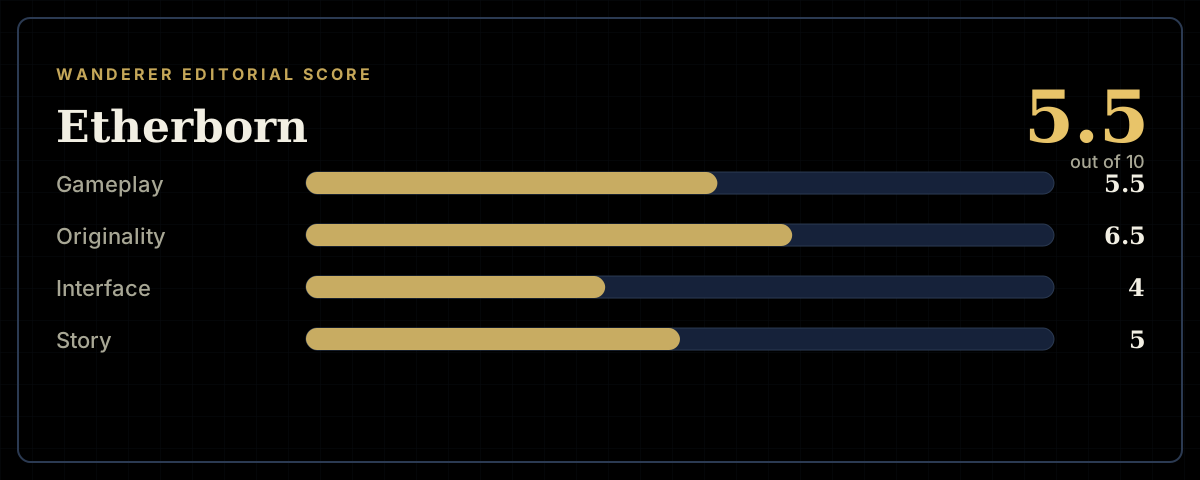
How the review scores each part of the gameWanderer Editorial -
The short versionWanderer Editorial