
Game review
Emily is Away Too
7 / 10
- Developer
- Kyle Seeley
- Publisher
- Kyle Seeley
- Released
- 26 May 2017
- Platforms
- Windows, macOS
- Genre
- Narrative instant-messenger simulator
- Monetisation
- One-off purchase, no in-game currency, ads or gameplay-affecting purchases
- Players
- None; single-player only, though a "chat with your Steam friends" novelty feature is advertised as part of the package
The short version
Emily is Away Too recreates its era's instant-messaging interface with real specificity — buddy icons, away messages, the particular anxiety of watching someone type and then stop — and builds a genuinely clever branching story around managing two separate relationships at once rather than one. Reviewers respond to the nostalgia almost unanimously, and the format's core trick still works: several describe real emotional engagement with choices that feel consequential in the moment. A smaller, specific critical thread argues the expansion to two conversation partners costs the tighter, more story-focused feel of the original, and a handful of reviewers flag serious real-world topics arriving without much warning, unsettling players who came in expecting pure nostalgia. The most concrete, unambiguous problem is technical rather than narrative: years after launch, the embedded YouTube and Facebook links central to the experience have substantially rotted, and at least one reviewer reports the game effectively broken on Linux due to a save-file bug.
Biggest strengths
- A genuinely precise recreation of mid-2000s instant-messenger culture, down to specific era- appropriate slang, buddy icon customization, and away-message habits that land as authentic rather than generic
- Managing two simultaneous, independent relationships adds real structural complexity over the original game's single conversation, rewarding players who track both threads carefully
- Multiple distinct endings driven by dialogue choices give the branching narrative real stakes and a reason to replay
Biggest weaknesses
- Years after launch, embedded YouTube and Facebook links central to extending the story beyond the chat window have substantially stopped working, with at least one reviewer calling the game "basically unplayable" as a result of missing context
- A specific, reported save-file bug on Linux can force players to restart the entire game from scratch, with at least one reviewer never finishing because of it
- A meaningful minority of reviewers argue splitting attention across two relationships dilutes the narrative focus that made the original Emily is Away more effective
Who it's for: Anyone who used AIM, MSN Messenger, or similar chat clients in the 2000s and wants a sharply observed nostalgia trip with real narrative stakes attached. Less suited to players wanting the tighter, single-relationship focus of the original game, or anyone who'd rather avoid unexpected heavy subject matter in what markets itself as a nostalgic comedy.
Our recommendation: Worth its very low typical price for the nostalgia and the branching narrative concept, with the caveat that some embedded external content has degraded over the years since launch.
7 / 10
Emily is Away Too puts players back behind a simulated instant-messenger window during senior year of high school, this time juggling conversations with two people — Emily and a new character, Evelyn — rather than one. Released in May 2017 as the spiritual successor to Kyle Seeley's well-received original, it leans further into its central conceit: the interface itself is the game, complete with customizable buddy icons, away messages, and embedded YouTube links and Facebook profiles meant to extend the story past the chat window. Reviewers responded warmly — 93.8% positive across nearly 3,930 English reviews — and the sample makes clear the nostalgia still lands precisely for most players nearly a decade later, even as a real, specific technical problem has emerged in the years since launch that any current buyer should know about upfront.
A format that still nails its specific era
The strongest, most consistent praise concerns pure authenticity of recreation. One reviewer sums it up simply: "A great MSN-style simulator, where you deal with people having meltdowns over trivial things and using outdated memes. Perfect, just like the old days." Another frames the appeal generationally: "I'm of a certain age, so more than anything, I enjoyed this and the first game for the nostalgia hit of returning to a simpler time." That specificity — not generic "retro" nostalgia but a precisely observed recreation of a particular chat-client era's rhythms and social anxieties — is what the game's fans return to across nearly every positive review, and it's a genuinely difficult thing to fake convincingly.
Two conversations, and a real debate about whether that's better
The headline structural change from the original — managing Emily and Evelyn simultaneously rather than one relationship — draws real, split reactions. One reviewer welcomes the added complexity: "I did like the dynamic of handling multiple people to talk to." A separate reviewer reaches the opposite conclusion about the same change: "The first one was so story based, and in this one I felt I couldn't really pay attention when I was rushed in t[ime]," while a third calls the whole sequel "a little more shallow and short compared to the first." Neither camp is simply wrong — this reads as a genuine design trade-off, more breadth for less depth per relationship, and reasonable players land on different sides of whether that trade was worth making.
A specific technical problem years in the making
The most concrete, least disputable issue in the review sample isn't about the writing at all: the game's embedded external content has aged badly. One reviewer states the consequence bluntly: "now 100% of the links don't work, making this game basically unplayable as I have no idea the context they are trying to provide me." Since the branching narrative leans on YouTube videos and Facebook profiles as extensions of the in-chat story, broken links don't just remove flavor — they remove plot context the base game assumes is present. A second, distinct technical complaint concerns platform-specific save reliability: one reviewer reports "saves are broken on Linux," forcing a full restart and ultimately preventing them from finishing the game at all. Neither of these is a matter of taste; they're specific, checkable problems that any current buyer should expect to encounter in some form given how much time has passed since launch.
Heavier material than the marketing suggests
A smaller thread worth naming honestly: several reviewers report the story moves into serious, heavy real-world territory without much warning, a tonal shift some found genuinely unsettling rather than effective. One writes plainly: "honestly kind of triggering, which was a bummer. it gets into some heavy topics and makes a game out of it which i wasn't expecting." That's a different, more measured complaint than a content-suitability disqualifier — the game isn't graphic or explicit — but it's fair to flag for anyone approaching this expecting a purely comic nostalgia trip, since several reviewers specifically didn't.
A scavenger hunt for a specific kind of player
Beyond the main branching story, the game hides a large set of secondary achievements tied to spotting internet-culture references scattered through buddy icons and conversation options — nods to Rick and Morty, Overwatch, Kappa, Newgrounds, and similar 2010s internet touchstones. Achievement data shows this layer reaches only a fraction of the audience that completes the main story: while over half of players finish the later story chapters, each individual icon-hunting achievement sits in the 9-14% range. That's not a flaw exactly — it reads as a deliberate bonus layer for a specific kind of completionist player rather than content most buyers are expected to find — but it's worth knowing that the game's full scope is considerably larger than a single story playthrough reveals, for anyone deciding how much time to budget for it.
How it sits next to the original
Reviewers who played both games consistently use the original Emily is Away as their point of comparison, and the verdict skews toward "different, not strictly better." One reviewer's assessment is representative: "it was good, it was a bit odd compared to the first one... but at the same time it felt it took away from the actual story." Given how frequently this comparison recurs, it's worth stating plainly for a new player choosing between the two: the original offers a tighter, more focused single relationship, while this sequel trades some of that focus for structural ambition and a larger world to explore. Neither approach is objectively correct, and a reader with no history with the series can reasonably start with either.
Verdict
Emily is Away Too still succeeds at its core trick: a precisely observed recreation of a specific, now-vanished chat-client era, wrapped around a genuinely branching narrative with real stakes. Its expansion to two simultaneous relationships is a real, debatable trade-off rather than a clear improvement or downgrade, and years of link rot have introduced a genuine, disqualifying-for-some technical problem that didn't exist at launch. Buy it cheap for the nostalgia and the format; expect some of the extended story content to no longer function as intended.
Sources: Steam store page and appdetails API (release date, pricing, platform data); Steam's aggregate review data (query_summary totals, English-language sample); individually read user reviews, both positive and negative, sorted by helpfulness and recency; Steam's global achievement statistics API.
Pros and cons
Pros
- A genuinely precise recreation of mid-2000s instant-messenger culture, down to specific era- appropriate slang, buddy icon customization, and away-message habits that land as authentic rather than generic
- Managing two simultaneous, independent relationships adds real structural complexity over the original game's single conversation, rewarding players who track both threads carefully
- Multiple distinct endings driven by dialogue choices give the branching narrative real stakes and a reason to replay
- A large secondary layer of hidden, internet-culture-referencing achievements adds a genuine scavenger-hunt incentive beyond the main story for completionists
- Achievement data confirms healthy story-chapter engagement, with over half the playerbase reaching the later chapters
Cons
- Years after launch, embedded YouTube and Facebook links central to extending the story beyond the chat window have substantially stopped working, with at least one reviewer calling the game "basically unplayable" as a result of missing context
- A specific, reported save-file bug on Linux can force players to restart the entire game from scratch, with at least one reviewer never finishing because of it
- A meaningful minority of reviewers argue splitting attention across two relationships dilutes the narrative focus that made the original Emily is Away more effective
- Several reviewers report serious, heavy real-world topics arriving with little warning inside what markets itself primarily as a nostalgic comedy, describing the tonal shift as unsettling rather than earned
- Achievement completion for the game's secondary "internet culture icon" collectibles falls to roughly 10-14%, suggesting this bonus content reaches only a small share of the audience that finishes the main story
Screenshots
-

Emily is Away TooImage: Kyle Seeley via Steam -

Emily is Away TooImage: Kyle Seeley via Steam -

Emily is Away TooImage: Kyle Seeley via Steam -
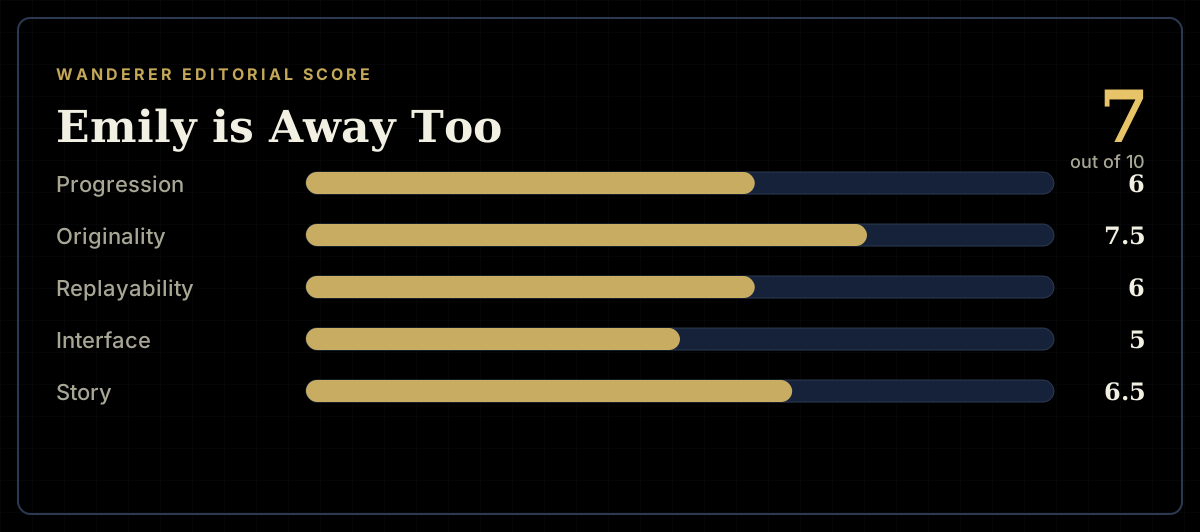
How the review scores each part of the gameWanderer Editorial -
The short versionWanderer Editorial