
Game review
El Paso, Elsewhere
6.5 / 10
- Developer
- Strange Scaffold
- Publisher
- Strange Scaffold
- Released
- 26 September 2023
- Platforms
- Windows
- Genre
- Neo-Noir Third-Person Shooter
- Monetisation
- One-time premium purchase; no ads, DLC or in-game store found
- Players
- Single-player only; no online, co-op or PvP modes
The short version
El Paso, Elsewhere is an unapologetic, deeply specific homage to Max Payne, right down to the bullet-time dives, painkillers and hardboiled monologues, transplanted into a reality-shifting motel full of vampires and werewolves. Reviewers consistently describe the atmosphere, voice acting and story as genuinely exceptional, with more than one comparing its emotional weight — built around themes of an abusive relationship — to real literary or cinematic art rather than a typical genre pastiche.
The mechanical foundation draws far more consistent, specific criticism. Max Payne's bullet-time dive was built to help players clear rooms of gun-wielding enemies at range; El Paso, Elsewhere's enemies are overwhelmingly melee-focused creatures that rush the player, and multiple independent reviewers make the same detailed observation that diving in this context leaves you prone on the ground getting swarmed rather than tactically repositioned. Combined with real repetition across a lengthy 20-plus level campaign, this is a well-corroborated structural mismatch between a borrowed mechanic and the game built around it.
Biggest strengths
- A genuinely exceptional, emotionally affecting story that multiple reviewers describe in unusually strong terms, built around real thematic weight beneath its pulpy horror premise
- Outstanding voice acting, particularly for the lead character, that reviewers consistently single out as elevating scenes well past typical genre dialogue
- A meticulously crafted homage to Max Payne and other Remedy Entertainment games, capturing the specific tone, presentation and cinematic style reviewers say almost no other game has attempted this precisely
Biggest weaknesses
- A well-documented, specific mechanical mismatch: the game's bullet-time dive was designed around Max Payne's ranged gunfights, but El Paso, Elsewhere's enemies are overwhelmingly melee-focused, and multiple independent reviewers describe diving leaving the player prone and vulnerable rather than tactically useful
- Enemy and level variety draw consistent complaints across a lengthy 20-plus level campaign, with several reviewers reporting they'd seen everything the game had to offer well before reaching the halfway point
- Gunplay itself is criticized by multiple reviewers for inconsistent hitboxes, weak damage feedback, and occasional wonky enemy pathfinding that undercuts moment-to-moment combat satisfaction
Who it's for: Fans of narrative-driven, atmosphere-heavy games and Max Payne devotees specifically interested in seeing its mechanics reinterpreted, who can tolerate real friction in how those mechanics actually play out. Less suited to anyone expecting tight, well-tuned third-person shooter combat.
Our recommendation: Worth playing primarily for the story, voice acting and atmosphere, with realistic expectations that the combat built around that story is a genuine, well-documented weak point rather than a rare complaint.
6.5 / 10
Few games wear an influence as openly and precisely as El Paso, Elsewhere wears Max Payne — down to a special thanks credit for Remedy Entertainment itself. Bullet-time dives, painkillers, hard- boiled internal monologues, and a reality-warping motel standing in for the original's rain-soaked New York all recur here, transplanted into a story about hunting vampires and werewolves instead of mobsters. Reviewers who grew up on the Remedy catalogue describe Strange Scaffold as perhaps the only other studio to fully grasp what made those games work, and the story especially draws comparisons to genuine art rather than pastiche.
A story and presentation reviewers call genuinely exceptional
The praise for atmosphere, voice acting and narrative is close to unanimous. Reviewers describe a story with real emotional weight beneath its pulpy horror premise, with at least one detailed account describing the narrative's depiction of an abusive relationship as resonating with painful personal accuracy rather than feeling like genre dressing. Voice acting, particularly for lead character James, draws consistent, specific praise for elevating scenes well beyond typical third-person shooter dialogue. A distinctive, genre-spanning original soundtrack, including dedicated in-game musical "song stage" sequences reminiscent of Alan Wake and Control, rounds out a presentation package reviewers describe as oozing style from the title screen onward.
A mechanic borrowed without its context
Set against that acclaim sits a specific, well-documented mechanical problem that recurs across independent reviews with striking consistency. Max Payne's bullet-time dive exists to help players clear rooms of gun-wielding enemies shooting at range — diving buys distance and repositioning time against ranged threats. El Paso, Elsewhere's enemies are overwhelmingly melee-focused creatures that close distance and rush the player directly, and multiple reviewers independently make nearly the same observation: diving in this context leaves the player lying prone on the ground, vulnerable to being swarmed by exactly the enemies the dive was meant to help avoid. One detailed critical review puts it plainly: "there's no reason not to just use the dedicated slow-down-time" instead of diving, since the core Max Payne maneuver actively works against the game's own enemy design rather than complementing it. This isn't a subtle balance quibble — it's a fundamental mismatch between a borrowed mechanic and the game built around it, corroborated by enough independent, detailed accounts to treat as a genuine structural issue.
Repetition across a lengthy campaign
A related, equally consistent complaint concerns length and variety. Across a campaign several reviewers describe running well past 20 levels, enemy and environment variety draws repeated criticism, with reviewers reporting they'd seen everything the game had to offer well before reaching the halfway point. One reviewer, giving up partway through despite loving the story and atmosphere, describes looking up chapter counts to estimate how much longer the campaign would run and disengaging once realizing they weren't close to finished. That combination — real fatigue with repeated content stretched across a lengthy runtime — recurs often enough to treat as a genuine pacing problem rather than a matter of individual patience.
A developer that responded, without rebuilding the foundation
To Strange Scaffold's credit, the patch record shows real, sustained engagement with player feedback: a specific October 2023 update adjusted the timing of vampire melee attacks directly, and a substantial March 2024 update introduced an extensive suite of optional difficulty modifiers, letting players adjust enemy speed, enemy health, ammo scarcity, and slow-mo consumption rate to suit their own preference. That's a genuine, thoughtful response to the balance and pacing complaints above, but it's worth being precise about what it does and doesn't address: these are optional player-facing tuning tools rather than a fundamental rework of the dive-versus-melee mismatch itself, meaning the core mechanical tension described by reviewers remains present in the game's default, as-designed state.
What the achievement data confirms
Global achievement figures back up the shape of real mid-campaign attrition. The tutorial achievement sits at 94.3% of the playerbase, but that figure declines steadily to around 20% for the game's main ending achievements — a substantial drop-off consistent with reviewer accounts of repetition and combat friction driving players away before the credits. Notably, the achievement tied to using the dive mechanic itself sits at just 25.4%, a low figure that lines up with reviewer accounts describing the move as something players actively avoid once they discover it works against them.
A cultural footprint beyond the mechanical complaints
Independent of the combat criticism, El Paso, Elsewhere's reach extended well past its original release. A sequel, El Paso, Elsewhere 2, was announced roughly two years later, and in 2024 the developer announced that actor LaKeith Stanfield was in talks to produce and star in a film adaptation — a genuinely unusual milestone for a small-studio narrative shooter, and one that speaks to how strongly the story and central performance resonated beyond the immediate player base. That level of continued creative and commercial investment is worth weighing alongside the combat complaints above: whatever friction exists in the moment-to-moment gameplay, the writing and character work clearly connected strongly enough to generate real momentum beyond a single release.
Where it lands
El Paso, Elsewhere succeeds completely as a piece of writing, voice performance and atmospheric craft, and reviewers across the board credit it with genuinely understanding what made its inspirations resonate on those specific fronts. The mechanical foundation underneath that story is a real, well-documented weak point, though — a borrowed dive mechanic that works against rather than with its own melee-heavy enemy design, stretched across a campaign several reviewers found longer than its content variety could sustain. For players who prioritize story and atmosphere above tightly tuned combat, this remains a distinctive, worthwhile experience; for anyone expecting Max Payne-quality gunplay to match the Max Payne-quality writing, the gap is real and consistently documented.
Pros and cons
Pros
- A genuinely exceptional, emotionally affecting story that multiple reviewers describe in unusually strong terms, built around real thematic weight beneath its pulpy horror premise
- Outstanding voice acting, particularly for the lead character, that reviewers consistently single out as elevating scenes well past typical genre dialogue
- A meticulously crafted homage to Max Payne and other Remedy Entertainment games, capturing the specific tone, presentation and cinematic style reviewers say almost no other game has attempted this precisely
- A distinctive, varied original soundtrack that reviewers praise even outside their usual musical tastes, including dedicated in-game "song stage" sequences
- Extensive post-launch support, including a lengthy string of patches addressing bugs, accessibility, and eventually a full difficulty-modifier system letting players tailor combat to their own preference
Cons
- A well-documented, specific mechanical mismatch: the game's bullet-time dive was designed around Max Payne's ranged gunfights, but El Paso, Elsewhere's enemies are overwhelmingly melee-focused, and multiple independent reviewers describe diving leaving the player prone and vulnerable rather than tactically useful
- Enemy and level variety draw consistent complaints across a lengthy 20-plus level campaign, with several reviewers reporting they'd seen everything the game had to offer well before reaching the halfway point
- Gunplay itself is criticized by multiple reviewers for inconsistent hitboxes, weak damage feedback, and occasional wonky enemy pathfinding that undercuts moment-to-moment combat satisfaction
- A lack of clear off-screen threat indicators is a specific, repeated complaint, with reviewers describing deaths to projectiles or enemies they had no way of anticipating
- Achievement data confirms a real drop-off across the campaign, with only about a fifth of the playerbase reaching the game's main endings, consistent with reviewer accounts of repetition driving players away before the credits
Screenshots
-

El Paso, ElsewhereImage: Strange Scaffold via Steam -

El Paso, ElsewhereImage: Strange Scaffold via Steam -

El Paso, ElsewhereImage: Strange Scaffold via Steam -
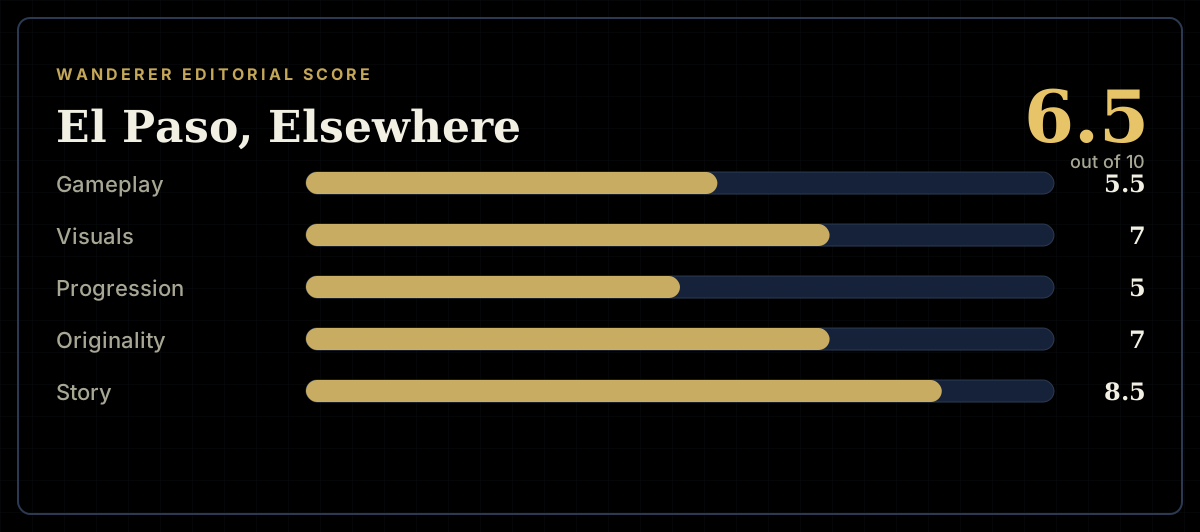
How the review scores each part of the gameWanderer Editorial -
The short versionWanderer Editorial