
Game review
Trepang2
7 / 10
- Developer
- Trepang Studios
- Publisher
- Team17
- Released
- 21 June 2023
- Platforms
- Windows
- Genre
- Bullet-Time Horror FPS
- Monetisation
- One-time premium purchase plus optional paid DLC (Survival Mode, Bladekisser); base campaign is complete without them
- Players
- Single-player only; no online, co-op or PvP modes
The short version
Trepang2 sets out to recreate the specific, beloved feel of 2005's F.E.A.R. — fluid bullet-time movement, dual-wielded guns, sliding, grabbing and kicking enemies through gory, physics-heavy combat — and on that single, narrow goal it succeeds almost completely. Reviewers across the spectrum, including many who otherwise criticize the game harshly, agree without reservation that the core gunplay rivals its inspiration.
Everything built around that gunplay draws far more mixed reactions. A substantial share of reviewers describe the story as thin, disjointed and ultimately abandoned partway through, with masked, interchangeable characters replacing the human stakes that made F.E.A.R.'s narrative work. An equally substantial complaint concerns structure: reviewers report the game's back half shifting away from level-based exploration into repetitive horde-defense objectives — hold a point, kill a wave, resupply, repeat — that feel disconnected from the atmospheric, exploratory tension the opening hours promise.
Biggest strengths
- Gunplay that reviewers across the spectrum, including harsh critics, agree genuinely rivals F.E.A.R. — fluid bullet-time, dual-wielded weapons, sliding, grabbing and environmental physics-driven combat all executed with real polish
- Distinctive, high-production-value environment art that reviewers describe as a clear step up from typical indie FPS presentation
- An intense, well-received soundtrack that multiple reviewers specifically praise as matching the game's frenetic combat pacing
Biggest weaknesses
- A substantial share of reviewers describe the story as thin and ultimately abandoned partway through, with masked, largely identical characters replacing the human-stakes storytelling that gave F.E.A.R. its tension
- An equally substantial complaint concerns structure: reviewers report the game's back half shifting heavily into repetitive horde-defense objectives — hold a point, kill a wave, resupply — that feel disconnected from the atmospheric level design the opening hours establish
- At least one detailed reviewer documents a specific continuity error where losing a hand in a story beat doesn't match the player character's still-intact on-screen model, alongside unusable pickups placed near the final boss that reference an ability the story has removed
Who it's for: FPS fans who specifically want best-in-class F.E.A.R.-style bullet-time gunplay and are willing to accept minimal narrative investment and a repetitive back half in exchange for it. Less suited to anyone expecting a coherent horror story or sustained level variety throughout.
Our recommendation: A strong recommendation purely on gunplay quality, best approached with the explicit expectation that the story and mission variety won't match it — go in for the combat, not the narrative.
7 / 10
Very few games set out to recreate the specific feel of a nearly two-decade-old shooter as precisely as Trepang2 does with F.E.A.R. — the fluid bullet-time slow-motion, the dual-wielded weapons, the sliding kicks and enemy grabs, the physics-heavy gore. On that narrow, specific goal, reviewers across the entire spectrum of opinion agree without much reservation: the gunplay works, and works exceptionally well. What divides opinion sharply is nearly everything the game builds around that combat foundation.
Gunplay that earns its comparisons
The praise for combat is close to universal, and notably, it shows up just as strongly in critical reviews as glowing ones. Reviewers describe fluid movement, satisfying weapon feel, and genuinely impressive physics-driven gore — one reviewer specifically praises the game for "passing the John Woo test," describing a single shot into a bookshelf scattering an entire library's worth of pages across the screen. Beyond the core campaign, an extensive combat simulator mode gives players who prioritize the gunplay above all else a substantial amount of additional content, with unlockable customization options, cheats and challenge maps to explore. High-production-value environment art and an intense, well-matched soundtrack round out a presentation package reviewers consistently rate well above typical indie FPS output.
A story that starts strong and gives up
Where the reception splits is almost everything surrounding that combat. A substantial share of reviewers describe the story as thin, disjointed, and ultimately abandoned partway through its own runtime. One detailed critical review captures the specific disappointment: the opening hours recreate F.E.A.R.'s formula convincingly, with panicked, distinct-sounding survivors and tense briefings building real narrative momentum, only for later sections to replace that texture with masked, interchangeable characters separated by glass and virtually identical voices, undercutting the "brief humanity" that made F.E.A.R.'s quieter moments unsettling. Reviewers who came in hoping for a coherent mystery in the vein of F.E.A.R.'s Alma Wade plotline describe the payoff as underwhelming relative to the setup, with lore delivered mostly through environmental notes rather than meaningful character interaction.
A structure that leans into repetition
An equally consistent complaint concerns the game's mission structure specifically. Multiple reviewers describe the campaign's back half shifting heavily away from the exploratory, level-based design of its opening into repetitive horde-defense objectives — hold a switch, plant explosives, survive a timer — each punctuated by waves of enemies and resupply breaks. One reviewer summarizes the resulting loop bluntly as "kill wave of enemies, resupply, kill next wave of enemies, resupply," arguing that what made F.E.A.R. memorable wasn't combat in isolation but the sense of moving through a real, connected space, a quality this review's research found repeatedly cited as missing from Trepang2's later missions.
A specific, documented continuity error
Beyond broader structural criticism, at least one detailed reviewer documents a specific, concrete bug: a story beat has an enemy sever the player character's hand, disabling grenade-throwing and enemy-grabbing abilities for the remainder of the game — except the player's on-screen model still clearly shows both hands intact, and grenades are placed as pickups directly outside the final boss arena despite being permanently unusable at that point in the story. That's a small detail in isolation, but it's emblematic of the broader narrative-execution complaints above: a game more focused on getting individual combat encounters right than on maintaining consistency in the story wrapped around them.
What the achievement data shows
Global achievement figures back up a real drop-off across the campaign consistent with reviewer accounts of later-game fatigue. Completion figures decline steadily from 81.6% finishing the prologue down to just 28.0% completing the full campaign on any difficulty — a substantial decline that, combined with the repetitive-structure complaints above, suggests a meaningful share of players who enjoy the opening hours don't push through to the credits once the horde-mode pattern sets in.
A responsive, if limited, patch record
To the developer's credit, a substantial first major patch shipped a few months after launch, addressing a genuinely wide range of issues: significantly improved controller support and aim assist, new deadzone and aim-acceleration settings, fixed Steam Deck text-scaling problems, several named crash fixes tied to specific weapons and environmental interactions, and numerous localization corrections. That patch, alongside a later free Halloween content update adding new maps and weapon skins, reflects real continued investment from a notably small four-person studio. What it doesn't appear to include, based on the public patch record, is any indication that the story-pacing or mission-structure complaints above were directly addressed — the developer's own post-launch messaging focuses on technical fixes and new combat content rather than reworking the campaign's back half, meaning the structural criticism above should be read as a lasting characteristic of the current release rather than a rough edge likely to be patched away.
Weighing the price complaint
A smaller but recurring complaint concerns value for money: several reviewers who otherwise enjoyed the gunplay argue the asking price feels steep relative to how much genuine variety and narrative substance backs it up, with at least one reviewer suggesting the game would have been an easy recommendation at a lower price point but feels like a harder sell at full retail given how quickly the campaign's structure repeats itself. That's a fair, practical consideration distinct from the quality of the combat itself — reviewers largely agree on what the game does well and poorly, and disagree mainly on whether the strength of the gunplay alone justifies the full asking price given how thin everything else is by comparison.
Where it lands
Trepang2 delivers exactly what it promises on its single most important axis: gunplay that stands up to genuine comparison with F.E.A.R., praised without real reservation across nearly the entire review base. Everything else — story, mission variety, narrative consistency — draws real, substantial, well-corroborated criticism that keeps this from being an easy top-tier recommendation despite its combat strength. For FPS fans specifically chasing that exact bullet-time, dual-wielding feel and willing to accept a thin, occasionally repetitive package around it, this remains a worthwhile, distinctive pickup.
Pros and cons
Pros
- Gunplay that reviewers across the spectrum, including harsh critics, agree genuinely rivals F.E.A.R. — fluid bullet-time, dual-wielded weapons, sliding, grabbing and environmental physics-driven combat all executed with real polish
- Distinctive, high-production-value environment art that reviewers describe as a clear step up from typical indie FPS presentation
- An intense, well-received soundtrack that multiple reviewers specifically praise as matching the game's frenetic combat pacing
- Extensive optional content for players who prioritize the gunplay above all else, including a combat simulator mode with unlockable customization, cheats and challenge maps
- Ongoing free post-launch support, including a Halloween content update and multiple bug-fix patches, alongside paid DLC expanding the game's content further
Cons
- A substantial share of reviewers describe the story as thin and ultimately abandoned partway through, with masked, largely identical characters replacing the human-stakes storytelling that gave F.E.A.R. its tension
- An equally substantial complaint concerns structure: reviewers report the game's back half shifting heavily into repetitive horde-defense objectives — hold a point, kill a wave, resupply — that feel disconnected from the atmospheric level design the opening hours establish
- At least one detailed reviewer documents a specific continuity error where losing a hand in a story beat doesn't match the player character's still-intact on-screen model, alongside unusable pickups placed near the final boss that reference an ability the story has removed
- Several reviewers feel the asking price is steep relative to the amount of narrative and mission variety on offer, even while praising the combat itself without reservation
- Global achievement data shows a real drop-off through the campaign, with only 28% of the playerbase completing it on any difficulty, consistent with reviewer accounts of later-game fatigue setting in
Screenshots
-

Trepang2Image: Team17 via Steam -

Trepang2Image: Team17 via Steam -

Trepang2Image: Team17 via Steam -
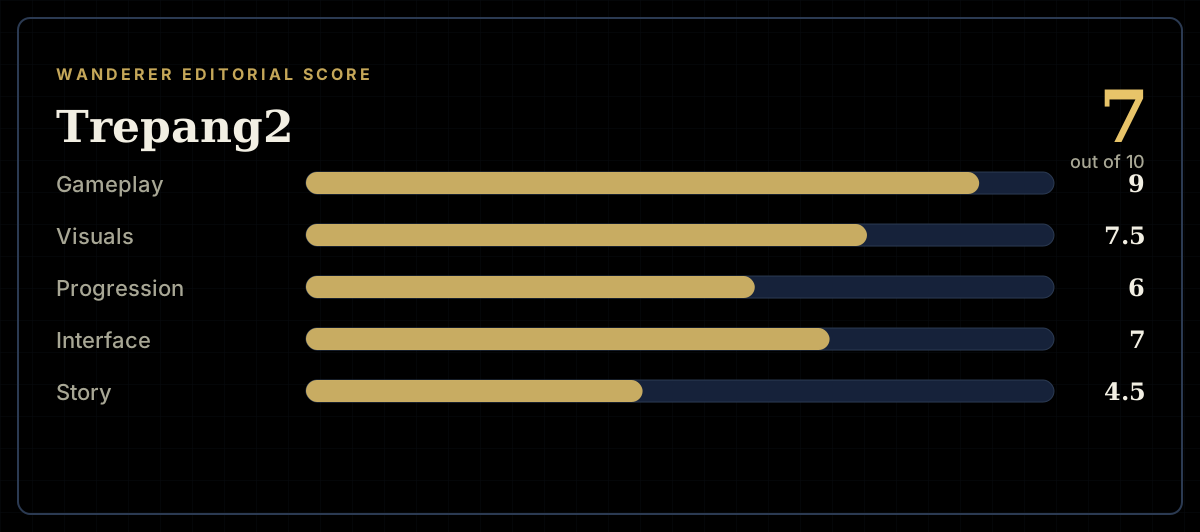
How the review scores each part of the gameWanderer Editorial -
The short versionWanderer Editorial