
Game review
Egg, Inc.
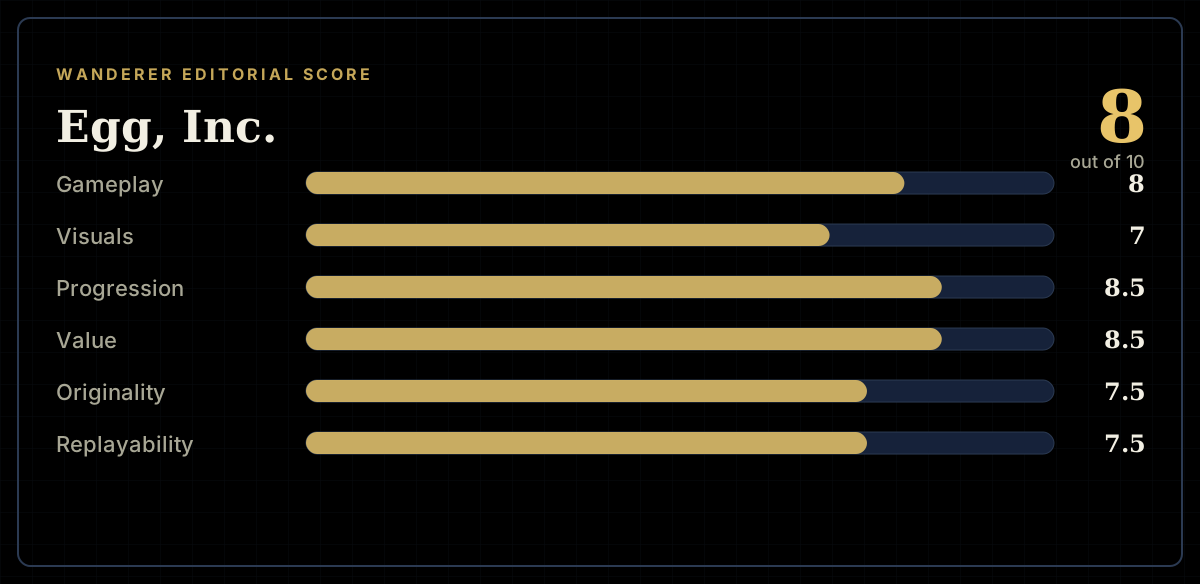
8 / 10
- Developer
- Auxbrain
- Publisher
- Auxbrain
- Released
- 14 July 2016
- Platforms
- Android, iOS
- Genre
- Idle / Incremental
- Monetisation
- Free to play. Golden Eggs (the premium currency) can be earned through play or bought outright, a one-off Pro Permit removes ads and adds passive bonuses, and a passively filling Piggy Bank can be cracked open for real money. Optional rewarded video ads restore offline earnings or grant temporary boosts.
- Players
- Asynchronous co-op through timed contract groups; no chat, PvP or real-time play
The short version
Egg, Inc. has spent ten years proving that a chicken-farm skin on top of an idle spreadsheet can carry a genuinely deep game. The prestige loop, the Artifacts crafting layer and a co-op contract system that actually needs other people to complete keep it feeling alive long after most mobile idles have run out of ideas.
The same co-op system is also the thing that can make it feel like a second job. Egg, Inc. asks players to be somewhere at a specific time, with a coordinated group, more often than an idle game usually dares — and whether that reads as its best idea or its biggest ask depends entirely on who you're playing it with.
Biggest strengths
- Co-op contracts genuinely require coordination, giving a solitary genre a real social hook other idle games don't attempt
- The Soul Egg and Prophecy Egg prestige stack gives every session a reason to matter even after an individual farm stops growing
- Golden Eggs, the Pro Permit and every Artifact are earnable through play, so nothing at the top of the game is purchase-only
Biggest weaknesses
- Coordinating a co-op contract's boost windows can feel like scheduling a work shift rather than playing a game
- Missing a group contract's deadline costs Prophecy Eggs that are slow to earn back any other way
- The Artifacts menu buries new players in acronyms, tiers and stone slots long before it explains why any of it matters
Who it's for: Idle-game veterans who've exhausted the solo genre and want a reason to check a group chat, plus anyone who liked the shape of a cookie-clicker prestige loop and wants it dressed up with fifty tiers of tractors and spaceships.
Our recommendation: Install it for free and treat the first prestige or two as the tutorial — the interesting decisions don't start until Soul Eggs, research and the first artifacts are in play. Only join a serious co-op contract group once you understand what missing a deadline costs you.
8 / 10
Egg, Inc. turned ten years old in July 2026, which in mobile-game terms is closer to geological time than a birthday. Most of the free-to-play idle games it launched alongside are gone, folded into a publisher's back catalogue, or limping along on autopilot. Egg, Inc. is still receiving updates, still sitting near the top of its category on both storefronts, and still built around an idea that was mildly ridiculous in 2016 and remains mildly ridiculous now: tap a chicken, sell the eggs, buy a bigger truck, repeat until you are launching space-station farms staffed by hens bred for interstellar egg production.
What keeps it interesting a decade on isn't the premise. It's that Auxbrain kept building systems on top of the original tap loop instead of just re-skinning it, and one of those systems — co-op contracts — does something almost no other idle game bothers attempting: it asks you to coordinate with strangers on a clock, in a genre whose entire appeal is usually that nobody needs you to show up at a specific time.
The loop underneath the loop
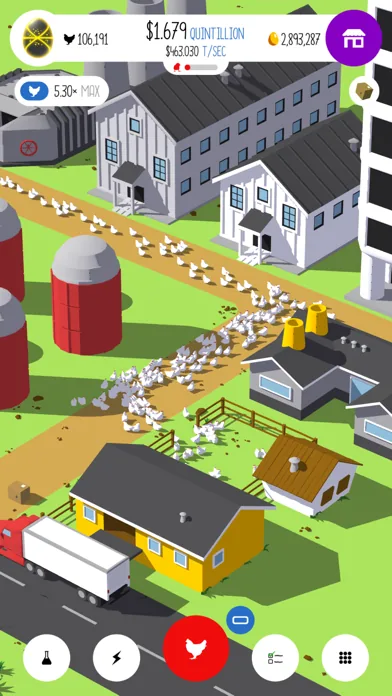
The surface game is simple almost to the point of self-parody. You tap a big red button to release chickens onto your farm, sell the eggs they produce, and spend the proceeds on bigger hen houses, faster delivery trucks, and research that raises egg value or production speed. Silos let the farm keep earning while your phone is in your pocket, at a flat rate lower than active play but real enough that ignoring the game for eight hours isn't a wasted eight hours.
None of that would carry a review on its own — it's the shape of every idle game since Cookie Clicker. What Egg, Inc. does well is pacing the unlocks so a new decision arrives roughly every time the previous one stops being interesting: a new egg tier, a new vehicle class, a new research tree, a farm upgrade that changes the shape of the optimisation problem rather than just making the existing numbers bigger. The escalation from a literal backyard coop to a habitat orbiting Jupiter is silly on its face and is exactly the kind of silly that keeps a fundamentally repetitive action from feeling like the same screen for ten years.
Prestige, and the two currencies that actually matter
Egg, Inc.'s long game runs on prestige. Reset your farm back to the very first egg tier and you lose your cash and your current buildings, but you keep Golden Eggs, epic research, artifacts, the Pro Permit if you own one, and — critically — Soul Eggs, a permanent multiplier earned from the farm value you built before resetting. Every prestige makes the next farm grow faster, which makes the next prestige come sooner, which is the entire trick of the genre executed about as cleanly as it gets on mobile.
Above Soul Eggs sits a second, rarer currency: Prophecy Eggs, which multiply the value of every Soul Egg you've ever earned rather than adding to the pile directly. Prophecy Eggs aren't handed out for ordinary play — they're a reward tied specifically to completing the harder tiers of contracts, which is the first hint that the game wants you engaging with its social layer rather than treating it as an optional side mode. Ignore contracts entirely and you can still play Egg, Inc. productively for a long time; you just cap out well below where the game's own economy expects a committed player to sit.
Contracts and co-op: the game's actual spine
This is where Egg, Inc. earns its place ahead of most solo idlers, and where it also asks the hardest question of anyone considering a serious investment in it.
Contracts are time-limited goals — deliver a set volume of a specific egg type inside a countdown — and they can be attempted alone or as part of a group. Solo, a contract is just another number to chase at your own pace, capped at whatever tier a single farm can realistically reach before the clock runs out. Group a contract with other players, though, and the goal scales up dramatically: tougher tiers, bigger rewards, and access to the top-tier completion bonuses that are the main source of Prophecy Eggs. A well-coordinated group can clear goals that would be mathematically out of reach for any individual farm, no matter how optimised.
The catch is that "well-coordinated" is doing real work in that sentence. Co-op contracts reward groups that time their temporary earnings boosts to land in the final stretch before a deadline, which means showing up, at a specific point in a specific window, with your boosts ready — the closest thing this genre has to a raid schedule. Miss that window because you were asleep, and the group's result (and your own Prophecy Egg payout) suffers for it. This is the trade the entire review turns on: Egg, Inc. is one of the only idle games that gives players a reason to actually need each other, and that need is also an obligation, landing in a genre most people play precisely because it doesn't demand appointments. Whether that's a feature or a flaw depends entirely on whether you already have — or want — people to play it with. Played solo, Egg, Inc. is a very good, slightly slower idle game. Played with an active, coordinated group, it becomes something closer to a live-service commitment wearing a chicken costume, and the difference in what it asks of you between those two modes is bigger than the storefront description lets on.
Artifacts: a second game bolted onto the first
Several years into its life, Egg, Inc. added Artifacts, and it's the system that turns the game from "well-tuned idle clicker" into something with a genuine loadout puzzle underneath it. Artifacts sit in a small number of equipped slots, come in families with distinct effects — some raise the ceiling on offline earnings, some extend how long temporary boosts last, some expand vehicle or habitat capacity — and each artifact carries a tier and a rarity that determine how strong its effect is. Higher-rarity artifacts can also socket stones for a further, stackable bonus.
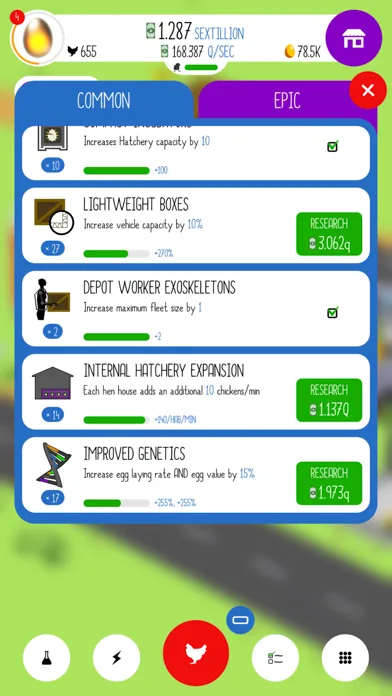
You don't buy artifacts outright. You earn the ingredients to craft them by sending ships on timed expeditions, choosing between short runs that return quickly with modest ingredients and longer missions that tie up a ship for hours in exchange for better odds at rarer materials — its own small idle loop nested inside the larger one. The system rewards genuine theorycrafting: which artifact family matters most for the stage of the game you're in, which stones are worth chasing, whether a lower-tier artifact with the right stone beats a higher-tier one without. It's also, frankly, a lot to absorb on a phone screen the first time it's introduced, and Egg, Inc. doesn't do much to ease new players into it — the menu assumes you're already fluent in its own acronyms.
What the shop actually sells
Checked on the Apple App Store on 30 July 2026, Egg, Inc.'s in-app purchases range from small Golden Egg top-ups around $4–5 through to a $19.99 bulk bundle, alongside a one-time $9.99 Pro Permit that removes ads and grants ongoing passive bonuses, and a further "Ultra" tier above that. None of it is required. Golden Eggs — the premium currency that fuels temporary boosts, hab and vehicle slots, and some research — are earned steadily through drone drops, achievements and contract rewards, and the Pro Permit's ad-free convenience is a nice-to-have rather than a progression gate. Optional rewarded video ads let non-paying players restore full offline earnings or grab a temporary boost, which is a fairer trade than the mandatory-timer approach a lot of the genre still leans on.
The one moment the monetisation gets genuinely pointed is the Piggy Bank: a pot that fills passively with a bonus percentage of what you earn, visible on the farm screen the entire time, that can only be claimed by paying real money to crack it open — otherwise it caps and the potential bonus is simply gone. It's not predatory in the sense of blocking progress, but it is the one system clearly designed to catch your eye at the exact moment the payoff looks biggest, and it sits oddly next to a game that is otherwise unusually patient about asking for money.
Presentation and interface
Egg, Inc.'s farm scenes are clean, legible and essentially unchanged in style since 2016: flat, sunny dioramas that scale from a backyard coop to an orbital station without ever asking much of the hardware running them. That's a reasonable trade for a game meant to be glanced at dozens of times a day, and it means Egg, Inc. runs comfortably on almost anything with the app stores' minimum specifications. It also means the game has never really tried to look impressive — everything past the farm screen is lists, bars and numbers, and the Artifacts and research menus in particular read like spreadsheets wearing a coat of paint. Functional, unglamorous, and showing its age more in the UI than in the core loop.
Verdict
Ten years in, Egg, Inc. still does the thing that made it stand out at launch — a tap-to-earn loop with real long-term structure underneath — and it has spent the intervening decade adding systems that deepen rather than dilute that structure. The Artifacts layer gives it a genuine strategic game within the idle game, and the prestige stack of Soul Eggs and Prophecy Eggs keeps every hour spent feeling like it's building toward something specific rather than just a bigger number.
Co-op contracts are the reason it scores above most of its solo-idle peers, and they're also the reason it won't suit everyone that genre usually attracts: people who chose idle games specifically because nothing in them needs to happen on a schedule. Play it alone and it's a very good, generous, fairly monetised idle game. Play it with a serious group and it asks more of your actual calendar than almost anything else in the category — for better and for worse, often in the same week.
Players who like progression that keeps ticking over without demanding constant attention, minus the scheduled group obligations, may find Wanderer sits closer to the pace they're after.
Monetisation and store details checked 30 July 2026.
Pros and cons
Pros
- Co-op contracts genuinely require coordination, giving a solitary genre a real social hook other idle games don't attempt
- The Soul Egg and Prophecy Egg prestige stack gives every session a reason to matter even after an individual farm stops growing
- Golden Eggs, the Pro Permit and every Artifact are earnable through play, so nothing at the top of the game is purchase-only
- The Artifacts system layers a genuine crafting and loadout game on top of the tap-and-wait loop without breaking either one
- Optional rewarded ads instead of an energy meter respect players who never intend to spend a cent
Cons
- Coordinating a co-op contract's boost windows can feel like scheduling a work shift rather than playing a game
- Missing a group contract's deadline costs Prophecy Eggs that are slow to earn back any other way
- The Artifacts menu buries new players in acronyms, tiers and stone slots long before it explains why any of it matters
- Visual presentation has barely moved since 2016 — flat farm dioramas and a UI built from lists of numbers
- The Piggy Bank's real-money crack-open pitch is the one moment the game leans on impulse rather than patience
Screenshots
-

Egg, Inc.Image: Auxbrain, Inc. via the App Store -
Egg, Inc.Image: Auxbrain, Inc. via the App Store -
Egg, Inc.Image: Auxbrain, Inc. via the App Store -
How the review scores each part of the gameWanderer Editorial -
The short versionWanderer Editorial