
Game review
Echobreaker
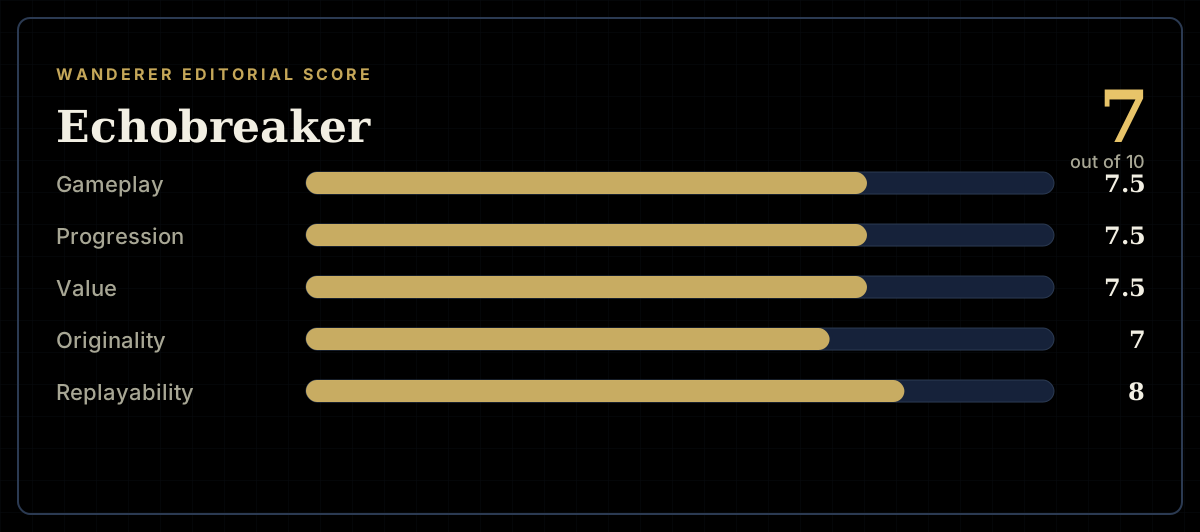
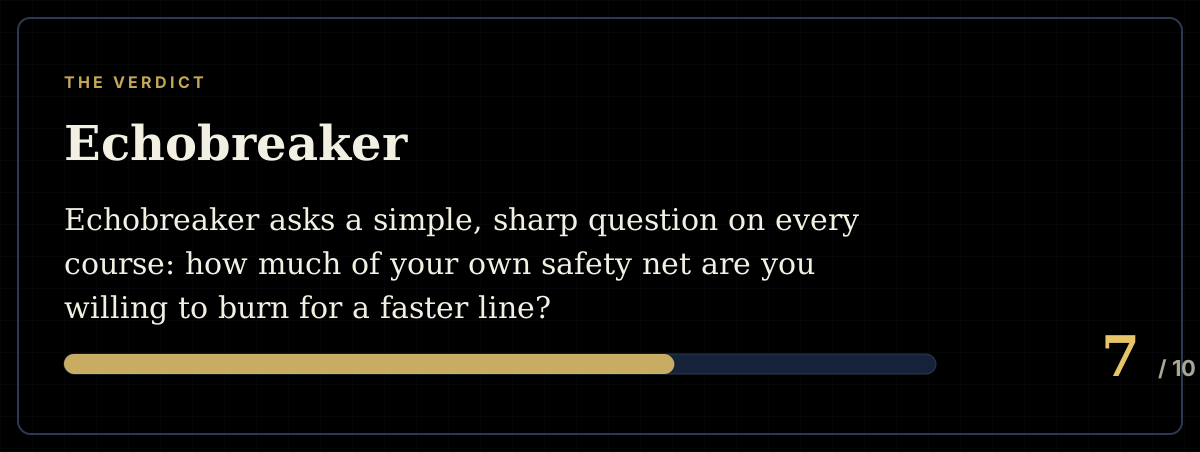
7 / 10
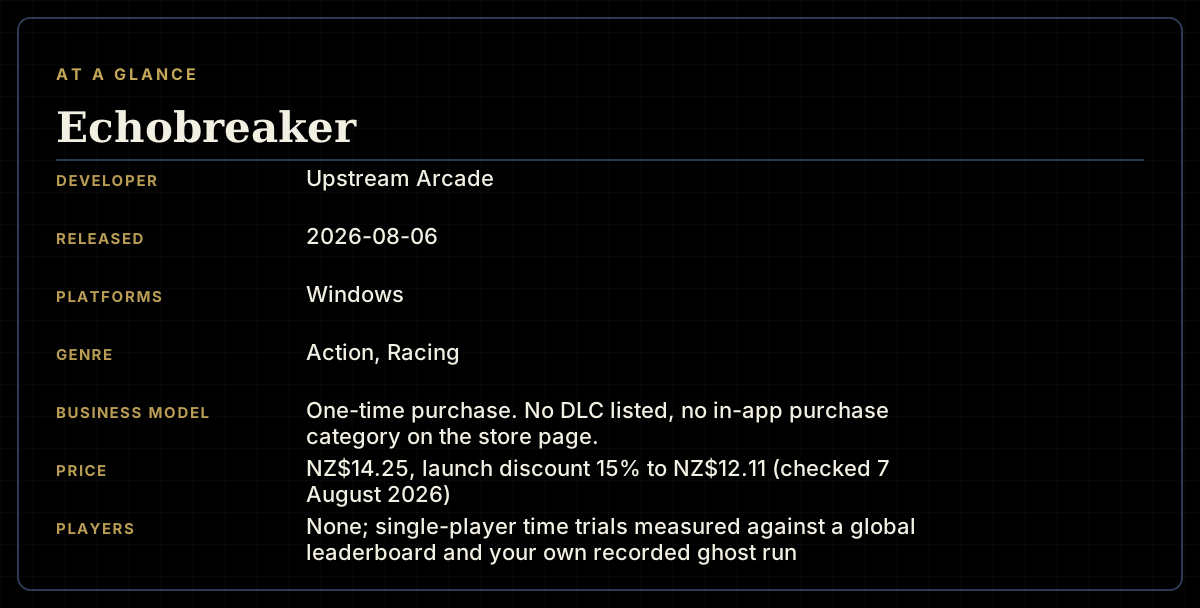
- Developer
- Upstream Arcade
- Publisher
- Weekend Games
- Released
- 6 August 2026
- Platforms
- Windows
- Genre
- Action, Racing
- Monetisation
- One-time purchase. No DLC listed, no in-app purchase category on the store page.
- Players
- None; single-player time trials measured against a global leaderboard and your own recorded ghost run
The short version
Echobreaker asks a simple, sharp question on every course: how much of your own safety net are you willing to burn for a faster line? You pilot a rig that can slip into an Echo State, slowing time to gun down enemies and bank a burst of speed, then spend that stored resource — called Echoes — on jumps, boosts and shortcuts that would otherwise be out of reach. Fifteen handcrafted levels, split across three zones, each carry the same five-medal ladder from Bronze up to a brutal Par time, with instant restarts and a recorded ghost of your own best run to chase.
It released one day before this review and currently has zero public Steam reviews, so nothing here can speak to how the wider audience feels about it yet. What's verifiable is the shape of the design, and it's an unusually disciplined one for a debut-priced indie: a tight, legible core loop, a demo that ran through two public showcases before launch, and a medal structure built specifically to reward the kind of players who replay a fifteen-minute game for forty hours chasing a better split.
Biggest strengths
- The Echo State ties combat directly into movement — killing enemies while time is slowed banks the speed boost you then spend on jumps and shortcuts, instead of combat and racing running on separate tracks
- A five-tier medal ladder (Bronze, Silver, Gold, Platinum, and a much harder Par time) sits on every one of the fifteen levels, giving the same course a genuinely different job to do on a first clear versus a hundredth attempt
- Instant restarts and a ghost of your own best run remove the reload friction that usually kills a time-trial loop before it gets going
Biggest weaknesses
- Released with zero public Steam reviews and an early achievement sample small enough that the site's own difficulty curve is closer to a rumour than a verdict — anyone buying today is an early adopter in every sense
- The public demo that ran through Steam Next Fest and a second showcase was pulled the weekend before launch, so there is currently no way to try the movement and combat feel before paying
- English is the only supported language, including for audio, on a store page listing full controller support and global leaderboards that assume an international audience
Who it's for: Time-trial and speedrun players who already loop Trackmania ghosts or N++ leaderboards, and anyone who likes a movement game where the combat exists to feed the movement rather than the other way round.
Our recommendation: Worth buying at its NZ$12.11 launch price for the target audience described above. Everyone else should treat the medal-ladder structure as the deciding factor — if chasing a Platinum split doesn't sound like fun on its own, the rest of the package won't change that.
7 / 10
Most games that let you slow down time treat it as a cheat code — a way to make a hard moment easier. Echobreaker treats it as a loan. Slip into its Echo State, gun down the enemies scattered along a course while everything moves at a crawl, and you bank a burst of speed and a resource called Echoes. Spend that resource on the jump you can't otherwise make, the boost that opens a shortcut, or the dash that keeps a run alive, and you've made the course faster and your rig more fragile at the same time. Released a single day before this review, with a public review corpus of exactly zero, Echobreaker is a debut-priced indie asking players to trust a design before anyone else has weighed in on it publicly — and the design itself is specific enough to be worth that trust.
A rig that spends its own safety net
The pitch, straight from the store page: it's 2097, a testing lab called TDS Industries hands you an experimental rig running on a "volatile Temporal Echo Drive," and your job is to see how far it can be pushed before it breaks. That framing barely qualifies as a story — there's no cast, no dialogue beyond flavour text, and nothing resembling a narrative arc — but it isn't trying to be one. It exists purely to justify the mechanic, and the mechanic is the whole pitch.
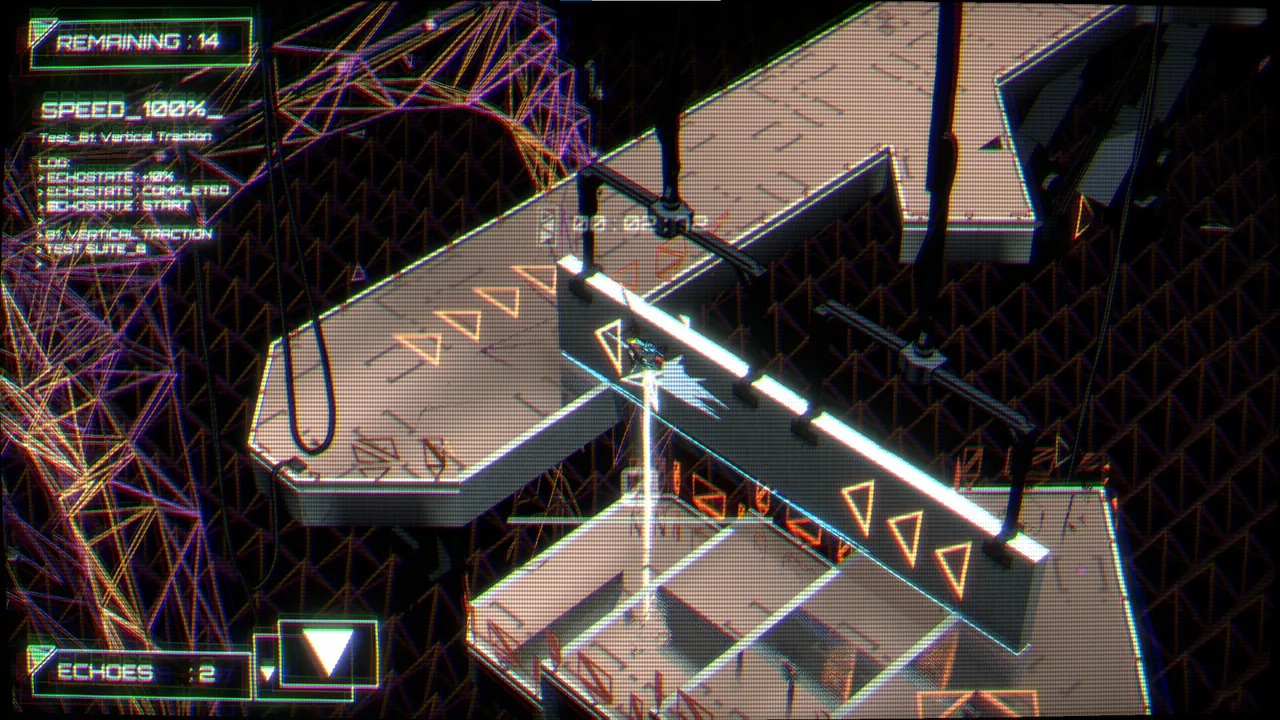
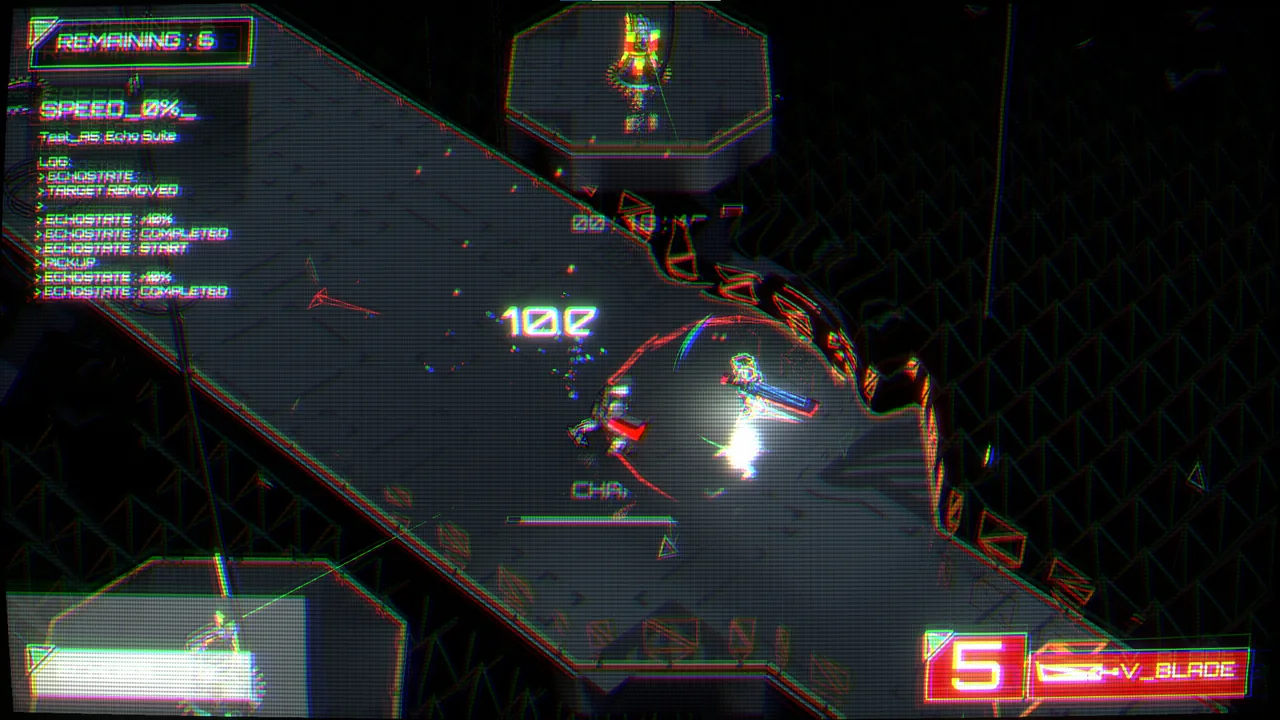
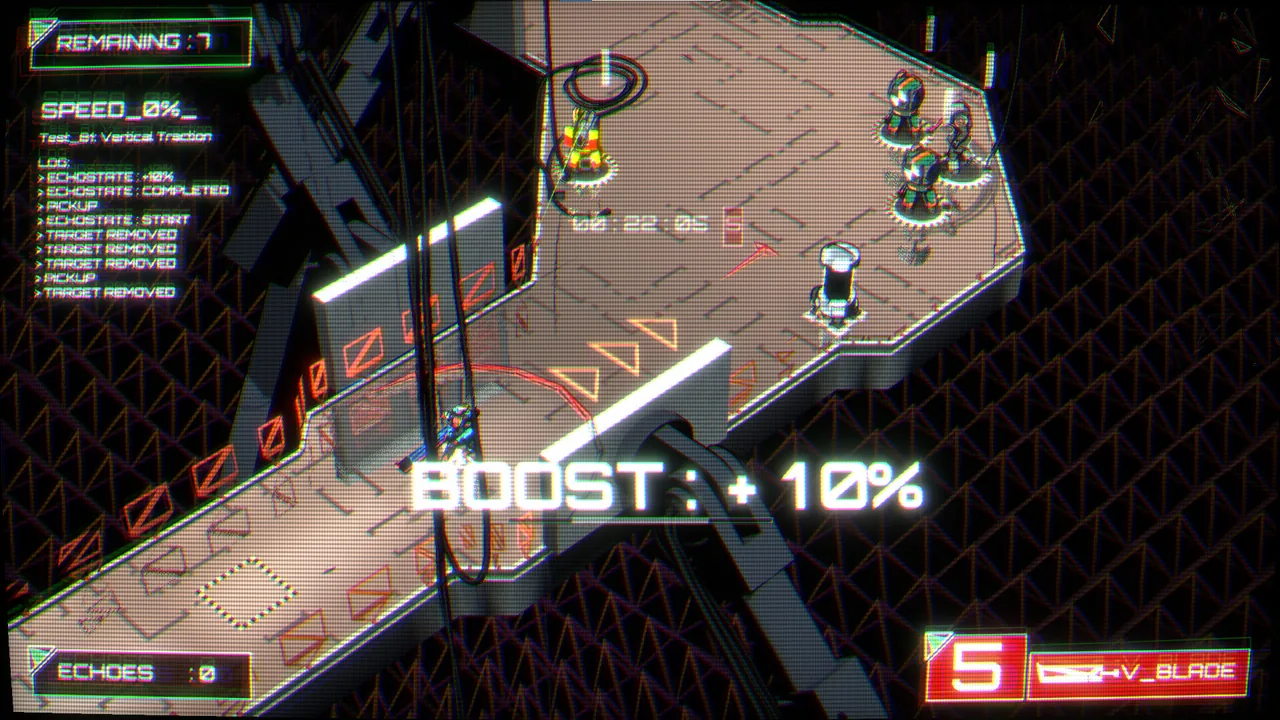
The Echo State is the hinge everything turns on. Entering it slows time and turns the level's enemies into a resource rather than an obstacle: clearing them out while slowed builds up Echoes, which then unlock jumps, speed boosts and shortcuts that aren't available to a rig running on empty. The trade-off is that spending Echoes also spends your margin for error — the store page is blunt about this, describing it as sacrificing "your own health for momentum." That's a more interesting design than it sounds on paper, because it fuses two genres that don't usually share a game cleanly: the target-elimination rhythm of an arena shooter and the line-optimisation obsession of a time trial. A route through a level isn't just about finding the fastest path — it's about deciding how many enemies are worth stopping for, and how much of your own safety you're willing to gamble to skip the ones you don't.
Fifteen courses, five medals each
The clearest evidence of what kind of game this is trying to be sits in its achievement list rather than its marketing copy. Fifteen levels split across three zones (labelled A, B and C, five levels each) each carry an identical five-rung ladder: a general clear, then Bronze, Silver and Gold time thresholds, then a Platinum medal per level, and above that a still-harder Par time that functions as the real target for anyone chasing a leaderboard spot rather than just a completion.
Steam's own achievement-completion data, checked the day after launch, already sketches the shape of that curve even on a tiny early sample: the general clear and the Bronze-through-Gold tier sit comfortably in the high 60s to low 80s percent, the first zone's Platinum medal drops to under 40 percent, and by the third zone several Platinum and Par thresholds show no completions at all yet. Read as a definitive verdict, that's nothing — the sample is small enough that a handful of players either finishing or not finishing a level swings the percentage by several points. Read as a shape, it's exactly what a well-tuned difficulty curve for this genre should look like: broadly accessible at the front, and genuinely unclaimed at the back for anyone chasing a world-leading time. Every run is also raced against a recorded ghost of your own best attempt, and restarts are instant rather than routed through a reload screen — the two features that decide whether a time-trial loop actually holds someone's attention or gets abandoned after the friction wears them down.
No demo left to try it on
One detail is worth being specific about, because it's easy to get wrong from the storefront alone. Echobreaker ran a public demo through two events — Steam Next Fest and a showcase called Convergence — and the developer's own news post from the final pre-launch weekend says plainly that the demo would be "taken down for good" before release. It has been: the demo's Steam page now redirects straight to the full game's listing. That means there is currently no low-commitment way to test the movement and combat feel before buying, despite the marketing having leaned on exactly that demo for months beforehand. Anyone weighing this purchase is doing so on trailers, screenshots and a feature list rather than anything hands-on, at least for now.
The launch announcement also mentions the game shipped as part of "Tiny Teams," a curated indie showcase, which is a mild but real signal of external vetting beyond the developer's own marketing copy — the kind of inclusion that tends to go to games with a clear, finished pitch rather than scope-creep in progress.
Value, and who this is actually for
At NZ$14.25 before its 15 percent launch discount, Echobreaker is priced like what it is: a tight, single-idea indie rather than a content-heavy release. Fifteen levels sounds thin next to almost any other genre, but it's a reasonable number for a game whose entire design intent is that each level gets played dozens of times on the way to a Par medal — the question isn't how much content exists, it's how much replay value the medal ladder actually generates once someone's hooked, and that's precisely the part no review corpus exists yet to confirm either way. Full controller support, including named DualSense and DualShock compatibility, and minimum system requirements low enough to run on nearly anything with a GPU from the last decade, both remove friction that has nothing to do with the core pitch. English-only audio and text is the one real gap in an otherwise frictionless package, on a game whose leaderboards and Steam Achievements assume a genuinely global player base.
Final verdict
Echobreaker earns its price tag on the strength of one clean idea, executed with more discipline than most games in this exact niche manage: time-slowed combat that directly funds the speed and shortcuts a time trial needs, wrapped in a five-medal ladder specific enough to give the same fifteen levels a different job on your first clear versus your fiftieth attempt. Controller support is full rather than bolted on, the hardware bar is low enough to be a non-issue, and the achievement data already hints at a difficulty curve built the right way round — generous at the front, genuinely unclaimed at the back.
What holds it at a 7 rather than higher is almost entirely a matter of timing rather than design. This is a one-day-old game with no public reviews to weigh against its own marketing, a demo that existed for months and was pulled the weekend before anyone reading this could use it, and a content list — fifteen levels, English only — that's honest about being a tightly scoped debut rather than a promise of a long tail. None of that is a flaw in the game itself so much as a flaw in the timing of buying it this week. For a time-trial player who already knows whether chasing a Par medal sounds like a good way to spend forty hours, that's an easy recommendation. For anyone who needs to be convinced the genre is worth their time, waiting for an actual audience to weigh in — or for the demo to reappear — is the more sensible call.
Pros and cons
Pros
- The Echo State ties combat directly into movement — killing enemies while time is slowed banks the speed boost you then spend on jumps and shortcuts, instead of combat and racing running on separate tracks
- A five-tier medal ladder (Bronze, Silver, Gold, Platinum, and a much harder Par time) sits on every one of the fifteen levels, giving the same course a genuinely different job to do on a first clear versus a hundredth attempt
- Instant restarts and a ghost of your own best run remove the reload friction that usually kills a time-trial loop before it gets going
- Full controller support, including named DualSense and DualShock compatibility, in a genre that too often assumes keyboard and mouse by default
- Minimum system requirements (a 1.8GHz processor, 1GB of video memory, and support back to Windows 7) are low enough that hardware is unlikely to be the reason anyone bounces off it
Cons
- Released with zero public Steam reviews and an early achievement sample small enough that the site's own difficulty curve is closer to a rumour than a verdict — anyone buying today is an early adopter in every sense
- The public demo that ran through Steam Next Fest and a second showcase was pulled the weekend before launch, so there is currently no way to try the movement and combat feel before paying
- English is the only supported language, including for audio, on a store page listing full controller support and global leaderboards that assume an international audience
- Windows only, with no Mac or Linux build, and no listed release on any console storefront
- Fifteen levels across three zones is a tight number of environments to look at even for a genre built around replaying the same course, and the store page gives no sense of a post-launch content roadmap
Screenshots
-
EchobreakerImage: Weekend Games via Steam -
EchobreakerImage: Weekend Games via Steam -
EchobreakerImage: Weekend Games via Steam -
How the review scores each part of the gameWanderer Editorial -
The game at a glanceWanderer Editorial -
The short versionWanderer Editorial