
Game review
Ducks in Disguise Review
4.5 / 10
- Developer
- Dinomore Games
- Publisher
- Dinomore Games
- Released
- 27 July 2026
- Platforms
- ["Windows"]
- Genre
- Hidden Object
A Duck-Themed Spin on a Familiar Formula
Ducks in Disguise, from solo-scale developer and publisher Dinomore Games, released on Steam on July 27, 2026, for $1.99. It's a hidden object game in the well-worn mold of "find the cats" titles, except the quarry here is rubber ducks, each one announcing itself with a quack when clicked. Across 24 black-and-white scenes, the player hunts for ten to twenty-five camouflaged ducks per level; find them all and the scene blooms into full color. It's a tiny, inexpensive package, and the Steam review sample, sitting at a Mixed 65% positive across 52 reviews, reflects a game that lands its core appeal with a real chunk of players while stumbling badly on trust and content volume for a similarly sized chunk of others.
The Quacking Is the Whole Pitch, and It Mostly Works
For the reviewers who liked it, the appeal is almost entirely about tone rather than challenge. The recurring quack sound effect gets singled out by name in review after review as the thing that actually makes the format charming rather than rote, and several reviewers describe playing with children specifically because the mechanic is simple enough for a young kid to follow while still being satisfying to complete. The color-reveal payoff at the end of each scene is the other consistently cited hook: watching a black-and-white illustration flood with color is a small, clean reward that reviewers say keeps them clicking through scene after scene even once the novelty of duck-hunting itself wears thin. None of this is complicated design, but for a $1.99 cozy game, reviewers who bought it for exactly that experience mostly got what they expected.
A Trust Problem the Store Page Created for Itself
The single loudest and most consistent complaint in the sample has nothing to do with the hidden object mechanics themselves. Ducks in Disguise's own store description calls it a "hand-drawn hidden object game," and a large share of the negative reviews dispute that claim directly, arguing the backgrounds are visibly AI-generated rather than hand-illustrated. The specific complaint recurs with striking consistency: multiple reviewers point out that the ducks themselves read as noticeably higher-fidelity or differently rendered than the surrounding scene art, which several say makes them trivially easy to spot compared to a genuinely hand-drawn hidden object game, undercutting the challenge the genre depends on. One detailed review frames it as "terrible behavior to claim your art is hand drawn when in fact you generated it with AI," and that sentiment, in close variations, appears across a large number of independent reviews rather than as an isolated complaint. At least one reviewer pushes back, arguing the developer has stated the art is hand-drawn and that "AI slop" has become an overused accusation, but the sheer volume and specificity of the disagreement, focused squarely on a claim the store page itself makes, is hard to wave away as noise.
Twenty Minutes to a Hundred Percent
Length is the second major fault line. Reviewers repeatedly report finishing all 24 levels and unlocking every achievement in well under an hour, with several landing in the 20-to-30-minute range for full completion. For a $1.99 purchase that isn't necessarily damning on its own, but it does mean the game is essentially a single, brief sitting rather than something with any real staying power, and more than one reviewer explicitly asks for additional levels or a paid expansion because the current run feels like it ends just as it's getting going. Compounding that, the game's special "sticker" ducks, a small collection mechanic layered on top of the main hunt, stop appearing after roughly the first third of the level list, which one detailed review reads as a sign the developer ran out of steam partway through and shipped anyway rather than finishing the idea.
A Real Bug Locks Some Players Out Entirely
Beyond the art dispute and the brevity, there's a functional problem that isn't a matter of taste: several reviewers on widescreen monitors report that the game offers no resolution options, cropping the scene so severely that some hidden ducks fall permanently outside the visible frame. For those players, this isn't just an inconvenience, it's a hard progress-blocker, since a scene can't be completed if part of it is never rendered onscreen. It's the kind of basic support gap that should have been caught before launch, and for the unlucky subset of players who hit it, the actual quality of the art or the hunting mechanics never even gets a fair chance to matter.
Kids, Casual Players, and Achievement Hunters Are the Best Fit
Setting the disputes aside, the positive reviews cluster around a specific audience: parents playing with young children, achievement collectors looking for a quick and low-effort 100%, and players who just want a few minutes of low-stakes, sound-effect-driven relaxation. Within that narrow lane, Ducks in Disguise does what it sets out to do, and reviewers in that camp are broadly satisfied with what they paid for. It's just a much smaller lane than the store page's "intricate 2D illustrations" pitch implies, and the gap between that framing and what a meaningful share of buyers say they actually received is the review sample's defining tension.
Verdict
Ducks in Disguise is a serviceable, extremely short hidden object game whose central problem isn't the hunting itself, it's a widening credibility gap between what the store page claims and what a large, consistent share of its own reviewers say they experienced, compounded by a widescreen bug that can hard-block progress and a special-ducks system that visibly runs out of content early. At $1.99 it's cheap enough that the quacking, the color reveal, and a lazy twenty minutes with a kid on your lap might be worth it regardless, but the "hand-drawn" claim on the store page is exactly the kind of thing a buyer should weigh before clicking purchase, not after.
Screenshots
-
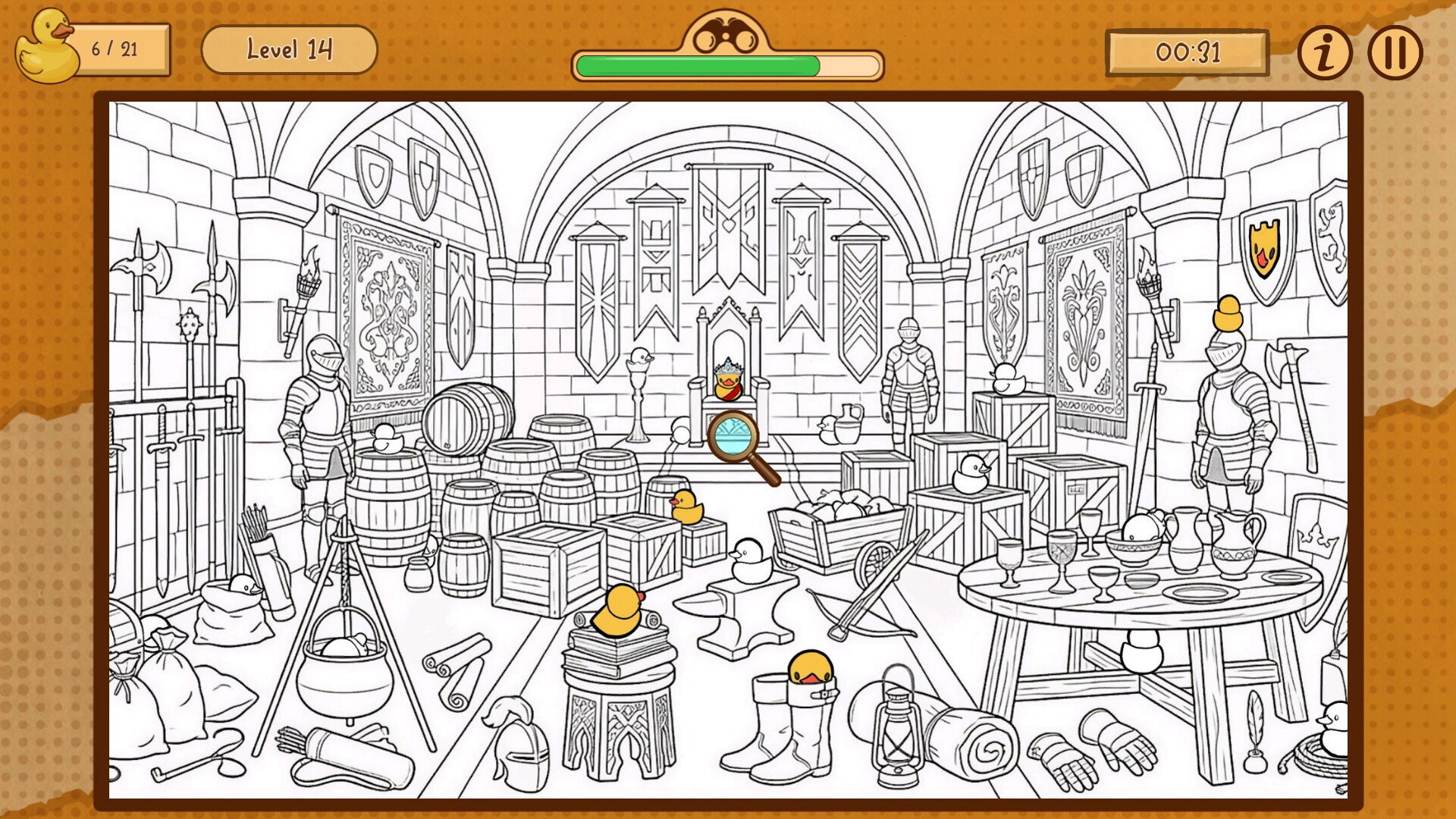
A castle armory scene midway through Level 14, ducks tucked into barrels, boots, and suits of armor.Image: Dinomore Games via Steam -
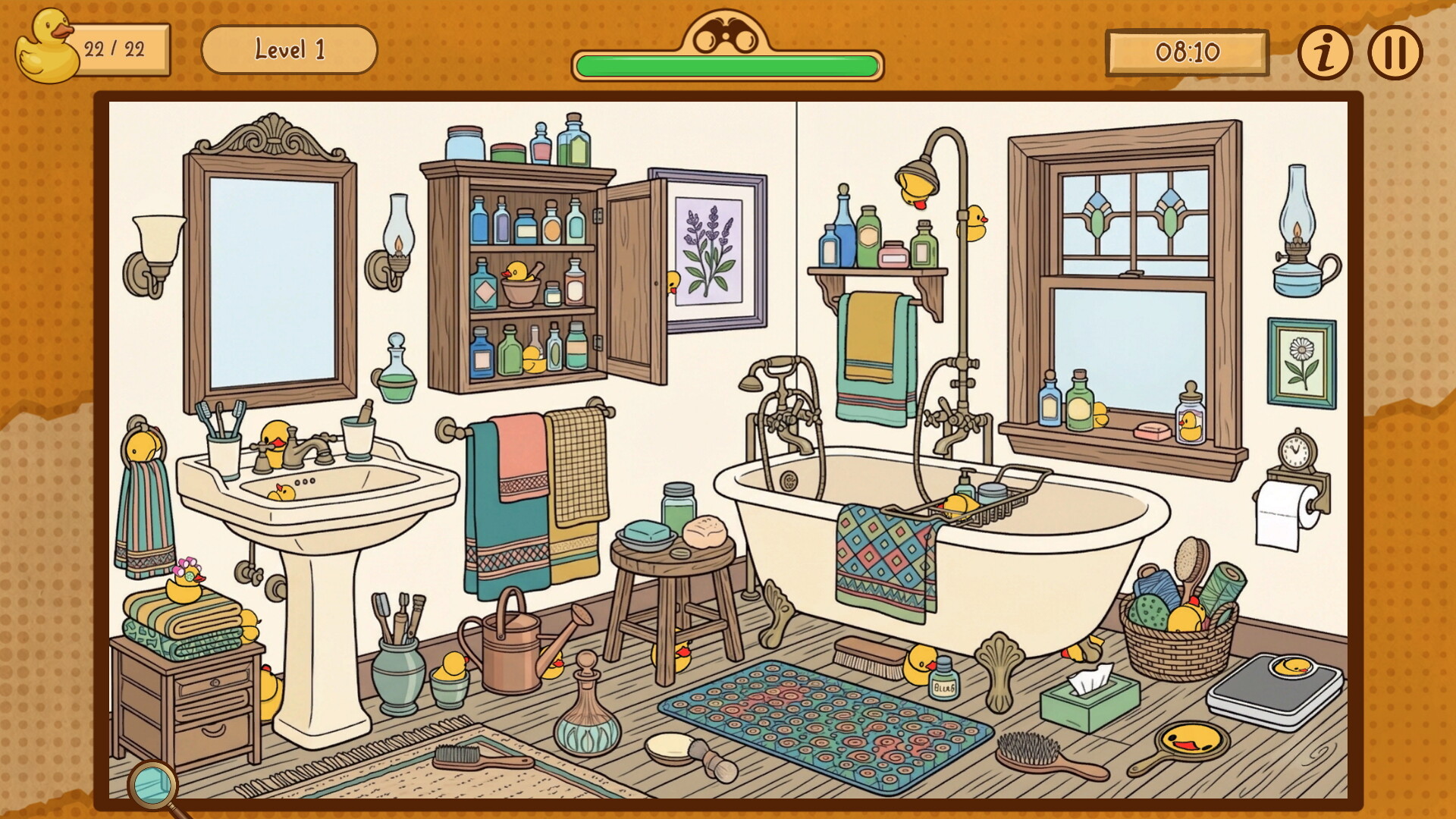
The same bathroom scene once every duck is found, the color-reveal payoff reviewers cite as the game's best moment.Image: Dinomore Games via Steam -
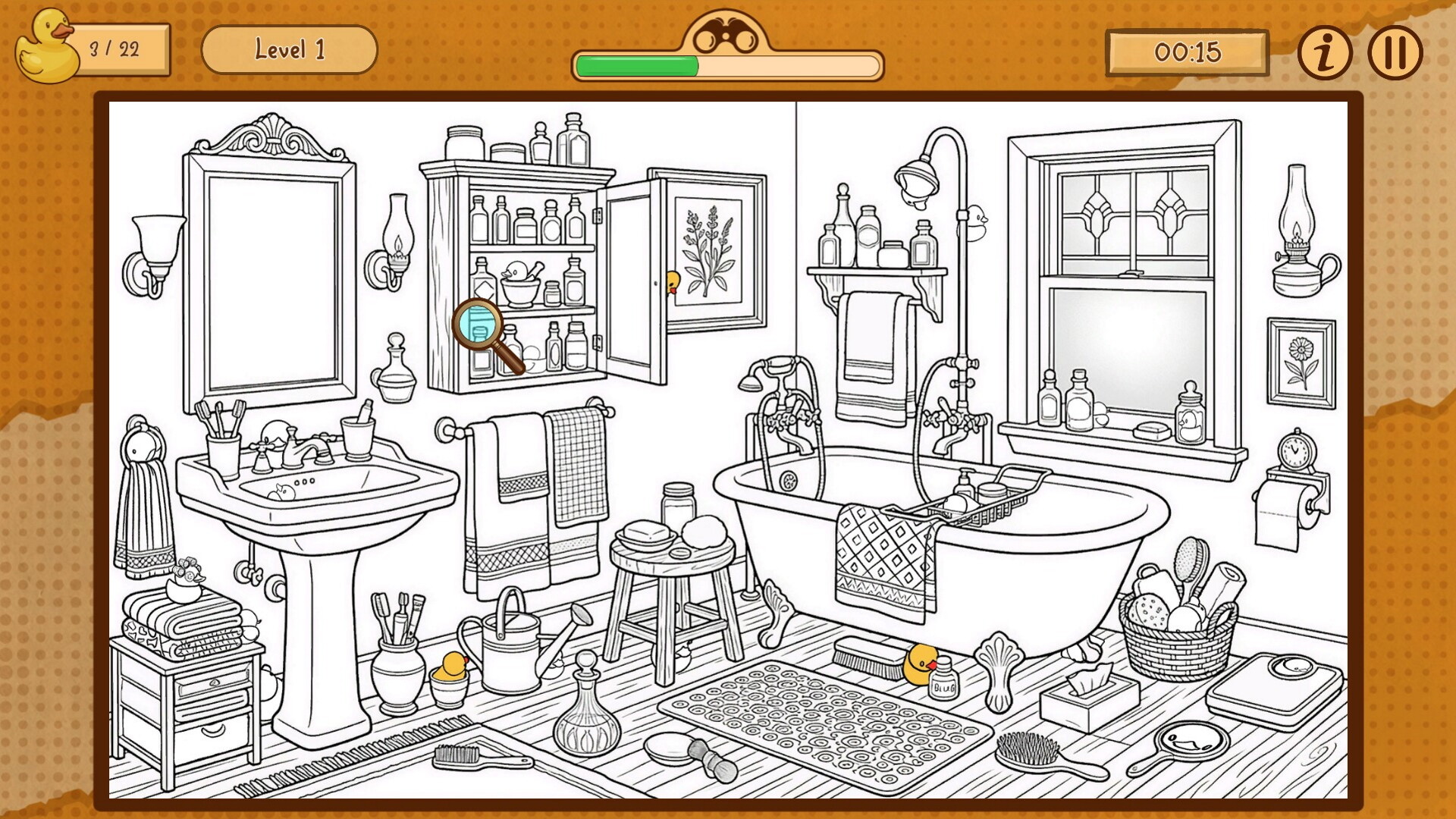
The same bathroom scene at the start of Level 1, still in black-and-white with most of its ducks yet to be found.Image: Dinomore Games via Steam